EP0592668A1 - Elastomere de polyurethane thermoplastique, procede et dispositif de production, et fibre elastique realisee a partir de cet elastomere - Google Patents
Elastomere de polyurethane thermoplastique, procede et dispositif de production, et fibre elastique realisee a partir de cet elastomere Download PDFInfo
- Publication number
- EP0592668A1 EP0592668A1 EP92908499A EP92908499A EP0592668A1 EP 0592668 A1 EP0592668 A1 EP 0592668A1 EP 92908499 A EP92908499 A EP 92908499A EP 92908499 A EP92908499 A EP 92908499A EP 0592668 A1 EP0592668 A1 EP 0592668A1
- Authority
- EP
- European Patent Office
- Prior art keywords
- polyurethane
- polyurethane elastomer
- elastomer
- molecular
- diol
- Prior art date
- Legal status (The legal status is an assumption and is not a legal conclusion. Google has not performed a legal analysis and makes no representation as to the accuracy of the status listed.)
- Granted
Links
Images
Classifications
-
- D—TEXTILES; PAPER
- D01—NATURAL OR MAN-MADE THREADS OR FIBRES; SPINNING
- D01F—CHEMICAL FEATURES IN THE MANUFACTURE OF ARTIFICIAL FILAMENTS, THREADS, FIBRES, BRISTLES OR RIBBONS; APPARATUS SPECIALLY ADAPTED FOR THE MANUFACTURE OF CARBON FILAMENTS
- D01F6/00—Monocomponent artificial filaments or the like of synthetic polymers; Manufacture thereof
- D01F6/58—Monocomponent artificial filaments or the like of synthetic polymers; Manufacture thereof from homopolycondensation products
- D01F6/70—Monocomponent artificial filaments or the like of synthetic polymers; Manufacture thereof from homopolycondensation products from polyurethanes
-
- C—CHEMISTRY; METALLURGY
- C08—ORGANIC MACROMOLECULAR COMPOUNDS; THEIR PREPARATION OR CHEMICAL WORKING-UP; COMPOSITIONS BASED THEREON
- C08G—MACROMOLECULAR COMPOUNDS OBTAINED OTHERWISE THAN BY REACTIONS ONLY INVOLVING UNSATURATED CARBON-TO-CARBON BONDS
- C08G18/00—Polymeric products of isocyanates or isothiocyanates
- C08G18/06—Polymeric products of isocyanates or isothiocyanates with compounds having active hydrogen
- C08G18/08—Processes
- C08G18/0895—Manufacture of polymers by continuous processes
-
- C—CHEMISTRY; METALLURGY
- C08—ORGANIC MACROMOLECULAR COMPOUNDS; THEIR PREPARATION OR CHEMICAL WORKING-UP; COMPOSITIONS BASED THEREON
- C08G—MACROMOLECULAR COMPOUNDS OBTAINED OTHERWISE THAN BY REACTIONS ONLY INVOLVING UNSATURATED CARBON-TO-CARBON BONDS
- C08G18/00—Polymeric products of isocyanates or isothiocyanates
- C08G18/06—Polymeric products of isocyanates or isothiocyanates with compounds having active hydrogen
- C08G18/08—Processes
- C08G18/10—Prepolymer processes involving reaction of isocyanates or isothiocyanates with compounds having active hydrogen in a first reaction step
-
- C—CHEMISTRY; METALLURGY
- C08—ORGANIC MACROMOLECULAR COMPOUNDS; THEIR PREPARATION OR CHEMICAL WORKING-UP; COMPOSITIONS BASED THEREON
- C08G—MACROMOLECULAR COMPOUNDS OBTAINED OTHERWISE THAN BY REACTIONS ONLY INVOLVING UNSATURATED CARBON-TO-CARBON BONDS
- C08G2250/00—Compositions for preparing crystalline polymers
Definitions
- This invention relates to a thermoplastic polyurethane elastomer, a process for producing same, an apparatus for producing same, and elastomer fibers made from same. More specifically, this invention relates to a polyurethane elastomer having a high molecular weight and a narrow molecular-weight distribution and containing a very small amount of polyurethane substrate-based small grains, a process for producing same, an apparatus for producing same and elastomer fibers made from same.
- thermoplastic polyurethane As a method for producing thermoplastic polyurethane, a solution polymerization method using a solvent and a bulk melt polymerization method not using a solvent have been known.
- a method for producing a polyurethane elastomer by solution-polymerizing a polymer glycol, a diisocyanate compound and a crosslinking agent batchwise in a solvent gives a polyurethane elastomer having a relatively narrow molecular-weight distribution, but does not provide so high a degree of polymerization, requires a step of separating the solvent from the reaction product after the reaction, and is batchwise. Therefore, said method is extremely inefficient.
- Japanese Patent Publication Sho 39-17093 discloses a method for producing a polyurethane elastomer by bulk-polymerizing a polymer glycol and a diisocyanate compound batchwise in the absence of a solvent with a kneading machine such as a kneader.
- This method affords a polyurethane elastomer having a high degree of polymerization.
- this polyurethane elastomer has a wide molecular-weight distribution and shows strong adhesion, so that said elastomer can hardly be peeled off from a rotating blade.
- it is very hard to strictly regulate proportions of starting materials to be fed in each batch, treatment temperatures, treatment times, a water content, extrusion times or the like. Due to this, a degree of polymerization and a molecular-weight distribution cannot be controlled and hence, it is quite difficult to make products uniform.
- Japanese Patent Publication Sho 44-25600 (No. 25,600/1969) discloses a method for continuously producing a thermoplastic polyurethane resin, which comprises kneading a heat-molten liquid polyisocyanate compound and a compound containing at least two groups having an active hydrogen capable of reacting with an isocyanate group in a multi-screw extruder for a residence time of 3 to 60 minutes to polymerise them.
- This document describes 50 to 200°C as a polymerization temperature, and employs a residence time of 7 to 15 minutes and a polymerization temperature (a cylinder temperature) of 140 to 195°C in Examples.
- Japanese Patent Publication Sho 49-3451 discloses a method for producing polyurethane elastic yarns by a continuous synthesis in the absence of a solvent and a direct spinning, which method includes a step of preliminarily reacting a high-molecular dihydroxy compound having a molecular weight of 500 or more with an organic diisocyanate such that 70 to 100 % of a finally necessary amount of the high-molecular dihydroxy compound substantially becomes an isocyanate group.
- Said document shows 150 to 250°C as a reaction temperature of a prepolymer formed in the above preliminary reaction step, the remaining high-molecular dihydroxy compound and a low-molecular dihydroxy compound, and adopts 180°C x 15 minutes and 160°C x 20 minutes as reaction conditions in Examples.
- Japanese Patent Publication Hei 3-54963 discloses a method in which when continuously producing a thermoplastic polyurethane by reacting in an extruder a high-molecular diol having an average molecular weight of 500 to 3,000, a low-molecular diol having a molecular weight of less than 500 and an organic diisocyanate, a molar ratio of the amount of isocyanate groups of the organic diisocyanate to a total amount of hydroxyl groups of the high-molecular diol and the low-molecular diol is adjusted to the range of 1 ⁇ 0.002 to control variation in melt viscosity of the resulting polyurethane.
- the recommanded polymerization temperature (a temperature inside the extruder) which is adopted in Examples of said document is 220°C at the highest. Said document does not have a description of 220°C or higher.
- Japanese Laid-open Patent Application (Kokai) Hei 2-20514 (No. 20,514/1990) discloses a process for producing thermoplastic polyurethane by melt polymerization using, as a high-molecular diol, a polyester diol or a polycarbonate diol containing a residue of 2-methyl-1,8-octanediol or a residue of 1,9-nonanediol.
- Said document shows a polymerization temperature of at least 200°C but at most 240°C, and describes that with the polymerization temperature of 240°C or lower, heat resistance of the resulting thermoplastic polyurethane increases.
- thermoplastic polyurethane in which MB being MFR (a melt flow ratio) at 220°C is 5 to 50 and a ratio (MB/MA) of MB and MA being MFR at 200°C is 1 to 5.
- MB being MFR
- MA being MFR
- Said document states that the thermoplastic polyurethane has low temperature dependence of melt fluidity near 200°C and is uniform and that conventional polyurethane containing an undissolved material or gel in large amounts cannot achieve this value. It is described in this document that the undissolved material is judged by dissolving a given amount of polyurethane in dimethylformamide at room temperature and measuring an amount (wt.%) of the undissolved material.
- the present inventors' investigations have revealed, however, that the polyurethane elastomer obtained by the above techniques, when subjected to ordinary melt-spinning, has difficulty in controlling the spinning temperature, allows formation of gels that prevent passage through a filter, and causes yarn breakage in spinning, etc. As a result, spinning for a long time is impossible, the yield varies in the range of 50 to 80 %. Further, when producing a polyurethane elastomer sheet, a dimensional stability is inferior and fish eyes are formed, making it impossible to stably provide a good-quality sheet; moldability is still insufficient.
- thermoplastic polyurethane elastomer which has a high molecular weight and a narrow molecular-weight distribution and which contains a very small amount of polyurethane-based small grains.
- Another object of this invention is to provide a polyurethane elastomer which is excellent in melt moldability and which can solve problems such as yarn breakage in spinning, etc. due to the small grains in particular.
- Still another object of this invention is to provide an industrially advantageous process for continously producing the thermoplastic polyurethane elastomer of this invention, which comprises subjecting a prepolymer composed of a high-molecular diol and an organic diisocyanate and a low-molecular diol to bulk melt polymerization at a relatively high temperature for a short period of time.
- a further object of this invention is to provide polyurethane elastomer fibers formed of the polyurethane elastomer of this invention and having excellent qualities.
- a still further object of this invention is to provide an apparatus for producing a polyurethane elastomer, which is suitable for giving the polyurethane elastomer of this invention by practising the production process of this invention.
- thermoplastic polyurethane elastomer characterized in that
- the polyurethane elastomer of this invention has, as described above, the number-average molecular weight of 160,000 to 200,000, and the weight-average molecular weight of 300,000 to 450,000.
- the preferable range of the number-average molecular weight is 170,000 to 200,000, and the preferable range of the weight-average molecular weight is 350,000 to 450,000.
- the weight-average molecular weight/number-average molecular weight ratio of the polyurethane elastomer in this invention is 1.8 to 2.3.
- the preferable range of said ratio is 1.9 to 2.1.
- the polyurethane elastomer of this invention contains only 500 or less polyurethane-based small grains per kilogram of the polyurethane.
- the polyurethane-based small grains shall be understood not to include additives being added to polyurethane, e.g., a filler and a delusterant such as titanium oxide, and an undissolved material (dust) being incorporated without intention.
- the number of the small grains is preferably 200 or less, more preferably 100 or less per kilogram of the polyurethane.
- the polyurethane-based small grains are (a) crystalline particles which have a size of 5 to 50 ⁇ m at 20°C and melt at a melting point (Tm) of a homopolymer composed only of a hard segment making up the polyurethane substrate, or (b) gel-like particles which have a size of 5 to 50 ⁇ m at 20°C and do not melt at the above melting point (Tm).
- thermoplastic polyurethane elastomer of this invention is a soft material which is usually rubbery at room temperature. This can be confirmed by observation with a polarization microscope. It shows that a crystallized portion of a hard segment in the polyurethane elastomer is color-formed (birefringence) and disappears when heated to a crystal melting point of a polymer composed of the hard segment.
- a mass having a size of 5 ⁇ m or more in the crystallized portion of the hard segment (hereinafter referred to as "a crystalline mass of the hard segment") has a crystal melting point of 245 to 260°C in case of, e.g., 1,4-butanediol and 4,4'-diphenylmethane diisocyanate.
- melt extrusion molding e.g., melt spinning is conducted usually at 200 to 240°C
- said mass remains as such in fibers or films and becomes a small grain or a core of the small grain, which causes troubles such as yarn breakage in spinning, insufficient unwinding of wound yarns due to notable hang-up, holing or weft bar of a knitted fabric, formation of fish eyes in a film, etc.
- a large crystalline mass having a size of about 40 ⁇ m or above, for example, which does not pass a filter causes increase in filtration pressure.
- gel-like particles having a size of 5 ⁇ m or more which do not disappear even at the above crystal melting point, are less color-formed than the crystalline mass and are amorphous in most cases.
- the gel-like particles remain as an undissolved material when dissolved in a solvent of a polyurethane elastomer.
- the gel-like particles being almost the same as the size of the filter pore can pass through the filter, but like the crystalline mass, become small grains or cores of small grains in the fiber, the film, etc., which gives rise to troubles.
- the color-formed portion having a size of less than 5 ⁇ m does not arouse the above troubles.
- the polyurethane elastomer of this invention is preferably produced by bulk melt polymerization.
- the process of this invention is a process for producing a polyurethane elastomer, which comprises subjecting a polyurethane prepolymer composed of a high-molecular diol and an organic diisocyanate and a given amount of a low-molecular diol to bulk melt polymerization at a temperature of 240 to 270°C, preferably 245 to 265°C, while thoroughly mixing them, for 1 to 10 minutes in a screw extruder in such proportions that a molar ratio of total amount of hydroxyl groups of the high-molecular and low-molecular diols/amount of isocyanate groups of the diisocyanate is 0.95 to 1.05, to form polyurethane.
- the organic diisocyanate used as a starting material in this invention may be either an aromatic or aliphatic diisocyanate which are generally used to produce a polyurethane resin.
- the organic diisocyanate include known diisocyanates such as 4,4'-diphenylmethane diisocyanate, toluene diisocyanate, naphthalene-1,5-diisocyanate, polymethylene polyphenylisocyanate, xylylene diisocyanate, 2,2'-dimethyl-4,4'-diphenylmethane diisocyanate, 1,3- or 1,4-bis(isocyanate methyl)benzene, 1,3- or 1,4-bis(isocyanate methyl)cyclohexane, 4,4'-methylenebiscyclohexyl metadiisocyanate, isophorone diisocyanate, hexamethylene diisocyanate and cyclohexane diisocyanate;
- Preferred examples of the high-molecular diol include a polyester diol, a polyether diol, a polycarbonate diol and a polyester ether diol. They may be used either singly or in admixture of two or more.
- polyester diol examples include polycondensed products of ethylene glycol, propylene glycol, 1,4-butanediol, 1,5-pentanediol, 1,6-hexanediol, neopentyl glycol, 2-methylpropanediol and the other low-molecular diols and low-molecular dicarboxylic acids such as glutaric acid, adipic acid, pimelic acid, suberic acid, sebacic acid, terephthalic acid and isophthalic acid; and polylactone diols obtained by ring opening polymerization of lactones, such as polycaprolactone glycol, polypropiolactone glycol and polyvalerolactone glycol.
- polyether diol examples include polyalkylene ether glycols such as polyethylene ether glycol, polypropylene ether glycol, polytetramethylene ether glycol and polyhexamethylene ether glycol.
- polycarbonate diol examples include polycarbonate diols obtained by condensing low-molecular diols, e.g., aliphatic or alicyclic diols such as 1,4-butanediol, pentanediol, 1,6-hexanediol, octanediol and decanediol with diphenyl carbonate or phosgene.
- polyester ether diol examples include polyalkylene ether diols such as polyethylene ether glycol, polypropylene ether glycol, polytetramethylene ether glycol and polyhexamethylene ether glycol.
- the average molecular weight of these high-molecular diols is preferably 500 to 3,000, more preferably 500 to 2,500.
- compatibility with the organic diisocyanate is too good, decreasing elasticity of the resulting polyurethane.
- compatibility with the organic diisocyanate is so poor as not to well conduct mixing in the polymerization step, and a gel-like mass is formed, making it hard to obtain stable polyurethane.
- the low-molecular diol is a diol having a molecular weight of less than 500.
- Preferred examples of the low-molecular diol include aliphatic and aromatic diols such as ethylene glycol, propylene glycol, 1,4-butanediol, 1,5-pentane glycol, 3-methylpentane glycol, 1,6-hexanediol and 1,4-bishydroxyethylbenzene. They may be used either singly or in combination.
- a polyurethane prepolymer composed of the high-molecular diol and the organic diisocyanate is first prepared and then the polyurethane prepolymer is reacted with a low-molecular diol.
- the polyurethane prepolymer is preferably formed by
- the high-molecular diol/organic diisocyanate molar ratio is preferably 4:1 to 2:1, more preferably 3.5:1 to 2.5:1.
- These starting materials are fed to the high-speed mixer at the given molar ratio, using a metering pump, for example. That is, these starting materials are mixed with a mixer which is rotated at high speed of preferably 500 to 4,000 rpm, more preferably 1,000 to 3,000 rpm.
- the starting materials uniformly mixed with the high-speed mixer are fed into the reaction cylinder fitted with one or more perforated plates from its upper portion and are allowed to react during flowing-down, to form a polyurethane prepolymer.
- the perforated plate has an opening area ratio of 3 to 60 %, more preferably 5 to 40 %.
- L/D of the reaction cylinder is preferably 2 to 30, more preferably 3 to 20.
- baffle cone is mounted under the perforated plate group in the reaction cylinder to increase plug flow property (rectification). It is advisable that an outer diameter of the baffle cone is 1/10 to 2/10, preferably 1/3 to 1/2 of the inner diameter of the reaction cylinder in the mounting position.
- An average residence time in the reaction cylinder is preferably 15 to 120 minutes, more preferably 30 to 80 minutes.
- a reaction temperature is preferably 50 to 120°C, more preferably 70 to 90°C. It is advisable that feeding of the reactants to the reaction cylinder is controlled such that a level on the uppermost perforated plate, for example, becomes a predetermined value. It is advisable that the feeding of the given amounts of the high-molecular diol and the organic diisocyanate to the high-speed mixer is controlled by this level of the monomer mixture in the reaction cylinder.
- the process of this invention is carried out by subjecting the above-obtained polyurethane prepolymer and the low-molecular diol to the bulk melt polymerization.
- the polyurethane prepolymer and the low-molecular diol are used in such proportions that the molar ratio (R value) of total amount of hydroxyl groups of the high-molecular and low-molecular diols/amount of isocyanate groups of the organic diisocyanate is 0.95 to 1.05.
- the preferable range of the molar ratio is 1.00 to 1.05.
- the formed polyurethane elastomer is not satisfactory in physical properties or melt moldability, and there is a high possibility that many gel-like particles are contained in the elastomer. Thus, it is undesirable.
- the polyurethane prepolymer and the low-molecular diol are fed to a screw extruder. It is also possible to preliminarily mix the polyurethane prepolymer and the low-molecular diol to form into a uniform mixture with the high-speed mixer.
- a twin-screw extruder is suitable as the screw extruder.
- the number of rotations is preferably 30 to 300 rpm, more preferably 60 to 200 rpm.
- the cylinder temperature of the polymerization zone is 240 to 270°C, preferably 245 to 265°C.
- At least one zone of the cylinder is set at a temperature near the melting point of a crystalline mass to disperse the formed crystalline mass by kneading.
- the top extrusion pressure is preferably 20 to 45 kg/cm2.
- An average residence time varies depending on a screw or L/D, but is preferably 1 to 10 minutes, more preferably 2 to 6 minutes. Hence, the product is continuously extruded from an outlet in such short period of time. It is advantageous that the bulk polymerized polyurethane elastomer is, for example, led to water, rapidly cooled and pelletized.
- a known polymerization catalyst such as dibutyltin laurate or N-methylmorphorine can also be used upon dispersing it in the low-molecular diol.
- a polyurethane elastic yarn is produced by a wet spinning method or a dry spinning method.
- melt spinning method involves problems that the conventional polyurethane elastomer is liable to form small grains; that since heat stability in melting is generally poor, long-term stable operation is difficult; and that since the polyurethane elastomer obtained by the melt spinning has poor heat resistance, restoration from deformation at high temperatures is insufficient.
- the content of active isocyanate groups in polyurethane jetted from a kneading extruder is 0.5 % by weight or more, preferably 0.5 to 1.1 % by weight.
- heat resistance is not improved enough.
- spinnability decreases, urethane yarns wound up are liable to hang up undesirably.
- the content of the active isocyanate groups in polyurethane is measured by dissolving polyurethane in dimethyl sulfoxide (DMSO), reacting the solution with excess dibutylamine, and titrating the remaining dibutylamine with an ethanol solution of hydrochloric acid, and is expressed by wt. % in terms of [NCO].
- a suitable method for increasing the content of the active isocyanate groups is a method in which a polyisocyanate compound is added to polyurethane, in which the polyaddition reaction has completed and the content of the isocyanate groups has decreaed, either directly or after pelletized and remelted, and the mixture is then melt spun.
- the thus-spun urethane yarns cause allophanate crosslinking during ageing at room temperature for more than one day to improve heat resistance.
- the polyisocyanate compound used in this invention is a compound having at least 2 isocyanate groups in one molecule, and can be formed, for example, by adding 2 mols or more of an organic diisocyanate to a polyol used to synthesize polyurethane, and reacting the mixture. Trifunctional or higher polyols are also usable.
- the number of isocyanate groups contained in one molecule of the polyisocyanate compound is 2 to 4.
- Especially preferable is a diisocyanate compound containing 2 isocyanate groups. When the number of the isocyanate groups is too large, a viscosity of the polyisocyanate compound becomes too high, and it is difficult to treat.
- the polyisocyanate compound has an average molecular weight of usually 500 or more, especially preferably 1,000 to 3,000.
- the average molecular weight is lower than the above limit, a steam pressure is high at the temperature in adding and mixing the molten polyurethane, which is inconvenient in operation.
- the activity is too high, properties tend to change during storage, causing a nonuniform reaction during spinning.
- the molecular weight is too high, the amount of the polyisocyanate compound to be added has to be large, and spinning after mixing tends to be unstable. This is undesirable.
- the amount of the polyisocyanate compound in this invention is preferably 3 to 20 % by weight, especially preferably 5 to 15 % by weight, based on the mixture of the thermoplastic polyurethane elastomer to be spun and the polyisocyanate compound.
- the polyisocyanate compound can be also mixed with the molten polyurethane using a device in which they are mixed with a rotary kneader, and then spun. It is more preferable to use a mixer having a stationary kneading element.
- Examples of the mixer having the stationary kneading element are known mixers such as “Static Mixer” of Kennix Ltd, “Scare Mixer” of Sakura Seisakusho, “Honeycomb Mixer” of Tsubasa Kogyo K.K., and “T.K-ROSSISG Mixer” of Tokushukakogyo K.K.
- the shape and number of these stationary kneading elements vary depending on the used conditions: these are selected such that kneading is sufficiently completed before jetting the polyurethane elastomer and the polyisocyanate compound from the spinneret.
- the thus-produced polyurethane elastic yarns have improved heat resistance, and the heat resistance is improved from about 40 % to 60 to 90 % in evaluation terms of an elongation recovery rate at 190°C as will be later described.
- the polyurethane elastomer of this invention can be molded into various articles.
- the polyurethane elastomer can contain known additives such as a coloring agent, an antioxidant, a lubricant, a weathering agent, a heat resistance imparting agent, etc.
- additives can be pulverized or melted and then injected into a bent port of a screw extruder via a micro-metering pump or dispersed in a prepolymer.
- the polymerized polyurethane elastomer can be extruded into a sheet from an outlet die of the screw extruder, or extruded into a strand and then pelletized with a pelletizer. Especially with an underwater pelletizer, spherical pellets are stably obtained and good biting can be provided in a spinning step: it is thus desirable.
- the polymerized polyurethane elastomer is melt spun as such or formed into a nonwoven fabric by melt blowing.
- an apparatus for producing a polyurethane elastomer which is suitable for practising the above process of this invention, particularly the process of this invention, which includes also the step of producing the polyurethane prepolymer composed of the high-polymer diol and the organic diisocyanate.
- an apparatus for producing the polyurethane elastomer of this invention comprises
- the apparatus of this invention can further comprise a device for adding a polyisocyanate compound to the formed polyurethane and mixing them or an underwater pelletizer for pelletizing the formed polyurethane in water.
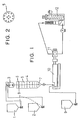
- 1 is a reservoir for a high-molecular diol
- 2 is a reservoir for an organic diisocyanate.
- the high-molecular diol and the organic diisocyanate are fed to a high-speed mixer 3 and well mixed.
- the resulting monomer mixture is then fed to a reaction cylinder 4 fitted with at least 1 perforated plate 5 (eight perforated plates in the drawing).
- Figure 2 shows an example of the perforated plate.
- a baffle cone 7 is provided in a lower portion of the perforated plate 5.
- Feeding of the high-molecular diol from the reservoir 1 and the organic diisocyanate from the reservoir 2 to the reaction cylinder 4 is preferably controlled by a level controlling zone 8 on the basis of a reactant level 6 in the reaction cylinder 4.
- the polyurethane prepolymer from the reaction cylinder 4 and the low-molecular diol from a reservoir 9 for a low-molecular diol are mixed preferably with the high-speed mixer and then introduced into a twin-screw extruder 10.
- twin extruding screw the bulk melt polymerization in the process of this invention is carried out as described above.
- the polyurethane elastomer from the twin extruding screw is pelletized preferably with an underwater pelletizer and as required, introduced into a centrifugal dehydrator 12 to separate the pellets from water.
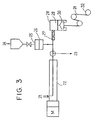
- a polyisocyanate 24 is added via a metering pump 25 and a filter 26, and they are uniformly mixed with the stationary kneading element 27. Subsequently, the resulting mixture is formed into a polyurethane elastic filament 31 with a melt spinning device comprising a spinning head 28, a metering pump 29 and a spinning nozzle 30, and wound up on a roll 32.
- the polyurethane elastomer of this invention is, either directly or after pelletized, molded into various articles as stated above.
- fibers made of the polyurethane elastomer of this invention are extremely high-quality because the number of small grains contained in the elastomer is extremely small.
- this invention allows to continuously produce the high-quality polyurethane elastomer stably for a short period of time and enables continuous operation for a long period of time (20 days or more). Still further, in producing the fibers, for example, yarn breakage in spinning owing to small grains is remarkably reduced, a spinneret life becomes longer, and the yield is improved to 85 to 98 %.
- this invention is to provide fibers formed of such polyurethane elastomer.
- the fibers of this invention can be used in combination with the other fibers and provide knitted articles such as stockings, swimming suits, inner wear, etc. in which holing, weft bar, etc. are greatly improved. Further, the fibers having improved heat resistance allows high-temperature dyeing or false-twisting, leading to widening of their usage.
- Figure 1 is an example of an apparatus for producing a polyurethane elastomer of this invention.
- Figure 2 is an example of a perforated plate used in the apparatus.
- Figure 3 is an example of a suitable apparatus for directly producing fibers having improved heat resistance from the polyurethane elastomer of this invention.
- small grains and a viscosity are measured and defined as follows.
- Small grains having a diameter of 100 ⁇ m or more are measured as follows. A fiber (a diameter thereof is usually about 20 ⁇ m to 70 ⁇ m) is run between a pair of roll bearings, and variation in interval therebetween is detected and measured with a strain gauge. Regarding a sheet and a film (a thickness thereof is usually about 20 ⁇ m to 600 ⁇ m), small grains having a size of 100 ⁇ m or more are counted with a microscope.
- Absorption intensity is measured at 280 nm of UV light in a concentration of 0.35 % by weight at a column temperature of 50°C in the presence of dimethylformamide as a solvent using a gel permeation chromatograph equipped with a 710 model fully automatic sample processor manufactured by Waters Co., Ltd., a 590 model multipurpose pump manufactured by Waters Co., Ltd., a 481 model wavelength variable UV portion detector manufactured by Waters Co., Ltd., and K-80M and KD-802 model filling columns manufactured by Showa Denko K.K.
- a polyester diol polyhexanediol adipic acid ester: PHA, a molecular weight 2,000 obtained by polycondensation of adipic acid and 1,6-hexanediol and 26.5 parts by weight of 4,4'-diphenylmethane diisocyanate (MDI) were melted at 80°C respectively. These melts were mixed with a high-speed mixer and allowed to react for 2 hours with a stirrer-equipped preparation vessel kept at 80°C to produce a prepolymer.
- PHA polyhexanediol adipic acid ester
- MDI 4,4'-diphenylmethane diisocyanate
- 1,4-butanediol (1,4-BD) as a low-molecular diol was prepared in a reservoir kept at 80°C.
- a twin-screw extruder rotating in the same direction having a diameter of 45 mm, the prepolymer was fed from the preparation vessel at a rate of 18.7 kg/hr and the low-molecular diol from the reservoir at a rate of 1.3 kg/hr respectively via a metering pump to conduct polymerization.
- the cylinder temperatures of the twin-screw extruder were 160°C, 200°C, 220°C, 250°C and 210°C in this order from a starting material feed opening.
- the extrudate was discharged from a two-hole spinneret having a diameter of 2.4 mm with the number of screw rotations of 150 rpm at an extrusion pressure of 35 kg/cm2 (using a 60 ⁇ m filter) in an average residence time of 4 minutes, and pellets could be obtained stably with an underwater pelletizer.
- a polyurethane elastomer monofilament was produced in the same manner as in Example 1 except that the high-molecular diol was changed to a polyether diol (polytetramethylene glycol: PTMG, a molecular weight 1,000) obtained by ring opening polymerization of tetrahydrofuran and that all the cylinder temperatures were elevated by 10°C.
- PTMG polytetramethylene glycol
- a polyurethane elastomer filament was produced in the same manner as in Example 1 except that the high-molecular diol was changed into polyhexamethylene-1,6-carbonate glycol (a molecular weight 2,000) and that all the cylinder temperatures were elevated by 5°C. The results are shown in Table 1.
- Example 1 The polyol (13.3 kg/cm2) having the molecular weight of 2,000, 5.4 kg/cm2 of MDI and 1.3 kg/cm2 of 1,4-BD in Example 1 were continuously fed to a twin-screw extruder, and polymerized (a one-shot process) upon setting the cylinder temperatures at 75°C, 165°C, 240°C, 240°C and 210°C. Using the pellets of the resulting polyurethane elastomer, a monofilament was produced as in Example 1. The results are shown in Table 1.
- Example 1 The prepolymer (18.7 parts) and 1.3 parts of 1,4-BD in Example 1 were fed to a kneader heated at 90 to 150°C. The mixture was reacted for 30 minutes with stirring to obtain a polyurethane powder (a kneader method). The polyurethane powder was heat-treated at 95°C for 18 hours, then fed to a twin-screw extruder having a diameter of 45 mm and pelletized. The cylinder temperatures of the screw were 160°C, 190°C, 210°C, 230°C and 210°C in this order from the feed opening. Using the pellets of the resulting polyurethane elastomer, a monofilament was produced as in Example 1. The results are shown in Table 1.
- a polyurethane elastomer and a monofilament thereof were produced in the same manner as in Example 1 except that the R ratio was changed to 1.07.
- the resulting monofilament contained a large amount of small grains having a gel-like substance as a core, and yarn breakage in spinning occurred a bit frequently. The results are shown in Table 1.
- the pellets were centrifugally dehydrated and dried to a water content of 80 ppm or less, and then melt spinning of 30 denier 1 filament x 8 was carried out with a single screw extruder having a diameter of 25 mm at a head temperature of 190°C. Small grains were measured on the resulting polyurethane elastomer monofilament. As a result, the polyurethane elastomer was found to contain a very small amount of the small grains. The results are shown in Table 2.
- a polyurethane elastomer monofilament was produced in the same manner as in Example 4 except that the cylinder temperatures of the twin-screw extruder were changed into 200°C, 220°C, 230°C and 230°C. The results are shown in Table 2.
- the melt of the polyurethane elastomer polymerized in Example 4 was led as such to a melt blow spinning device having slits for jetting a heated gas in both sides of nozzles having a diameter of 0.8 mm and mounted in a row, and injected at a head temperature of 240°C and a rate of 0.5 g/min in each nozzle. Air heated at 200°C was jetted from the slits at a pressure of 3.5 kg/cm3 to conduct attenuation.
- the attenuated filament was collected on a conveyor made of a 30-mesh wire net and located 25 cm below the nozzles, and was taken off between rollers to obtain a nonwoven fabric having a weight of 50 g/m2 (see Example 2 of Japanese Patent Publication Hei 1-30,945 (No. 30,945/1989)).
- monofilaments of the polyurethane elastomer fibers were laminated in a spread state, and intertwined points between the monofilaments were bound with each other by fusion. When small grains were measured, the number thereof was found to be as small as about 80 per kilogram.
- the fiber was composed of the narrow, uniform monofilaments having a diameter of about 20 ⁇ m.
- Example 4 The dried pellets in Example 4 were melted with an extruder and then extruded onto a quenching rotary drum from a slit die of 240°C to form a sheet having a film thickness of 0.6 mm.
- Dihydroxy poly- ⁇ -caprolactone (1,500 parts) having a hydroxyl number of 150 and 1,000 parts of p,p-diphenylmethane diisocyanate were reacted at 80°C to obtain a viscous polyisocyanate compound.
- the polyisocyanate compound had an isocyanate content of 6.74 % and a molecular weight of 1,250.
- Example 4 The polyurethane elastomer polymerized in Example 4 was introduced into the apparatus shown in Figure 3, and part of the elastomer divided at the end of the extruder was injected into water from a spinneret having a diameter of 2.4 mm, and pelletized. After injecting the polyisocyanate compound, the other part was kneaded with a mixer having a stationary kneading element, weighed with a gear pump and spun into a monofilament having a denier of 40 at a take-up speed of 500 m/min. using a nozzle having a diameter of 1.0 mm. Spinning was conducted by changing the amount of the polyisocyanate compound added to polyurethane. The results are shown in Table 3.
- the qualities of the filaments were measured after allowed to stand at room temperature for 2 days after spinning.
- the number of small grains in the filament was good and 1 or less per 1,000 m in each case.
- an elongation recovery rate at 190°C based on which a heat resistance of the polyurethane elastomer fiber was evaluated was measured as follows.
Landscapes
- Chemical & Material Sciences (AREA)
- Chemical Kinetics & Catalysis (AREA)
- Engineering & Computer Science (AREA)
- Health & Medical Sciences (AREA)
- Medicinal Chemistry (AREA)
- Polymers & Plastics (AREA)
- Organic Chemistry (AREA)
- Manufacturing & Machinery (AREA)
- General Chemical & Material Sciences (AREA)
- Textile Engineering (AREA)
- Polyurethanes Or Polyureas (AREA)
- Artificial Filaments (AREA)
Abstract
Applications Claiming Priority (7)
| Application Number | Priority Date | Filing Date | Title |
|---|---|---|---|
| JP190707/91 | 1991-07-03 | ||
| JP19070791 | 1991-07-03 | ||
| JP282151/91 | 1991-10-01 | ||
| JP28215191 | 1991-10-01 | ||
| JP79001/92 | 1992-02-29 | ||
| JP7900192 | 1992-02-29 | ||
| PCT/JP1992/000437 WO1993001222A1 (fr) | 1991-07-03 | 1992-04-08 | Elastomere de polyurethane thermoplastique, procede et dispositif de production, et fibre elastique realisee a partir de cet elastomere |
Publications (3)
| Publication Number | Publication Date |
|---|---|
| EP0592668A1 true EP0592668A1 (fr) | 1994-04-20 |
| EP0592668A4 EP0592668A4 (en) | 1994-05-18 |
| EP0592668B1 EP0592668B1 (fr) | 1999-03-10 |
Family
ID=27302882
Family Applications (1)
| Application Number | Title | Priority Date | Filing Date |
|---|---|---|---|
| EP92908499A Expired - Lifetime EP0592668B1 (fr) | 1991-07-03 | 1992-04-08 | Procede et dispositiv de production d' un elastomere de polyurethane thermoplastique |
Country Status (7)
| Country | Link |
|---|---|
| US (1) | US5391682A (fr) |
| EP (1) | EP0592668B1 (fr) |
| KR (1) | KR0163798B1 (fr) |
| CN (1) | CN1038037C (fr) |
| CA (1) | CA2112578C (fr) |
| DE (1) | DE69228606T2 (fr) |
| WO (1) | WO1993001222A1 (fr) |
Cited By (6)
| Publication number | Priority date | Publication date | Assignee | Title |
|---|---|---|---|---|
| WO1996025539A1 (fr) * | 1995-02-13 | 1996-08-22 | Karl Fischer Industrieanlagen Gmbh | Procede de filature a chaud de polyurethane et/ou polyurethane-uree |
| EP0982332A1 (fr) * | 1998-08-26 | 2000-03-01 | Bayer Corporation | Composition et procédé pour la préparation de polyuréthanes thermoplastiques (Polyuréthane thermoplastique à partir d'un segment souple de polybutadiène) |
| KR100526948B1 (ko) * | 2002-01-29 | 2005-11-08 | 주식회사 효성 | 저내열성 폴리우레탄 탄성섬유의 제조방법 |
| US9565877B2 (en) | 2013-10-18 | 2017-02-14 | Mast Industries (Far East) Limited | Garment that clings to a wearer's skin and method of manufacture thereof |
| US9883702B2 (en) | 2015-10-07 | 2018-02-06 | Mast Industries (Far East) Limited | Portion of bra and bra having zones of varying elastic moduli |
| WO2018046699A1 (fr) | 2016-09-09 | 2018-03-15 | Covestro Deutschland Ag | Multifilaments filés à l'état fondu à base de polyuréthane thermoplastique, leur production et leur utilisation |
Families Citing this family (53)
| Publication number | Priority date | Publication date | Assignee | Title |
|---|---|---|---|---|
| DE4217365A1 (de) * | 1992-05-26 | 1993-12-02 | Bayer Ag | Verfahren zur Herstellung von thermoplastisch verarbeitbaren Polyurethan-Elastomeren durch einen mehrstufigen Prozeß |
| CN1059478C (zh) * | 1994-03-12 | 2000-12-13 | 陶宇 | 一种生产聚氨酯弹性纤维的方法 |
| DE4437586A1 (de) * | 1994-10-20 | 1996-04-25 | Basf Schwarzheide Gmbh | Verfahren zur Herstellung von thermoplastischen Polyurethanen |
| US6521164B1 (en) | 1996-02-06 | 2003-02-18 | Parker-Hannifin Corporation | Injection-moldable thermoplastic polyurethane elastomer |
| US6399003B1 (en) * | 1997-09-03 | 2002-06-04 | Dupont-Toray Co. Ltd. | Process for making melt-spun spandex |
| US5840233A (en) | 1997-09-16 | 1998-11-24 | Optimer, Inc. | Process of making melt-spun elastomeric fibers |
| DE19924089C1 (de) * | 1999-05-26 | 2001-01-25 | Bayer Ag | Verfahren zur kontinuierlichen Herstellung von thermoplastisch verarbeitbaren Polyurethanen mit verbessertem Erweichungsverhalten |
| DK1234031T3 (en) | 1999-11-30 | 2017-07-03 | Mayo Foundation | B7-H1, AN UNKNOWN IMMUNE REGULATORY MOLECULE |
| US7030219B2 (en) | 2000-04-28 | 2006-04-18 | Johns Hopkins University | B7-DC, Dendritic cell co-stimulatory molecules |
| JP4803916B2 (ja) * | 2001-07-27 | 2011-10-26 | 日東電工株式会社 | アクリル系感圧性接着剤及びその製造方法 |
| KR100351742B1 (en) * | 2001-10-10 | 2002-09-05 | Hosung Chemax Co Ltd | Molded article comprising thermoplastic polyurethane consisting of ether-containing polyester polyol |
| KR20030073486A (ko) * | 2002-03-11 | 2003-09-19 | 류재원 | 폴리우레탄 폼과 분말 혼합장치 |
| US7432351B1 (en) | 2002-10-04 | 2008-10-07 | Mayo Foundation For Medical Education And Research | B7-H1 variants |
| US8506959B2 (en) | 2002-11-01 | 2013-08-13 | Neotope Biosciences Limited | Prevention and treatment of synucleinopathic and amyloidogenic disease |
| TW200509968A (en) | 2002-11-01 | 2005-03-16 | Elan Pharm Inc | Prevention and treatment of synucleinopathic disease |
| CN100567604C (zh) * | 2002-12-12 | 2009-12-09 | 日清纺织株式会社 | 含聚氨酯弹性体纤维的共混机织或针织织物及其生产方法 |
| TWI306129B (en) * | 2003-01-24 | 2009-02-11 | Mitsui Chemicals Inc | Fiber mixture, stretch nonwoven fabric comprising the same, and production method for the stretch nonwoven fabric |
| PL2361928T3 (pl) | 2003-05-19 | 2017-09-29 | Prothena Biosciences Limited | Skrócone fragmenty alfa-synukleiny w chorobie z ciałami Lewy'ego |
| US7358331B2 (en) | 2003-05-19 | 2008-04-15 | Elan Pharmaceuticals, Inc. | Truncated fragments of alpha-synuclein in Lewy body disease |
| US7799255B2 (en) * | 2003-06-30 | 2010-09-21 | Lubrizol Advanced Materials, Inc. | Melt spun elastic tape and process |
| CN100537859C (zh) * | 2003-07-16 | 2009-09-09 | 李绍光 | 一种制造聚氨酯弹性纤维的熔融纺丝法 |
| DK1810026T3 (en) | 2004-10-06 | 2018-07-16 | Mayo Found Medical Education & Res | B7-H1 AND PD-1 FOR TREATMENT OF RENAL CELL CARCINOM |
| DE102005039933B4 (de) * | 2005-08-24 | 2007-12-27 | Bayer Materialscience Ag | Verfahren zur Herstellung von thermoplastisch verarbeitbaren Polyurethanen |
| US8440185B2 (en) | 2006-12-26 | 2013-05-14 | The Johns Hopkins University | Compositions and methods for the treatment of immunologic disorders |
| EP2124998B8 (fr) | 2006-12-27 | 2015-05-06 | The Johns Hopkins University | Procédés pour la detection d'inflammations et de maladies auto-immunes |
| US7989173B2 (en) | 2006-12-27 | 2011-08-02 | The Johns Hopkins University | Detection and diagnosis of inflammatory disorders |
| PL2583978T3 (pl) | 2007-02-23 | 2016-07-29 | Prothena Biosciences Ltd Co | Profilaktyka i leczenie chorób synukleinopatycznych i amyloidogennych |
| HUE043966T2 (hu) | 2007-02-23 | 2019-09-30 | Prothena Biosciences Ltd | Szinukleinopátiás és amiloidogén betegség megelõzése és kezelése |
| CN101784564B (zh) | 2007-07-13 | 2014-07-02 | 约翰霍普金斯大学 | B7-dc变体 |
| CA2772204A1 (fr) | 2009-08-31 | 2011-03-03 | Amplimmune, Inc. | Methodes et compositions permettant d'inhiber les rejets de greffe |
| KR20130114637A (ko) * | 2010-06-15 | 2013-10-17 | 루브리졸 어드밴스드 머티어리얼스, 인코포레이티드 | 균일한 탄성률을 지닌 용융 방사 탄성 섬유 |
| EP2655467B1 (fr) | 2010-12-21 | 2016-05-11 | Lubrizol Advanced Materials, Inc. | Résines élastomères, fibres et tissus de celles-ci, et utilisations de celles-ci |
| FR2992649B1 (fr) * | 2012-07-02 | 2015-06-19 | Michelin & Cie | Procede de synthese en continu d'un elastomere dienique |
| US9302005B2 (en) | 2013-03-14 | 2016-04-05 | Mayo Foundation For Medical Education And Research | Methods and materials for treating cancer |
| WO2015004633A1 (fr) | 2013-07-12 | 2015-01-15 | Neotope Biosciences Limited | Anticorps reconnaissant le polypeptide amyloïde des ilôts (iapp) |
| US9850302B2 (en) | 2013-07-12 | 2017-12-26 | Prothena Biosciences Limited | Antibodies that recognize IAPP |
| ES2714708T3 (es) | 2013-10-01 | 2019-05-29 | Mayo Found Medical Education & Res | Procedimientos para el tratamiento de cáncer en pacientes con niveles elevados de Bim |
| TWI667285B (zh) | 2013-10-18 | 2019-08-01 | 德商巴斯夫歐洲公司 | 膨脹熱塑性彈性體之製造 |
| FR3014441B1 (fr) * | 2013-12-05 | 2016-01-08 | Merylithe | Procede de preparation de prepolymeres a terminaison isocyanate pour la preparation de polyurethanes |
| CA2944402A1 (fr) | 2014-04-08 | 2015-10-15 | Prothena Biosciences Limited | Navettes de la barriere hemato-encephalique contenant des anticorps reconnaissant l'alpha-synucleine |
| US10302653B2 (en) | 2014-05-22 | 2019-05-28 | Mayo Foundation For Medical Education And Research | Distinguishing antagonistic and agonistic anti B7-H1 antibodies |
| WO2016014148A1 (fr) | 2014-07-23 | 2016-01-28 | Mayo Foundation For Medical Education And Research | Ciblage d'adn-pkcs et de b7-h1 pour traiter le cancer |
| WO2017075045A2 (fr) | 2015-10-30 | 2017-05-04 | Mayo Foundation For Medical Education And Research | Anticorps anti-b7-h1 |
| ES2883182T3 (es) | 2016-07-06 | 2021-12-07 | Prothena Biosciences Ltd | Ensayo para la detección de alfa-sinucleína total y fosforilada en S129 |
| CN107217513A (zh) * | 2017-08-03 | 2017-09-29 | 合肥梵清电子商务有限公司 | 一种彩色氨纶纤维的制备方法 |
| WO2019213932A1 (fr) * | 2018-05-11 | 2019-11-14 | Covestro Deutschland Ag | Composition de polyuréthane thermoplastique et son utilisation |
| EP3873540A4 (fr) | 2018-10-31 | 2022-07-27 | Mayo Foundation for Medical Education and Research | Procédés et matériaux pour le traitement du cancer |
| WO2020092839A1 (fr) | 2018-10-31 | 2020-05-07 | Mayo Foundation For Medical Education And Research | Méthodes et matériaux de traitement du cancer |
| EP3994299A1 (fr) * | 2019-07-03 | 2022-05-11 | Lubrizol Advanced Materials, Inc. | Fibres de polyuréthane thermoplastique à deux constituants et tissus fabriqués à partir de celles-ci |
| CN111394821A (zh) * | 2020-05-09 | 2020-07-10 | 万华化学集团股份有限公司 | 一种高强度、高回弹的氨纶纤维及其制备方法 |
| TWI772203B (zh) * | 2021-10-15 | 2022-07-21 | 南亞塑膠工業股份有限公司 | 可適用於熔融紡絲的熱塑性聚氨酯樹脂 |
| US11840656B2 (en) | 2021-11-05 | 2023-12-12 | Industrial Technology Research Institute | Halogen free flame-retardant materials and method for manufacturing the same |
| JP2023147247A (ja) * | 2022-03-29 | 2023-10-12 | 三井化学株式会社 | メルトブローン不織布及び衛生材料 |
Family Cites Families (6)
| Publication number | Priority date | Publication date | Assignee | Title |
|---|---|---|---|---|
| US3963679A (en) * | 1973-01-19 | 1976-06-15 | Bayer Aktiengesellschaft | Process for the production of polyurethane elastomers |
| US4192928A (en) * | 1976-12-30 | 1980-03-11 | Teijin Limited | Thermoplastic polyurethane and process for the preparation thereof |
| JPS57185313A (en) * | 1981-05-08 | 1982-11-15 | Daicel Chem Ind Ltd | Polyurethane and its preparation |
| JPS60149623A (ja) * | 1984-01-13 | 1985-08-07 | Toyobo Co Ltd | ポリウレタン弾性体成形品の製造方法 |
| JPH02628A (ja) * | 1988-12-01 | 1990-01-05 | Daicel Chem Ind Ltd | 分子量分布の狭いラクトン重合体及びその製造法 |
| DE3930995A1 (de) * | 1989-09-16 | 1991-03-28 | Bayer Ag | Verfahren zur herstellung von polyester (urethan) polyolen enger molekulargewichtsverteilung und ihre verwendung |
-
1992
- 1992-04-08 EP EP92908499A patent/EP0592668B1/fr not_active Expired - Lifetime
- 1992-04-08 WO PCT/JP1992/000437 patent/WO1993001222A1/fr not_active Ceased
- 1992-04-08 US US08/175,359 patent/US5391682A/en not_active Expired - Fee Related
- 1992-04-08 DE DE69228606T patent/DE69228606T2/de not_active Expired - Fee Related
- 1992-04-08 CA CA002112578A patent/CA2112578C/fr not_active Expired - Fee Related
- 1992-04-08 KR KR1019930704100A patent/KR0163798B1/ko not_active Expired - Lifetime
- 1992-04-09 CN CN92103374A patent/CN1038037C/zh not_active Expired - Lifetime
Cited By (8)
| Publication number | Priority date | Publication date | Assignee | Title |
|---|---|---|---|---|
| WO1996025539A1 (fr) * | 1995-02-13 | 1996-08-22 | Karl Fischer Industrieanlagen Gmbh | Procede de filature a chaud de polyurethane et/ou polyurethane-uree |
| EP0982332A1 (fr) * | 1998-08-26 | 2000-03-01 | Bayer Corporation | Composition et procédé pour la préparation de polyuréthanes thermoplastiques (Polyuréthane thermoplastique à partir d'un segment souple de polybutadiène) |
| US6166166A (en) * | 1998-08-26 | 2000-12-26 | Bayer Corporation | Composition and process for preparation of thermoplastic polyurethanes (TPU based on a polybutadiene soft segment) |
| KR100526948B1 (ko) * | 2002-01-29 | 2005-11-08 | 주식회사 효성 | 저내열성 폴리우레탄 탄성섬유의 제조방법 |
| US9565877B2 (en) | 2013-10-18 | 2017-02-14 | Mast Industries (Far East) Limited | Garment that clings to a wearer's skin and method of manufacture thereof |
| US9883702B2 (en) | 2015-10-07 | 2018-02-06 | Mast Industries (Far East) Limited | Portion of bra and bra having zones of varying elastic moduli |
| WO2018046699A1 (fr) | 2016-09-09 | 2018-03-15 | Covestro Deutschland Ag | Multifilaments filés à l'état fondu à base de polyuréthane thermoplastique, leur production et leur utilisation |
| US11346021B2 (en) | 2016-09-09 | 2022-05-31 | Covestro Deutschland Ag | Melt spun multifilaments based on thermoplastic polyurethane, their production and use |
Also Published As
| Publication number | Publication date |
|---|---|
| US5391682A (en) | 1995-02-21 |
| EP0592668B1 (fr) | 1999-03-10 |
| CN1068341A (zh) | 1993-01-27 |
| CA2112578C (fr) | 2000-10-10 |
| CA2112578A1 (fr) | 1993-01-21 |
| KR0163798B1 (ko) | 1999-01-15 |
| DE69228606T2 (de) | 1999-06-24 |
| EP0592668A4 (en) | 1994-05-18 |
| KR940701414A (ko) | 1994-05-28 |
| DE69228606D1 (de) | 1999-04-15 |
| WO1993001222A1 (fr) | 1993-01-21 |
| CN1038037C (zh) | 1998-04-15 |
Similar Documents
| Publication | Publication Date | Title |
|---|---|---|
| US5391682A (en) | Thermoplastic polyurethane elastomer, process for producing same, apparatus producing same and elastomer fibers made from same | |
| EP1611177B1 (fr) | Fibres de tpu filees a l'etat fondu et procede | |
| US6399003B1 (en) | Process for making melt-spun spandex | |
| JPS5846573B2 (ja) | ポリウレタン弾性糸の製造方法 | |
| JP3247777B2 (ja) | ポリウレタン弾性体及びその製造方法 | |
| JP2878841B2 (ja) | 熱可塑性ポリウレタン弾性体、その製造法およびそれからなる弾性繊維 | |
| EP0977790B1 (fr) | Procede de fabrication de spandex et spandex ainsi fabrique | |
| JP2752317B2 (ja) | 耐熱性に優れたポリウレタン弾性体及びその製造方法 | |
| JPS6353288B2 (fr) | ||
| JPH05214062A (ja) | 熱可塑性ポリウレタンの製造方法 | |
| JP2619844B2 (ja) | ポリウレタン弾性糸の製造方法 | |
| JPWO1993001222A1 (ja) | 熱可塑性ポリウレタン弾性体、その製造法およびそれからなる弾性繊維 | |
| JPH04146915A (ja) | ポリウレタン弾性体及びその製造方法 | |
| JP2566902B2 (ja) | 耐熱ウレタン糸の製造法 | |
| JPH04316609A (ja) | ポリオレフィン系複合弾性糸 | |
| JP2653711B2 (ja) | ポリウレタン | |
| JP2619844C (fr) | ||
| JP2809413B2 (ja) | 耐熱ウレタン糸の製造法 | |
| JPS5844764B2 (ja) | ポリウレタン弾性糸の製造方法 | |
| JPH02127515A (ja) | 耐熱ウレタン糸の製造法 | |
| JPH0376811A (ja) | ポリウレタン弾性繊維 | |
| JPS6215219A (ja) | 均質な熱可塑性ポリウレタンの製造方法 | |
| JPH04277513A (ja) | ポリウレタン弾性体の製造方法及びその繊維とシート | |
| JP2005048316A (ja) | ポリウレタン弾性繊維の製造方法 | |
| JPS6043445B2 (ja) | ポリウレタン弾性糸の製造方法 |
Legal Events
| Date | Code | Title | Description |
|---|---|---|---|
| PUAI | Public reference made under article 153(3) epc to a published international application that has entered the european phase |
Free format text: ORIGINAL CODE: 0009012 |
|
| 17P | Request for examination filed |
Effective date: 19940110 |
|
| AK | Designated contracting states |
Kind code of ref document: A1 Designated state(s): DE FR GB IT |
|
| A4 | Supplementary search report drawn up and despatched | ||
| AK | Designated contracting states |
Kind code of ref document: A4 Designated state(s): DE FR GB IT |
|
| K1C3 | Correction of patent application (complete document) published |
Effective date: 19940420 |
|
| 17Q | First examination report despatched |
Effective date: 19960206 |
|
| GRAG | Despatch of communication of intention to grant |
Free format text: ORIGINAL CODE: EPIDOS AGRA |
|
| GRAG | Despatch of communication of intention to grant |
Free format text: ORIGINAL CODE: EPIDOS AGRA |
|
| GRAH | Despatch of communication of intention to grant a patent |
Free format text: ORIGINAL CODE: EPIDOS IGRA |
|
| GRAH | Despatch of communication of intention to grant a patent |
Free format text: ORIGINAL CODE: EPIDOS IGRA |
|
| GRAA | (expected) grant |
Free format text: ORIGINAL CODE: 0009210 |
|
| AK | Designated contracting states |
Kind code of ref document: B1 Designated state(s): DE FR GB IT |
|
| REF | Corresponds to: |
Ref document number: 69228606 Country of ref document: DE Date of ref document: 19990415 |
|
| ITF | It: translation for a ep patent filed | ||
| ET | Fr: translation filed | ||
| PLBE | No opposition filed within time limit |
Free format text: ORIGINAL CODE: 0009261 |
|
| 26N | No opposition filed | ||
| REG | Reference to a national code |
Ref country code: GB Ref legal event code: IF02 |
|
| PGFP | Annual fee paid to national office [announced via postgrant information from national office to epo] |
Ref country code: GB Payment date: 20030402 Year of fee payment: 12 |
|
| PGFP | Annual fee paid to national office [announced via postgrant information from national office to epo] |
Ref country code: FR Payment date: 20030408 Year of fee payment: 12 |
|
| PG25 | Lapsed in a contracting state [announced via postgrant information from national office to epo] |
Ref country code: GB Free format text: LAPSE BECAUSE OF NON-PAYMENT OF DUE FEES Effective date: 20040408 |
|
| GBPC | Gb: european patent ceased through non-payment of renewal fee |
Effective date: 20040408 |
|
| PG25 | Lapsed in a contracting state [announced via postgrant information from national office to epo] |
Ref country code: FR Free format text: LAPSE BECAUSE OF NON-PAYMENT OF DUE FEES Effective date: 20041231 |
|
| REG | Reference to a national code |
Ref country code: FR Ref legal event code: ST |
|
| PGFP | Annual fee paid to national office [announced via postgrant information from national office to epo] |
Ref country code: DE Payment date: 20050331 Year of fee payment: 14 |
|
| PG25 | Lapsed in a contracting state [announced via postgrant information from national office to epo] |
Ref country code: IT Free format text: LAPSE BECAUSE OF NON-PAYMENT OF DUE FEES;WARNING: LAPSES OF ITALIAN PATENTS WITH EFFECTIVE DATE BEFORE 2007 MAY HAVE OCCURRED AT ANY TIME BEFORE 2007. THE CORRECT EFFECTIVE DATE MAY BE DIFFERENT FROM THE ONE RECORDED. Effective date: 20050408 |
|
| PG25 | Lapsed in a contracting state [announced via postgrant information from national office to epo] |
Ref country code: DE Free format text: LAPSE BECAUSE OF NON-PAYMENT OF DUE FEES Effective date: 20061101 |