EP0623683A1 - Systèmes d'amplification/détection d'acides nucléiques à base de transcription - Google Patents
Systèmes d'amplification/détection d'acides nucléiques à base de transcription Download PDFInfo
- Publication number
- EP0623683A1 EP0623683A1 EP94200266A EP94200266A EP0623683A1 EP 0623683 A1 EP0623683 A1 EP 0623683A1 EP 94200266 A EP94200266 A EP 94200266A EP 94200266 A EP94200266 A EP 94200266A EP 0623683 A1 EP0623683 A1 EP 0623683A1
- Authority
- EP
- European Patent Office
- Prior art keywords
- subsegment
- sequence
- rna
- segment
- primer
- Prior art date
- Legal status (The legal status is an assumption and is not a legal conclusion. Google has not performed a legal analysis and makes no representation as to the accuracy of the status listed.)
- Granted
Links
Images





Classifications
-
- C—CHEMISTRY; METALLURGY
- C12—BIOCHEMISTRY; BEER; SPIRITS; WINE; VINEGAR; MICROBIOLOGY; ENZYMOLOGY; MUTATION OR GENETIC ENGINEERING
- C12N—MICROORGANISMS OR ENZYMES; COMPOSITIONS THEREOF; PROPAGATING, PRESERVING, OR MAINTAINING MICROORGANISMS; MUTATION OR GENETIC ENGINEERING; CULTURE MEDIA
- C12N15/00—Mutation or genetic engineering; DNA or RNA concerning genetic engineering, vectors, e.g. plasmids, or their isolation, preparation or purification; Use of hosts therefor
-
- C—CHEMISTRY; METALLURGY
- C12—BIOCHEMISTRY; BEER; SPIRITS; WINE; VINEGAR; MICROBIOLOGY; ENZYMOLOGY; MUTATION OR GENETIC ENGINEERING
- C12Q—MEASURING OR TESTING PROCESSES INVOLVING ENZYMES, NUCLEIC ACIDS OR MICROORGANISMS; COMPOSITIONS OR TEST PAPERS THEREFOR; PROCESSES OF PREPARING SUCH COMPOSITIONS; CONDITION-RESPONSIVE CONTROL IN MICROBIOLOGICAL OR ENZYMOLOGICAL PROCESSES
- C12Q1/00—Measuring or testing processes involving enzymes, nucleic acids or microorganisms; Compositions therefor; Processes of preparing such compositions
- C12Q1/68—Measuring or testing processes involving enzymes, nucleic acids or microorganisms; Compositions therefor; Processes of preparing such compositions involving nucleic acids
- C12Q1/6844—Nucleic acid amplification reactions
- C12Q1/6867—Replicase-based amplification, e.g. using Q-beta replicase
-
- C—CHEMISTRY; METALLURGY
- C12—BIOCHEMISTRY; BEER; SPIRITS; WINE; VINEGAR; MICROBIOLOGY; ENZYMOLOGY; MUTATION OR GENETIC ENGINEERING
- C12N—MICROORGANISMS OR ENZYMES; COMPOSITIONS THEREOF; PROPAGATING, PRESERVING, OR MAINTAINING MICROORGANISMS; MUTATION OR GENETIC ENGINEERING; CULTURE MEDIA
- C12N15/00—Mutation or genetic engineering; DNA or RNA concerning genetic engineering, vectors, e.g. plasmids, or their isolation, preparation or purification; Use of hosts therefor
- C12N15/09—Recombinant DNA-technology
- C12N15/10—Processes for the isolation, preparation or purification of DNA or RNA
-
- C—CHEMISTRY; METALLURGY
- C12—BIOCHEMISTRY; BEER; SPIRITS; WINE; VINEGAR; MICROBIOLOGY; ENZYMOLOGY; MUTATION OR GENETIC ENGINEERING
- C12Q—MEASURING OR TESTING PROCESSES INVOLVING ENZYMES, NUCLEIC ACIDS OR MICROORGANISMS; COMPOSITIONS OR TEST PAPERS THEREFOR; PROCESSES OF PREPARING SUCH COMPOSITIONS; CONDITION-RESPONSIVE CONTROL IN MICROBIOLOGICAL OR ENZYMOLOGICAL PROCESSES
- C12Q1/00—Measuring or testing processes involving enzymes, nucleic acids or microorganisms; Compositions therefor; Processes of preparing such compositions
- C12Q1/68—Measuring or testing processes involving enzymes, nucleic acids or microorganisms; Compositions therefor; Processes of preparing such compositions involving nucleic acids
-
- C—CHEMISTRY; METALLURGY
- C12—BIOCHEMISTRY; BEER; SPIRITS; WINE; VINEGAR; MICROBIOLOGY; ENZYMOLOGY; MUTATION OR GENETIC ENGINEERING
- C12Q—MEASURING OR TESTING PROCESSES INVOLVING ENZYMES, NUCLEIC ACIDS OR MICROORGANISMS; COMPOSITIONS OR TEST PAPERS THEREFOR; PROCESSES OF PREPARING SUCH COMPOSITIONS; CONDITION-RESPONSIVE CONTROL IN MICROBIOLOGICAL OR ENZYMOLOGICAL PROCESSES
- C12Q1/00—Measuring or testing processes involving enzymes, nucleic acids or microorganisms; Compositions therefor; Processes of preparing such compositions
- C12Q1/68—Measuring or testing processes involving enzymes, nucleic acids or microorganisms; Compositions therefor; Processes of preparing such compositions involving nucleic acids
- C12Q1/6844—Nucleic acid amplification reactions
- C12Q1/6865—Promoter-based amplification, e.g. nucleic acid sequence amplification [NASBA], self-sustained sequence replication [3SR] or transcription-based amplification system [TAS]
-
- C—CHEMISTRY; METALLURGY
- C12—BIOCHEMISTRY; BEER; SPIRITS; WINE; VINEGAR; MICROBIOLOGY; ENZYMOLOGY; MUTATION OR GENETIC ENGINEERING
- C12Q—MEASURING OR TESTING PROCESSES INVOLVING ENZYMES, NUCLEIC ACIDS OR MICROORGANISMS; COMPOSITIONS OR TEST PAPERS THEREFOR; PROCESSES OF PREPARING SUCH COMPOSITIONS; CONDITION-RESPONSIVE CONTROL IN MICROBIOLOGICAL OR ENZYMOLOGICAL PROCESSES
- C12Q1/00—Measuring or testing processes involving enzymes, nucleic acids or microorganisms; Compositions therefor; Processes of preparing such compositions
- C12Q1/68—Measuring or testing processes involving enzymes, nucleic acids or microorganisms; Compositions therefor; Processes of preparing such compositions involving nucleic acids
- C12Q1/6876—Nucleic acid products used in the analysis of nucleic acids, e.g. primers or probes
-
- C—CHEMISTRY; METALLURGY
- C12—BIOCHEMISTRY; BEER; SPIRITS; WINE; VINEGAR; MICROBIOLOGY; ENZYMOLOGY; MUTATION OR GENETIC ENGINEERING
- C12Q—MEASURING OR TESTING PROCESSES INVOLVING ENZYMES, NUCLEIC ACIDS OR MICROORGANISMS; COMPOSITIONS OR TEST PAPERS THEREFOR; PROCESSES OF PREPARING SUCH COMPOSITIONS; CONDITION-RESPONSIVE CONTROL IN MICROBIOLOGICAL OR ENZYMOLOGICAL PROCESSES
- C12Q1/00—Measuring or testing processes involving enzymes, nucleic acids or microorganisms; Compositions therefor; Processes of preparing such compositions
- C12Q1/70—Measuring or testing processes involving enzymes, nucleic acids or microorganisms; Compositions therefor; Processes of preparing such compositions involving virus or bacteriophage
- C12Q1/701—Specific hybridization probes
- C12Q1/702—Specific hybridization probes for retroviruses
- C12Q1/703—Viruses associated with AIDS
-
- C—CHEMISTRY; METALLURGY
- C12—BIOCHEMISTRY; BEER; SPIRITS; WINE; VINEGAR; MICROBIOLOGY; ENZYMOLOGY; MUTATION OR GENETIC ENGINEERING
- C12Q—MEASURING OR TESTING PROCESSES INVOLVING ENZYMES, NUCLEIC ACIDS OR MICROORGANISMS; COMPOSITIONS OR TEST PAPERS THEREFOR; PROCESSES OF PREPARING SUCH COMPOSITIONS; CONDITION-RESPONSIVE CONTROL IN MICROBIOLOGICAL OR ENZYMOLOGICAL PROCESSES
- C12Q2600/00—Oligonucleotides characterized by their use
- C12Q2600/158—Expression markers
Definitions
- the present invention relates generally to advances in molecular biology and molecular genetics.
- the present invention relates to novel methods and kits containing requisite reagents and means for increasing the in vitro or x-vivo copy number of, i.e., amplifying, at least one selected segment (sequence) of nucleic acid or its complement or hybridizing homologous segment, in a sample comprising one or more nucleic acids, which may include RNA, DNA or both.
- the methods and kits of this invention find utility are 1) in analyses of body fluids and tissues for the detection of specific nucleic acid sequences characteristic of a genetic or pathogenic disease or condition by in vitro or x-vivo nucleic acid probe hybridization assays and 2) in the selective cloning of single-copy or rare or low-expression genes.
- nucleic acid probe hybridization assays for blood-borne pathogens or defective genes
- a fundamental problem in such work is to detect or isolate and then quantitate a nucleic acid sequence of interest.
- biological materials such as cell cultures, tissue specimens, and blood samples, typically are comprised of a complex mixture of RNA and DNA entities of which at most only a minuscule fraction has a sequence of interest.
- nucleic acid probe hybridization assays have been limited because the sensitivity of the assays, when carried out with reagents suitable for routine use and over acceptably short time periods, is too low to detect sequences of interest at the low concentration at which they occur in real samples.
- target segment a nucleic acid sequence of interest
- the amount of nucleic acid (including the target segment) in a sample is not altered; instead, a signal-generating system is associated with the target segment and produces a detectable signal representative of the number of molecules of target segment.
- a nucleic acid probe with a sequence complementary to that of a subsegment of the target segment is linked to an enzyme such as alkaline phosphatase and is mixed with sample under hybridization conditions that will effect hybridization between the probe and the target segment (but not appreciably between probe and other nucleic acid sequences in the sample).
- an enzyme such as alkaline phosphatase
- a chromogenic substrate for alkaline phosphatase is added under suitable conditions and, in principle, a large number of detectable, colored molecules is rapidly produced for each probe molecule hybridized to target segment.
- RNAs are known that are susceptible to (autocatalytically) replicase-induced replication by certain polymerase, such as bacteriophage RNA-dependent RNA polymerase, such as Q ⁇ replicase and the replicase from brome mosaic virus (BMV).
- both an RNA and the RNA of complementary sequence are templates for replication by the RNA polymerase; consequently the amount of replicated RNA increases exponentially with time (as long as the number of RNA template molecules does not exceed the number of RNA polymerase molecules in a system).
- a system in which probe for a target segment is linked to an RNA capable of being replicated by Q ⁇ replicase is described by Chu et al ., Nucl. Acids Res. 14 , 5591 (1986) and that by BMV replicase by Marsh et al. , Positive strand RNA Viruses, Alan R. Liss (publr.; New York) (1987; Proceedings of UCLA Symposium, 1986).
- the first approach has two serious drawbacks.
- a signal due to "background” is unavoidable; that is, invariably there is some signal due to probe that non-specifically adheres to filters or other solid supports or hybridizes to segments with sequences closely similar to that of target segment. If the copy number of target is too low, the time constant ratio of signal from target plus background (i.e.
- This second approach is fundamentally different and involves increasing the copy number of the target segment itself, preferably to an extent greater than that of other sequences in a sample, particularly those that might erroneously be detected as target segment because of similarities in sequence.
- Examples of this second approach include various culture techniques in which cells that harbor the target segment are caused to increase in number, sometimes more rapidly than numbers of other cells, or in which particular nucleic acids (e.g., plasmids, RNAs) therein having disposed target segment are caused to increase in number.
- PCR polymerase chain reaction
- a particular segment increases in copy number exponentially with a number of cycles, each of which entails (1) hybridizing to a 3'-terminal subsegment of each of the target segment and its complement (i.e., the segment of sequence complementary to that of target segment) a DNA primer, (2) extending each of the primers with a DNA polymerase, and (3) rendering single stranded by thermal denaturation the duplexes resulting from step (2).
- This technique is described in Saiki et al ., Science 230 , 1350 (1985), and Mullis et al. , European Patent Application Publication Nos. 200362 and 201184. See also U.S. Patents 4683195 and 4683202.
- the copy number of a target segment can be increased by a factor of about 105. Because only those segments to which a specific primer hybridizes with a sufficient stability to initiate chain extension by the polymerase to form the complement and which have a complement to which another specific primer hybridizes similarly to yield target segment upon chain extension, they increase exponentially in copy number while other non-target segments not erroneously hybridized with the employed primer increase, if at all, at most linearly in copy number as a function of number of cycles.
- the polymerase chain reaction technique can greatly increase not only the copy number of target segment but also the ratio of the amount of target segment to that of background-causing segments in a sample.
- this second approach can be applied to a sample in conjunction with use of the first approach applied with the amplified target segment to provide even a stronger detection signal.
- the present invention is concerned with a novel technique for carrying out the second approach to detecting a target segment present at a low level in a complex mixture of nucleic acids. It employs a novel RNA transcript production step in conjunction with, and derived from, a synthesized double-stranded cDNA copy of the target sequence as a complete cycle. Multiple cycles can be employed.
- a transcription-based amplification system TAS
- the novel technique of the present TAS invention results in rapid increase in copy number of a selected target segment by making use of two properties of DNA-dependent RNA polymerase: (1) appreciable initiation of transcription from only a small number of sequences specific for each polymerase, see, e.g., Brown et al ., Nucl. Acids Res. 14 , 3521 (1986); and (2) rapid production of a large number of transcripts from each copy of a promoter (typically 102-104 per hour) recognized by an RNA polymerase. See Milligan et al. , Nucleic Acids Res. 15 , 8783 (1987).
- the technique of the invention can also utilize the ability of RNAs with certain sequences to be rapidly (autocatalytically) replicated by RNA-dependent RNA replicases. See also Miele et al ., supra . In addition, it provides a standardization technique making possible unambiguous measurement of the amount of target DNA present in a sample.
- the present invention (unless induced (autocatalytic) replication is employed) yields a single-stranded RNA transcript, or an RNA-DNA duplex formed therefrom when measures are not undertaken to prevent its formation, that has a subsegment that has the sequence of the target segment or the sequence complementary to that of the target segment, and that is present in large excess relative to nucleic acid with a subsegment of complementary sequence.
- This excess initially of a single-stranded RNA transcript is advantageous in certain methods for detecting amplified product with a labeled nucleic acid probe because little segment of complementary sequence is present to compete with probe for hybridizing to the amplified product.
- the single-stranded RNA transcript product hereof is struck-off more or less continuously and provides for direct detection of target segment without the necessity of cumbersome, error-prone repeated PCR cycles and strand separation.
- Such advantages are not provided by the PCR technique that yields double-stranded DNA (one strand of which comprises target segment and the other strand of which comprises complement of target segment) that need to be separated before detection and only after a large number of repeated cycles necessary to reach acceptable amplification levels.
- the techniques of the present invention provide amplification of a selected target segment to an extent at least as great as the PCR technique over about the same period of time, but in a far more simplistic and reproducible manner and distinct from natural processes or other art.
- bacteriophage DNA-dependent RNA polymerase can be used to rapidly amplify (i.e., increase the copy number of) a selected target nucleic acid sequence (target sequence or segment) present in a sample of nucleic acids. Further, we have discovered how bacteriophage DNA-dependent RNA polymerase can be used together with bacteriophage RNA-dependent RNA polymerase to accomplish the same result. Heretofore, it has not been appreciated that such bacteriophage RNA polymerase could be used for this purpose.
- the invention entails methods based on these discoveries and kits for carrying out the methods.
- kits are particularly usefully applied in connection with nucleic acid probe hybridization assays for a nucleic acid which includes a target segment amplified in accordance with the invention.
- the invention also entails methods, and kits for carrying out the methods, for detecting the presence or absence of a segment in a sample of a nucleic acid, which comprises a particular segment, by means of a probe hybridized to that segment after amplification in accordance with the invention.
- the present invention is predicated on the novelty of certain RNA transcripts, their production, optional replication, and use, to achieve desired amplification and detection of corresponding (in sequence) target nucleic acid sequence.
- the invention is practiced in an in vitro or x-vivo setting, and is employed conjunctively with the synthesis of a double-stranded cDNA copy of the target sequence in order to produce a double-stranded nucleic acid template used in turn for production of said RNA transcripts.
- This process of double-stranded cDNA synthesis and RNA transcription constitutes a single cycle of the present transcription-based amplification system (TAS). If desired, this cycle may be repeated in order to achieve even higher levels of amplification.
- TAS transcription-based amplification system
- the transcripts correspond (identically or complementarily) in sequence to a target nucleic acid sequence contained in an original sample amongst a mixture of nucleic acids, and therefore, the presence of the transcripts in amplified form provides for their detection, and hence by correspondence, the in vitro or x-vivo detection of the presence of the target nucleic acid sequence in said sample.
- the present invention involves the in vitro or x-vivo detection of at least one specific nucleic acid sequence (target sequence or segment) in a sample containing nucleic acid.
- the present invention reduces to a method comprising preparing a double-stranded nucleic acid containing a sequence corresponding to a target sequence operably linked to a promoter therefor, employing said double-stranded nucleic acid as a double-stranded nucleic acid template for the preparation of a plurality of RNA transcripts therefrom, each bearing an RNA sequence corresponding to said target sequence, and detecting the presence of said RNA sequence and by analogy the presence of target sequence.
- the present invention is directed to all methods and means associated with the preparation and use of such RNA transcripts.
- the present invention is directed to the optionally repetitive method of preparing said double-stranded nucleic acid template defined above comprising providing a first nucleic acid primer containing a promoter sequence operably linked to a sequence corresponding to a segment of a target sequence, as defined above, hybridizing under suitable conditions said first nucleic acid primer with target sequence in a sample containing nucleic acid, extending the hybridized said first nucleic acid primer in a polymerase extension reaction complementarily to the target sequence to form a corresponding duplex nucleic acid, separating the strands of said duplex, hybridizing to the separated promoter containing sequence strand under suitable conditions a second nucleic acid primer at the end opposite said promoter sequence, and extending the hybridized said second nucleic acid primer in a polymerase extension reaction complementarily to said promoter containing sequence.
- the present invention is further directed to further, and alternative, methods and means of preparing said double-stranded nucleic acid template ( supra ), for example, an essentially single-pot reaction comprising providing a first nucleic acid primer containing a promoter sequence operably linked to a sequence complementary to a segment of a target sequence and a second nucleic acid primer having a sequence identical to a segment of a target sequence, said primers corresponding to different regions of said target sequence but not, or not substantially, overlapping in their correspondence to the target and being selected such that an extension product of one when separated from its complement can serve as a template for an extension product of the other, contacting a sample containing nucleic acid including target sequence with said primers under sequential hybridizing and strand separation conditions so as to produce, in turn, extension products of said primers.
- the present invention is further directed to methods and means of employing said double-stranded nucleic acid supra. , as a template for the preparation of a plurality of RNA transcripts therefrom in a reaction catalyzed by a DNA-dependent RNA polymerase that recognizes the promoter thereof, and detecting and measuring, the presence of said RNA transcripts.
- the present invention is further directed to methods and means to standardize the amount of target sequence detected (by correspondence to the amount of RNA transcript detected) by further correlation to the presence of known nucleic acid used as an internal standard.
- the copy number of the standard is predetermined, the standard shall experience the same conditions, hence fate, during the practice of this invention as does target sequence and it shall therefore serve as an evaluation means in determining relative amounts of transcripts prepared in parallel for it and for target sequence.
- the present invention is further directed to the further replication of obtained RNA transcripts defined above via the presence therein of replicase recognition sites.
- This is conveniently accomplished by providing said first nucleic acid primer defined above additionally bearing a replicase recognition site sequence, preferably between the promoter sequence and sequence corresponding to target sequence, and/or additionally containing a replicase recognition site on the second nucleic acid primer defined above.
- the consequent transcripts bear the replicase recognition site(s), such that presence of a replicase (in the reaction locus or kit for example) (autocatalytically) induces replication of the transcripts producing additional copies to further facilitate detection.
- kits comprising requisite reagents and associated means useful in the in vitro or x-vivo detection of at least one specific nucleic acid sequence (target sequence) in a sample containing nucleic acid, employing the methods and means defined supra.
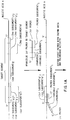
- Figures 1A, 1B and 1C illustrate a method according to the invention for amplifying a target segment of a nucleic acid (Nucleic Acid A), which is a DNA or RNA, wherein many copies of a first RNA (RNA I) with a segment with a sequence complementary to that of target segment are made.
- Nucleic Acid A which is a DNA or RNA
- RNA I first RNA
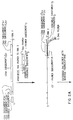
- Figures 2A, 2B, 2C illustrate the further amplification according to the invention of a segment of an RNA I, made as illustrated in Figures 1A, 1B and 1C, to make many copies of a second RNA (RNA II) with a segment with a sequence the same as that of a subsegment of the target segment, which was amplified to make the RNA I.
- RNA II second RNA
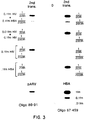
- Figure 3 depicts autoradiograms showing various concentrations of HIV RNA amplified by TAS simultaneously with a fixed concentration of human ⁇ -globin nucleic acid.
- Figure 4 displays a general strategy whereby RNA produced through a DNA-dependent RNA polymerase yields an RNA molecule that can serve as a template for an RNA-dependent replicase.
- DNA probe or primer preparation including DNA synthesis
- hybridization methodology including variations in stringency conditions for producing more or less hybridization certainty depending upon the degree of homology of the primer to a target DNA sequence
- promoter is meant a nucleic acid sequence (naturally occurring or synthetically produced or a product of restriction digest) that is specifically recognized by an RNA polymerase that binds to a recognized sequence and initiates the process of transcription whereby an RNA transcript is produced. It may optionally contain nucleotide bases extending beyond the actual recognition site, thought to impart additional stability toward degradation processes.
- any promoter sequence may be employed for which there is a known and available polymerase that is capable of recognizing the initiation sequence. Typical, known and useful promoters are those that are recognized by certain bacteriophage polymerase such as bacteriophage T3, T7 or SP6. See Siebenlist et al. , Cell 20 , 269 (1980). These are but examples of those polymerase which can be employed in the practice of the present invention in conjunction with their associated promoter sequences.
- RNA transcript hereof is the ribonucleic acid sequence produced after transcription initiation following RNA polymerase recognition of the promoter sequence (See supra ). The production of such transcripts is more or less continuous, dependent in part on the amount of polymerase present.
- primer in the present context is meant a nucleic acid sequence (naturally occurring or synthetically produced or a product of restriction digest) that has sufficient homology with the target sequence such that under suitable hybridization conditions it is capable of hybridizing, that is binding to, the target sequence.
- a typical primer is at least about 10 nucleotides in length, and most preferably is of approximately 35 or more nucleotide bases in length, and in its most preferred embodiments, it shares identity or very high homology with the target sequence. See, for example, EPA 128042 (publd. 12 Dec 84).
- operably linked in particular in connection with the linkage of a promoter sequence within a primer sequence, refers to the functionality of the ultimate "double-stranded nucleic acid template" of the present invention such that it, the template, is capable of producing corresponding RNA transcripts when the promoter is recognized by the suitable polymerase--see supra.
- the primer extension reaction to produce a duplex is known per se . See references supra.
- Polymerase useful for this purpose include E. coli DNA polymerase I, Klenow fragment of E. coli DNA polymerase I, T4 DNA polymerase, reverse transcriptase, and so forth.
- replicases for (autocatalytic) induction of replication of the RNA transcripts of the present invention are generally known in the art.
- Suitable examples of such replicases that are useful in the present invention include the so-called Q ⁇ virus replicase that recognizes certain nucleic acid sequence sites at both the 3'- and 5'- ends of the given RNA transcript and the so-called brome mosaic virus (BMV) as well as the alpha virus replicases which are thought to recognize nucleic acid sequence sites at the 3' ⁇ end of a given RNA transcript.
- BMV brome mosaic virus
- These replicases serve to replicate, that is reproduce, the RNA transcripts and complements so as to multiply copies thereof.
- the multiple transcripts that are produced during transcription can themselves undergo replication so as to exponentially increase the amount of RNA transcript product.
- Internal standardization is defined as a process which is used to: a) insure that the TAS amplification process has not failed because of a procedural error, and b) measure the levels of target nucleic acid relative to a predetermined quantity of nucleic acid which is always associated with the sample of interest.
- Such internal standardization occurs by coamplifying a portion of the target sequence, as well as an endogenous sequence, in the same reaction. For example, by knowing the cell count present within the biological sample, a single-copy gene (e.g. , ⁇ -globin) could be used as an internal standard and, since it is not expressed in the form of RNA, its initial copy number is equal to two times the total number of cells in the sample.
- the ratios of the amplified signals can be compared to quantitate the levels of target sequence of interest. Since every cell has two copies (in diploid cells) of this internal standard, irrespective of whether the biological sample contains separate target sequences (e.g. , HIV), each sample is expected to produce a positive amplification signal resulting from the internal standard. See Groudine et al. , Nucleic Acids Research 12 , 1427 (1984) and McKnight, Cell 31 , 355 (1982). See also British Patent Application Publn. No. 2187283 A (publd. 3 Sept. 87).
- the invention is a method for amplifying a target nucleic acid segment of Formula I 3'-(first subsegment) t -(second subsegment) t -(third subsegment) t -5' I wherein (first subsegment) t is a nucleic acid segment of known sequence of at least 10 nucleotides adjoining the 3'-terminus of (second subsegment) t , (second subsegment) t is a nucleic acid segment of 0 or more nucleotides, and (third subsegment) t is a nucleic acid segment of known sequence of at least 10 nucleotides adjoining the 5'-terminus of (second subsegment) t , which method comprises:
- kits for carrying out the amplification methods of the invention In the case of the method of the invention which entails making a first RNA product, a kit of the invention would comprise the two primers, the corresponding bacteriophage DNA-dependent RNA polymerase, and the DNA polymerase.
- a kit for carrying out a method in accordance with the invention which entails making both a first and a second RNA product would comprise four suitable primers (two sets of two) with the corresponding necessary polymerases.
- Methods and kits according to the invention for carrying out nucleic acid hybridization probe assays which entail amplifying a target segment in accordance with the invention entail, in addition to the steps and components, respectively, of the methods and kits for amplification, steps and components necessary for detecting the RNA product resulting from amplification according to the invention.
- (3'-primer subsegment)1, (5'-primer subsegment)2, (3'-primer subsegment)3, and (5'-primer subsegment)4 have between 20 and 40 nucleotides, and more preferably about 30 nucleotides to enhance the specificity with which the various primers bind to the ends of the target segments which are sought to be amplified.
- the target segment of a nucleic acid of interest which is selected for amplification be selected so that (second subsegment) t r have at least 30, and more preferably at least about 50, nucleotides.
- bacteriophage DNA-dependent RNA polymerase can use templates longer than 1000 bp, their efficiency of transcription decreases as the template becomes longer. Thus, target segments less than 1000 bases long are favored.
- RNA it is preferred to use the identical set of primers used in the synthesis of RNA, to produce RNA in a second cycle of TAS.
- the primer pair should not overlap.
- the subsegment of target segment with sequence complementary to that of (5'-primer subsegment)4 be in the 5'-direction from and not overlap the subsegment of target segment with sequence complementary to that of (3'-primer subsegment)1.
- the subsegment of target segment with sequence the same as that of (3'-primer subsegment)3 be in the 3'-direction from and not overlap the subsegment of target segment with sequence the same as that of (5'-primer subsegment)2.
- This strategy may be preferred because it reduces the competition of the different primers for the same sites and, thereby, may markedly enhances the efficiency of amplification according to the invention.
- the focus of the present invention is on bacteriophage DNA-dependent RNA polymerase because of their high specificity for certain promoters.
- Other polymerase which have similarly high specificity for particular promoters could be employed in accordance with the invention in place of the bacteriophage polymerase and the invention is intended to cover such other polymerase as well.
- the preferred of the bacteriophage DNA-dependent RNA polymerase are those from T7, T3 and SP6.
- Preferred promoters for use with these polymerase are described in the examples and claims, but numerous other promoters for these polymerase are known in the art and can be employed as well.
- polymerase from bacteriophages other than the preferred three, and promoters recognized by such other polymerase, can be employed in accordance with the invention.
- DNA polymerase it is preferred to employ for DNA polymerase in the methods of the invention reverse transcriptases and DNA polymerase which lack 5' to 3' exonuclease activity. It is most preferred that a single DNA polymerase be used for all steps in the methods. Most preferred of the DNA polymerase are the AMV reverse transcriptase and recombinant MMLV reverse transcriptase. Other polymerase are acceptable however, such as the heat-stable DNA polymerase from Thermus aquaticus (see Chien et al . J. Bacteriol. 127 , 1550 (1976)), SequenaseTM brand recombinant T7 DNA polymerase from the U. S. Biochemicals Corp., Cleveland, Ohio, U.S.A., and the well known Klenow Fragment of E. coli DNA polymerase I, and calf thymus DNA polymerase alpha.
- variable subsegments that are optionally included in the various primers serve three functions. In fact, they might be more aptly termed “multipurpose subsegments.”
- the promoter subsegments preferably include transcription initiation sequences that are preferred by the RNA polymerase corresponding to the promoter.
- a variable subsegment can optionally contain a particular segment whereby RNA product from the amplification can be detected in a nucleic acid probe hybridization assay.
- variable subsegment can also contain a polylinker sequence that conveniently contains a plurality of restriction sites for ease of cloning subsequently.
- variable subsegments can be used to incorporate into the RNA product from amplification sequences necessary to allow the RNA product to be (autocatalytically) replicated by a bacteriophage RNA-specific RNA polymerase, such as the Q ⁇ replicase, see Miele et al ., supra , and BMV sequences from the RNA-3 chromosome of the plant virus that promotes the synthesis of coat mRNA.
- a bacteriophage RNA-specific RNA polymerase such as the Q ⁇ replicase, see Miele et al ., supra
- BMV sequences from the RNA-3 chromosome of the plant virus that promotes the synthesis of coat mRNA.
- RNA product i.e., RNA.
- RNA II in Figure 1; see also Figure 4
- RNA II in Figure 1; see also Figure 4
- RNA II in Figure 1; see also Figure 4
- BMV replicase use also known, this is preferably carried out by including the following sequence for BMV in variable sequence 2 (bases 1-25) (in the specific use of the HIV example infra ): as a core sequence, additionally AU rich sequence 5'-thereof may be used to enhance the replicase activity from BMV.
- This oligo is to be used as the second primer.
- the first primer used with this second primer is a T7-based, HIV-specific primer.
- 10ml of blood from a patient suspected of being infected with a human immunodeficiency virus-type 1 is fractionated with a SepracellTM apparatus (Sepratech Corp., Oklahoma City, Oklahoma, U.S.A.) or, alternatively, with a Ficoll gradient, to isolate lymphocytes.
- the lymphocytes are then lysed and nucleic acid from them is isolated with an extractor apparatus (Molecular Biosystems, Inc., San Diego, California, U.S.A.) or, alternatively, the lymphocytes are lysed by standard sodium dodecyl sulfate (SDS)-enzyme treatment and the nucleic acid isolated with reverse phase chromatography over DEAE cellulose.
- SDS sodium dodecyl sulfate
- total nucleic acid from the sample is dissolved in 100 ⁇ l of TE buffer (10mM Tris.Cl, 1mM EDTA, pH8). 10 ⁇ l of the 100 ⁇ l of total nucleic acid is dissolved to a final volume of 100 ⁇ l containing: 40mM Tris.Cl, pH8 25mM NaCl 10mM MgCl2 10mM dithiolthreitol (DTT) 2mM spermidine 100 ⁇ g/ml bovine serum albumin 400mM each of dATP, dCTP, dGTP and TTP 30nM of the 101 base single-stranded DNA of sequence is added.
- TE buffer 10mM Tris.Cl, 1mM EDTA, pH8
- DTT dithiolthreitol
- Primer B which is the second primer, has the sequence of bases 5151-5179 in the SOR gene of the HIV-1.
- Primer A is the first primer; its 64 5'-nucleotides form the plus-strand of a promoter for the SP6 DNA-dependent RNA polymerase.
- oligonucleotides employed in these examples are made by solid-phase synthesis on an Applied Biosystems, Inc. (Foster City, California, U.S.A.) automated synthesizer (Model No. 380A) and are purified chromatographically essentially to homogeneity by HPLC using a C8 reverse phase column.
- Applied Biosystems, Inc. Fluorescence-Activated C12
- U.S.A. Automatesizer
- the 100 ⁇ l of solution is heated at 65°C for 2 minutes and is then cooled to 42°C over the course of 1 minute. This heating and then holding at 42°C or above, in combination with the composition of the solution, provides conditions of stringency sufficient to provide hybridization of (3'-primer subsequent)1, with sufficient stability to prime DNA synthesis, of high specificity to the sequence complementary to that of (3'-primer subsequent)1.
- avian myoblastosis virus (AMV) reverse transcriptase or 500 units of recombinant Moloney murine leukemia virus (MMLV) reverse transcriptase are added to the solution and the solution is incubated for 10 minutes at 42°C.
- AMV avian myoblastosis virus
- MMLV Moloney murine leukemia virus
- One unit incorporates 1nmole of TTP into acid-precipitable form in 10 minutes at 37°C using poly(A).oligo(T)12 ⁇ 18 as template-primer as defined by Houts et al., J. Virol. 29 , 517 (1979)).
- the solution is placed in a boiling water bath for 1 minute. This heating causes strand-separation of the duplex formed by the reverse transcriptase.
- the solution is cooled to 42°C over 1 minute.
- the second primer hybridizes to the 3'-terminal segment of the complement of target segment formed in the reaction catalyzed by the reverse transcriptase.
- the hybridization conditions are sufficiently stringent for sufficiently specific hybridization between the second primer and sequence complementary to that of second primer.
- RNasin R brand ribonuclease inhibitor from Promega Biotec, Madison, Wisconsin, U.S.A. is added (optionally) to a concentration of 1 unit per ml. (1 unit is the amount of inhibitor required to inhibit by 50% the activity of 5ng of ribonuclease A. Roth, Meth. Cancer Res. 3 , 151 (1976)).
- each of the ribonucleoside 5'-triphosphates, ATP, GTP, CTP and UTP is added to 400mM.
- SP6 DNA-dependent RNA polymerase purchased from Promega Biotec, are added and the resulting solution is incubated at 42°C for 30 to 60 minutes.
- RNA polymerase (1 unit is the amount of the RNA polymerase required to catalyze the incorporation of 1 nmole of ribonucleoside triphosphate into acid insoluble product in 60 minutes at 37°C under standard reaction conditions (40mM Tris.Cl, pH 7.9, 6mM MgCl2, 10mM DTT, 2mM spermidine, 0.5 mM of each of ATP, GTP, CTP and UTP, 0.5Ci of 3H-CTP, 1g of SP6 DNA and the enzyme in a total volume of 50 ⁇ l.))
- fourth primer 5'-TTTTTTGGTG TTATTAATGC TGCTAGTGCC-3'
- the 5'-terminal 64 bases are the promoter segment and the next 6 bases are the variable segment.
- the variable segment is the first six bases transcribed from the promoter by the SP6 RNA polymerase, and these bases are selected to enhance the level of such transcription.
- the (3'-primer subsegment)3 portion of the third primer is the 3'-terminal 33 bases, in the same sequence as bases 5388-5420 in the short open reading frame (SOR) gene of the HIV-1.
- the fourth primer has the sequence complementary to that of bases 5546-5517 of the SOR gene of the HIV-1.
- the solution is incubated at 42°C for 1 minute. During this period, hybridization occurs between (3'-primer subsegment)3 of third primer and the first RNA formed in the reaction catalyzed by the SP6 RNA polymerase. Because of the stringency of the hyhridization conditions, the (3'-primer subsegment)3 hybridizes, with stability sufficient for priming of DNA synthesis, with high specificity to the segment of complementary sequence in the first RNA.
- the solution is then suspended in a boiling water bath for 1 minute and cooled to 42°C over 1 minute to, first, render single-stranded the duplex between third complementary DNA and first RNA and, second, allow hybridization between fourth primer and third complementary DNA.
- the conditions are sufficiently stringent that hybridization of fourth primer, with stability sufficient to prime DNA synthesis, occurs with high specificity to the segment of third complementary DNA of sequence complementary to that of fourth primer.
- RNasin R brand ribonuclease inhibitor is added (optionally) to 1 unit per ml, followed by 10-20 units of SP6 RNA polymerase, and the solution is incubated for 30 minutes to 1 hour at 42°C.
- the resulting second RNA can then be detected by a nucleic acid probe hybridization technique.
- Example I The procedure of Example I is followed, with a modification noted below, with three samples: (A) one of 10ml of human blood known to be free of HIV, (B) one of 10ml of culture known to have about 103 HIV-1 infected cells per ml, and (C) one of 10ml of blood from a person suspected of being infected with an HIV-1.
- the modification of the procedure is that an alpha-32 P -labeled ribonucleoside triphosphate is included as a substrate in the reaction catalyzed by the SP6 RNA polymerase to make the second RNA.
- the second RNA is, consequently, 32P-labeled.
- the support materials are porous silicate glass or macroporous cross-linked dextran, derivatized with an amino-terminated linker, with substantially all of the amino groups that are not covalently joined through a phosphoramidate group to the terminal nucleoside of the capture probe being blocked from interacting non-specifically with nucleic acid having an aliphatic acyl group; macroporous cross-linked dextran activated with cyanogen bromide, which reacts with amines to link to aminoalkylphosphoramidate derivatized oligonucleotides; and porous silicate glass, macroporous cross-linked dextran or divinylbenzene-crosslinked polystyrene derivatized with a carboxyl-terminated or succinimide-ester-terminated linker, with a fraction of the carboxyl groups joined in an amide linkage to one amino group of a diaminoalkan
- Preferred support materials are long chain alkylamine-derivatized and carboxyl-derivatized controlled pore glass as sold by Pierce Chemical Co., Rockford, Illinois, USA, under product numbers 24875 and 23735, respectively, in the form of beads with nominal pore diameter of 500 Angstroms and particle diameters between about 125 and 177 microns, and Sephacryl S-500, sold by Pharmacia Inc., Piscataway, New Jersey, USA under Code No.
- the solid support is one of:
- Each of three batches of 50mg of Sephacryl beads, derivatized as described above, is soaked for 15 minutes at 37°C C in 250 ⁇ l of a prehybridization solution containing 0.1% SDS, 10% dextran sulfate, 1mg/ml salmon sperm DNA, and 5x SSPE (0.75M NaCl, 50mM NaH2PO4, pH 7.4, and 5mM EDTA). After the soaking, the bead material is pelleted by centrifugation and prehybridization solution is removed by aspiration.
- a prehybridization solution containing 0.1% SDS, 10% dextran sulfate, 1mg/ml salmon sperm DNA, and 5x SSPE (0.75M NaCl, 50mM NaH2PO4, pH 7.4, and 5mM EDTA).
- nucleic acid from the amplification procedure on each of the three samples is isolated by ethanol precipitation and is then dissolved to 250 ⁇ l in solution that is the same as pre-hybridization solution but lacks the salmon sperm DNA.
- Each of the resulting nucleic acid solutions is then combined with one batch of prehybridized oligonucleotide-derivatized Sephacryl beads and the resulting mixture is incubated with gentle agitation at 42°C C for 90 minutes.
- the Sephacryl beads are then pelleted by centrifugation, hybridization solution is removed by aspiration, and the beads are then washed three times, 10 minutes each at 37°C C, in 1ml of a solution of 2 x SSC (0.30M NaCl, 0.03M Na.Citrate, pH 7.0). After each wash, the beads are pelleted by centrifugation and solution is removed by aspiration.
- the beads are subjected to Cerenkov counting.
- the beads with amplified nucleic acid from sample A produce a low level of counts, barely above background counts from scintillation fluid alone.
- the beads with amplified nucleic acid from sample B produce counts at a much higher level than that observed with beads associated with sample A.
- the beads with amplified nucleic acid from sample C if they produce a level of counts significantly above the level produced with beads associated with sample A, indicate that the person, whose blood was taken for sample C, is infected with HIV-1.
- Example I and II The procedures of Examples I and II are carried out with T7 RNA polymerase (Promega Biotec) in place of SP6 RNA polymerase, with each of the subsegment 5'-(promoter)1-(variable subsegment)1-3' of first primer and the subsegment 5'-(promoter)3-(variable subsegment)3-3' of third primer having the sequence 5'-TAATACGACT CACTATA GGGA-3', wherein the 17 5'-terminal bases are the promoter subsegment and the 4 3'-bases are the variable subsegment.
- the variable segment corresponds to the 4 5'-terminal bases of the transcript from the promoter.
- Ribonuclease inhibitor is not used in any step in this process, at least with the polymerase preparation from Promega Biotec.
- Examples I and II are carried out with T3 RNA polymerase (from Stratagene, San Diego, California) in place of the SP6 RNA polymerase and with the following segment used as the (promoter)1-(variable subsegment)1 subsegment of first primer and the (promoter)3-(variable subsegment)3 subsegment of third primer: 5'-TATTAACCCT CACTAAA GGGA-3', where the 17 5'-terminal bases are the promoter segment and the 4 3'-terminal bases the variable segment, including the 5'-terminal 4 bases in transcripts from the promoter.
- T3 RNA polymerase from Stratagene, San Diego, California
- target segment in the genome of HIV from human blood samples is amplified using the following primers in place of the primers specified in Example I: wherein the 30 3'-terminal bases are complementary in sequence to bases 7076-7047 of the ENV gene of HIV-1.
- Second Primer 5'-ACAAGTTGTA ACACCTCAGT CATTACACAG-3' with the sequence of bases 6838-6866 in the ENV gene of HIV-1.
- target segment in the genome of HIV from human blood samples is amplified using the following primers in place of the primers specified in Example I: First Primer: Same 21 5'-terminal nucleotides as the first and third primers of Example V adjoined to the following 31 3'-terminal nucleotides: 5'-CACCTAGGGC TAACTATGTG TCCTAATAAG G-3', which have the sequence complementary to that of bases 5471-5441 of the SOR gene of HIV-1.
- Second Primer 5'-ACACCATATG TATGTTTCAG GGAAAGCTA-3', which has the same sequence as bases 5151-5179 of the SOR gene of HIV-1.
- Example I The procedure of Example I is followed for the isolation of nucleic acid from: 1) one sample containing 103 HIV-infected CEM cells mixed with 106 uninfected CEM cells (Cancer Center Research Foundation; CCRF-CEM; ATCC No. CCL 119); and 2) one sample containing 106 uninfected CEM cells. These samples are resuspended in 100 ⁇ l 10 mM Tris-HCl, pH 7.4, 1 mM EDTA (TE) after the ethanol precipitation step to concentrate the sample obtained from the ExtractorTM column (MBI). The resuspended samples are fractionated on a Sephadex G-50 fine spin column (Maniatis supra ) eluting with TE.
- the eluted samples are concentrated by ethanol precipitation (in 0.8 M LiCl, 3 volumes ethanol, in dry ice/ethanol bath for 15 minutes).
- the precipitated sample is pelleted by centrifugation.
- the pellet is drained, dried, and then resuspended in 100 ⁇ l containing 40 mM Tris-HCl, pH 8.1, 8 mM MgCl2, 25 mM NaCl, 2 mM spermidine, 5 mM dithiothreitol, 100 ⁇ M each dATP, dGTP, dCTP, and dTTP, 1 mM each rATP, rCTP, rGTP, and rUTP, 100 ⁇ g/ml BSA (nuclease-free) and 250 nM each of DNA oligonucleotide
- Oligonucleotide primer D (5'-ACATTGCTTCTGACACAACTGTGTTCA-') and primer C (5'-TAATACGACTCACTATAGGGACAAAGGACTCAAA-3'), which are specific for ⁇ -globin sequence, were added to the ⁇ -globin reaction at 250 nM each.
- the reactions are heated to 65°C for 1'.
- the ⁇ -globin sample is boiled for 1'. All samples are cooled to 42°C for 1 minute; then, 10 units of AMV reverse transcriptase are added.
- the reactions are incubated for 15 minutes at 42°C, boiled for 1 minute, and then cooled at 42°C for 1 minute.
- Ten additional units of AMV reverse transcriptase are added, incubating at 42°C for 15 minutes.
- One hundred units of T7 RNA polymerase are added to the reactions, and the reactions are incubated at 37°C for 30 minutes.
- the samples are boiled for 1 minute and cooled at 42°C for 1 minute, followed by the addition of 10 units AMV reverse transcriptase.
- the reactions are incubated at 42°C for 15 minutes, boiled for 1 minute and cooled to 42°C for 1 minute.
- An additional 10 units of reverse transcriptase are added, followed by incubation at 42°C for 15 minutes.
- One hundred units of T7 RNA polymerase are added, with a 30-minute incubation at 37°C. This cycle is repeated two additional times.
- the amplified target is then detected using OligoBeadsTM as described below.
- Sephacryl beads containing HIV-1-specific oligonucleotides were prepared as described and stored in TE at 4°C at a concentration such that 250 ⁇ l of the suspension contains 50mg of Sephacryl beads. Oligonucleotides were synthesized and HPLC purified as described.
- the oligonucleotides employed for both attachment to the beads and detection are homologous to the SOR region of the HIV-1 genome.
- the oligonucleotides used in these studies were 86-31 (detection oligo nucleotide) (5'-GCACACAAGTAGACCCTGAACTAGCAGACCA-3') and 87-83 (capture oligo nucleotide on the bead: 5'-ATGCTAGATTGGTAATAACAACATATT-3'), which are homologous to the nonsense strand of the SOR region, and separated by approximately 100 nucleotides.
- the oligonucleotides were end labeled with 32-P according to a standard protocol. The unincorporated label was removed by gel filtration on a Sephadex G-50 fine column, and the oligonucleotide was stored at -20°C.
- BSSHS sandwich hybridization system
- the target and 32P-labeled detection oligonucleotide are denatured in 10 ⁇ l of TE containing 0.2% SDS at 65°C for 5 minutes in an Eppendorf tube.
- 10 ⁇ l of 2X Solution Hybridization Mix (10X SSPE/10% Dextran Sulfate) are added. The solution is mixed, centrifuged 2 seconds, and incubated at 42°C for 1 hour.
- the Sephacryl beads are prehybridized.
- the stock suspension of beads is mixed well, and 250 ⁇ l aliquots (50 mg of beads) are transferred to Eppendorf tubes with mixing between each removal to ensure a uniform suspension.
- the aliquots are centrifuged for 10 seconds, and the TE is removed with a drawn-out Pasteur pipet.
- 250 ⁇ l of Hybridization Solution (5X SSPE [0.9M NaCl, 50 mM NaH2PO4, pH 7.4, 1mM EDTA] 10% Dextran Sulfate/0.1% SDS) is added, the beads are suspended by gentle shaking and incubated 37°C for 30-60 minutes with occasional mixing.
- the beads are centrifuged for 10 seconds, the prehybridization solution is removed, 80 ⁇ l of Hybridization Solution at 37°C are added, and the beads are returned to 37°C.
- the solution hybridization is centrifuged for 2 seconds and transferred to the beads and Hybridization Solution.
- the beads are suspended and incubated at 37°C for 1 hour with frequent mixing to maintain the suspension.
- the beads are centrifuged 10 seconds and the Hybridization Solution, containing uncaptured target and detection oligonucleotide, is transferred to a scintillation counter vial.
- the beads are then washed 5 times with 2X SSC at 37°C. The first 3 washes are rapid; 1 ml of wash is added, the beads are mixed well and centrifuged 10 seconds, and the wash is transferred to a counting vial. For the final 2 washes, 1 ml of wash is added and the beads are mixed and incubated at 37°C for 5 minutes before being centrifuged. Each wash is counted separately to monitor the procedure.
- Example I The procedure of Example I is followed for isolation of nucleic acids from two samples: a) 103 HIV-infected CEM cells with 106 uninfected CEM cells; and b) 106 uninfected cultured CEM cells to which 0.01 fmoles of purified HIV are added after extraction.
- the procedure is then modified by further purification through a Sephadex G-50 (fine) spin column (Maniatis supra ) eluting with TE after the Extractor column step. This is followed by an ethanol precipitation of the nucleic acid (in 0.8 M LiCl and 2.5 volume of EtOH).
- the nucleic acid is then resuspended in 100 ⁇ l containing: 40 mM Tris-HCl, pH 8.1 8 mM MgCl2 25 mM NaCl 2 mM spermidine 5 mM DTT (dithiothreitol) 100 ⁇ M dATP, dTTP, dCTP, dGTP (each) 1 mM rATP, rCTP, rGTP, rUTP 100 ⁇ g/ml BSA nuclease-free 250 nM 29 bp DNA oligonucleotide with the sequence 5'ACACCATATGTATGTTTGAGGGAAAGCTA-3' (Primer B) 250 nM 56 bp DNA oligonucleotide with the sequence
- the 100 ⁇ l of solution are heated to 65°C for 1 minute and cooled to 42°C over the course of 1 minute.
- This heating and then holding at 42°C or above, in combination with the composition of the solution provides conditions of stringency sufficient for hybridization of (3'-primer subsegment)1, (see Figure 1) with sufficient stability to the sequence complementary to that of (3'-primer subsegment)1, in the target HIV RNA with high specificity.
- avian myoblastosis virus (AMV) reverse transcriptase Life Sciences, Inc.
- AMV avian myoblastosis virus
- 10 units of avian myoblastosis virus (AMV) reverse transcriptase Life Sciences, Inc.
- AMV avian myoblastosis virus
- One unit incorporates 1 nmole of TTP into acid-precipitable form in 10 minutes at 37°C using poly(A)-oligo (T)12-18 as template-primer, as defined by Houts et al. J. Virol. 29 , 517, (1979)].
- the solution is placed in a boiling water bath for one minute. This heating causes strand separation of the duplex formed by reverse transcriptase and inactivation of the reverse transcriptase.
- the solution is cooled to 42°C over one minute.
- the second primer, primer B hybridizes to the 3'-terminal end (third subsegment) t2c , see Figure 1, of the target complement of DNA strand formed in the reaction catalyzed by the reverse transcriptase in the previous step.
- the hybridization conditions are sufficiently stringent for specific hybridization between the second primer and the sequence complementary to that of the second primer.
- RNA transcript is synthesized which is complementary to the original target HIV RNA starting from the T7 promoter present at the 5' end of the duplex DNA template newly synthesized by the reverse transcriptase.
- the transcript has the sequence 5'-GGGA, then continues with sequence which is complementary to the second subsegment of the target sequence (i.e. , second subsegment tcr , see Figure 1). Since the reverse transcriptase has not been inactivated prior to this step, and since primer B is present, as well as the deoxynucleotide triphosphates, a secondary synthesis occurs at this stage.
- Primer B hybridizes to the 3' region of the newly synthesized RNA transcript (third subsegment) t2cr , see Figure 1, which is complementary to B primer.
- the reverse transcriptase (which had been added at the previous step) synthesizes a DNA strand using the newly synthesized RNA transcript (made by T7 polymerase) as a template, and using oligonucleotide B as the primer at the 5' end.
- the reaction is then boiled for one minute to denature the RNA:DNA duplex.
- the reaction is then cooled to 42°C over one minute.
- the target complementary segment of primer A hybridizes to the DNA strand synthesized during the previous step.
- primer B hybridizes to its complementary sequence on the RNA transcript synthesized in the previous step.
- Reverse transcriptase synthesizes DNA complementary to the HIV target using oligonucleotide A as a primer at the 5' end and DNA made in the previous step as a template.
- a second DNA strand is synthesized using oligonucleotide B as a primer and the RNA transcript made in the previous step as a template.
- the reaction is boiled for one minute to denature the DNA duplex and the RNA:DNA duplex.
- the reaction is cooled to 42°C over one minute.
- Primer A hybridizes to the cDNA made using the RNA transcript as template in the previous step. (If the 3' end of the template strand is used as a reverse transcriptase primer also, a product identical to the end product of the next reaction is produced.)
- Primer B hybridizes to the DNA strand which is complementary to the target HIV RNA. This second synthesis produces a product which is a duplex DNA containing a T7 promoter sequence at its 5' end, as well as a 4 bp "variable" segment, 5'-GGGA-3'.
- T7 polymerase One hundred units of T7 polymerase are added to the reaction. The reaction is incubated for 30 minutes at 37°C.
- the T7 RNA polymerase uses the double-stranded duplex DNA containing a duplex T7 promoter as a template to transcribe an RNA which is complementary to the target second subsegment containing the additional sequence 5'-GGGA-3' at its 5' end.
- This cycle (boil 1', 1' at 42°C, RT 10' at 42°C, RT 10'at 42°C, T7 polymerase 37°C 30') can be repeated as many times as needed to achieve the desired amplification of target sequence.
- the resulting product can then be detected by a nucleic acid probe hybridization technique.
- This heating and cooling step in combination with the composition of the solution, provides conditions of stringency sufficient for the hybridization of primer A with sufficient stability to the sequence complementary to that of the primer A region in the target HIV RNA [(first subseqment) t2 , in Figure 1] with high specificity.
- avian myoblastosis virus (AMV) reverse transcriptase (Life Science, Inc.) are added to the solution, and the solution is incubated for 10 minutes at 42°C. After a ten-minute incubation, the solution is placed in a boiling water bath for one minute. This heating causes strand separation of the duplex formed by reverse transcriptase and inactivation of the reverse transcriptase.
- AMV avian myoblastosis virus
- the solution is cooled to 42°C over one minute.
- the second primer B hybridizes to the 3' end of the newly synthesized target-complementary strand [or (third subseqment) t2c in Figure 1].
- the hybridization conditions are sufficiently stringent for specific hybridization between the second primer and the sequence complementary to that of the second primer.
- RNA transcript is synthesized which is complementary to the original target HIV RNA starting from the T7 promoter present at the 5' end of the duplex DNA template synthesized by the reverse transcriptase.
- the RNA transcript has the sequence 5'-GGGA, then continues with the sequence which is complementary to the second subsegment of the target sequence ( i.e. , second subsegment tcr , Figure 1).
- RNA transcriptase Since the reverse transcriptase has not been inactivated prior to this step, and since primer B is present as well as the deoxynucleotide triphosphates, a secondary synthesis occurs at this stage.
- Primer B hybridizes to the 3' region of the newly synthesized RNA transcript [(third subsegment) t2cr , see Figure 1] which is complementary to primer B.
- the reverse transcriptase (which had been added at the previous step) synthesizes a DNA strand using the newly synthesized RNA transcript (made by the T7 RNA polymerase) as a template, and oligonucleotide B as a primer at the 5' end.
- the reaction is then boiled for one minute to denature the RNA:DNA duplex.
- the reaction is then cooled to 42°C over one minute.
- the target-complementary segment of primer A hybridizes to the DNA strand synthesized in the previous step.
- primer B hybridizes to its complementary sequence on the RNA transcript synthesized in the previous step.
- Reverse transcriptase synthesizes DNA complementary to the HIV target using oligonucleotide A as a primer at the 5' end and DNA made in the previous step as a template. The 3' end of the template strand is used as a primer to produce a final duplex DNA with a double-stranded, T7 promoter site at its 5' end.
- a second DNA strand is synthesized using oligonucleotide B as a primer and the RNA transcript made in the previous step as a template.
- T7 polymerase One hundred units of T7 polymerase are added to the reaction. The reaction is incubated for 30 minutes at 37°C.
- the T7 RNA polymerase synthesizes an RNA transcript using the duplex DNA containing the polymerase binding site (T7 promoter) at its 5' end as a template.
- the RNA transcript is complementary to the target second subsegment, see Figure 1, containing the additional sequence 5'-GGGA-3' at its 5' end. Further cycles may be performed to increase the amplification.
- the resulting products can be detected by a nucleic acid hybridization protocol.
- Samples were prepared having: 1) 0.1 fm HIV RNA and 0.1 fm ⁇ -globin DNA sequences (H ⁇ 19A cleaved with Pst I); 2) 0.01 fm HIV RNA and 0.1 fm ⁇ -globin DNA (H ⁇ 19A cleaved with Pst I); 3) 0.1 fm HIV RNA; or 4) 0.1 fm ⁇ -globin DNA (H ⁇ 19A cleaved with Pst I in 100 ⁇ l containing 40 mM Tris-HCl, pH 8.1, 8 mM MgCl2, 25 mM NaCl, 2 mM spermidine-(HCl)3, 5 mM dithiothreitol, 100 ⁇ l each dATP, dTTP, dCTP and dGTP, 1 mM each rATP, rUTP, rCTP, and rGTP, 100 ⁇ g/ml BSA (nuclease-free
- the samples were boiled for 1 minute and cooled at 42°C for 1 minute, followed by the addition of 10 units of AMV reverse transcriptase.
- the reactions are incubated at 42°C for 15 minutes, boiled for 1 minute, and cooled at 42°C for 1 minute.
- An additional 10 units of AMV reverse transcriptase are added, followed by incubation at 42°C for 15 minutes.
- One hundred units of T7 RNA polymerase are added, followed by incubation at 37°C for 30 minutes. This cycle is repeated a second time. (More cycles can be done, depending on the amplification needed.)
- Two samples containing 1/20th the starting target nucleic acids were placed into denaturing solution for the second transcription time-point samples.
- One membrane was hybridized with 32p-labeled oligonucleotide 86-311, which is specific for the amplified product of HIV.
- the other membrane was hybridized to 32p-labeled oligonucleotide 87-4592, which will hybridize to the amplified ⁇ -globin product, as well as to the target ⁇ -globin plasmid.
- the hybridizations were in 1% SDS, 0.9 M NaCl, 50 nM NaH2PO4 (pH 7.4), 5 mM EDTA (pH 7.4), and 106 cpm/m. 32p-labeled oligonucleotide for 1 hour at 55°C.
- the membranes were washed 3 times in 1% SDS, 0.18 M NaCl, 10 mM NaH2PO4 (pH 7.4), and 1 mM EDTA at room temperature, followed by 1 wash in the same buffer at 55°C.
- the membranes were then autoradiographed for 16 hours on Kodak XAR film at -70°C with one intensifying screen.
Landscapes
- Chemical & Material Sciences (AREA)
- Life Sciences & Earth Sciences (AREA)
- Health & Medical Sciences (AREA)
- Organic Chemistry (AREA)
- Engineering & Computer Science (AREA)
- Zoology (AREA)
- Wood Science & Technology (AREA)
- Genetics & Genomics (AREA)
- Proteomics, Peptides & Aminoacids (AREA)
- Bioinformatics & Cheminformatics (AREA)
- General Engineering & Computer Science (AREA)
- Biotechnology (AREA)
- Molecular Biology (AREA)
- Physics & Mathematics (AREA)
- Biochemistry (AREA)
- Microbiology (AREA)
- General Health & Medical Sciences (AREA)
- Biophysics (AREA)
- Immunology (AREA)
- Analytical Chemistry (AREA)
- Biomedical Technology (AREA)
- Virology (AREA)
- Plant Pathology (AREA)
- Chemical Kinetics & Catalysis (AREA)
- Crystallography & Structural Chemistry (AREA)
- AIDS & HIV (AREA)
- Measuring Or Testing Involving Enzymes Or Micro-Organisms (AREA)
- Air Bags (AREA)
- Radar Systems Or Details Thereof (AREA)
- Indicating And Signalling Devices For Elevators (AREA)
Applications Claiming Priority (5)
| Application Number | Priority Date | Filing Date | Title |
|---|---|---|---|
| US64141 | 1979-08-06 | ||
| US6414187A | 1987-06-19 | 1987-06-19 | |
| US20297888A | 1988-06-06 | 1988-06-06 | |
| US202978 | 1988-06-06 | ||
| EP88906601A EP0368906B2 (fr) | 1987-06-19 | 1988-06-17 | Systemes d'amplification/detection d'acides nucleiques a base de transcription |
Related Parent Applications (2)
| Application Number | Title | Priority Date | Filing Date |
|---|---|---|---|
| EP88906601A Division EP0368906B2 (fr) | 1987-06-19 | 1988-06-17 | Systemes d'amplification/detection d'acides nucleiques a base de transcription |
| EP88906601.5 Division | 1988-06-17 |
Publications (2)
| Publication Number | Publication Date |
|---|---|
| EP0623683A1 true EP0623683A1 (fr) | 1994-11-09 |
| EP0623683B1 EP0623683B1 (fr) | 2000-09-27 |
Family
ID=26744190
Family Applications (2)
| Application Number | Title | Priority Date | Filing Date |
|---|---|---|---|
| EP94200266A Expired - Lifetime EP0623683B1 (fr) | 1987-06-19 | 1988-06-17 | Systèmes d'amplification/détection d'acides nucléiques à base de transcription |
| EP88906601A Expired - Lifetime EP0368906B2 (fr) | 1987-06-19 | 1988-06-17 | Systemes d'amplification/detection d'acides nucleiques a base de transcription |
Family Applications After (1)
| Application Number | Title | Priority Date | Filing Date |
|---|---|---|---|
| EP88906601A Expired - Lifetime EP0368906B2 (fr) | 1987-06-19 | 1988-06-17 | Systemes d'amplification/detection d'acides nucleiques a base de transcription |
Country Status (17)
| Country | Link |
|---|---|
| EP (2) | EP0623683B1 (fr) |
| JP (1) | JP2843586B2 (fr) |
| KR (1) | KR960014107B1 (fr) |
| AT (2) | ATE114335T1 (fr) |
| BR (1) | BR8807097A (fr) |
| DE (2) | DE3856428T2 (fr) |
| DK (1) | DK175614B1 (fr) |
| ES (1) | ES2009286A6 (fr) |
| FI (1) | FI93743C (fr) |
| GR (1) | GR880100396A (fr) |
| HU (1) | HU216317B (fr) |
| IE (1) | IE65089B1 (fr) |
| IL (1) | IL86724A (fr) |
| NO (1) | NO303068B1 (fr) |
| NZ (1) | NZ225077A (fr) |
| PT (1) | PT87769B (fr) |
| WO (1) | WO1988010315A1 (fr) |
Cited By (2)
| Publication number | Priority date | Publication date | Assignee | Title |
|---|---|---|---|---|
| US5981183A (en) * | 1993-12-01 | 1999-11-09 | Toyo Boseki Kabushiki Kaisha | Method for amplifying and detecting of target nucleic acid sequence using thermostable enzyme |
| EP1400598A1 (fr) * | 1997-01-24 | 2004-03-24 | Tosoh Corporation | Procédé de détermination de séquences d'acides nucléiques |
Families Citing this family (435)
| Publication number | Priority date | Publication date | Assignee | Title |
|---|---|---|---|---|
| US5356774A (en) * | 1986-04-16 | 1994-10-18 | The Trustees Of Columbia University In The City Of New York | Replicative RNA-based amplification/detection systems |
| CA1340843C (fr) * | 1987-07-31 | 1999-12-07 | J. Lawrence Burg | Amplification selective de sequences polynucleotidiques cibles |
| JP2846018B2 (ja) * | 1988-01-21 | 1999-01-13 | ジェネンテク,インコーポレイテッド | 核酸配列の増幅および検出 |
| EP0358737A4 (en) * | 1988-01-28 | 1992-04-08 | Mayo Foundation For Medical Education And Research | Genomic amplification with direct sequencing |
| CA1340807C (fr) * | 1988-02-24 | 1999-11-02 | Lawrence T. Malek | Procede d'amplification d'une sequence d'acide nucleique |
| US5130238A (en) * | 1988-06-24 | 1992-07-14 | Cangene Corporation | Enhanced nucleic acid amplification process |
| WO1990002819A1 (fr) * | 1988-09-08 | 1990-03-22 | The Salk Institute For Biological Studies | Systemes de detection bases sur l'amplification d'arn replicative |
| CA1339991C (fr) * | 1988-09-08 | 1998-08-11 | The Trustees Of Columbia University | Systeme d'amplification/detection a base d'arn susceptible de replication |
| CA2004574A1 (fr) * | 1988-12-05 | 1990-06-05 | Barbara C. Chu | Systeme d'amplification/detection d'un acide nucleique cible |
| WO1990006995A1 (fr) | 1988-12-16 | 1990-06-28 | Siska Diagnostics, Inc. | Systeme auto-entretenu de replication sequentielle |
| US5237016A (en) * | 1989-01-05 | 1993-08-17 | Siska Diagnostics, Inc. | End-attachment of oligonucleotides to polyacrylamide solid supports for capture and detection of nucleic acids |
| CA2046919A1 (fr) * | 1989-02-14 | 1990-08-15 | Mark P. Pasek | Paires d'amorces oligonucleotidiques pour l'amplification d'un gene de sequence inconnue |
| IE66597B1 (en) * | 1989-05-10 | 1996-01-24 | Akzo Nv | Method for the synthesis of ribonucleic acid (RNA) |
| US5112734A (en) | 1989-05-26 | 1992-05-12 | Gene-Trak Systems | Target-dependent synthesis of an artificial gene for the synthesis of a replicatable rna |
| US5683896A (en) * | 1989-06-01 | 1997-11-04 | Life Technologies, Inc. | Process for controlling contamination of nucleic acid amplification reactions |
| US7009041B1 (en) | 1989-07-11 | 2006-03-07 | Gen-Probe Incorporated | Oligonucleotides for nucleic acid amplification and for the detection of Mycobacterium tuberculosis |
| US5480784A (en) * | 1989-07-11 | 1996-01-02 | Gen-Probe Incorporated | Nucleic acid sequence amplification methods |
| US6589734B1 (en) | 1989-07-11 | 2003-07-08 | Gen-Probe Incorporated | Detection of HIV |
| CA2020958C (fr) * | 1989-07-11 | 2005-01-11 | Daniel L. Kacian | Methodes d'amplification de sequences d'acide nucleique |
| US5766849A (en) * | 1989-07-11 | 1998-06-16 | Gen-Probe Incorporated | Methods of amplifying nucleic acids using promoter-containing primer sequence |
| US5219727A (en) * | 1989-08-21 | 1993-06-15 | Hoffmann-Laroche Inc. | Quantitation of nucleic acids using the polymerase chain reaction |
| DE3929030A1 (de) * | 1989-09-01 | 1991-03-07 | Boehringer Mannheim Gmbh | Verfahren zur vermehrung von nukleinsaeuren |
| US5545522A (en) * | 1989-09-22 | 1996-08-13 | Van Gelder; Russell N. | Process for amplifying a target polynucleotide sequence using a single primer-promoter complex |
| US7049102B1 (en) | 1989-09-22 | 2006-05-23 | Board Of Trustees Of Leland Stanford University | Multi-gene expression profile |
| US5215899A (en) * | 1989-11-09 | 1993-06-01 | Miles Inc. | Nucleic acid amplification employing ligatable hairpin probe and transcription |
| US7585512B1 (en) | 1990-05-08 | 2009-09-08 | Thomas Jefferson University | Composition and method of using tumor cells |
| US5194370A (en) * | 1990-05-16 | 1993-03-16 | Life Technologies, Inc. | Promoter ligation activated transcription amplification of nucleic acid sequences |
| US5645994A (en) * | 1990-07-05 | 1997-07-08 | University Of Utah Research Foundation | Method and compositions for identification of species in a sample using type II topoisomerase sequences |
| JPH04141098A (ja) * | 1990-09-29 | 1992-05-14 | Shimadzu Corp | Rna検出用試薬及びそれを用いたrnaの検出方法 |
| US5474895A (en) * | 1990-11-14 | 1995-12-12 | Siska Diagnostics Inc. | Non-isotopic detection of nucleic acids using a polystyrene support-based sandwich hybridization assay and compositions useful therefor |
| DE69128077T2 (de) | 1990-12-31 | 1998-02-26 | Promega Corp., Madison, Wis. | Nuklein-säure amplifikation mit dns abhängigen rns polymerasen aktivität von rns-replikasen |
| US5518900A (en) * | 1993-01-15 | 1996-05-21 | Molecular Tool, Inc. | Method for generating single-stranded DNA molecules |
| WO1992020820A1 (fr) * | 1991-05-15 | 1992-11-26 | Vanderbilt University | Methode de determination du potentiel metastatique des cellules tumorales |
| US5169766A (en) * | 1991-06-14 | 1992-12-08 | Life Technologies, Inc. | Amplification of nucleic acid molecules |
| ATE143700T1 (de) * | 1991-09-23 | 1996-10-15 | Pfizer | Verfahren für die detektion von spezifische mrns und dns in zellen |
| DE4213029A1 (de) * | 1991-09-26 | 1993-04-01 | Boehringer Mannheim Gmbh | Verfahren zur spezifischen vervielfaeltigung von nukleins aeuresequenzen |
| DE4132133A1 (de) * | 1991-09-26 | 1993-04-01 | Boehringer Mannheim Gmbh | Verfahren zur spezifischen herstellung von ribonukleinsaeuren |
| US5981179A (en) * | 1991-11-14 | 1999-11-09 | Digene Diagnostics, Inc. | Continuous amplification reaction |
| CA2135073C (fr) * | 1992-05-06 | 2002-11-19 | Daniel L. Kacian | Procede, composition et trousse d'amplification des sequences d'acides nucleiques |
| JP4372837B2 (ja) * | 1992-08-04 | 2009-11-25 | ジェン−プローブ・インコーポレイテッド | 核酸配列増幅 |
| WO1994003624A1 (fr) * | 1992-08-04 | 1994-02-17 | Auerbach Jeffrey I | Procedes d'amplification isothermique de molecules d'acide nucleique |
| US6261808B1 (en) | 1992-08-04 | 2001-07-17 | Replicon, Inc. | Amplification of nucleic acid molecules via circular replicons |
| US5614389A (en) * | 1992-08-04 | 1997-03-25 | Replicon, Inc. | Methods for the isothermal amplification of nucleic acid molecules |
| US5733733A (en) * | 1992-08-04 | 1998-03-31 | Replicon, Inc. | Methods for the isothermal amplification of nucleic acid molecules |
| US5834202A (en) | 1992-08-04 | 1998-11-10 | Replicon, Inc. | Methods for the isothermal amplification of nucleic acid molecules |
| KR100325554B1 (ko) | 1993-03-26 | 2002-11-02 | 젠-프로브 인코포레이티드 | 사람의면역결핍 바이러스타입1의검출 |
| AU689789B2 (en) * | 1993-07-23 | 1998-04-09 | Gen-Probe Incorporated | Methods for enhancing nucleic acid amplification |
| FR2714062B1 (fr) * | 1993-12-22 | 1996-02-16 | Bio Merieux | Promoteur modifié pour ARN polymérase, sa préparation et ses applications. |
| JPH09510351A (ja) * | 1994-03-16 | 1997-10-21 | ジェン−プローブ・インコーポレイテッド | 等温鎖置換核酸増幅法 |
| US5863724A (en) * | 1994-04-13 | 1999-01-26 | Baylor College Of Medicine | Methods of screening for persistent hyperinsulinemic hypoglycemia of infancy |
| FR2724934B1 (fr) * | 1994-09-26 | 1997-01-24 | Bio Merieux | Oligonucleotide chimere et son utilisation dans l'obtention de transcrits d'un acide nucleique |
| US5514551A (en) * | 1994-10-14 | 1996-05-07 | Gen-Probe Incorporated | Compositions for the detection of Chlamydia trachomatis |
| FR2726277B1 (fr) | 1994-10-28 | 1996-12-27 | Bio Merieux | Oligonucleotide utilisable comme amorce dans une methode d'amplification basee sur une replication avec deplacement de brin |
| US5606043A (en) | 1994-11-03 | 1997-02-25 | The Regents Of The University Of California | Methods for the diagnosis of glaucoma |
| US5849879A (en) * | 1994-11-03 | 1998-12-15 | The Regents Of The University Of California | Methods for the diagnosis of glaucoma |
| US5789169A (en) * | 1994-11-03 | 1998-08-04 | Regents Of The University Of California | Methods for the diagnosis of glaucoma |
| US5654141A (en) * | 1994-11-18 | 1997-08-05 | Thomas Jefferson University | Amplification based detection of bacterial infection |
| US6001610A (en) * | 1994-11-23 | 1999-12-14 | Roche Diagnostics, Gmbh | Method for the particularly sensitive detection of nucleic acids |
| DE4441626A1 (de) * | 1994-11-23 | 1996-05-30 | Boehringer Mannheim Gmbh | Verfahren zum besonders sensitiven Nachweis von Nukleinsäuren |
| US5830655A (en) | 1995-05-22 | 1998-11-03 | Sri International | Oligonucleotide sizing using cleavable primers |
| US5652126A (en) * | 1995-06-07 | 1997-07-29 | Gen-Probe Incorporated | Use of restriction endonuclease sequences for cleaving phosphorothioate oligonucleotides |
| US5932450A (en) * | 1995-06-07 | 1999-08-03 | Gen-Probe Incorporated | Enzymatic synthesis of oligonucleotides using digestible templates |
| US5916777A (en) * | 1995-06-07 | 1999-06-29 | Gen-Probe Incorporated | Enzymatic synthesis of oligonucleotides using 3'-ribonucleotide primers |
| US5739311A (en) * | 1995-06-07 | 1998-04-14 | Gen-Probe Incorporated | Enzymatic synthesis of phosphorothioate oligonucleotides using restriction endonucleases |
| AU710996B2 (en) | 1996-05-22 | 1999-10-07 | Gen-Probe Incorporated | Compositions and methods for the detection of mycobacterium kansasii |
| US5914229A (en) * | 1996-06-14 | 1999-06-22 | Sarnoff Corporation | Method for amplifying a polynucleotide |
| JPH1028585A (ja) * | 1996-07-16 | 1998-02-03 | Toyobo Co Ltd | 耐熱性リボヌクレアーゼhを用いる核酸増幅法 |
| US6132954A (en) * | 1996-08-20 | 2000-10-17 | Baylor College Of Medicine | Methods of screening for agents that delay a cell cycle and compositions comprising era and an analogue of wild-type era |
| US6043283A (en) * | 1996-09-20 | 2000-03-28 | Baylor College Of Medicine | Tyramine compounds and their neuronal effects |
| US6071493A (en) * | 1996-09-20 | 2000-06-06 | Baylor College Of Medicine | Method of screening for an agent that inhibits mononuclear phagocyte-plaque component complex formation |
| AU746549B2 (en) | 1996-11-20 | 2002-05-02 | Becton Dickinson & Company | Microfabricated isothermal nucleic acid amplification devices and methods |
| CA2274587A1 (fr) | 1996-12-10 | 1998-06-18 | Genetrace Systems Inc. | Molecules d'etiquetage massique, non volatiles et liberables |
| US6025133A (en) * | 1996-12-30 | 2000-02-15 | Gen-Probe Incorporated | Promoter-sequestered oligonucleoside and method of use |
| US6171788B1 (en) | 1997-01-28 | 2001-01-09 | The Regents Of The University Of California | Methods for the diagnosis, prognosis and treatment of glaucoma and related disorders |
| US6475724B1 (en) | 1997-01-28 | 2002-11-05 | The Regents Of The University Of California | Nucleic acids, kits, and methods for the diagnosis, prognosis and treatment of glaucoma and related disorders |
| US7138511B1 (en) | 1997-01-28 | 2006-11-21 | The Regents Of The University Of California | Nucleic acids, kits and methods for the diagnosis, prognosis and treatment of glaucoma and related disorders |
| US6262242B1 (en) | 1997-01-30 | 2001-07-17 | Board Of Regents, The University Of Texas System | Tumor suppressor designated TS10Q23.3 |
| US6482795B1 (en) | 1997-01-30 | 2002-11-19 | Myriad Genetics, Inc. | Tumor suppressor designated TS10q23.3 |
| GB9703146D0 (en) | 1997-02-14 | 1997-04-02 | Innes John Centre Innov Ltd | Methods and means for gene silencing in transgenic plants |
| US6713300B1 (en) | 1997-02-27 | 2004-03-30 | University Of Utah Research Foundation | Nucleic acid and amino acid sequences for ATP-binding cassette transporter and methods of screening for agents that modify ATP-binding cassette transporter |
| EP1591541B1 (fr) | 1997-04-01 | 2012-02-15 | Illumina Cambridge Limited | Methode de séquençage d'acide nucléique |
| ES2271994T3 (es) | 1997-05-02 | 2007-04-16 | Gen-Probe Incorporated | Hibridacion en dos pasos y captura de un polinucleotido. |
| US6534273B2 (en) | 1997-05-02 | 2003-03-18 | Gen-Probe Incorporated | Two-step hybridization and capture of a polynucleotide |
| US6287770B1 (en) * | 1997-07-08 | 2001-09-11 | Cytocell Limited | Nucleic acid promoters |
| JP3689333B2 (ja) | 1997-08-08 | 2005-08-31 | アクゾ・ノベル・エヌ・ベー | Hiv−1の全てのサブタイプを増幅及び検出するためにプライマー及びプローブとして使用できる核酸配列 |
| US6268131B1 (en) | 1997-12-15 | 2001-07-31 | Sequenom, Inc. | Mass spectrometric methods for sequencing nucleic acids |
| PT1040192E (pt) | 1997-12-18 | 2006-12-29 | Monsanto Technology Llc | Plantas transgénicas resistentes a insectos e métodos para melhoramento da actividade 8-endotoxina contra insectos |
| US6673914B1 (en) | 1998-01-22 | 2004-01-06 | John Wayne Cancer Institute | Human tumor-associated gene |
| US20020147143A1 (en) | 1998-03-18 | 2002-10-10 | Corixa Corporation | Compositions and methods for the therapy and diagnosis of lung cancer |
| ES2322859T3 (es) | 1998-05-01 | 2009-06-30 | Gen-Probe Incorporated | Analizador de diagnostico automatizado. |
| DE19834948A1 (de) * | 1998-08-03 | 2000-02-17 | Monika Jecht | Verfahren zur spezifischen Detektion von RNA |
| US6207379B1 (en) | 1998-09-11 | 2001-03-27 | One Lambda | Method for amplification of DNA |
| AR021833A1 (es) | 1998-09-30 | 2002-08-07 | Applied Research Systems | Metodos de amplificacion y secuenciacion de acido nucleico |
| HK1044040A1 (zh) | 1998-11-16 | 2002-10-04 | 德克萨斯州立大学董事会 | Hiv-特异的t-细胞诱导 |
| US6156515A (en) | 1999-02-09 | 2000-12-05 | Urocor, Inc. | Prostate-specific gene for diagnosis, prognosis and management of prostate cancer |
| WO2000066780A2 (fr) | 1999-04-30 | 2000-11-09 | University Of Florida | Ribozymes fournis par virus adeno-associes pour la decouverte de fonctions geniques |
| DK1471926T3 (da) | 1999-06-01 | 2011-02-28 | Baylor College Medicine | Sammensætninger og fremgangsmåder til terapeutisk anvendelse af en atonal-associeret sekvens |
| JP2003510017A (ja) | 1999-06-22 | 2003-03-18 | インビトロジェン コーポレイション | 核酸の検出および識別のために改良されたプライマーおよび方法 |
| US6830902B1 (en) | 1999-07-02 | 2004-12-14 | Invitrogen Corporation | Compositions and methods for enhanced sensitivity and specificity of nucleic acid synthesis |
| CA2384838C (fr) | 1999-09-13 | 2006-07-18 | Nugen Technologies, Inc. | Procedes et compositions utiles pour l'amplification isothermique lineaire de sequences de polynucleotides |
| US6692918B2 (en) | 1999-09-13 | 2004-02-17 | Nugen Technologies, Inc. | Methods and compositions for linear isothermal amplification of polynucleotide sequences |
| US6489114B2 (en) | 1999-12-17 | 2002-12-03 | Bio Merieux | Process for labeling a ribonucleic acid, and labeled RNA fragments which are obtained thereby |
| US6902891B2 (en) | 1999-12-17 | 2005-06-07 | Bio Merieux | Process for labeling a nucleic acid |
| US20040002068A1 (en) | 2000-03-01 | 2004-01-01 | Corixa Corporation | Compositions and methods for the detection, diagnosis and therapy of hematological malignancies |
| DE60133190T2 (de) | 2000-04-21 | 2009-04-02 | CORIXA CORP., Wilmington | Verbindungen und verfahren zur behandlung und diagnose von chlamydia-infektionen |
| US7846733B2 (en) | 2000-06-26 | 2010-12-07 | Nugen Technologies, Inc. | Methods and compositions for transcription-based nucleic acid amplification |
| ATE455186T1 (de) | 2000-06-26 | 2010-01-15 | Nugen Technologies Inc | Methoden und zusammensetzungen zur auf transkription basierenden vervielfältigung von nukleinsäuren |
| EP1319069B1 (fr) | 2000-06-28 | 2008-05-21 | Corixa Corporation | Compositions et methodes pour le traitement et le diagnostic du cancer du poumon |
| DE60045932D1 (de) | 2000-09-01 | 2011-06-16 | Gen Probe Inc | HIV-1-Sequenzverstärkung zur Erkennung von Sequenzen in Zusammenhang mit Wirkstoffresistenz-Mutationen |
| ATE386821T1 (de) | 2000-10-23 | 2008-03-15 | Gen Probe Inc | Zusammensetzungen und methoden zur detektion von humanem immundefizienz virus 2 (hiv-2) |
| AR031640A1 (es) | 2000-12-08 | 2003-09-24 | Applied Research Systems | Amplificacion isotermica de acidos nucleicos en un soporte solido |
| WO2002048402A2 (fr) | 2000-12-13 | 2002-06-20 | Nugen Technologies, Inc. | Methodes et compositions de generation de copies multiples de sequences d'acides nucleiques et methodes de detection correspondantes |
| KR20030088035A (ko) * | 2001-03-07 | 2003-11-15 | 바이오메리욱스 비.브이. | 전사 기초한 증폭을 이용하는 dna의 증폭 및 검출 방법 |
| KR20030082535A (ko) | 2001-03-09 | 2003-10-22 | 뉴젠 테크놀로지스 인코포레이티드 | Rna 서열의 증폭을 위한 방법 및 조성물 |
| CA2439074A1 (fr) | 2001-03-09 | 2002-09-19 | Nugen Technologies, Inc. | Methodes et compositions pour amplification de sequences d'arn |
| CA2446788A1 (fr) | 2001-05-09 | 2002-11-14 | Corixa Corporation | Compositions et procedes pour la therapie et le diagnostic du cancer de la prostate |
| WO2002095002A2 (fr) | 2001-05-22 | 2002-11-28 | University Of Chicago | Arn polymerase dependant de l'adn a brin unique de virion n4 |
| EP1908851A3 (fr) | 2001-09-19 | 2008-06-25 | Intergenetics Incorporated | Analyse génétique pour la stratification du risque de cancer |
| US20040002071A1 (en) | 2001-09-19 | 2004-01-01 | Intergenetics, Inc. | Genetic analysis for stratification of cancer risk |
| EP2980222A1 (fr) | 2001-09-24 | 2016-02-03 | One Lambda, Inc. | Système de détection de sondes de diagnostic |
| US20030165859A1 (en) | 2001-10-23 | 2003-09-04 | Invitrogen Corporation | Primers and methods for the detection and discrimination of nucleic acids |
| EP1581119B1 (fr) | 2001-12-17 | 2013-01-30 | Corixa Corporation | Compositions et procedes applicables a la therapie et au diagnostic pour la maladie intestinale inflammatoire |
| EP3415625A1 (fr) | 2002-02-01 | 2018-12-19 | Life Technologies Corporation | Oligonucléotides à double brin |
| US20060009409A1 (en) | 2002-02-01 | 2006-01-12 | Woolf Tod M | Double-stranded oligonucleotides |
| KR20050008720A (ko) | 2002-05-17 | 2005-01-21 | 벡톤 디킨슨 앤드 컴퍼니 | 표적 핵산 서열의 분리, 증폭 및 검출을 위한 자동화 시스템 |
| AU2003253651C1 (en) | 2002-06-14 | 2010-06-03 | Gen-Probe Incorporated | Compositions and methods for detecting hepatitis B virus |
| US7504215B2 (en) | 2002-07-12 | 2009-03-17 | Affymetrix, Inc. | Nucleic acid labeling methods |
| US6916474B2 (en) | 2002-07-15 | 2005-07-12 | Board Of Regents, The University Of Texas System | Antibodies with increased affinities for anthrax antigens |
| EP2269619A1 (fr) | 2002-08-12 | 2011-01-05 | Jennerex Biotherapeutics ULC | Procédés et compositions concernant des poxvirus et le cancer |
| AU2002951411A0 (en) | 2002-09-16 | 2002-09-26 | The University Of Sydney | Genotype screen |
| CA2957200C (fr) | 2002-10-16 | 2020-05-26 | Gen-Probe Incorporated | Compositions et methodes de detection du virus du nil occidental |
| US7074561B2 (en) | 2002-10-22 | 2006-07-11 | Biomerieux, Inc. | Isothermal amplification based assay for the detection and quantitation of alpha-fetoprotein mRNA |
| DK1589934T3 (en) | 2003-01-06 | 2015-12-21 | Corixa Corp | Certain AMINOAL COOLER GLUCOSAMINIDE PHOSPHATE COMPOUNDS AND APPLICATION |
| US7960522B2 (en) | 2003-01-06 | 2011-06-14 | Corixa Corporation | Certain aminoalkyl glucosaminide phosphate compounds and their use |
| US6852494B2 (en) | 2003-01-10 | 2005-02-08 | Linden Technologies, Inc. | Nucleic acid amplification |
| CA2513889A1 (fr) | 2003-01-29 | 2004-08-19 | 454 Corporation | Sequencage a double extremite |
| US7718403B2 (en) | 2003-03-07 | 2010-05-18 | Rubicon Genomics, Inc. | Amplification and analysis of whole genome and whole transcriptome libraries generated by a DNA polymerization process |
| EP2390352A1 (fr) | 2003-03-18 | 2011-11-30 | Quantum Genetics Ireland Limited | Systemes et procedes pour accroitre la production de proteines et de lait chez des bovins laitiers |
| JP2006523465A (ja) | 2003-04-14 | 2006-10-19 | ニューゲン テクノロジーズ, インコーポレイテッド | ランダムにプライミングされる複合プライマーを用いる大規模増幅 |
| EP1633892A4 (fr) | 2003-06-10 | 2007-10-24 | Univ Boston | Methodes de detection de troubles pulmonaires |
| EP1654361B2 (fr) | 2003-07-25 | 2023-01-18 | Life Technologies Corporation | Procedes et compositions de preparation d'une arn a partir d'un echantillon fixe |
| US20050059024A1 (en) | 2003-07-25 | 2005-03-17 | Ambion, Inc. | Methods and compositions for isolating small RNA molecules |
| EP1668111A4 (fr) | 2003-08-08 | 2008-07-02 | Genenews Inc | Biomarqueurs d'osteoarthrite et leurs utilisations |
| AU2004272102A1 (en) | 2003-09-12 | 2005-03-24 | University Of Cincinnati | Methods for risk assessment, survival prediction and treatment of heart failure and other conditions based on adrenergic receptor polymorphisms |
| EP1709198B1 (fr) | 2003-11-26 | 2013-08-14 | AdvanDx, Inc. | Sondes d'acides nucleiques peptidiques pour l'analyse de certaines especes staphylococcus |
| CA2547750C (fr) | 2003-12-19 | 2014-04-08 | Gen-Probe Incorporated | Compositions, methodes et trousses destinees a la detection des acides nucleiques du vih 1 et du vih 2 |
| CA2497324A1 (fr) | 2004-02-17 | 2005-08-17 | Affymetrix, Inc. | Methodes de fragmentation et de marquage d'adn |
| EP1718770B1 (fr) | 2004-02-19 | 2011-05-25 | The Governors of the University of Alberta | Polymorphismes du promoteur de la leptine et utilisations correspondantes |
| EP1598428A1 (fr) | 2004-05-18 | 2005-11-23 | Georg Dewald | Procédés et trousses pour la détection d'angioedema héréditaire type III |
| CN102453763A (zh) | 2004-06-03 | 2012-05-16 | 阿什洛米克斯控股有限公司 | 诊断应激的药物和方法 |
| AU2005262317B2 (en) | 2004-07-13 | 2009-07-16 | Gen-Probe Incorporated | Compositions and methods for detection of hepatitis A virus nucleic acid |
| US7713697B2 (en) | 2004-08-27 | 2010-05-11 | Gen-Probe Incorporated | Methods and kits for amplifying DNA |
| EP2071031B1 (fr) | 2004-08-27 | 2013-10-09 | Gen-Probe Incorporated | Procédés d'amplification d'acide nucléique à simple amorce |
| EP1630236A3 (fr) | 2004-08-30 | 2006-05-03 | FBF- Förderverein Biologieforschung der Deutschen Schweineproduktion e.V. | Régions génétiques associées aux hernies inguinales ou scrotales |
| ES2345993T3 (es) | 2004-09-14 | 2010-10-07 | The Regents Of The University Of Colorado, A Body Corporate | Metodo para el tratamiento con bucindolol basado en direccionamiento genetico. |
| US20060073506A1 (en) | 2004-09-17 | 2006-04-06 | Affymetrix, Inc. | Methods for identifying biological samples |
| ES2759991T3 (es) | 2004-09-30 | 2020-05-12 | Gen Probe Inc | Ensayo para detectar y cuantificar el VIH-1 |
| EP1645640B1 (fr) | 2004-10-05 | 2013-08-21 | Affymetrix, Inc. | Procédé pour la détection des translocations chromosomales |
| US7682782B2 (en) | 2004-10-29 | 2010-03-23 | Affymetrix, Inc. | System, method, and product for multiple wavelength detection using single source excitation |
| CA2524964A1 (fr) | 2004-10-29 | 2006-04-29 | Affymetrix, Inc. | Methode automatisee pour fabriquer des matrices de polymeres |
| US20090197249A1 (en) | 2004-11-01 | 2009-08-06 | George Mason University | Compositions and methods for diagnosing colon disorders |
| CA2582661C (fr) | 2004-11-09 | 2015-08-11 | Gen-Probe Incorporated | Compositions et methode de detection de streptocoques du groupe a |
| CN103497993A (zh) | 2005-02-07 | 2014-01-08 | 基因信息公司 | 轻度骨关节炎生物标志物及其用途 |
| US20060177859A1 (en) | 2005-02-07 | 2006-08-10 | Gen-Probe Incorporated | Compositions and methods for detecting group B streptococci |
| CA2597319C (fr) | 2005-02-18 | 2014-09-30 | Gen-Probe Incorporated | Procede de preparation d'echantillons faisant appel a un choc alcalin |
| JP2008531039A (ja) | 2005-02-28 | 2008-08-14 | バイオクエスト インク | 核酸分子が含まれる直接酵素反応方法 |
| WO2006095941A1 (fr) | 2005-03-05 | 2006-09-14 | Seegene, Inc. | Oligonucleotide a double specificite et processus l'utilisant |
| EP2360278A1 (fr) | 2005-04-14 | 2011-08-24 | Trustees Of Boston University | Diagnostic des troubles pulmonaires à l'aide d'une prédiction de classe |
| EP1712557A1 (fr) | 2005-04-14 | 2006-10-18 | RWTH Aachen | Analogues de s-adénosyl-L-méthionine avec des groupes activés, allongés pour tranfert avec méthyltranférases |
| EP2471805A3 (fr) | 2005-05-06 | 2013-01-16 | Gen-Probe Incorporated | Compositions et procédés pour la détection spécifique d'acide nucléique des virus Influenza A ou B |
| US8242249B2 (en) | 2005-05-13 | 2012-08-14 | Wako Pure Chemical Industries, Ltd. | Primer and probe for use in detection of Mycobacterium kansasii and method for detection of Mycobacterium kansasii using the same |
| AU2006246975B2 (en) | 2005-05-17 | 2011-08-11 | Ozgene Pty Ltd | Sequential cloning system |
| EP1910565A4 (fr) | 2005-07-07 | 2009-10-28 | Athlomics Pty Ltd | Gènes à polynucléotides marqueurs et leur expression dans le diagnostique de l'endotoxémie |
| US7494788B2 (en) | 2005-07-11 | 2009-02-24 | Molecular Kinetics, Inc. | Entropic bristle domain sequences and their use in recombinant protein production |
| US7838646B2 (en) | 2005-08-18 | 2010-11-23 | Quest Diagnostics Investments Incorporated | Cystic fibrosis transmembrane conductance regulator gene mutations |
| US8980246B2 (en) | 2005-09-07 | 2015-03-17 | Sillajen Biotherapeutics, Inc. | Oncolytic vaccinia virus cancer therapy |
| US7939258B2 (en) | 2005-09-07 | 2011-05-10 | Nugen Technologies, Inc. | Nucleic acid amplification procedure using RNA and DNA composite primers |
| CA2625414A1 (fr) | 2005-10-17 | 2007-04-26 | Gen-Probe Incorporated | Compositions et procedes destines a detecter des acides nucleiques de legionella pneumophila |
| JP5237817B2 (ja) | 2005-10-21 | 2013-07-17 | ジーンニュース インコーポレーティッド | バイオマーカー産物レベルを疾患に相関させるための方法および装置 |
| EP1940755A2 (fr) | 2005-10-28 | 2008-07-09 | Praecis Pharmaceuticals Inc. | Procedes d'identification de composes etudies, par recours a des bibliotheques codees |
| EP1785434A1 (fr) | 2005-11-11 | 2007-05-16 | Ludwig-Maximilians-Universität München | Ciblage et suivi d'antigènes dans des cellules vivantes |
| JP5071987B2 (ja) | 2005-11-14 | 2012-11-14 | ジェン−プロウブ インコーポレイテッド | パラメトリック較正方法 |
| US8014957B2 (en) | 2005-12-15 | 2011-09-06 | Fred Hutchinson Cancer Research Center | Genes associated with progression and response in chronic myeloid leukemia and uses thereof |
| EP1999472A2 (fr) | 2006-03-09 | 2008-12-10 | The Trustees Of Boston University | Méthodes de diagnostic et de pronostic pour troubles des poumons utilisant des profils d'expression de gènes de cellules épithéliales nasales |
| CN101400806A (zh) | 2006-03-13 | 2009-04-01 | 和光纯药工业株式会社 | 突变基因的检测方法 |
| JP5254949B2 (ja) | 2006-03-15 | 2013-08-07 | マイクロニクス, インコーポレイテッド | 一体型の核酸アッセイ |
| US8188256B2 (en) | 2006-05-02 | 2012-05-29 | Wako Pure Chemical Industries, Ltd. | Primer and probe for detection of Mycobacterium intracellulare |
| US7588897B2 (en) | 2006-05-12 | 2009-09-15 | Gen-Probe Incorporated | Compositions and methods to detect Enterococci nucleic acid |
| CA2976174C (fr) | 2006-05-25 | 2019-12-03 | Monsanto Technology Llc | Procede d'identification de locus quantitatifs resistant aux maladies dans le soja, et compositions associees |
| WO2007149269A2 (fr) | 2006-06-12 | 2007-12-27 | Oncomethylome Sciences S.A. | Marqueurs de méthylation destinés à une détection et un pronostic précoces de cancers du côlon |
| JP5244103B2 (ja) | 2006-08-09 | 2013-07-24 | ホームステッド クリニカル コーポレイション | 器官特異的蛋白質およびその使用方法 |
| CN102026645B (zh) | 2006-09-15 | 2016-01-27 | 渥太华医院研究机构 | 溶瘤弹状病毒 |
| US9845494B2 (en) | 2006-10-18 | 2017-12-19 | Affymetrix, Inc. | Enzymatic methods for genotyping on arrays |
| EP2092074A4 (fr) | 2006-11-02 | 2010-06-09 | Univ Yale | Estimation de la competence d'ovocytes |
| US8293684B2 (en) | 2006-11-29 | 2012-10-23 | Exiqon | Locked nucleic acid reagents for labelling nucleic acids |
| ATE555128T1 (de) | 2006-11-30 | 2012-05-15 | Res Dev Foundation | Verbesserte immunglobulin-bibliotheken |
| EP2479273A3 (fr) | 2006-12-18 | 2012-10-10 | Wako Pure Chemical Industries, Ltd. | Amorce et sonde pour la détection de Mycobacterium avium et procédé pour la détection de Mycobacterium avium les utilisant |
| CA2672951A1 (fr) | 2006-12-20 | 2008-07-03 | Bayer Healthcare Llc | Compose d'hydroxy methyle phenyle pyrazolyle uree utilise pour traiter un cancer |
| CA2673017C (fr) * | 2006-12-21 | 2015-08-04 | Gen-Probe Incorporated | Procedes et compositions pour l'amplification d'acide nucleique |
| US7794937B2 (en) | 2006-12-22 | 2010-09-14 | Quest Diagnostics Investments Incorporated | Cystic fibrosis transmembrane conductance regulator gene mutations |
| GB0701253D0 (en) | 2007-01-23 | 2007-02-28 | Diagnostics For The Real World | Nucleic acid amplification and testing |
| WO2008093098A2 (fr) | 2007-02-02 | 2008-08-07 | Illumina Cambridge Limited | Procedes pour indexer des echantillons et sequencer de multiples matrices nucleotidiques |
| US8183359B2 (en) | 2007-03-01 | 2012-05-22 | Gen-Probe Incorporated | Kits for amplifying DNA |
| HUE030719T2 (en) | 2007-04-09 | 2017-05-29 | Univ Florida | Raav vector compositions having tyrosine-modified capsid proteins and methods for use |
| ES2529790T3 (es) | 2007-04-13 | 2015-02-25 | Dana-Farber Cancer Institute, Inc. | Métodos de tratamiento de cáncer resistente a agentes terapéuticos de ERBB |
| DK2155789T3 (da) | 2007-05-01 | 2013-10-21 | Res Dev Foundation | Immunoglobulin-Fc-biblioteker |
| CA2715991A1 (fr) | 2007-12-26 | 2009-07-09 | Gen-Probe Incorporated | Oligomeres d'amplification et methodes pour detecter les sequences d'arnr 26s de candida albicans ou d'adn codant |
| JPWO2009099037A1 (ja) | 2008-02-08 | 2011-05-26 | 和光純薬工業株式会社 | クラミドフィラ・キャビエ検出用プライマー及びプローブ、並びにこれを用いたクラミドフィラ・キャビエの検出方法 |
| US8034568B2 (en) | 2008-02-12 | 2011-10-11 | Nugen Technologies, Inc. | Isothermal nucleic acid amplification methods and compositions |
| EP2250287B1 (fr) | 2008-02-19 | 2013-09-18 | MDxHealth SA | Détection et pronostic de cancer du poumon |
| CA2718092C (fr) | 2008-03-21 | 2019-03-19 | Oncomethylome Sciences S.A. | Detection et pronostic du cancer du col de l'uterus |
| GB2470672B (en) | 2008-03-21 | 2012-09-12 | Nugen Technologies Inc | Methods of RNA amplification in the presence of DNA |
| EP3957754B1 (fr) | 2008-04-21 | 2026-01-28 | Gen-Probe Incorporated | Procédé de détection de virus du chikungunya |
| WO2009145181A1 (fr) | 2008-05-28 | 2009-12-03 | 和光純薬工業株式会社 | Amorce et sonde pour la détection de mycobacterium intracellulare, et procédé pour la détection de mycobacterium intracellulare à l'aide de l'amorce ou de la sonde |
| EP2151502A1 (fr) | 2008-07-30 | 2010-02-10 | Lohmann Tierzucht GmbH | Variations génétiques associées au comportement de becquetage chez les espèces aviaires |
| CA2679750A1 (fr) | 2008-09-23 | 2010-03-23 | Nexus Dx, Inc. | Methodes de detection d'acides nucleiques dans un echantillon |
| WO2010038042A1 (fr) | 2008-10-02 | 2010-04-08 | Illumina Cambridge Ltd. | Enrichissement d'échantillons d'acide nucléique pour des applications de séquençage |
| EP2210944A1 (fr) | 2009-01-22 | 2010-07-28 | ATG:biosynthetics GmbH | Procédés de génération d'ARN et bibliothèques (poly)peptides et leur utilisation |
| CA2751888C (fr) | 2009-02-11 | 2022-06-14 | Caris Mpi, Inc. | Profil moleculaire de tumeurs |
| EP3118208A1 (fr) | 2009-02-26 | 2017-01-18 | Gen-Probe Incorporated | Dosage pour la détection de l'acide nucléique parvovirus humain |
| US8568730B2 (en) | 2009-04-22 | 2013-10-29 | Indiana University Research & Technology Corporation | Compositions for use in the treatment of chronic obstructive pulmonary diseases and asthma |
| WO2010126913A1 (fr) | 2009-04-27 | 2010-11-04 | Gen-Probe Incorporated | Procédés et coffrets pour une utilisation pour l'amplification sélective de séquences cibles |
| EP2446057B1 (fr) | 2009-06-23 | 2014-11-19 | Gen-Probe Incorporated | Compositions et procedes pour detecter un acide nucleique a partir de mollicutes |
| JP5785942B2 (ja) | 2009-06-29 | 2015-09-30 | ルミネックス コーポレーション | ヘアピンコンフォメーションを有するキメラプライマーおよびその使用法 |
| AU2010266234B2 (en) | 2009-07-01 | 2013-07-25 | Gen-Probe Incorporated | Methods and compositions for nucleic acid amplification |
| US9409983B2 (en) | 2009-07-23 | 2016-08-09 | The Board Of Trustess Of The University Of Illinois | Methods and compositions involving PBEF inhibitors for lung inflammation conditions and diseases |
| US10174368B2 (en) | 2009-09-10 | 2019-01-08 | Centrillion Technology Holdings Corporation | Methods and systems for sequencing long nucleic acids |
| US10072287B2 (en) | 2009-09-10 | 2018-09-11 | Centrillion Technology Holdings Corporation | Methods of targeted sequencing |
| WO2011032088A1 (fr) | 2009-09-11 | 2011-03-17 | Arca Biopharma, Inc. | Polymorphismes dans le gène pde3a |
| ES2671570T3 (es) | 2009-09-14 | 2018-06-07 | Sillajen Biotherapeutics, Inc. | Terapia combinada contra el cáncer con virus oncolítico de vaccinia |
| US8182994B2 (en) | 2009-09-15 | 2012-05-22 | Illumina Cambridge Limited | Centroid markers for image analysis of high denisty clusters in complex polynucleotide sequencing |
| WO2011036173A1 (fr) | 2009-09-24 | 2011-03-31 | Oncomethylome Sciences S.A. | Détection et pronostic du cancer du col de l'utérus |
| CA2779223A1 (fr) | 2009-10-27 | 2011-05-12 | Caris Mpi, Inc. | Profilage moleculaire pour medecine personnalisee |
| KR20110050327A (ko) | 2009-11-07 | 2011-05-13 | 주식회사 씨젠 | Thd 프라이머 타겟 검출 |
| US8501122B2 (en) | 2009-12-08 | 2013-08-06 | Affymetrix, Inc. | Manufacturing and processing polymer arrays |
| WO2011070440A2 (fr) | 2009-12-10 | 2011-06-16 | Ottawa Hospital Research Institute | Rhabdovirus oncolitique |
| US8835358B2 (en) | 2009-12-15 | 2014-09-16 | Cellular Research, Inc. | Digital counting of individual molecules by stochastic attachment of diverse labels |
| US9845492B2 (en) | 2009-12-21 | 2017-12-19 | Seegene, Inc. | TSG primer target detection |
| WO2011079273A2 (fr) | 2009-12-23 | 2011-06-30 | Arca Biopharma, Inc. | Procédés et compositions pour maladies et affections cardiovasculaires |
| EP2529026B1 (fr) | 2010-01-25 | 2013-11-13 | Rd Biosciences Inc. | Amplification par autorepliement d'acide nucléique cible |
| US9132423B2 (en) | 2010-01-29 | 2015-09-15 | Micronics, Inc. | Sample-to-answer microfluidic cartridge |
| WO2011103274A1 (fr) | 2010-02-17 | 2011-08-25 | Gen-Probe Incorporated | Compositions et procédés pour détecter l'acide nucléique d'atopobium vaginae |
| CN102918155B (zh) | 2010-03-23 | 2015-12-16 | 和光纯药工业株式会社 | 沙眼衣原体检测用引物和探针、以及使用该引物和探针的沙眼衣原体的检测方法 |
| CA2832672A1 (fr) | 2010-04-16 | 2011-10-20 | Nuevolution A/S | Complexes bifonctionnels et procedes de fabrication et d'utilisation de tels complexes |
| WO2011130728A1 (fr) | 2010-04-17 | 2011-10-20 | Bayer Healthcare Llc | Métabolites synthétiques d'oméga-carboxyaryldiphénylurées fluorosubstituées pour le traitement et la prévention de maladies et d'états |
| WO2011133811A2 (fr) | 2010-04-21 | 2011-10-27 | Gen-Probe Incorporated | Compositions, méthodes et kits permettant de détecter l'acide nucléique du virus de l'herpès simplex |
| JP5454338B2 (ja) | 2010-04-28 | 2014-03-26 | 株式会社島津製作所 | 液滴操作によるリアルタイム核酸増幅法 |
| KR101176139B1 (ko) | 2010-05-20 | 2012-08-22 | 광주과학기술원 | 관절염 동물모델로서 연골 특이적 HIF?2α 형질전환 마우스 및 이의 용도 |
| KR101223660B1 (ko) | 2010-05-20 | 2013-01-17 | 광주과학기술원 | HIF-2α 억제제를 유효성분으로 포함하는 관절염 예방 또는 치료용 약제학적 조성물 |
| EP3305920B1 (fr) | 2010-07-12 | 2020-02-12 | Gen-Probe Incorporated | Compositions et tests permettant de détecter l'acide nucléique du virus de la grippe a saisonnière h3 |
| EP2752247A3 (fr) | 2010-07-23 | 2016-08-31 | Beckman Coulter, Inc. | Système ou procédé comprenant des unités analytiques |
| WO2012030856A2 (fr) | 2010-08-30 | 2012-03-08 | Gen-Probe Incorporated | Compositions, procédés et mélanges réactionnels pour détection du virus xénotrope apparenté aux virus de la leucémie murine |
| US20130236893A1 (en) | 2010-09-02 | 2013-09-12 | Tokushukai | Method of detecting type ii diabetes |
| EP2625297B1 (fr) | 2010-10-04 | 2018-10-10 | Gen-Probe Prodesse, Inc. | Compositions, méthodes et kits pour détecter des acides nucléiques adénoviraux |
| US8563298B2 (en) | 2010-10-22 | 2013-10-22 | T2 Biosystems, Inc. | NMR systems and methods for the rapid detection of analytes |
| CA2815085C (fr) | 2010-10-22 | 2022-06-21 | T2 Biosystems, Inc. | Systemes de rmn et procedes de detection rapide d'analytes |
| CN103269787B9 (zh) | 2010-12-21 | 2016-07-20 | 株式会社岛津制作所 | 用于在管内操作对象成分的器件和方法 |
| WO2012090073A2 (fr) | 2010-12-30 | 2012-07-05 | The Netherlands Cancer Institute | Procédés et compositions pour prédire la sensibilité à la chimiothérapie |
| CN103429258B (zh) | 2011-01-04 | 2016-03-09 | 新罗杰公司 | 通过施用溶瘤痘苗病毒生成针对肿瘤抗原的抗体和生成肿瘤特异性补体依赖性细胞毒性 |
| AU2012214643B2 (en) | 2011-02-07 | 2016-12-15 | Research Development Foundation | Engineered immunoglobulin Fc polypeptides |
| EP2673380B1 (fr) | 2011-02-09 | 2018-12-12 | Bio-Rad Laboratories, Inc. | Analyse d'acides nucléiques |
| EP2678687B1 (fr) | 2011-02-24 | 2015-09-02 | Hill's Pet Nutrition, Inc. | Compositions et procédés pour diagnostiquer et traiter des troubles rénaux chez un félin |
| MX2013009863A (es) | 2011-02-28 | 2013-12-06 | Univ Iowa Res Found | Cambios de la hormona anti-mulleriana en el embarazo y prediccion de sexo y de resultados adversos en el embarazo. |
| AU2012226530B2 (en) | 2011-03-08 | 2016-12-01 | King Abdullah University Of Science And Technology | Molecular biomarker set for early detection of ovarian cancer |
| EP3498864B1 (fr) | 2011-03-10 | 2024-10-09 | Gen-Probe Incorporated | Procédés pour la sélection et l'optimisation de séquences de marquage oligonucléotidiques |
| US20120252682A1 (en) | 2011-04-01 | 2012-10-04 | Maples Corporate Services Limited | Methods and systems for sequencing nucleic acids |
| AU2012240246A1 (en) | 2011-04-04 | 2013-05-09 | Netherlands Cancer Institute | Methods and compositions for predicting resistance to anticancer treatment with protein kinase inhibitors |
| US20140296248A1 (en) | 2011-04-04 | 2014-10-02 | Stichting het Nederlands Kanker Instiuut-Antoni van Leeuwenhoek ziekenhuis | Methods and compositions for predicting resistance to anticancer treatment |
| KR101291668B1 (ko) | 2011-04-21 | 2013-08-01 | 서울대학교산학협력단 | 미코박테리아―대장균용 셔틀 벡터 및 이의 용도 |
| AU2012249751B2 (en) | 2011-04-25 | 2016-11-03 | Gen-Probe Incorporated | Compositions and methods for detecting BV-associated bacterial nucleic acid |
| AP2013007180A0 (en) | 2011-04-25 | 2013-10-31 | Advanced Bioscience Lab Inc | Truncated HIV envelope proteins (ENV), methods andcompositions related thereto |
| US9364532B2 (en) | 2011-06-08 | 2016-06-14 | Children's Hospital Of Eastern Ontario Research Institute Inc. | Compositions and methods for glioblastoma treatment |
| CA2839207A1 (fr) | 2011-06-15 | 2012-12-20 | Hill's Pet Nutrition, Inc. | Compositions et methodes de diagnostic et de surveillance de l'hyperthyroidie chez un felin |
| CN103608030A (zh) | 2011-06-21 | 2014-02-26 | 昂科发克特公司 | 用于治疗和诊断癌症的组合物和方法 |
| EP2723865B1 (fr) | 2011-06-21 | 2019-03-27 | Alnylam Pharmaceuticals, Inc. | PROCÉDÉS DE DÉTERMINATION DE L'ACTIVITÉ DU RNAi CHEZ UN SUJET |
| WO2013012708A1 (fr) | 2011-07-15 | 2013-01-24 | Gen-Probe Incorporated | Compositions et procédés de détection de l'acide nucléique du parvovirus humain et de détection des acides nucléiques du virus de l'hépatite a dans des dosages monoplexes ou multiplexes |
| WO2013024173A1 (fr) | 2011-08-17 | 2013-02-21 | Technische Universität München | Procédé mis en œuvre par ordinateur pour l'indentification de régions régulatrices ou de variations régulatrices |
| AU2012304327B2 (en) | 2011-09-08 | 2015-07-09 | Gen-Probe Incorporated | Compositions and methods for detecting BV-associated bacterial nucleic acid |
| US10040853B2 (en) | 2011-09-09 | 2018-08-07 | Fred Hutchinson Cancer Research Center | Methods and compositions involving NKG2D inhibitors and cancer |
| FR2981088B1 (fr) | 2011-10-06 | 2013-11-29 | Biomerieux Sa | Arn polymerases mutees |
| WO2013064163A1 (fr) | 2011-11-01 | 2013-05-10 | Academisch Medisch Centrum | Marqueurs de méthylation pour le cancer colorectal |
| JP6320926B2 (ja) | 2011-11-07 | 2018-05-09 | ベックマン コールター, インコーポレイテッド | 遠心分離機システムおよびワークフロー |
| JP6165755B2 (ja) | 2011-11-07 | 2017-07-19 | ベックマン コールター, インコーポレイテッド | ロボットアーム |
| US9046506B2 (en) | 2011-11-07 | 2015-06-02 | Beckman Coulter, Inc. | Specimen container detection |
| KR20140092378A (ko) | 2011-11-07 | 2014-07-23 | 베크만 컬터, 인코포레이티드 | 샘플을 처리하기 위한 시스템 및 방법 |
| JP6190380B2 (ja) | 2011-11-07 | 2017-08-30 | ベックマン コールター, インコーポレイテッド | 等分機システムおよびワークフロー |
| BR112014011044A2 (pt) | 2011-11-07 | 2017-04-25 | Beckman Coulter Inc | amortecimento magnético para sistema de transporte de espécime |
| KR102035877B1 (ko) | 2011-11-14 | 2019-10-23 | 알파시그마 에스.피.에이. | 우울증이 있는 대상체를 위한 치료 양생법 선택을 위한 검정법 및 치료 방법 |
| DE102011120550B4 (de) | 2011-12-05 | 2013-11-07 | Gen-Probe Prodesse, Inc. | Zusammensetzungen, Verfahren und Kits zur Detektion von Adenovirusnukleinsäuren |
| RU2612901C2 (ru) | 2011-12-19 | 2017-03-13 | Хилл'С Пет Ньютришн, Инк. | Композиции и способы диагностики и лечения гипертиреоза у животных-компаньонов |
| WO2013093629A2 (fr) | 2011-12-20 | 2013-06-27 | Netherlands Cancer Institute | Vaccins modulaires, procédés et compositions qui y sont liés |
| JP5807542B2 (ja) | 2011-12-22 | 2015-11-10 | 株式会社島津製作所 | 対象成分を操作するためのチップデバイス及びそれを用いた方法 |
| ES2645418T3 (es) | 2011-12-22 | 2017-12-05 | Ibis Biosciences, Inc. | Amplificación de una secuencia de un ácido ribonucleico |
| US9701959B2 (en) | 2012-02-02 | 2017-07-11 | Invenra Inc. | High throughput screen for biologically active polypeptides |
| US11098375B2 (en) | 2012-02-24 | 2021-08-24 | Gen-Probe Prodesse, Inc. | Detection of Shiga toxin genes in bacteria |
| US11177020B2 (en) | 2012-02-27 | 2021-11-16 | The University Of North Carolina At Chapel Hill | Methods and uses for molecular tags |
| CA2865575C (fr) | 2012-02-27 | 2024-01-16 | Cellular Research, Inc. | Compositions et trousses pour le comptage moleculaire |
| JP6346557B2 (ja) | 2012-02-29 | 2018-06-20 | 国立研究開発法人理化学研究所 | Hla−a*31:01アレルの検出方法 |
| CN104471075B (zh) | 2012-04-19 | 2018-06-22 | 生命技术公司 | 核酸扩增 |
| EP3095879B1 (fr) | 2012-04-19 | 2018-09-19 | Life Technologies Corporation | Amplification d'acides nucléiques |
| AU2013205110B2 (en) | 2012-04-24 | 2016-10-13 | Gen-Probe Incorporated | Compositions, Methods and Kits to Detect Herpes Simplex Virus Nucleic Acids |
| AU2013205064B2 (en) | 2012-06-04 | 2015-07-30 | Gen-Probe Incorporated | Compositions and Methods for Amplifying and Characterizing HCV Nucleic Acid |
| AU2013205087B2 (en) | 2012-07-13 | 2016-03-03 | Gen-Probe Incorporated | Method for detecting a minority genotype |
| US9932628B2 (en) | 2012-07-27 | 2018-04-03 | Gen-Probe Incorporated | Dual reference calibration method and system for quantifying polynucleotides |
| AU2013202808B2 (en) | 2012-07-31 | 2014-11-13 | Gen-Probe Incorporated | System and method for performing multiplex thermal melt analysis |
| EP2890814B1 (fr) | 2012-08-30 | 2019-11-13 | Gen-Probe Incorporated | Amplification d'acides nucléiques en mode multiphase |
| EP3257952B1 (fr) | 2012-09-11 | 2020-02-12 | Life Technologies Corporation | Amplification d'acides nucléiques |
| WO2014043143A1 (fr) | 2012-09-11 | 2014-03-20 | Life Technologies Corporation | Amplification d'acides nucléiques |
| MY167603A (en) | 2012-10-04 | 2018-09-20 | The Board Of Trustees Of Leland Stanford Junior Univ | Method and reagents for detection, quantitation, and serotyping of dengue viruses |
| AU2013205122B2 (en) | 2012-10-11 | 2016-11-10 | Gen-Probe Incorporated | Compositions and Methods for Detecting Human Papillomavirus Nucleic Acid |
| EP2740805B1 (fr) | 2012-12-07 | 2019-02-20 | SuppreMol GmbH | Stratification et traitement de patients souffrant de purpura thrombocytopénique idiopathique |
| AU2013205090B2 (en) | 2012-12-07 | 2016-07-28 | Gen-Probe Incorporated | Compositions and Methods for Detecting Gastrointestinal Pathogen Nucleic Acid |
| WO2014100743A2 (fr) | 2012-12-21 | 2014-06-26 | Micronics, Inc. | Films à faible élasticité pour utilisation micro-fluidique |
| EP2935908B1 (fr) | 2012-12-21 | 2019-08-14 | PerkinElmer Health Sciences, Inc. | Circuits fluidiques et procédés de fabrication associés |
| EP2935559B1 (fr) | 2012-12-21 | 2020-09-16 | PerkinElmer Health Sciences, Inc. | Système de détection par fluorescence |
| US10125373B2 (en) | 2013-01-22 | 2018-11-13 | Arizona Board Of Regents On Behalf Of Arizona State University | Geminiviral vector for expression of rituximab |
| JP2016509480A (ja) | 2013-01-24 | 2016-03-31 | カリフォルニア インスティチュート オブ テクノロジー | 発色団に基づく特徴づけおよび検出方法 |
| US10077475B2 (en) | 2013-01-24 | 2018-09-18 | California Institute Of Technology | FRET-based analytes detection and related methods and systems |
| JP2016513115A (ja) | 2013-02-21 | 2016-05-12 | チルドレンズ ホスピタル オブ イースタン オンタリオ リサーチ インスティチュート インコーポレイテッド | ワクチン組成物 |
| AU2013202805B2 (en) | 2013-03-14 | 2015-07-16 | Gen-Probe Incorporated | System and method for extending the capabilities of a diagnostic analyzer |
| CA2899645C (fr) | 2013-03-15 | 2022-08-30 | Gen-Probe Incorporated | Procede, appareil et produit programme d'ordinateur d'etalonnage |
| US9255265B2 (en) | 2013-03-15 | 2016-02-09 | Illumina, Inc. | Methods for producing stranded cDNA libraries |
| KR101403507B1 (ko) | 2013-03-21 | 2014-06-09 | 주식회사 현일바이오 | 결핵균 및 비결핵 마이코박테리아의 선택적 검출 방법, 그리고 이를 이용한 키트 |
| AU2014241191A1 (en) | 2013-03-27 | 2015-10-22 | Sample Technologies, Inc. | Recombinant phage and bacterial detection methods |
| KR101507505B1 (ko) | 2013-04-18 | 2015-04-07 | 사회복지법인 삼성생명공익재단 | 제 1 형 근긴장성 이영양증의 진단 방법 |
| EP2994532B1 (fr) | 2013-05-07 | 2017-11-15 | Micronics, Inc. | Procédés de préparation d'échantillons d'acides nucléiques faisant appel à des minéraux argileux et à des solutions alcalines |
| EP2994543B1 (fr) | 2013-05-07 | 2018-08-15 | Micronics, Inc. | Dispositif pour la préparation et l'analyse d'acides nucléiques |
| US10386377B2 (en) | 2013-05-07 | 2019-08-20 | Micronics, Inc. | Microfluidic devices and methods for performing serum separation and blood cross-matching |
| US20160186263A1 (en) | 2013-05-09 | 2016-06-30 | Trustees Of Boston University | Using plexin-a4 as a biomarker and therapeutic target for alzheimer's disease |
| AU2014281406A1 (en) | 2013-06-19 | 2016-01-21 | Sample6 Technologies, Inc. | Phage-based bacterial detection assay |
| US9547006B2 (en) | 2013-08-08 | 2017-01-17 | Institut Pasteur | Correlation of disease activity with clonal expansions of human papillomavirus 16-specific CD8+ T-cells in patients with severe erosive oral lichen planus |
| AU2014306512C1 (en) | 2013-08-14 | 2021-07-08 | Gen-Probe Incorporated | Compositions and methods for detecting HEV nucleic acid |
| US9567645B2 (en) | 2013-08-28 | 2017-02-14 | Cellular Research, Inc. | Massively parallel single cell analysis |
| AU2014329535B2 (en) | 2013-10-03 | 2017-09-07 | Oklahoma Medical Research Foundation | Biomarkers for systemic lupus erythematosus disease activity, and intensity and flare |
| AU2014349828B2 (en) | 2013-11-15 | 2021-01-28 | Centre National De La Recherche Scientifique | A molecular marker of Plasmodium falciparum artemisinin resistance |
| US20170009288A1 (en) | 2014-02-03 | 2017-01-12 | Thermo Fisher Scientific Baltics Uab | Method for controlled dna fragmentation |
| KR20170016915A (ko) | 2014-06-11 | 2017-02-14 | 마이크로닉스 인코포레이티드. | 핵산의 분석을 위한 통합 검정 대조군을 갖는 마이크로 유체 공학적 카트리지 및 장치 |
| GB201415349D0 (en) | 2014-08-29 | 2014-10-15 | Univ Leuven Kath | Cofactor analogues for methyltransferases |
| EP3224362B1 (fr) | 2014-11-26 | 2024-09-25 | The Regents of The University of California | Compositions thérapeutiques comprenant des facteurs de transcription et leurs procédés de préparation et d'utilisation |
| EP3230314B1 (fr) | 2014-12-08 | 2023-05-03 | Berg LLC | Utilisation de marqueurs comprenant de la filamine a dans le diagnostic et le traitement du cancer de la prostate |
| AU2016205179B2 (en) | 2015-01-09 | 2021-06-17 | Gen-Probe Incorporated | Methods and compositions for diagnosing bacterial vaginosis |
| WO2016118766A2 (fr) | 2015-01-21 | 2016-07-28 | T2 Biosystems, Inc. | Procédés et systèmes de rmn pour la détection rapide de pathogènes transmis par les tiques |
| KR101718800B1 (ko) | 2015-01-21 | 2017-03-24 | 주식회사 디알나노 | 약물 및 siRNA의 공동―운반용 나노복합체 및 이의 용도 |
| WO2016130516A1 (fr) | 2015-02-09 | 2016-08-18 | Research Development Foundation | Polypeptides ayant un domaine fc d'immunoglobuline modifié manifestant une activation du complément améliorée |
| EP3064592A1 (fr) | 2015-03-06 | 2016-09-07 | Brigitte König | Procédés pour la détection qualitative et quantitative de microbes dans un échantillon |
| AU2016233298B2 (en) | 2015-03-16 | 2021-09-02 | Gen-Probe Incorporated | Methods and compositions for detecting bacterial nucleic acid and diagnosing bacterial vaginosis |
| JP6698708B2 (ja) | 2015-06-09 | 2020-05-27 | ライフ テクノロジーズ コーポレーション | 分子タグ付けのための方法、システム、組成物、キット、装置、及びコンピュータ可読媒体 |
| CA2992717A1 (fr) | 2015-07-17 | 2017-01-26 | President And Fellows Of Harvard College | Procedes d'amplification de sequences d'acides nucleiques |
| WO2017040380A2 (fr) | 2015-08-28 | 2017-03-09 | Research Development Foundation | Variants de fc d'anticorps modifiés |
| RU2706203C1 (ru) | 2015-10-18 | 2019-11-14 | Эффиметрикс, Инк. | Мультиаллельное генотипирование однонуклеотидных полиморфизмов и индел-мутаций |
| KR101651817B1 (ko) | 2015-10-28 | 2016-08-29 | 대한민국 | Ngs 라이브러리 제작용 프라이머 세트 및 이를 이용한 ngs 라이브러리 제작방법 및 키트 |
| WO2017100283A1 (fr) | 2015-12-09 | 2017-06-15 | Life Technologies Corporation | Détection et détermination quantitative de molécules d'acide nucléique associées à une surface |
| CN108779499B (zh) | 2016-01-04 | 2023-08-11 | 简·探针公司 | 用于检测念珠菌属物种的方法和组合物 |
| WO2017121836A1 (fr) | 2016-01-15 | 2017-07-20 | Thermo Fisher Scientific Baltics Uab | Mutants d'adn polymérases thermophiles |
| US20190032104A1 (en) | 2016-01-21 | 2019-01-31 | T2 Biosystems, Inc. | Rapid antimicrobial susceptibility testing using high-sensitivity direct detection methods |
| KR101845957B1 (ko) | 2016-02-23 | 2018-04-05 | 전남대학교기술지주회사(주) | 프로히비틴 유전자 타깃 백혈병 진단용 키트 및 이를 이용한 진단 방법 |
| WO2017180745A1 (fr) | 2016-04-14 | 2017-10-19 | T2 Biosystems, Inc. | Procédés et systèmes d'amplification dans des échantillons complexes |
| JP7042755B2 (ja) | 2016-06-05 | 2022-03-28 | バーグ エルエルシー | 患者層別化及び潜在的バイオマーカー同定のためのシステム及び方法 |
| EP3469103B1 (fr) | 2016-06-10 | 2021-10-06 | Gen-Probe Incorporated | Compositions et procédés de détection d'acide nucléique du virus zika |
| ES2919927T3 (es) | 2016-08-10 | 2022-07-29 | Pasteur Institut | Métodos y reactivos para la detección del paludismo por Plasmodium falciparum resistente a la piperaquina |
| WO2018071522A1 (fr) | 2016-10-11 | 2018-04-19 | Life Technologies Corporation | Amplification rapide d'acides nucléiques |
| CA3040907A1 (fr) | 2016-10-19 | 2018-04-26 | Gen-Probe Incorporated | Compositions et methodes de detection ou quantification du virus de l'hepatite c |
| EP4671386A3 (fr) | 2016-11-21 | 2026-04-15 | Gen-Probe Incorporated | Compositions et procédés pour détecter ou quantifier le virus de l'hépatite b |
| ES2903538T3 (es) | 2016-12-29 | 2022-04-04 | Seegene Inc | Procedimiento para reducir la formación de dímeros de cebadores y aumentar la eficacia de la amplificación |
| KR101936799B1 (ko) | 2017-01-09 | 2019-01-11 | 주식회사 엠이티라이프사이언스 | 구강전암의 치료용 약학 조성물 및 구강전암 또는 구강암의 예측 또는 진단 방법 |
| WO2018140606A1 (fr) | 2017-01-26 | 2018-08-02 | Oklahoma Medical Research Foundation | Biomarqueurs de l'activité, de l'intensité et de l'éruption de la maladie du lupus érythémateux disséminé |
| WO2018146162A1 (fr) | 2017-02-07 | 2018-08-16 | Academisch Medisch Centrum | Biomarqueur moléculaire pour le pronostic de patients atteints de septicémie |
| EP4282985A3 (fr) | 2017-03-24 | 2024-02-28 | Gen-Probe Incorporated | Compositions et procédés pour détecter ou quantifier le virus parainfluenza |
| EP4219771A3 (fr) | 2017-03-24 | 2023-08-16 | Gen-Probe Incorporated | Compositions et procédés pour la détection multiplex d'agents pathogènes viraux dans des échantillons |
| CN110914448A (zh) | 2017-06-02 | 2020-03-24 | 昂飞股份有限公司 | 使用差异性标记的等位基因特异性探针分析混合样品的基于阵列的方法 |
| US11441174B2 (en) | 2017-06-02 | 2022-09-13 | Affymetrix, Inc. | Array-based methods for analysing mixed samples using differently labelled allele-specific probes |
| EP4276201A3 (fr) | 2017-06-07 | 2024-01-17 | Gen-Probe Incorporated | Détection d'acide nucléique d'espèce babesia dans un échantillon |
| US11542540B2 (en) | 2017-06-16 | 2023-01-03 | Life Technologies Corporation | Control nucleic acids, and compositions, kits, and uses thereof |
| US12140592B2 (en) | 2017-06-16 | 2024-11-12 | Oklahoma Medical Research Foundation | Biomarkers for assessing risk of transitioning to systemic lupus erythematosus classification and disease pathogenesis |
| US11618891B2 (en) | 2017-06-26 | 2023-04-04 | Thermo Fisher Scientific Baltics Uab | Thermophilic DNA polymerase mutants |
| CN111032209A (zh) | 2017-07-10 | 2020-04-17 | 简·探针公司 | 分析系统和方法 |
| KR101956315B1 (ko) | 2017-07-19 | 2019-03-08 | 국민대학교 산학협력단 | 파킨슨병 바이오마커로서의 miR494 및 이를 이용한 진단키트 |
| WO2019017680A2 (fr) | 2017-07-19 | 2019-01-24 | 국민대학교 산학협력단 | Micro-arn utilisé en tant que biomarqueur de la maladie de parkinson et kit diagnostique le mettant en oeuvre |
| CA3072452A1 (fr) | 2017-08-11 | 2019-02-14 | Gen-Probe Incorporated | Compositions et methodes de detection de staphylococcus aureus |
| US20200339987A1 (en) | 2017-11-09 | 2020-10-29 | Alnylam Pharmaceuticals, Inc. | Assays and methods for determining expression of the lect2 gene |
| AU2018369872B2 (en) | 2017-11-17 | 2022-11-24 | Gen-Probe Incorporated | Compositions and methods for detecting C1orf43 nucleic acid |
| EP3746225B1 (fr) | 2018-01-29 | 2024-10-30 | Gen-Probe Incorporated | Systèmes et procédés analytiques |
| CN111684077B (zh) | 2018-02-06 | 2024-10-11 | 简·探针公司 | 远红染料探针调配物 |
| US20190366292A1 (en) | 2018-05-29 | 2019-12-05 | Centrillion Technologies, Inc. | Increasing Efficiency Of Photochemical Reactions On Substrates |
| CA3103442A1 (fr) | 2018-06-13 | 2019-12-19 | Gen-Probe Incorporated | Compositions et procedes de detection d'acide nucleique de streptocoque du groupe b |
| JP7470095B2 (ja) | 2018-07-10 | 2024-04-17 | ジェン-プローブ・インコーポレーテッド | 核酸を検出および定量するための方法およびシステム |
| US12227812B2 (en) | 2018-08-01 | 2025-02-18 | Gen-Probe Incorporated | Compositions and methods for detecting nucleic acids of Epstein-Barr virus |
| CN109306376B (zh) * | 2018-08-03 | 2022-06-24 | 国家卫生计生委科学技术研究所 | 检验核酸扩增均一性的质量控制标准品及其制备方法 |
| AU2019319203B8 (en) | 2018-08-08 | 2025-10-09 | Gen-Probe Incorporated | Compositions, methods and kits for detecting Mycoplasma genitalium |
| CA3107043A1 (fr) | 2018-08-21 | 2020-02-27 | Gen-Probe Incorporated | Compositions et procedes d'amplification, de detection ou de quantification de cytomegalovirus humain |
| KR102937202B1 (ko) | 2018-08-24 | 2026-03-11 | 젠-프로브 인코포레이티드 | 세균성 핵산을 검출하고 세균성 질염을 진단하기 위한 조성물 및 방법 |
| WO2020053808A1 (fr) | 2018-09-12 | 2020-03-19 | Georg Dewald | Procédé de diagnostic de troubles vasorégulateurs |
| CA3112651A1 (fr) | 2018-09-27 | 2020-04-02 | Gen-Probe Incorporated | Compositions et procedes de detection d'acides nucleiques de bordetella pertussis et de bordetella parapertussis |
| AU2019365821C1 (en) | 2018-10-22 | 2025-08-14 | Gen-Probe Incorporated | Compositions and methods for amplifying, detecting or quantifying human polyomavirus BK virus |
| ES2975662T3 (es) | 2018-10-31 | 2024-07-11 | Univ Arizona | Biomarcadores y métodos de uso para la lesión pulmonar inducida por radiación |
| WO2020113237A1 (fr) | 2018-11-30 | 2020-06-04 | Caris Mpi, Inc. | Profilage moléculaire de nouvelle génération |
| TW202030333A (zh) | 2018-12-20 | 2020-08-16 | 美商簡 探針公司 | 用於檢測瘧原蟲物種核酸之組成物及方法 |
| US20220080425A1 (en) | 2018-12-31 | 2022-03-17 | Gen-Probe Incorporated | Tray for transfering solid reagents to a multi-well cartridge |
| EP3956476A1 (fr) | 2019-04-17 | 2022-02-23 | Igenomix S.L. | Méthodes améliorées de diagnostic précoce de léiomyomes utérins et de léiomyosarcomes |
| SG11202111824UA (en) | 2019-04-30 | 2021-11-29 | Larimar Therapeutics Inc | Frataxin-sensitive markers for determining effectiveness of frataxin replacement therapy |
| US12210028B2 (en) | 2019-05-03 | 2025-01-28 | Gen-Probe Incorporated | Receptacle delivery system |
| WO2020251306A1 (fr) | 2019-06-14 | 2020-12-17 | Seegene, Inc. | Procédé mis en œuvre par ordinateur permettant la fabrication collaborative de réactifs de détection d'acides nucléiques cibles |
| AU2020299621B2 (en) | 2019-07-03 | 2025-10-30 | Gen-Probe Incorporated | Oligonucleotides for use in determining the presence of Trichomonas vaginalis in a sample. |
| AU2020335996A1 (en) | 2019-08-23 | 2022-03-31 | Gen-Probe Incorporated | Compositions, methods and kits for detecting Treponema pallidum |
| WO2021046270A1 (fr) | 2019-09-05 | 2021-03-11 | Gen-Probe Incorporated | Détection de variants d'acide nucléique de chlamydia trachomatis |
| WO2021055489A1 (fr) | 2019-09-16 | 2021-03-25 | Grohar Patrick J | Compositions et méthodes pour le traitement de tumeurs mutantes swi-snf |
| KR20260043144A (ko) | 2019-12-02 | 2026-03-31 | 캐리스 엠피아이, 아이엔씨. | 범-암 백금 반응 예측기 |
| EP4361284B1 (fr) | 2019-12-09 | 2025-09-10 | Gen-Probe Incorporated | Quantification d'analytes polynucléotidiques à partir d'échantillons séchés |
| AU2021230341C8 (en) | 2020-03-04 | 2026-05-07 | Gen-Probe Incorporated | Compositions and methods for detecting SARS-CoV-2 nucleic acid |
| CN115698325A (zh) | 2020-05-07 | 2023-02-03 | 盖立复诊断解决方案公司 | 用于检测SARS-CoV-2核酸的方法和组合物 |
| CN121884957A (zh) | 2020-05-22 | 2026-04-17 | 因斯特罗公司 | 使用机器学习模型预测疾病结果 |
| KR20230007464A (ko) | 2020-06-05 | 2023-01-12 | 주식회사 씨젠 | 호흡기 병원체 검출을 위한 검체수송 키트 및 이를 이용한 호흡기 병원체 검출방법 |
| CN115989415A (zh) | 2020-06-30 | 2023-04-18 | 健肺生命人工智能公司 | 用于检测肺癌的方法 |
| WO2022047359A1 (fr) | 2020-08-31 | 2022-03-03 | Berg Llc | Biomarqueurs protéiques du cancer du pancréas |
| CA3177256A1 (fr) | 2020-10-21 | 2022-04-28 | Gen-Probe Incorporated | Systeme de gestion de conteneurs de fluide |
| CA3214819A1 (fr) | 2021-04-06 | 2022-10-13 | Guisong WANG | Marqueurs proteiques pour un cancer du sein positif au recepteur des ?strogenes (er) de type luminal a (la) et de type luminal b1 (lb1) |
| CA3214833A1 (fr) | 2021-04-06 | 2022-10-13 | Bpgbio, Inc. | Marqueurs proteiques pour le pronostic de la progression du cancer du sein |
| EP4320441A1 (fr) | 2021-04-06 | 2024-02-14 | BPGbio, Inc. | Marqueurs protéiques pour le cancer du sein du type positif aux récepteurs des oestrogènes (er) et du type négatif aux récepteurs des oestrogènes (er) |
| IL310256A (en) | 2021-07-21 | 2024-03-01 | Seegene Inc | Complex analysis system, method and computer-readable recording means |
| CA3226812A1 (fr) | 2021-07-27 | 2023-02-02 | Gen-Probe Incorporated | Compositions et procedes de detection d'agents pathogenes gastro-intestinaux |
| WO2023054848A1 (fr) | 2021-09-30 | 2023-04-06 | 주식회사 씨젠 | Procédé de traitement et d'analyse d'échantillon dans un système de diagnostic moléculaire |
| US20240398393A1 (en) | 2021-10-29 | 2024-12-05 | Seegene, Inc. | Sample collecting swab tool and method for detection of respiratory pathogen |
| CN119365780A (zh) | 2022-04-06 | 2025-01-24 | 拉利玛生物医药公司 | 用于监测共济蛋白替代疗法的共济蛋白敏感性标志物 |
| EP4282980A1 (fr) | 2022-05-23 | 2023-11-29 | Mobidiag Oy | Procédés d'amplification d'un acide nucléique |
| WO2023230531A1 (fr) | 2022-05-24 | 2023-11-30 | Lunglife Ai, Inc. | Procédés de détection de cellules génétiquement anormales circulantes |
| WO2023240201A1 (fr) | 2022-06-08 | 2023-12-14 | Larimar Therapeutics, Inc. | Marqueurs sensibles à la frataxine pour surveiller la progression et le traitement du syndrome de leigh |
| JP2025519556A (ja) | 2022-06-10 | 2025-06-26 | リサーチ ディベロップメント ファウンデーション | 操作されたFcRIIb選択的IgG1 Fcバリアントおよびその使用 |
| KR102559124B1 (ko) | 2022-08-25 | 2023-07-26 | 주식회사 엔젠바이오 | Flt3 유전자 증폭용 조성물 및 이의 용도 |
| WO2024054924A1 (fr) | 2022-09-08 | 2024-03-14 | Gen-Probe Incorporated | Procédé de détection d'analytes d'acides nucléiques à l'aide d'amorces à double spécificité |
| WO2024161179A1 (fr) | 2023-01-31 | 2024-08-08 | Mobidiag Oy | Compositions et procédés de détection d'acides nucléiques stx |
| EP4454758A1 (fr) | 2023-04-28 | 2024-10-30 | Mobidiag Oy | Commandes de processus d'amplification d'acide nucléique |
| EP4455303A1 (fr) | 2023-04-28 | 2024-10-30 | Mobidiag Oy | Commandes de processus d'amplification d'acide nucléique |
| EP4455304A1 (fr) | 2023-04-28 | 2024-10-30 | Mobidiag Oy | Commandes de processus d'amplification d'acide nucléique |
| WO2025155991A2 (fr) | 2024-01-19 | 2025-07-24 | Bpgbio, Inc. | Biomarqueurs prédictifs pour la réponse à un traitement par coenzyme q10 dans le cadre d'un cancer du pancréas |
| WO2026044153A1 (fr) | 2024-08-21 | 2026-02-26 | Bpgbio, Inc. | Utilisation de biomarqueurs dans le diagnostic du cancer du pancréas |
Citations (6)
| Publication number | Priority date | Publication date | Assignee | Title |
|---|---|---|---|---|
| EP0128042A2 (fr) | 1983-06-06 | 1984-12-12 | Genentech, Inc. | Procédé pour l'identification ou l'isolation d'une séquence d'ADN, et une sonde hybridation d'ADN pour sa mise en oeuvre |
| EP0194809A1 (fr) | 1985-03-07 | 1986-09-17 | Lubrizol Genetics Inc. | Vecteur de transformation d'ARN |
| EP0200362A2 (fr) | 1985-03-28 | 1986-11-05 | F. Hoffmann-La Roche Ag | Procédé pour l'amplification, la détection et/ou le clonage des séquences d'acide nucléique |
| EP0201184A2 (fr) | 1985-03-28 | 1986-11-12 | F. Hoffmann-La Roche Ag | Procédé pour l'amplification des séquences d'acide nucléique |
| US4683195A (en) | 1986-01-30 | 1987-07-28 | Cetus Corporation | Process for amplifying, detecting, and/or-cloning nucleic acid sequences |
| GB2187283A (en) | 1986-02-27 | 1987-09-03 | Orion Yhtymae Oy | Quantification of nucleic acid molecules |
Family Cites Families (2)
| Publication number | Priority date | Publication date | Assignee | Title |
|---|---|---|---|---|
| AU606043B2 (en) * | 1985-03-28 | 1991-01-31 | F. Hoffmann-La Roche Ag | Detection of viruses by amplification and hybridization |
| CA1339653C (fr) * | 1986-02-25 | 1998-02-03 | Larry J. Johnson | Appareil servant a l'amplification automatisee de sequences nucleotidiques et d'essais au moyen de cycle de chauffage et de refroidissement |
-
1988
- 1988-06-13 IL IL8672488A patent/IL86724A/en not_active IP Right Cessation
- 1988-06-17 KR KR1019890700303A patent/KR960014107B1/ko not_active Expired - Lifetime
- 1988-06-17 AT AT88906601T patent/ATE114335T1/de not_active IP Right Cessation
- 1988-06-17 IE IE184888A patent/IE65089B1/en not_active IP Right Cessation
- 1988-06-17 EP EP94200266A patent/EP0623683B1/fr not_active Expired - Lifetime
- 1988-06-17 DE DE3856428T patent/DE3856428T2/de not_active Expired - Lifetime
- 1988-06-17 WO PCT/US1988/002108 patent/WO1988010315A1/fr not_active Ceased
- 1988-06-17 ES ES888801899A patent/ES2009286A6/es not_active Expired
- 1988-06-17 BR BR888807097A patent/BR8807097A/pt not_active Application Discontinuation
- 1988-06-17 NZ NZ225077A patent/NZ225077A/en unknown
- 1988-06-17 PT PT87769A patent/PT87769B/pt not_active IP Right Cessation
- 1988-06-17 AT AT94200266T patent/ATE196657T1/de not_active IP Right Cessation
- 1988-06-17 EP EP88906601A patent/EP0368906B2/fr not_active Expired - Lifetime
- 1988-06-17 HU HU884791A patent/HU216317B/hu unknown
- 1988-06-17 DE DE3852177T patent/DE3852177T3/de not_active Expired - Lifetime
- 1988-06-17 JP JP63506404A patent/JP2843586B2/ja not_active Expired - Lifetime
- 1988-06-20 GR GR880100396A patent/GR880100396A/el unknown
-
1989
- 1989-12-18 NO NO895090A patent/NO303068B1/no not_active IP Right Cessation
- 1989-12-19 FI FI896077A patent/FI93743C/fi active IP Right Grant
- 1989-12-19 DK DK198906444A patent/DK175614B1/da not_active IP Right Cessation
Patent Citations (9)
| Publication number | Priority date | Publication date | Assignee | Title |
|---|---|---|---|---|
| EP0128042A2 (fr) | 1983-06-06 | 1984-12-12 | Genentech, Inc. | Procédé pour l'identification ou l'isolation d'une séquence d'ADN, et une sonde hybridation d'ADN pour sa mise en oeuvre |
| EP0194809A1 (fr) | 1985-03-07 | 1986-09-17 | Lubrizol Genetics Inc. | Vecteur de transformation d'ARN |
| EP0200362A2 (fr) | 1985-03-28 | 1986-11-05 | F. Hoffmann-La Roche Ag | Procédé pour l'amplification, la détection et/ou le clonage des séquences d'acide nucléique |
| EP0201184A2 (fr) | 1985-03-28 | 1986-11-12 | F. Hoffmann-La Roche Ag | Procédé pour l'amplification des séquences d'acide nucléique |
| US4683202A (en) | 1985-03-28 | 1987-07-28 | Cetus Corporation | Process for amplifying nucleic acid sequences |
| US4683202B1 (fr) | 1985-03-28 | 1990-11-27 | Cetus Corp | |
| US4683195A (en) | 1986-01-30 | 1987-07-28 | Cetus Corporation | Process for amplifying, detecting, and/or-cloning nucleic acid sequences |
| US4683195B1 (fr) | 1986-01-30 | 1990-11-27 | Cetus Corp | |
| GB2187283A (en) | 1986-02-27 | 1987-09-03 | Orion Yhtymae Oy | Quantification of nucleic acid molecules |
Non-Patent Citations (43)
| Title |
|---|
| A. ROTH, METH. CANCER RES., vol. 3, 1976, pages 151 |
| AHLQUIST ET AL., J. MOL. BIOL., vol. 153, 1981, pages 23 |
| AHLQUIST ET AL., J. MOL. BIOL., vol. 172, 1984, pages 369 |
| AHLQUIST ET AL., PLANT MOL. BIOL., vol. 3, 1984, pages 37 |
| BEAUCAGE ET AL., TETRAHEDRON LETTERS, vol. 22, 1981, pages 1859 |
| BROWN ET AL., METH. ENZYM., vol. 68, 1979, pages 109 |
| BROWN ET AL., NUCL. ACIDS RES., vol. 14, 1986, pages 3521 |
| CARUTHERS ET AL., METH. ENZYM., vol. 154, 1985, pages 287 |
| CHIEN ET AL., J. BACTERIOL., vol. 127, 1976, pages 1550 |
| CHU ET AL., NUCL. ACIDS RES., vol. 14, 1986, pages 5591 |
| CHU, F ET AL.: "SYNTHESIS OF AMPLIFIABLE REPORTER RNA FOR BIOASSAYS", NUCLEIC ACIDS RESEARCH., vol. 14, no. 14, 1986, ARLINGTON, VIRGINIA US, pages 5591 - 5603, XP001189656 * |
| COOKE ET AL., J. BIOL. CHEM., vol. 255, 1980, pages 6502 |
| CREA ET AL., NUCLEIC ACIDS RES., vol. 8, 1980, pages 2331 |
| GROUDINE ET AL., NUCLEIC ACIDS RESEARCH, vol. 12, 1984, pages 1427 |
| HITZEMAN ET AL., J. BIOL. CHEM., vol. 255, 1980, pages 2073 |
| HONG, BIOSCIENCE REPORTS, vol. 1, 1981, pages 243 |
| HOUTS ET AL., J. VIROL., vol. 29, 1979, pages 517 |
| KRUPP, G. ET AL.: "Simplified in vitro synthesis of mutated RNA molecules.", FEBS LETTERS., vol. 212, no. 2, February 1987 (1987-02-01), AMSTERDAM NL, pages 271 - 275, XP025602229, DOI: doi:10.1016/0014-5793(87)81359-5 * |
| LEE ET AL., SCIENCE, vol. 239, 1988, pages 1288 |
| LUCIW ET AL., NATURE, vol. 312, 1984, pages 760 |
| MANIATIS ET AL.: "Molecular Clonina: A Laboratorv Manual", 1982, COLD SPRING HARBOR LABORATORY |
| MARSH ET AL.: "Positive Strand RNA Viruses", 1986, ALAN R. LISS, article "Proceedings of UCLA Symposium" |
| MARSH ET AL.: "Positive Strand RNA Viruses", 1986, ALAN R. LISS, article "Proceedings of UCLA Symposium", pages: 327 - 336 |
| MCKNIGHT, CELL, vol. 31, 1982, pages 355 |
| MELTON, D. ET AL: "Efficient in vitro synthesis of biologically active RNA and RNA hybridization probes from plasmids containing a bacteriophage SP6 promoter", NUCLEIC ACIDS RESEARCH., vol. 12, no. 18, 25 September 1984 (1984-09-25), ARLINGTON, VIRGINIA US, pages 7035 - 56, XP002717976 * |
| MILLER ET AL., J. MOL. BIOL., vol. 187, 1986, pages 537 |
| MILLER ET AL., NATURE, vol. 313, 1985, pages 68 |
| MILLER ET AL., VIROLOGY, vol. 125, 1983, pages 236 |
| MILLIGAN ET AL., NUCLEIC ACIDS RES., vol. 15, 1987, pages 8783 |
| MILLIGAN, J. ET AL: "Oligonucleotide synthesis using T7 RNA polymerase and synthetic DNA templates", NUCLEIC ACIDS RESEARCH., vol. 15, no. 21, October 1987 (1987-10-01), ARLINGTON, VIRGINIA US, pages 8783 - 98 * |
| MURAKAWA ET AL., DNA, vol. 7, 1988, pages 287 |
| NARANG ET AL., METH. ENZYM., vol. 68, 1979, pages 90 |
| OU ET AL., PNAS, vol. 79, 1982, pages 5235 |
| RATNER ET AL., NATURE, vol. 313, 1985, pages 277 |
| SAIKI ET AL., SCIENCE, vol. 230, 1985, pages 1350 |
| SAIKI, R. ET AL: "Enzymatic amplification of beta-globin genomic sequences and restriction site analysis for diagnosis of sickle cell anemia", SCIENCE., vol. 230, 20 December 1985 (1985-12-20), LANCASTER, PA US, pages 1350 - 55 * |
| SIEBENLIST ET AL., CELL, vol. 20, 1980, pages 269 |
| STOFLET ET AL., SCIENCE, vol. 239, 1988, pages 491 |
| STOFLET, E. ET AL.: "Genomic amplification with transcript sequencing", SCIENCE., vol. 239, 29 January 1988 (1988-01-29), LANCASTER, PA US, pages 491 - 493 * |
| WALLACE ET AL., NUCL. ACIDS RES., 1981, pages 3647 |
| WALLACE ET AL., NUCL. ACIDS RES., vol. 9, 1981, pages 3647 |
| ZOLLER ET AL., METHODS IN ENZVMOLOQY, vol. 100, 1983, pages 468 - 500 |
| ZOLLER ET AL., METHODS IN ENZYMOLOAY, vol. 100, no. 46, 1983, pages 8 - 500 |
Cited By (2)
| Publication number | Priority date | Publication date | Assignee | Title |
|---|---|---|---|---|
| US5981183A (en) * | 1993-12-01 | 1999-11-09 | Toyo Boseki Kabushiki Kaisha | Method for amplifying and detecting of target nucleic acid sequence using thermostable enzyme |
| EP1400598A1 (fr) * | 1997-01-24 | 2004-03-24 | Tosoh Corporation | Procédé de détermination de séquences d'acides nucléiques |
Also Published As
Similar Documents
| Publication | Publication Date | Title |
|---|---|---|
| EP0368906B2 (fr) | Systemes d'amplification/detection d'acides nucleiques a base de transcription | |
| AU675520B2 (en) | Self-sustained, sequence replication system | |
| EP0487628B1 (fr) | Procede d'amplification ameliore d'acides nucleiques | |
| US5112734A (en) | Target-dependent synthesis of an artificial gene for the synthesis of a replicatable rna | |
| JP2846018B2 (ja) | 核酸配列の増幅および検出 | |
| US6063603A (en) | Nucleic acid amplification process | |
| EP0329822B1 (fr) | Procédé d'amplification d'acides nucléiques | |
| JPH08509382A (ja) | 置換を用いた転写による核酸増幅方法、及び該方法のために試薬及びキット | |
| AU623602B2 (en) | Transcription-based nucleic acid amplification/detection systems | |
| IE83297B1 (en) | Transcription-based nucleic acid amplification/detection systems | |
| IE19950293A1 (en) | Transcription-based nucleic acid amplification/detection systems | |
| IE903415A1 (en) | Nucleic acid detection method using unequal primer¹concentrations in polymerase chain reaction |
Legal Events
| Date | Code | Title | Description |
|---|---|---|---|
| PUAI | Public reference made under article 153(3) epc to a published international application that has entered the european phase |
Free format text: ORIGINAL CODE: 0009012 |
|
| AC | Divisional application: reference to earlier application |
Ref document number: 368906 Country of ref document: EP |
|
| AK | Designated contracting states |
Kind code of ref document: A1 Designated state(s): AT BE CH DE FR GB IT LI LU NL SE |
|
| 17P | Request for examination filed |
Effective date: 19950303 |
|
| RAP1 | Party data changed (applicant data changed or rights of an application transferred) |
Owner name: AKZO NOBEL N.V. |
|
| 17Q | First examination report despatched |
Effective date: 19971023 |
|
| GRAG | Despatch of communication of intention to grant |
Free format text: ORIGINAL CODE: EPIDOS AGRA |
|
| GRAG | Despatch of communication of intention to grant |
Free format text: ORIGINAL CODE: EPIDOS AGRA |
|
| GRAH | Despatch of communication of intention to grant a patent |
Free format text: ORIGINAL CODE: EPIDOS IGRA |
|
| GRAH | Despatch of communication of intention to grant a patent |
Free format text: ORIGINAL CODE: EPIDOS IGRA |
|
| GRAA | (expected) grant |
Free format text: ORIGINAL CODE: 0009210 |
|
| AC | Divisional application: reference to earlier application |
Ref document number: 368906 Country of ref document: EP |
|
| AK | Designated contracting states |
Kind code of ref document: B1 Designated state(s): AT BE CH DE FR GB IT LI LU NL SE |
|
| REF | Corresponds to: |
Ref document number: 196657 Country of ref document: AT Date of ref document: 20001015 Kind code of ref document: T |
|
| REG | Reference to a national code |
Ref country code: CH Ref legal event code: NV Representative=s name: ISLER & PEDRAZZINI AG Ref country code: CH Ref legal event code: EP |
|
| REF | Corresponds to: |
Ref document number: 3856428 Country of ref document: DE Date of ref document: 20001102 |
|
| ET | Fr: translation filed | ||
| ITF | It: translation for a ep patent filed | ||
| PLBE | No opposition filed within time limit |
Free format text: ORIGINAL CODE: 0009261 |
|
| STAA | Information on the status of an ep patent application or granted ep patent |
Free format text: STATUS: NO OPPOSITION FILED WITHIN TIME LIMIT |
|
| 26N | No opposition filed | ||
| REG | Reference to a national code |
Ref country code: GB Ref legal event code: IF02 |
|
| PGFP | Annual fee paid to national office [announced via postgrant information from national office to epo] |
Ref country code: SE Payment date: 20070521 Year of fee payment: 20 Ref country code: AT Payment date: 20070521 Year of fee payment: 20 |
|
| PGFP | Annual fee paid to national office [announced via postgrant information from national office to epo] |
Ref country code: NL Payment date: 20070522 Year of fee payment: 20 |
|
| PGFP | Annual fee paid to national office [announced via postgrant information from national office to epo] |
Ref country code: DE Payment date: 20070612 Year of fee payment: 20 |
|
| PGFP | Annual fee paid to national office [announced via postgrant information from national office to epo] |
Ref country code: CH Payment date: 20070613 Year of fee payment: 20 |
|
| PGFP | Annual fee paid to national office [announced via postgrant information from national office to epo] |
Ref country code: BE Payment date: 20070626 Year of fee payment: 20 |
|
| PGFP | Annual fee paid to national office [announced via postgrant information from national office to epo] |
Ref country code: LU Payment date: 20070705 Year of fee payment: 20 |
|
| REG | Reference to a national code |
Ref country code: CH Ref legal event code: PCAR Free format text: ISLER & PEDRAZZINI AG;POSTFACH 1772;8027 ZUERICH (CH) |
|
| PGFP | Annual fee paid to national office [announced via postgrant information from national office to epo] |
Ref country code: GB Payment date: 20070612 Year of fee payment: 20 |
|
| PGFP | Annual fee paid to national office [announced via postgrant information from national office to epo] |
Ref country code: IT Payment date: 20070616 Year of fee payment: 20 |
|
| PGFP | Annual fee paid to national office [announced via postgrant information from national office to epo] |
Ref country code: FR Payment date: 20070629 Year of fee payment: 20 |
|
| BE20 | Be: patent expired |
Owner name: *AKZO NOBEL N.V. Effective date: 20080617 |
|
| REG | Reference to a national code |
Ref country code: GB Ref legal event code: PE20 Expiry date: 20080616 |
|
| REG | Reference to a national code |
Ref country code: CH Ref legal event code: PL |
|
| NLV7 | Nl: ceased due to reaching the maximum lifetime of a patent |
Effective date: 20080617 |
|
| EUG | Se: european patent has lapsed | ||
| PG25 | Lapsed in a contracting state [announced via postgrant information from national office to epo] |
Ref country code: NL Free format text: LAPSE BECAUSE OF EXPIRATION OF PROTECTION Effective date: 20080617 |
|
| PG25 | Lapsed in a contracting state [announced via postgrant information from national office to epo] |
Ref country code: GB Free format text: LAPSE BECAUSE OF EXPIRATION OF PROTECTION Effective date: 20080616 |