EP0347245A2 - Entwicklungsverfahren für vorsensibilisierte Druckplatten - Google Patents
Entwicklungsverfahren für vorsensibilisierte Druckplatten Download PDFInfo
- Publication number
- EP0347245A2 EP0347245A2 EP89306131A EP89306131A EP0347245A2 EP 0347245 A2 EP0347245 A2 EP 0347245A2 EP 89306131 A EP89306131 A EP 89306131A EP 89306131 A EP89306131 A EP 89306131A EP 0347245 A2 EP0347245 A2 EP 0347245A2
- Authority
- EP
- European Patent Office
- Prior art keywords
- developer
- replenisher
- plate
- sio2
- alkali metal
- Prior art date
- Legal status (The legal status is an assumption and is not a legal conclusion. Google has not performed a legal analysis and makes no representation as to the accuracy of the status listed.)
- Granted
Links
Images

Classifications
-
- G—PHYSICS
- G03—PHOTOGRAPHY; CINEMATOGRAPHY; ANALOGOUS TECHNIQUES USING WAVES OTHER THAN OPTICAL WAVES; ELECTROGRAPHY; HOLOGRAPHY
- G03F—PHOTOMECHANICAL PRODUCTION OF TEXTURED OR PATTERNED SURFACES, e.g. FOR PRINTING, FOR PROCESSING OF SEMICONDUCTOR DEVICES; MATERIALS THEREFOR; ORIGINALS THEREFOR; APPARATUS SPECIALLY ADAPTED THEREFOR
- G03F7/00—Photomechanical, e.g. photolithographic, production of textured or patterned surfaces, e.g. printing surfaces; Materials therefor, e.g. comprising photoresists; Apparatus specially adapted therefor
- G03F7/26—Processing photosensitive materials; Apparatus therefor
- G03F7/30—Imagewise removal using liquid means
- G03F7/3042—Imagewise removal using liquid means from printing plates transported horizontally through the processing stations
-
- G—PHYSICS
- G03—PHOTOGRAPHY; CINEMATOGRAPHY; ANALOGOUS TECHNIQUES USING WAVES OTHER THAN OPTICAL WAVES; ELECTROGRAPHY; HOLOGRAPHY
- G03F—PHOTOMECHANICAL PRODUCTION OF TEXTURED OR PATTERNED SURFACES, e.g. FOR PRINTING, FOR PROCESSING OF SEMICONDUCTOR DEVICES; MATERIALS THEREFOR; ORIGINALS THEREFOR; APPARATUS SPECIALLY ADAPTED THEREFOR
- G03F7/00—Photomechanical, e.g. photolithographic, production of textured or patterned surfaces, e.g. printing surfaces; Materials therefor, e.g. comprising photoresists; Apparatus specially adapted therefor
- G03F7/26—Processing photosensitive materials; Apparatus therefor
- G03F7/30—Imagewise removal using liquid means
- G03F7/32—Liquid compositions therefor, e.g. developers
- G03F7/322—Aqueous alkaline compositions
Definitions
- the present invention relates to a method for development processing a presensitized plate for use in making lightographic printing plates and more specifically to an improved method for development processing such presensitized plates which makes it possible to constantly perform stable development processing thereof.
- PS plates presensitized plates for use in making lithographic printing plates
- an automatic developing machine is generally utilized and it is one of the leading mainstreams in this field that alkaline developers composed of water as a main solvent are used as a developer for such development processing from the viewpoint of their safety and smell.
- J.P. KOKAI Japanese Patent Un-examined Publication
- Nos. Sho 54-62004 U.S. Patent 4,259,434
- Sho 56-12645 G.B. 2046931A
- Sho 58-95349 U.S. Patent 4,537,496
- Such a method for supplementing a replenisher permits the reduction in the frequency of developer exchange, but cannot prevent the deterioration of the developer due to absorption of carbon dioxide in the air.
- silicates adhere to the surface of internal walls of a developing bath and/or a top cover thereof due to splashing of the developer by a brush or they suspend in the developer. These phenomena possibly lead to clogging of a spray nozzle and cause problems concerning quality of products obtained after the development processing such as adhesion of extraneous matters. They in turn make washing operations difficult. Such problems become more severer, in particular when the temperature of a developer is raised to not less than 28 ° C to reduce time required for development processing.
- J.P. KOKAI Nos. Sho 55-32044 and Sho 61-243455 or U.S. Patent No. 4,222,656 disclose methods comprising supplying a substantially fresh developer to a PS plate to perform development processing. Since a substantially fresh developer is used for every PS plates in these methods, the developer is not influenced by carbon dioxide in the air and the activity of the developer solution is very stable. However, to perform uniform development over the whole surface of an exposed PS plate, it is necessary to provide a liquid film of a developer having a uniform thickness on the surface of the PS plate and to use a coating apparatus having high precision and complicated constructions.
- the present invention provides a method for development processing PS plates which comprises imagewise exposing a PS plate to light and development processing the exposed PS plate with an alkaline developer and a replenisher therefor utilizing a conveying type developing machine having a section for dip-developing provided with a plate for preventing contact between the developer and air.
- the method is characterized in that the developer and the replenisher therefor are aqueous solutions containing alkali metal silicates and that the ratio, [SiO2] / [M2O] (wherein [SiO2] is the molar concentration of SiO2 and [M2O] is that of an alkali metal oxide M2O), of the replenisher ranges from 0.6 to 1.5.
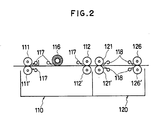
- reference numberals have the following meanings. 1, 3, 4, 5, 6 ... conveyer roller, 2, 7 ... guide roller, 8, 9 ... spray, 10, 21 ... circulation pump, 11 ... developer, 12, 13 ... supplementation pump, 14 ... sensor for detecting impedance of developer, 15 ... impedance controller, 16 ... water, 17 ... replenisher for developer, 23 ... air-shielding plate, A ... developing zone, B ... rinsing zone, 110 ... developing zone, 111, 111′, 112, 112′, 121, 121′, 126, 126′ ... conveyer roller, 116 ... brush, 117, 118 ... spray, 120 ... rinsing or desensitizing zone.
- PS plates comprising, as a substrate, an aluminum plate having an anodized layer of 0.5 to 6.0 g/m2 and hence improved resistance to defects.
- the method of this invention can be applied to the development processing performed at a high temperature ranging from 28 to 40° C with extremely excellent effects.
- FIG. 1 An example of the automatic developing machine for developing PS plates used in the present invention is shown in Fig. 1 More specifically, the apparatus is equipped with a storage tank for developer and a PS plate to be processed is conveyed and dipped in a developer 11 contained in the storage tank. A plate 23 for preventing the contact between the developer and air is disposed at an upper portion of the storage tank. Therefore, the alkaline developer used in the invention, in particular, developers composed of aqueous solutions having a high pH of not less than 12 is not deteriorated so severe that the foregoing problems arise since the absorption of carbon dioxide is effectively prevented by the plate 23, when compared with spraying type automatic developing machines as shown in Fig. 2 which have generally been used conventionally. This in turn results in the reduction of the amount of a replenisher to be supplemented. Moreover, the problem of contamination of the automatic developing machine can be solved since scattering of the developer due to spraying can also be prevented effectively.
- a plate for preventing the contact between the developer and air i.e., a shielding plate is employed in the invention.
- the rate of shielding of the developer surface by the plate is of primary importance and thus is desirably not less than 40%, preferably not less than 50% and more preferably not less than 60% of the whole developer-air interface.
- the composition of the developer used is also very important. More specifically, in a dipping-conveying type automatic developing machine used in the invention, a highly alkaline developer having a pH of not less than 12 is supplied to the surface of a PS plate in a large amount during development processing and, therefore, an aluminum substrate of the PS plate is liable to be etched. In particular, in the case of the PS plate whose aluminum substrate has an anodized film to enhance resistance to defects, a large amount of aluminum ions are dissolved out from the substrate into the developer.
- a conveying type automatic developing machine comprising a dip-developing portion provided with a plate for preventing the contact between the developer and air as in the invention
- qualities such as strength of alkali and the concentration of silicates in the developer and, in particular, those of the replenisher for developer.
- the present inventors have found that the amount of aluminum ions dissolved out is low, that almost no insoluble matters are formed, that a rapid high temperature processing can be performed, that the amount of the replenisher to be supplemented is low and that a stable development processing can be performed over a long time period of the order of not less than 3 months without exchanging the developer only when the replenisher for developer having the foregoing composition is used.
- the developers and the replenishers for developer used in the invention are aqueous solutions mainly composed of alkali metal silicates and alkali metal hydroxides.
- alkali metal silicates preferably used are, for instance, sodium silicate, potassium silicate, lithium silicate and sodium metasilicate.
- alkali metal hydroxides preferred are sodium hydroxide, potassium hydroxide and lithium hydroxide. From the viewpoint of preventing the formation of insoluble precipitates, it is particularly desirable that the developer comprise at least 20 mole% of potassium with respect to the total amount of alkali metals in the aqueous developing solution.
- the developers and the replenishers used in the invention may simultaneously contain other alkaline agents.
- other alkaline agents include such inorganic alkaline agents as ammonium hydroxide, sodium tertiary phosphate, sodium secondary phosphate, potassium tertiary phosphate, potassium secondary phosphate, ammonium tertiary phosphate, ammonium secondary phosphate, sodium bicarbonate, sodium carbonate, potassium carbonate and ammonium carbonate; and such organic alkaline agents as mono-, di- or triethanolamine, mono-, di- or trimethylamine, mono-, di- or triethylamine, mono- or di- isopropylamine, n-butylamine, mono-, di- or triisopropanolamine, ethyleneimine, ethylenediimine and tetramethylammonium hydroxide.
- the molar ratio of silicate [SiO2] to alkali metal oxide [M2O] in the replenisher for developer and the molar ratio, [SiO2] / [M2O] is generally 0.6 to 1.5, preferably 0.7 to 1.3. This is because if the molar ratio is less than 0.6, an automatic developing machine used is severely contaminated and great scattering of activity thereof is also observed, while if it exceeds 1.5, it becomes difficult to perform rapid development and the dissolving out or removal of the light-sensitive layer on non-image areas is liable to be incomplete.
- the concentration of SiO2 in the replenisher preferably ranges from 2 to 4% by weight. Such limitation of the concentration of SiO2 makes it possible to stably provide lithographic printing plates having good finishing qualities without causing formation of feculences even when a large amount of PS plates are processed for a long time period.
- an aqueous solution of an alkali metal silicate having a molar ratio, [SiO2] / [M2O] , which ranges from 1.0 to 1.5 and a concentration of SiO2 of 1 to 4% by weight is used as a developer.
- a replenisher having alkali strength equal to or more than that of the developer is employed.
- a molar ratio, [SiO2] / [M2O] , of the replenisher is equal to or smaller than that of the developer, or that a concentration of SiO2 is high if the molar ratio of the developer is equal to that of the replenisher.
- organic solvents having solubility in water at 20° C of not more than 10% by weight according to need.
- organic solvents are such carboxilic acid esters as ethyl acetate, propyl acetate, butyl acetate, amyl acetate, benzyl acetate, ethylene glycol monobutyl acatate, butyl lactate and butyl levulinate; such ketones as ethyl butyl ketone, methyl isobutyl ketone and cyclohexanone; such alcohols as ethylene glycol monobutyl ether, ethylene glycol benzyl ether, ethylene glycol monophenyl ether, benzyl alcohol, methylphenylcarbinol, n-amyl alcohol and methylamyl alcohol; such alkyl-substituted aromatic hydrocarbons as xylene; and such halogenated hydrocarbons as
- the developers and replenishers used in the present invention may simultaneously contain a surfactant for the purpose of improving developing properties thereof.
- surfactants include salts of higher alcohol (C8 ⁇ C22) sulfuric acid esters such as sodium salt of lauryl alcohol sulfate, sodium salt of octyl alcohol sulfate, ammonium salt of lauryl alcohol sulfate, Teepol B-81 (trade mark; available from Shell Chemicals Co., Ltd.) and disodium alkyl sulfates; salts of aliphatic alcohol phosphoric acid esters such as sodium salt of cetyl alcohol phosphate; alkyl aryl sulfonic acid salts such as sodium salt of dodecylbenzene sulfonate, sodium salt of isopropylnaphthalene sulfonate, sodium salt of dinaphthalene disulfonate and sodium salt of metanitrobenzene sulfonate; sulfonic acid salts of alkylamides such
- Examples of such compounds are neutral salts such as NaCl , KCl and KBr as disclosed in J.P. KOKAI No. Sho 58-75152; chelating agents such as EDTA and NTA as disclosed in J.P. KOKAI No. Sho 58-190952 (U.S. Patent 4,469,776); complexes such as (Co(NH3)6) C l 3 as disclosed in J.P. KOKAI No. Sho 59-121336 (U.S. Patent 4,606,995); ionizable compounds of elements of the group IIa, IIIa or IIIb the of Periodic Table such as those disclosed in J.P. KOKAI No.
- anionic or amphoteric surfactants such as sodium alkyl naphthalene sulfonate and N-tetradecyl-N,N-dihydroxyethyl betaine as disclosed in J.P. KOKAI No. Sho 50-51324; tetramethyldecyne diol as disclosed in U.S. Patent No. 4,374,920; nonionic surfactants as disclosed in J.P. KOKAI No. Sho 60-213943; cationic polymers such as methyl chloride quaternary products of p-dimethylaminomethyl polystyrene as disclosed in J.P. KOKAI No.
- J.P. KOKOKU Japanese Patent Publication for Opposition Purpose
- J.P. KOKOKU organic lithium compounds
- organometallic surfactants containing Si, Ti or the like as disclosed in J.P. KOKAI No. Sho 59-75255
- organoboron compounds as disclosed in J.P. KOKAI No. Sho 59-84241 (U.S. Patent 4,500,625)
- quaternary ammonium salts such as tetraalkylammonium oxides as disclosed in European Patent No.
- J.P.A. Japanese Patent Application Serial
- Sho 61-298534 J.P. KOKAI No. Sho 63-226657
- any known means of supplementing a replenisher for developer may be employed.
- Examples of such methods preferably used are a method for intermittently or continuously supplementing a replenisher as a function of the amount of PS plates processed and time as disclosed in J.P. KOKAI No. Sho 55-115039 (G.B. 2046931A), a method comprising disposing a sensor for detecting the degree of the light-sensitive layer dissolved out in the middle portion of a developing zone and supplementing the replenisher in proportion to the detected degree of the light-sensitive layer dissolved out as disclosed in J.P. KOKAI No. Sho 58-95349 (U.S. Patent 4,537,496); a method comprising determining the impedance value of a developer and processing the detected impedance value by a computer to perform supplementation of a replenisher as disclosed in G.B. 2208249A.
- the PS plates processed according to the method of this invention are comprised of a substrate having hydrophilic surfaces provided thereon with a light-sensitive layer containing a light-sensitive composition.
- light-sensitive compositions used herein are those comprising diazo compounds; those comprising azide compounds as disclosed in U.K. Patent Nos. 1,235,281 and 1,495,861; those containing photocross-linkable photopolymers as disclosed in U.S. Patent No. 3,860,426; those containing photopolymerizable photopolymers as disclosed in U.S. Patent Nos. 4,072,528 and 4,072,527; photoconductive compositions as disclosed in J.P. KOKAI Nos. Sho 56-19063 and 56-29250; and silver halide emulsion compositions as disclosed in J.P. KOKAI Nos. Sho 52-62501 and 56-111852.
- these light-sensitive compositions preferably used are those comprising diazo compounds since they are synthetically excellent in various properties such as storage properties of the light-sensitive layer; developability, for instance, development latitude; image properties, e.g. quality of images; printing properties, e.g., ink receptivity and wear resistance; and low possibility of causing environmental pollution of developers used.
- the light-sensitive compositions containing diazo compounds can roughly be divided into two groups, i.e., negative-working type and positive-working type ones.
- the negative-working light-sensitive compositions containing diazo compounds comprise light-sensitive diazo compounds and preferably polymeric compounds.
- the light-sensitive diazo compounds there may be used any ones conventionally known and preferred examples thereof are salts of organic solvent-soluble diazo resins such as salts of condensates of p-diazodiphenylamine and formaldehyde or acetaldehyde with hexafluorophosphates and salts thereof with 2-hydroxy-4-methoxybenzophenone-5-sulfonic acid salts.
- examples of the foregoing polymeric compounds preferably used are copolymers of acrylic acid or methacrylic acid; crotonic acid copolymers, itaconic acid copolymers, maleic acid copolymers, cellulose derivatives having carboxyl groups on the side chains thereof, polyvinyl alcohol derivatives having carboxyl groups on the side chains thereof, copolymers of hydroxyalkyl (meth)acrylate having carboxyl groups on the side chains thereof, and unsaturated polyester resins having carboxyl groups.
- any compounds conventionally known may be utilized and typical examples thereof are o-quinonediazides and preferably o-naphthoquinonediazide compounds. Particularly preferred are o-naphthoquinonediazidosulfonic acid esters or o-naphthoquinone diazidocarboxylic acid esters of various hydroxyl compounds; and o-naphthoquinonediazidosulfonic acid amides or o-naphthoquinonediazidocarboxylic acid amides of various aromatic amine compounds.
- Preferred hydroxyl compounds are condensed resins of phenols and carbonyl group-containing compounds.
- phenols include phenol, cresol, resorcin and pyrogallol;
- carbonyl group-containing compounds are formaldehyde, benzaldehyde and acetone.
- preferred hydroxyl compounds include phenol-formaldehyde resin, cresol-formaldehyde resin, pyrogallol-acetone resin and resorcin-benzaldehyde resin.
- Typical examples of o-quinonediazide compounds include esters of benzoquinone-(1,2)-diazidosulfonic acid or naphthoquinone-(1,2)-diazidosulfonic acid and phenol-formaldehyde resin or cresol-formaldehyde resin; ester of naphthoquinone-(1,2)-diazido-(2)-5-sulfonic acid and resorcin-benzaldehyde resin as disclosed in J.P. KOKAI No. Sho 56-1044; ester of naphthoquinone-(1,2)-diazidosulfonic acid and pyrogallol-acetone resin as disclosed in U.S. Patent No.
- Examples of other useful o-quinonediazide compounds are polyesters having hydroxyl groups at their termini esterified with o-naphthoquinonediazidosulfonyl chloride as disclosed in J.P. KOKAI No. Sho 50-117503; homopolymers of p-hydroxystyrene or copolymers thereof with other copolymerizable monomers esterified with o-naphthoquinonediazidosulfonyl chloride as disclosed in J.P. KOKAI No. Sho 50-113305; ester of bisphenol-formaldehyde resin and o-quinonediazidosulfonic acid as disclosed in J.P. KOKAI No.
- o-quinonediazide compounds may be used alone, but are preferably used as a mixture with an alkali-soluble resin to form a light-sensitive layer.
- Preferred alkali-soluble resins include novolak type phenol resins and typical examples thereof are phenol-formaldehyde resin, cresol-formaldehyde resin, and phenol-cresol-formaldehyde copolycondensed resins as disclosed in J.P. KOKAI No. Sho 55-57841. More preferably, the foregoing phenol resins are simultaneously used with a condensate of phenol or cresol substituted with an alkyl group having 3 to 8 carbon atoms and formaldehyde such as t-butylphenol-formaldehyde, as described in J.P. KOKAI No. Sho 50-125806.
- alkali-soluble polymers other than the above listed alkali-soluble novolak phenolic resins.
- alkali-soluble polymers other than the above listed alkali-soluble novolak phenolic resins.
- examples of such polymers are styrene-acrylic acid copolymer, methyl methacrylate-methacrylic acid copolymer, alkali-soluble polyurethane resin, and alkali-soluble vinylic resins and alkali-soluble polybutyral resins as disclosed in J.P. KOKOKU No. Sho 52-28401.
- the amount of the o-quinonediazide compounds is preferably 5 to 80% by weight and more preferably 10 to 50% by weight based on the total weight of the solid contents of the light-sensitive composition.
- that of the alkali-soluble resins is preferably 30 to 90% by weight and more preferably 50 to 85% by weight based on the total weight of the solid contents of the light-sensitive composition.
- the layer of the light-sensitive composition may be applied in the form of a multilayered structure.
- the light-sensitive composition may further comprise optional components such as dyes, plasticizers and components for imparting printing-out properties (ability of providing a visible image immediately after imagewise exposure).
- the coated amount of the light-sensitive composition applied onto the surface of a substrate preferably ranges from 0.1 to 7 g/m2 and more preferably 0.5 to 4 g/m2.
- an underlying coating between the substrate and the light-sensitive layer for instance, those composed of a metal salt and hydrophilic cellulose as disclosed in J.P. KOKOKU No. Sho 57-16349; a polyvinylsulfonic acid layer as disclosed in J.P. KOKOKU No. Sho 46-35685; a layer of ⁇ -alanine as disclosed in J.P. KOKAI No. Sho 60-149491; or a layer of triethanolamine hydrochloride as disclosed in J.P. KOKAI No. Sho 60- 232998.
- substrates used in the PS plates processed by the method of this invention preferred are aluminum (inclusive of aluminum alloys) plates, paper, plastic films such as polyethylene, polypropylene, polyethylene terephthalate, cellulose diacetate, cellulose triacetate. cellulose propionate, polyvinyl acetal and polycarbonate plates, and composite substrates composed of metal plates such as copper and zinc plates which are laminated with an aluminum foil or on which aluminum layer is deposited.
- the surface of these substrate is generally subjected to surface roughening treatment for the purpose of enhancing the water-retention property and improving the adhesion between the surface and the light-sensitive layer.
- surface roughening treatments there may be mentioned such commonly known methods as brush graining, ball graining, electrolytic etching, chemical etching, liquid honing, sand blast and a combination thereof, preferably brush graining, electrolytic etching, chemical etching and liquid honing and, in particular, the surface roughening treatments which include electrolytic etching process.
- Electrolytic baths used in the electrolytic etching are aqueous solutions containing acids, alkalis or salts thereof, or those containing organic solvents. Particularly preferred are electrolytes containing hydrochloric acid, nitric acid or a salt thereof.
- the aluminum plate which has been surface-roughened is optionally desmutted with an aqueous solution of an acid or an alkali.
- the aluminum plate thus obtained is preferably anodized.
- Particularly preferred method for anodization is to subject it to such treatment in a bath containing sulfuric acid or phosphoric acid.
- the aluminum plate may be subjected to other surface treatments such as sealing treatment and dipping in an aqueous solution of potassium fluorozirconate.
- the method of this invention is particularly effective for processing PS plates whose substrate is anodized to enhance its resistance to scratching and it is a real surprise that the method of this invention makes it possible to process PS plates provided thereon with an anodized layer of 0.5 to 6.0 g/m2, from which aluminum ions are easily delivered in a rapid processing, continuously over several months without exchanging the developer.
- the PS plates thus obtained are imagewise exposed, through an original transparency, to light from a light source rich in actinic rays such as a carbon arc lamp, a mercury lamp, a metal halide lamp, a tungsten lamp and a xenon lamp and are subsequently developed.
- a light source rich in actinic rays such as a carbon arc lamp, a mercury lamp, a metal halide lamp, a tungsten lamp and a xenon lamp
- PS plates developed are optionally subjected to water washing processes (with running water or circulating water washing), processes for rinsing the plates with an aqueous solution containing a surfactant, a desensitization treatment as well as a combination of water washing and rinsing processes or rinsing and desensitization treatments.
- An aluminum plate (1S) which had been grained was immersed in 2 wt% aqueous solution of sodium hydroxide maintained at 40 ° C for one minute to etch the plate. Then the plate was washed and was dipped in a sulfuric acid-chromic acid mixture for about one minute to expose the pure aluminum surface. The plate was immersed in 20 wt% sulfuric acid solution maintained at 30 ° C, was anodized at a DC voltage of 15V and a current density of 2 A/dm2 for 3 minutes to form an anodized layer of 3.0 g/m2, washed with water and dried.
- a PS plate was prepared by applying a solution of the following light-sensitive composition on the surface of the aluminum plate thus treated so that the amount of the solution applied was 2 g/m2 (weighed after drying) and then drying.
- Component Amount (g) Naphthoquinone-1,2-diazido-(2)-5-sulfonic acid ester of acetone-pyrogallol resin (synthesized by a method disclosed in Example 1 of U.S. Patent No.
- the positive-working PS plate thus obtained was imagewise exposed, through an original transparency, to light from a 3 KW metal halide lamp for 60 seconds.
- the machine comprises a developing bath A for storing the developer and dipping the PS plates. to be processed and a bath B for rinsing and processes the exposed PS plates successively while conveying the plates.
- the machine further comprises devices (10, 21) for circulating each processing solution in the order of a storage tank --> a pump --> a spray --> the storage tank and devices (12 to 17) for supplemeting each replenisher to the corresponding processing bath.
- Each processing bath is designed so that excess of each processing solution is delivered by overflow.
- a plate for shielding air of the developing bath there is used such a plate having rate of shielding of 70%.
- a replenisher B for developer having the following composition (500 m l each) was supplemented every change in solid portion of an Exposing Step Tablet for PS plates (available from Fuji Photo Film Co., Ltd.) by 1/2 corresponding to the amount of the PS plates processed.
- the replenisher was supplemented in the morning after stopping the automatic developing machine at night and during holidays in an amount corresponding to the change in step tablet to regenerate the developer. The development processing was thus continued.
- a commercialy available rinse solution FR-2 (available from Fuji Photo Film Co., Ltd.) was diluted in a ratio of 1:7 with water and 8 l of the diluted rinse solution was charged into a bath for rinsing.
- a diluted (1:15) rinsing solution FR-2 was supplemented thereto in an amount of 40 ml per 1 m2 of the processed PS plate.
- PS plates having a size of 1003 mm X 800 mm were processed in a rate of 60 sheets per day for 3 months.
- PS plates provided thereon with an anodized layer of 3.0 g/m2 were subjected to high temperature rapid processing, there was not observed any adhesion of contaminants on the PS plate processed and almost no precipitates were deposited on the bottom of the developing bath. This clearly indicates that very stable development processing could be performed.
- the amount of the replenisher supplemeted was only 70 ml per 1 m2 of the processed PS plate.
- Example 2 Using a conventional spraying type automatic developing machine as shown in Fig. 2 and the same PS plates, developer and replenisher as those used in Example 1, a rapid development processing in which temperature of the developer was 30° C and time for development processing was 10 seconds was performed as in Example 1. Two weeks after the initiation of the processing, there was formed sludge-like precipitates on the bottom of a developing bath and three weeks thereafter, contaminants were adhered to the surface of the processed PS plate. Moreover, the amount of the replenisher to be supplemented was 125 ml per 1 m2 of the processed PS plate.
- White contaminants on roller means that the roller is contaminated with white substances mainly composed of silicates used.
- the molar ratio, [SiO2] / [M2O] should be preferably limited to the range of from 0.6 to 1. and more preferably 0.7 to 1.3. Moreover, when the molar ratio was 1.2 and the content of SiO2 was less than 2 % by weight, the amount of the replenisher to be supplemented was increased and the lowering of the sensitivity was also great, while when the content of SiO2 exceeded 4% by weight, sludge was formed in the developing bath and a long term processing could not be performed.
- the method makes it possible to stably and rapidly continue the development processing for a long time period, the contamination of the automatic developing machine is very low and washing operations can be easily performed. Moreover, there are not observed adhesion of feculences onto the surface of PS plates and formation of scratch thereon during the processing. In addition, the method also makes it possible to reduce the amount of the replenisher to be used. Thus lithographic printing plates having constant quality can be obtained and the running cost can be greatly reduced.
Landscapes
- Physics & Mathematics (AREA)
- General Physics & Mathematics (AREA)
- Photosensitive Polymer And Photoresist Processing (AREA)
Applications Claiming Priority (2)
| Application Number | Priority Date | Filing Date | Title |
|---|---|---|---|
| JP149617/88 | 1988-06-17 | ||
| JP63149617A JP2639693B2 (ja) | 1988-06-17 | 1988-06-17 | 感光性平版印刷版の現像処理方法 |
Publications (3)
| Publication Number | Publication Date |
|---|---|
| EP0347245A2 true EP0347245A2 (de) | 1989-12-20 |
| EP0347245A3 EP0347245A3 (en) | 1990-12-12 |
| EP0347245B1 EP0347245B1 (de) | 1995-04-12 |
Family
ID=15479128
Family Applications (1)
| Application Number | Title | Priority Date | Filing Date |
|---|---|---|---|
| EP19890306131 Revoked EP0347245B1 (de) | 1988-06-17 | 1989-06-16 | Entwicklungsverfahren für vorsensibilisierte Druckplatten |
Country Status (3)
| Country | Link |
|---|---|
| EP (1) | EP0347245B1 (de) |
| JP (1) | JP2639693B2 (de) |
| DE (1) | DE68922144T2 (de) |
Cited By (18)
| Publication number | Priority date | Publication date | Assignee | Title |
|---|---|---|---|---|
| EP0490515A1 (de) * | 1990-11-28 | 1992-06-17 | Fuji Photo Film Co., Ltd. | Verfahren zur Herstellung einer Druckplatte |
| EP0492959A1 (de) * | 1990-12-20 | 1992-07-01 | Fuji Photo Film Co., Ltd. | Verfahren zum Entwickeln von vorsensibilisierten Platten in der Herstellung von lithographischen Druckplatten |
| EP0732628A1 (de) * | 1995-03-07 | 1996-09-18 | Minnesota Mining And Manufacturing Company | Wässrig-alkalische Lösung zum Entwickeln von Flachdruckplatten |
| WO1998054621A1 (en) * | 1997-05-30 | 1998-12-03 | Kodak Polychrome Graphics, L.L.C. | Methods of imaging and printing with a positive-working infrared radiation sensitive printing plate |
| WO1998054622A1 (en) * | 1997-05-30 | 1998-12-03 | Kodak Polychrome Graphics, L.L.C. | Alkaline developing composition and method of use to process lithographic printing plates |
| EP0908305A1 (de) * | 1997-10-08 | 1999-04-14 | Agfa-Gevaert N.V. | Verfahren zur Herstellung einer positiv arbeitenden Druckplatte aus wärmeempflindlichem Bildaufzeichnungsmaterial |
| EP0908304A1 (de) * | 1997-10-08 | 1999-04-14 | Agfa-Gevaert N.V. | Verfahren zur Herstellung einer positiv arbeitenden Druckplatte aus wärmempflindlichem Bildaufzeichungsmaterial |
| EP0914941A1 (de) * | 1997-11-07 | 1999-05-12 | Agfa-Gevaert N.V. | Verfahren zur Herstellung einer positiv arbeitenden lithographischen Druckplatte unter Verwendung eines wärmeempfindlichen Materials |
| US6004728A (en) * | 1997-10-08 | 1999-12-21 | Agfa-Gevaert, N.V. | Method for making positive working printing plates from a heat mode sensitive image element |
| EP0908306A3 (de) * | 1997-10-08 | 1999-12-29 | Agfa-Gevaert N.V. | Verfahren zur Herstellung einer positiv arbeitenden Druckplatte aus wärmempfindlichem Bildaufzeichnungsmaterial |
| EP0908307A3 (de) * | 1997-10-08 | 1999-12-29 | Agfa-Gevaert N.V. | Verfahren zur Herstellung einer positiv arbeitenden Druckplatte aus einem Wärmeempfindlichen Bildaufzeichnungsmaterial |
| EP0990950A1 (de) * | 1998-09-30 | 2000-04-05 | Agfa-Gevaert N.V. | Verarbeitungsverfahren und Vorrichtung für Bildelemente |
| US6060218A (en) * | 1997-10-08 | 2000-05-09 | Agfa-Gevaert, N.V. | Method for making positive working printing plates from a heat mode sensitive image element |
| US6235451B1 (en) | 1997-10-08 | 2001-05-22 | Agfa-Gevaert | Method for making positive working printing plates from a heat mode sensitive image element |
| US6248503B1 (en) | 1997-11-07 | 2001-06-19 | Agfa-Gevaert | Method for making positive working printing plates from a heat mode sensitive imaging element |
| US6251563B1 (en) | 1997-10-08 | 2001-06-26 | Agfa-Gevaert, N.V. | Method for making positive working printing plates from a heat mode sensitive image element |
| EP1334824A3 (de) * | 2002-02-08 | 2003-11-19 | Fuji Photo Film Co., Ltd. | Bilderzeugungsverfahren |
| EP1014200B1 (de) * | 1998-12-22 | 2015-03-18 | FUJIFILM Corporation | Verfahren zur Entwicklung einer lichtempfindlichen lithographischen Druckplattenvorstufe |
Families Citing this family (3)
| Publication number | Priority date | Publication date | Assignee | Title |
|---|---|---|---|---|
| JP2687047B2 (ja) * | 1990-12-20 | 1997-12-08 | 富士写真フイルム株式会社 | 平版印刷版の製造方法 |
| JP3442176B2 (ja) | 1995-02-10 | 2003-09-02 | 富士写真フイルム株式会社 | 光重合性組成物 |
| DE102004012191B4 (de) * | 2004-03-12 | 2008-04-10 | Kodak Graphic Communications Gmbh | Stabiler stark alkalischer Entwickler |
Family Cites Families (12)
| Publication number | Priority date | Publication date | Assignee | Title |
|---|---|---|---|---|
| US4119991A (en) * | 1977-04-08 | 1978-10-10 | Peter Vincent Martino | Horizontal one step automatic plate processor |
| JPS5522759A (en) * | 1978-08-08 | 1980-02-18 | Fuji Photo Film Co Ltd | Developing method of positive type photosensitive lithographic printing plate |
| GB2046931B (en) * | 1979-02-27 | 1983-03-16 | Fuji Photo Film Co Ltd | Method of developing positive-acting photosensitive lithographic printing plate precursor |
| DE8028682U1 (de) * | 1980-10-28 | 1981-02-12 | Hoechst Ag, 6000 Frankfurt | Entwicklungsgeraet |
| DE3147002A1 (de) * | 1981-11-27 | 1983-06-01 | Hoechst Ag, 6230 Frankfurt | Verarbeitungsgeraet fuer bildmaessig belichtete fotoempfindliche materialien |
| DE3204912C1 (de) * | 1982-02-12 | 1983-08-11 | Fritz Dipl.-Ing. 8000 München Knollmann | Vorrichtung zum Auswaschen belichteter Druckplatten, insbesondere dünner Kunststoffdruckplatten |
| DE3406102A1 (de) * | 1984-02-21 | 1985-08-22 | Hoechst Ag, 6230 Frankfurt | Verfahren zur nachbehandlung von aluminiumoxidschichten mit alkalimetallsilikat enthaltenden waessrigen loesungen und deren verwendung bei der herstellung von offsetdruckplattentraegern |
| JPH0612443B2 (ja) * | 1985-09-25 | 1994-02-16 | コニカ株式会社 | 感光性平版印刷版の現像液組成物及び現像方法 |
| JPH01166051A (ja) * | 1987-12-22 | 1989-06-29 | Konica Corp | 感光性平版印刷版の処理方法 |
| US4828965A (en) * | 1988-01-06 | 1989-05-09 | Olin Hunt Specialty Products Inc. | Aqueous developing solution and its use in developing positive-working photoresist composition |
| JPH022572A (ja) * | 1988-06-15 | 1990-01-08 | Konica Corp | 感光材料用現像液 |
| JPH022571A (ja) * | 1988-06-15 | 1990-01-08 | Konica Corp | 感光材料用現像液 |
-
1988
- 1988-06-17 JP JP63149617A patent/JP2639693B2/ja not_active Expired - Fee Related
-
1989
- 1989-06-16 DE DE1989622144 patent/DE68922144T2/de not_active Revoked
- 1989-06-16 EP EP19890306131 patent/EP0347245B1/de not_active Revoked
Cited By (22)
| Publication number | Priority date | Publication date | Assignee | Title |
|---|---|---|---|---|
| EP0490515A1 (de) * | 1990-11-28 | 1992-06-17 | Fuji Photo Film Co., Ltd. | Verfahren zur Herstellung einer Druckplatte |
| US5480762A (en) * | 1990-11-28 | 1996-01-02 | Fuji Photo Film Co., Ltd. | Method for preparing lithographic printing plate |
| EP0492959A1 (de) * | 1990-12-20 | 1992-07-01 | Fuji Photo Film Co., Ltd. | Verfahren zum Entwickeln von vorsensibilisierten Platten in der Herstellung von lithographischen Druckplatten |
| US5250393A (en) * | 1990-12-20 | 1993-10-05 | Fuji Photo Film Co., Ltd. | Method for developing presensitized plate for use in making lithographic printing plate |
| EP0732628A1 (de) * | 1995-03-07 | 1996-09-18 | Minnesota Mining And Manufacturing Company | Wässrig-alkalische Lösung zum Entwickeln von Flachdruckplatten |
| US5958655A (en) * | 1997-05-30 | 1999-09-28 | Kodak Polychrome Graphics Llc | Alkaline developing composition and method of use to process lithographic printing plates |
| WO1998054621A1 (en) * | 1997-05-30 | 1998-12-03 | Kodak Polychrome Graphics, L.L.C. | Methods of imaging and printing with a positive-working infrared radiation sensitive printing plate |
| WO1998054622A1 (en) * | 1997-05-30 | 1998-12-03 | Kodak Polychrome Graphics, L.L.C. | Alkaline developing composition and method of use to process lithographic printing plates |
| US6083662A (en) * | 1997-05-30 | 2000-07-04 | Kodak Polychrome Graphics Llc | Methods of imaging and printing with a positive-working infrared radiation sensitive printing plate |
| US6235451B1 (en) | 1997-10-08 | 2001-05-22 | Agfa-Gevaert | Method for making positive working printing plates from a heat mode sensitive image element |
| EP0908305A1 (de) * | 1997-10-08 | 1999-04-14 | Agfa-Gevaert N.V. | Verfahren zur Herstellung einer positiv arbeitenden Druckplatte aus wärmeempflindlichem Bildaufzeichnungsmaterial |
| EP0908304A1 (de) * | 1997-10-08 | 1999-04-14 | Agfa-Gevaert N.V. | Verfahren zur Herstellung einer positiv arbeitenden Druckplatte aus wärmempflindlichem Bildaufzeichungsmaterial |
| US6251563B1 (en) | 1997-10-08 | 2001-06-26 | Agfa-Gevaert, N.V. | Method for making positive working printing plates from a heat mode sensitive image element |
| US6004728A (en) * | 1997-10-08 | 1999-12-21 | Agfa-Gevaert, N.V. | Method for making positive working printing plates from a heat mode sensitive image element |
| EP0908306A3 (de) * | 1997-10-08 | 1999-12-29 | Agfa-Gevaert N.V. | Verfahren zur Herstellung einer positiv arbeitenden Druckplatte aus wärmempfindlichem Bildaufzeichnungsmaterial |
| EP0908307A3 (de) * | 1997-10-08 | 1999-12-29 | Agfa-Gevaert N.V. | Verfahren zur Herstellung einer positiv arbeitenden Druckplatte aus einem Wärmeempfindlichen Bildaufzeichnungsmaterial |
| US6060218A (en) * | 1997-10-08 | 2000-05-09 | Agfa-Gevaert, N.V. | Method for making positive working printing plates from a heat mode sensitive image element |
| US6248503B1 (en) | 1997-11-07 | 2001-06-19 | Agfa-Gevaert | Method for making positive working printing plates from a heat mode sensitive imaging element |
| EP0914941A1 (de) * | 1997-11-07 | 1999-05-12 | Agfa-Gevaert N.V. | Verfahren zur Herstellung einer positiv arbeitenden lithographischen Druckplatte unter Verwendung eines wärmeempfindlichen Materials |
| EP0990950A1 (de) * | 1998-09-30 | 2000-04-05 | Agfa-Gevaert N.V. | Verarbeitungsverfahren und Vorrichtung für Bildelemente |
| EP1014200B1 (de) * | 1998-12-22 | 2015-03-18 | FUJIFILM Corporation | Verfahren zur Entwicklung einer lichtempfindlichen lithographischen Druckplattenvorstufe |
| EP1334824A3 (de) * | 2002-02-08 | 2003-11-19 | Fuji Photo Film Co., Ltd. | Bilderzeugungsverfahren |
Also Published As
| Publication number | Publication date |
|---|---|
| JP2639693B2 (ja) | 1997-08-13 |
| DE68922144T2 (de) | 1995-08-10 |
| EP0347245A3 (en) | 1990-12-12 |
| JPH023065A (ja) | 1990-01-08 |
| DE68922144D1 (de) | 1995-05-18 |
| EP0347245B1 (de) | 1995-04-12 |
Similar Documents
| Publication | Publication Date | Title |
|---|---|---|
| EP0347245B1 (de) | Entwicklungsverfahren für vorsensibilisierte Druckplatten | |
| EP0279630B1 (de) | Entwickler für lichtempfindliche lithographische Druckplatte, gemeinschaftlich verarbeitungsfähig für den Negativ-Typ und den Positiv-Typ und Entwicklerzusammensetzung für lichtempfindliches Material | |
| US4762771A (en) | Method of treating photosensitive printing plate | |
| JPH0322621B2 (de) | ||
| JPS622254A (ja) | 感光材料の現像方法 | |
| US5149614A (en) | Developer compositions for ps plates and method for developing the same wherein the developer composition contains a surfactant having an aryl group, an oxyalkylene group and a sulfate ester or sulfonic acid group | |
| EP0390480B1 (de) | Entwickler für lichtempfindliche Platten bei der Herstellung von lithographischen Druckplatten und Verfahren zur Herstellung der Platten | |
| US5126229A (en) | Process for preparing positive or negative lithographic printing plates using a developer having at least one alkali-soluble mercapto compound and/or thioether compound | |
| EP0272686A2 (de) | Verfahren zur Herstellung von Flachdruckplatten | |
| EP0066990B1 (de) | Verfahren zur Herstellung von vorsensibilisierten lithographischen Druckplatten | |
| JPH01287561A (ja) | 感光性平版印刷版の現像液組成物 | |
| JPH022570A (ja) | 感光性平版印刷版現像処理装置 | |
| JPH0239157A (ja) | 感光性平版印刷版の現像液 | |
| JP2627577B2 (ja) | 平版印刷版の製版方法 | |
| JP2516001B2 (ja) | 平版印刷版の製版方法 | |
| JPH08123039A (ja) | 感光性平版印刷版の処理方法 | |
| JPS63109442A (ja) | ネガ型とポジ型を共通に安定に処理できる感光材料の処理方法 | |
| NL9400920A (nl) | Ontwikkelaarsamenstelling voor positiefwerkende lithografische drukplaten en werkwijze voor het ontwikkelen van positiefwerkende lithografische drukplaten. | |
| JPS6289060A (ja) | ネガ型感光性平版印刷版及びポジ型感光性平版印刷版共用現像液組成物、及び現像方法 | |
| JPH0612443B2 (ja) | 感光性平版印刷版の現像液組成物及び現像方法 | |
| JPS63109443A (ja) | 現像処理の安定性等が改良される感光性平版印刷版の現像処理方法 | |
| JPH01223448A (ja) | 感光材料の処理方法 | |
| JPS6235351A (ja) | 現像液組成物および現像方法 | |
| JPS6271959A (ja) | 感光性平版印刷版の処理方法 | |
| JPH0822117A (ja) | 感光性平版印刷版の処理方法及び装置並びに清浄方法 |
Legal Events
| Date | Code | Title | Description |
|---|---|---|---|
| PUAI | Public reference made under article 153(3) epc to a published international application that has entered the european phase |
Free format text: ORIGINAL CODE: 0009012 |
|
| AK | Designated contracting states |
Kind code of ref document: A2 Designated state(s): DE GB |
|
| PUAL | Search report despatched |
Free format text: ORIGINAL CODE: 0009013 |
|
| AK | Designated contracting states |
Kind code of ref document: A3 Designated state(s): DE GB |
|
| 17P | Request for examination filed |
Effective date: 19901220 |
|
| 17Q | First examination report despatched |
Effective date: 19930423 |
|
| GRAA | (expected) grant |
Free format text: ORIGINAL CODE: 0009210 |
|
| AK | Designated contracting states |
Kind code of ref document: B1 Designated state(s): DE GB |
|
| REF | Corresponds to: |
Ref document number: 68922144 Country of ref document: DE Date of ref document: 19950518 |
|
| PLBQ | Unpublished change to opponent data |
Free format text: ORIGINAL CODE: EPIDOS OPPO |
|
| PLBI | Opposition filed |
Free format text: ORIGINAL CODE: 0009260 |
|
| PLBF | Reply of patent proprietor to notice(s) of opposition |
Free format text: ORIGINAL CODE: EPIDOS OBSO |
|
| 26 | Opposition filed |
Opponent name: AGFA-GEVAERT N.V. Effective date: 19960110 |
|
| PLBF | Reply of patent proprietor to notice(s) of opposition |
Free format text: ORIGINAL CODE: EPIDOS OBSO |
|
| PLBF | Reply of patent proprietor to notice(s) of opposition |
Free format text: ORIGINAL CODE: EPIDOS OBSO |
|
| PLAB | Opposition data, opponent's data or that of the opponent's representative modified |
Free format text: ORIGINAL CODE: 0009299OPPO |
|
| PLBQ | Unpublished change to opponent data |
Free format text: ORIGINAL CODE: EPIDOS OPPO |
|
| R26 | Opposition filed (corrected) |
Opponent name: AGFA-GEVAERT N.V. Effective date: 19960110 |
|
| RDAH | Patent revoked |
Free format text: ORIGINAL CODE: EPIDOS REVO |
|
| APAE | Appeal reference modified |
Free format text: ORIGINAL CODE: EPIDOS REFNO |
|
| APAC | Appeal dossier modified |
Free format text: ORIGINAL CODE: EPIDOS NOAPO |
|
| APAC | Appeal dossier modified |
Free format text: ORIGINAL CODE: EPIDOS NOAPO |
|
| PGFP | Annual fee paid to national office [announced via postgrant information from national office to epo] |
Ref country code: GB Payment date: 20000524 Year of fee payment: 12 |
|
| PGFP | Annual fee paid to national office [announced via postgrant information from national office to epo] |
Ref country code: DE Payment date: 20000727 Year of fee payment: 12 |
|
| APAC | Appeal dossier modified |
Free format text: ORIGINAL CODE: EPIDOS NOAPO |
|
| RDAG | Patent revoked |
Free format text: ORIGINAL CODE: 0009271 |
|
| STAA | Information on the status of an ep patent application or granted ep patent |
Free format text: STATUS: PATENT REVOKED |
|
| 27W | Patent revoked |
Effective date: 20001004 |
|
| GBPR | Gb: patent revoked under art. 102 of the ep convention designating the uk as contracting state |
Free format text: 20001004 |
|
| APAH | Appeal reference modified |
Free format text: ORIGINAL CODE: EPIDOSCREFNO |