EP0485719A2 - Substrat mit dielektrischer Isolation und Verfahren zu dessen Herstellung - Google Patents
Substrat mit dielektrischer Isolation und Verfahren zu dessen Herstellung Download PDFInfo
- Publication number
- EP0485719A2 EP0485719A2 EP91116144A EP91116144A EP0485719A2 EP 0485719 A2 EP0485719 A2 EP 0485719A2 EP 91116144 A EP91116144 A EP 91116144A EP 91116144 A EP91116144 A EP 91116144A EP 0485719 A2 EP0485719 A2 EP 0485719A2
- Authority
- EP
- European Patent Office
- Prior art keywords
- substrate
- moats
- bond substrate
- plane
- members
- Prior art date
- Legal status (The legal status is an assumption and is not a legal conclusion. Google has not performed a legal analysis and makes no representation as to the accuracy of the status listed.)
- Ceased
Links
Images




Classifications
-
- H—ELECTRICITY
- H10—SEMICONDUCTOR DEVICES; ELECTRIC SOLID-STATE DEVICES NOT OTHERWISE PROVIDED FOR
- H10P—GENERIC PROCESSES OR APPARATUS FOR THE MANUFACTURE OR TREATMENT OF DEVICES COVERED BY CLASS H10
- H10P50/00—Etching of wafers, substrates or parts of devices
- H10P50/60—Wet etching
- H10P50/64—Wet etching of semiconductor materials
- H10P50/642—Chemical etching
- H10P50/644—Anisotropic liquid etching
-
- H—ELECTRICITY
- H10—SEMICONDUCTOR DEVICES; ELECTRIC SOLID-STATE DEVICES NOT OTHERWISE PROVIDED FOR
- H10P—GENERIC PROCESSES OR APPARATUS FOR THE MANUFACTURE OR TREATMENT OF DEVICES COVERED BY CLASS H10
- H10P50/00—Etching of wafers, substrates or parts of devices
- H10P50/69—Etching of wafers, substrates or parts of devices using masks for semiconductor materials
- H10P50/691—Etching of wafers, substrates or parts of devices using masks for semiconductor materials for Group V materials or Group III-V materials
- H10P50/693—Etching of wafers, substrates or parts of devices using masks for semiconductor materials for Group V materials or Group III-V materials characterised by their size, orientation, disposition, behaviour or shape, in horizontal or vertical plane
-
- H—ELECTRICITY
- H10—SEMICONDUCTOR DEVICES; ELECTRIC SOLID-STATE DEVICES NOT OTHERWISE PROVIDED FOR
- H10P—GENERIC PROCESSES OR APPARATUS FOR THE MANUFACTURE OR TREATMENT OF DEVICES COVERED BY CLASS H10
- H10P90/00—Preparation of wafers not covered by a single main group of this subclass, e.g. wafer reinforcement
- H10P90/19—Preparing inhomogeneous wafers
- H10P90/1904—Preparing vertically inhomogeneous wafers
- H10P90/1906—Preparing SOI wafers
-
- H—ELECTRICITY
- H10—SEMICONDUCTOR DEVICES; ELECTRIC SOLID-STATE DEVICES NOT OTHERWISE PROVIDED FOR
- H10W—GENERIC PACKAGES, INTERCONNECTIONS, CONNECTORS OR OTHER CONSTRUCTIONAL DETAILS OF DEVICES COVERED BY CLASS H10
- H10W10/00—Isolation regions in semiconductor bodies between components of integrated devices
- H10W10/01—Manufacture or treatment
- H10W10/041—Manufacture or treatment of isolation regions comprising polycrystalline semiconductor materials
-
- H—ELECTRICITY
- H10—SEMICONDUCTOR DEVICES; ELECTRIC SOLID-STATE DEVICES NOT OTHERWISE PROVIDED FOR
- H10W—GENERIC PACKAGES, INTERCONNECTIONS, CONNECTORS OR OTHER CONSTRUCTIONAL DETAILS OF DEVICES COVERED BY CLASS H10
- H10W10/00—Isolation regions in semiconductor bodies between components of integrated devices
- H10W10/01—Manufacture or treatment
- H10W10/061—Manufacture or treatment using SOI processes together with lateral isolation, e.g. combinations of SOI and shallow trench isolations
-
- H—ELECTRICITY
- H10—SEMICONDUCTOR DEVICES; ELECTRIC SOLID-STATE DEVICES NOT OTHERWISE PROVIDED FOR
- H10W—GENERIC PACKAGES, INTERCONNECTIONS, CONNECTORS OR OTHER CONSTRUCTIONAL DETAILS OF DEVICES COVERED BY CLASS H10
- H10W10/00—Isolation regions in semiconductor bodies between components of integrated devices
- H10W10/10—Isolation regions comprising dielectric materials
- H10W10/181—Semiconductor-on-insulator [SOI] isolation regions, e.g. buried oxide regions of SOI wafers
-
- H—ELECTRICITY
- H10—SEMICONDUCTOR DEVICES; ELECTRIC SOLID-STATE DEVICES NOT OTHERWISE PROVIDED FOR
- H10W—GENERIC PACKAGES, INTERCONNECTIONS, CONNECTORS OR OTHER CONSTRUCTIONAL DETAILS OF DEVICES COVERED BY CLASS H10
- H10W10/00—Isolation regions in semiconductor bodies between components of integrated devices
- H10W10/40—Isolation regions comprising polycrystalline semiconductor materials
-
- H—ELECTRICITY
- H10—SEMICONDUCTOR DEVICES; ELECTRIC SOLID-STATE DEVICES NOT OTHERWISE PROVIDED FOR
- H10P—GENERIC PROCESSES OR APPARATUS FOR THE MANUFACTURE OR TREATMENT OF DEVICES COVERED BY CLASS H10
- H10P90/00—Preparation of wafers not covered by a single main group of this subclass, e.g. wafer reinforcement
- H10P90/19—Preparing inhomogeneous wafers
- H10P90/1904—Preparing vertically inhomogeneous wafers
- H10P90/1906—Preparing SOI wafers
- H10P90/1914—Preparing SOI wafers using bonding
-
- Y—GENERAL TAGGING OF NEW TECHNOLOGICAL DEVELOPMENTS; GENERAL TAGGING OF CROSS-SECTIONAL TECHNOLOGIES SPANNING OVER SEVERAL SECTIONS OF THE IPC; TECHNICAL SUBJECTS COVERED BY FORMER USPC CROSS-REFERENCE ART COLLECTIONS [XRACs] AND DIGESTS
- Y10—TECHNICAL SUBJECTS COVERED BY FORMER USPC
- Y10S—TECHNICAL SUBJECTS COVERED BY FORMER USPC CROSS-REFERENCE ART COLLECTIONS [XRACs] AND DIGESTS
- Y10S148/00—Metal treatment
- Y10S148/012—Bonding, e.g. electrostatic for strain gauges
-
- Y—GENERAL TAGGING OF NEW TECHNOLOGICAL DEVELOPMENTS; GENERAL TAGGING OF CROSS-SECTIONAL TECHNOLOGIES SPANNING OVER SEVERAL SECTIONS OF THE IPC; TECHNICAL SUBJECTS COVERED BY FORMER USPC CROSS-REFERENCE ART COLLECTIONS [XRACs] AND DIGESTS
- Y10—TECHNICAL SUBJECTS COVERED BY FORMER USPC
- Y10S—TECHNICAL SUBJECTS COVERED BY FORMER USPC CROSS-REFERENCE ART COLLECTIONS [XRACs] AND DIGESTS
- Y10S148/00—Metal treatment
- Y10S148/05—Etch and refill
Definitions
- the present invention relates to substrates for use in integrated circuits and more particularly to a dielectrically isolated substrate of a bonding type having squared and maximized island regions.
- the invention further relates to a process for producing such a unique substrate.
- a p-n junction isolation technique using diffusion layers has been widely employed to isolate the individual elements of the substrate from each other.
- This isolation diffusion technique is not only relatively simple in steps but easy in process control. However, it is susceptible to excessive isolation capacitances and poor high frequency characteristics and hence low operating speed in circuits.
- a dielectric isolation technique using dielectric layers has been proposed which is pondered as fully acceptable in parasitic capacitances and breakdown characteristics.
- a dielectrically isolated substrate of a bonding type is known to be a substrate obtained by the last-mentioned dielectric isolation technique as disclosed for instance in Japanese Patent Laid-Open Publication No. 62-229855.
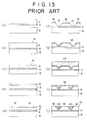
- This conventional substrate is produced as will be hereunder described with reference to FIGS. 13(a) through 13(j).
- N+ dopant such as of antimony (Sb), arsenic (Ar) or the like is buried and diffused to a mirror polished surface of a single crystal silicon substrate or bond substrate 2 with a (100) plane as the main crystl plane as shown in FIG. 13(a), followed by formation of a dielectric film 4 of silicon dioxide (SiO2) over the surface of the bond substrate 2 as by thermal oxidation.
- the bond substrate 2 is contacted with another substrate or base substrate 6 with their mirror polished surface opposed to each other and thereafter bonded together into an integral structure 8 at above 200°C as depicted in FIG. 13(b).
- the substrate 2 of the structure 8 is ground and polished to a thickness of 30 to 50 ⁇ m [FIG. 13(c)], followed by formation of oxide film 10 of nearly 0.6 ⁇ m in thickness, for subsequent photo-lithography, over an outer surface of the substrate 2 as through thermal oxidation [FIG. 13(d)].
- Small openings or windows 12 are formed photo-lithographically selectively in the oxide film 10 according to an isolation mask pattern [FIG. 13(e)], whereby the surface of the substrate 2 is anisotropically etched through the windows 12 into V-shaped isolation grooves or moats 14 so that island regions 16 are formed on both sides of each of the moats 14 [FIG. 13(f)].
- An isolation oxide film 18 is then disposed in a thickness of about 2 ⁇ m and over both the islands and the moats [FIG. 13(g)].
- Deposited over the oxide film 18 is a polycrystalline silicon layer 20 in a thickness of 40 to 80 ⁇ m [FIG. 13(h)], whereupon lapping is effected from toward the silicon layer 20 with the oxide film 18 being used as a stopper layer [FIG. 13(i)].
- a dielectrically isolated substrate D1 is obtained by finally removing the oxide film 18 [FIGS. 13(j) and 14].
- the island area becomes smaller as the substrate increases in thickness.
- the present invention seeks to provide a dielectrically isolated substrate for use in integrated circuits which exhibits increased integration with maximized island area, squared island surface and minimized surface loss.
- the invention also seeks to provide a process for the production of such a substrate.
- the invention provides a dielectrically isolated substrate for use in integrated circuits, which comprises a single crystal silicon bond substrate and a single crystal silicon base substrate integrally bonded to the bond substrate, the bond substrate including a plurality of discrete, vertical moats and a plurality of square islands each positioned contiguous to each of the moats.
- the invention provides a dielectrically isolated substrate for use in integrated circuits, which comprises a single crystal silicon bond substrate having a (110) plane as a main crystal plane, and a single crystal silicon base substrate integrally bonded to the bond substrate, the bond substrate including a plurality of discrete, vertical moats and a plurality of square islands each positioned contiguous to each of the moats, each of the moats being formed by the use of a mask pattern having two opposite pairs of rectangular members arranged in a square shape, one pair being smaller in width than the other, and meeting the following equation O ⁇ X ⁇ l tan 19.5° where X is an end distance between the two respective adjacent members, and l is a width of each of the wide members.
- the invention provides a process for producing a dielectrically isolated substrate for use in integrated circuits, which comprises the steps of: (a) coating a single crystal silicon bond substrate with a dielectric film, bringing the junction substrate into intimate contact with a single crystal silicon base substrate and heat-treating the same into a composite structure; (b) polishing the composite structure on a front surface of the bond substrate to a thickness; (c) forming an oxide film for photo-lithograpy over the polished surface of the bond substrate; (d) photo-lithographing the oxide film selectively with use of a mask pattern to thereby open a plurality of windows; (e) etching the bond substrate through the windows to thereby form a plurality of moats terminating at the dielectric film and a plurality of islands each positioned contiguous to each of the moats; (f) coating a dielectric isolation film onto the bond substrate; (g) depositing a polycrystalline silicon layer in a thickness onto the dielectric isolation film; (h) lapping the polycrystalline silicon
- the process according to the present invention is comprised of several specific process steps described later.
- a bond substrate formed from a signal crystal silicon and coated with a dielectric film is brought into contact with a base substrate from a single crystal silicon, and both substrates are heat-treated together into an integrally bonded structure.
- the resulting composite structure is polished on one surface to a thickness.
- Over the polished surface of the structure is coated an oxide film for being subsequently photo-lithographed.
- the oxide film is selectively removed by photo-lithography so as to match a given mask pattern, thereby defining small openings or windows.
- the bond substrate on its outer surface is etched through the windows, thus forming moats terminating at the above dielectric film and hence island regions standing in contiguous relation to the moats.
- the outer surface of the bond substrate thus etched is coated with a dielectric isolation film on which a polycrystalline silicon layer is deposited to a thickness. The silicon layer is lapped uniformly until the surface of each of the islands is exposed. The dielectric isolation film is finally removed.
- One important feature of the process of the invention resides in using a single crystal silicon of a (110) plane as the main crystal plane for the bond substrate and also in anisotropically etching the bond substrate with an alkaline etchant. This specific etching contributes to formation of discrete, vertical moats communicating with the dielectric film, leading to square islands of a large area.
- a mask pattern is positioned on the bond substrate.
- the mask pattern is of a substantially square shape having two pairs of two opposed sides, one pair extending vertically to a ⁇ 111 ⁇ orientation and the other to a ⁇ 112 ⁇ orientation.
- one pair of sides vertical to the ⁇ 111 ⁇ orientation may be rectangular and great in width
- other pair of sides vertical to the ⁇ 112 ⁇ orientation may be rectangular and small in width, all the sides being adequately distant.
- the distance between the two pairs of sides should meet the following equation. O ⁇ X ⁇ l tan 19.5°
- the parameter X is preferably as near to the parameter l as possible. Strict observance of this equation is responsible for an island region of maximized area.
- the process of the invention contemplates the use of the inherent characteristic of anisotropic etching in which the etch rate varies with the crystal plane of a silicon material constituting the bond substrate.
- the bond substrate is anisotropically etched with the use of the mask pattern specified above and in the presence of an alkaline etchant such as for example aqueous potassium hydroxide (KOH).
- KOH aqueous potassium hydroxide
- the etch rate on the ⁇ 111 ⁇ planes is extremely low as against that on the ⁇ 110 ⁇ planes so that etching develops rapidly vertically or in the ⁇ 110 ⁇ orientation but hardly laterally or in the ⁇ 111 ⁇ orientation.
- a moat having walls of the (111) plane upstanding vertically with respect to the surface of the base substrate and corresponding substantially to the width of the mask pattern opening.
- the etch rate on the (112) plane is 0.2 to 0.3 time that on the (110) plane. Etching progresses transversely or in the ⁇ 112 ⁇ orientation and at a speed of 0.2 to 0.3 time the etch rate in the vertical direction or ⁇ 110 ⁇ orientation. Disposed on the bond substrate is a moats having walls of the (112) plane vertical to the surface of the base substrate and corresponding substantially to the width of the mask pattern opening plus a width of 0.4 to 0.6 time the depth.
- the two discrete, vertical moats formed above should not be contacted at their ends until such time that the final process step is performed. If these moats are placed in contacted relation to each other while in anisotropic etching, then excessive etching takes place in the moats at their corner portions and hence fails to give a square island.
- the moats are not excessively etched owing to adjustment based on the distance and width of the mask pattern. This adjustment enables the moats to be smaller in width and thus the resultant islands to be larger in area without involving objectionable corner erosion, leading to maximum effective area and hence high integration of the bond substrate.
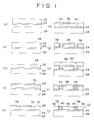
- an N + dopant such as of antimony (Sb), arsenic (Ar) or the like is buried and diffused to a mirror polished surfaceof a single crystal silicon substrate or bond substrate 22 of a (110) plane as the main crystl plane as shown in FIG. 1(a), followed by formation of a dielectric film 24 of silicon dioxide (SiO2) over that surface of the bond substrate 22 as by thermal oxidation.
- SiO2 silicon dioxide
- the single crystal silicon bond substrate 22 has a (110) crystal plane in place of the prior art substrate of a (100) plane.
- the bond substrate 22 is contacted with another substrate or base substrate 26 with their mirror polished surface opposed to each other and thereafter bonded together into an integral structure 28 at above 200°C as depicted in FIG. 1(b).
- the substrate 22 of the structure 28 is ground and polished to a thickness of 30 to 50 ⁇ m [FIG. 1(c)], followed by formation of oxide film 30 of nearly 0.6 ⁇ m in thickness, for subsequent photo-lithography, over an outer surface of the substrate 22 as through thermal oxidation [FIG. 1(d)].
- Small openings or windows 32 are formed photo-lithographically selectively in the oxide film 30 according to an isolation mask pattern [FIG.
- isolation oxide film 38 is then disposed in a thickness of about 2 ⁇ m and over both the islands and the moats [FIG. 1(g)].
- a polycrystalline silicon layer 40 is then disposed over the oxide film 38 in a thickness of 40 to 80 ⁇ m [FIG. 1(h)], whereupon lapping is effected from toward the silicon layer 40 with the oxide film 38 being used as a stopper layer [FIG. 1(i)].
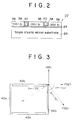
- a dielectrically isolated substrate D2 is obtained by finally removing the oxide film 38 [FIGS. 1(j) and 2].
- the vertically walled moats 34 can be formed by anisotropic etching with the result that the resulting islands 36 are substantially square in shape and highly large in area.
- the formation of such vertical moat permits a smaller width of the window 32 in contrast to the V-shaped recess of the prior art, resulting in greater effective area of the bond substrate 22.
- a pair of rectangular members 42a, 42a of large width and a pair of rectangular members 42b, 42b of small width are arranged substantially in a square shape and as the mask pattern.
- the members 42a, 42a are spaced apart as predetermined in parallel to the ⁇ 111 ⁇ orientation, whereas the members 42b, 42b are spaced apart as predetermined at right angles to the ⁇ 111 ⁇ orientation.
- the members 42a, 42a correpond to the ⁇ 111 ⁇ orientation and the members 42b, 42b to the ⁇ 112 ⁇ orientation as better seen from FIG. 3.
- the (111) plane arranged vertically to the ⁇ 111 ⁇ orientation is positioned at right angles to the bond substrate 22.
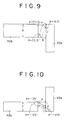
- Anisotropic etching progresses by far more slowly on the (111) plane than on the (110) plane so that a moat 34b is formed on the (111) plane, which moat is provided with a substantially vertical wall along a window 32b defined by the mask pattern members 42b, 42b as shown in FIGS. 11 and 12.
- the (112) plane M vertical to the ⁇ 112 ⁇ orientation is likewise at right angles to the bond substrate 22.
- the etch rate on the (112) plane M is nearly 0.2 to 0.3 time that on the (110) plane.
- a moat 34a is formed also with a vertical wall but with a greater width than that of a window 32a defined by the members 42a, 42a (FIG. 4); that is, the width of the moat 34a is a sum of the window width and a width of 0.4 to 0.6 time the moat depth.
- FIGS. 13a to 13j the (100) plane, single crystal silicon substrate 2 of the prior art has a greater width than its depth, say a balance of a square root of 2. This means that the invention differs substantially from the prior art.
- the structure D2 of the invention is incomparably larger in island area than the structure D1 of the prior art.
- the island region according to the invention is derived from forming the above noted moat by means of the above specified mask pattern.
- the (111) plane of an extremely low etch rate is present in the transverse direction.
- Anisotropic etching gives the vertically walled moat 34b along the window 32b.
- the (112) plane extends transversely. In this instance, etching is possible also along the width of the window 32a, whereby the moat 34a is formed with a greater width than the window width as stated above (FIG. 4).
- Arrangements of the mask pattern members 42a and 42b should be determined taking the etch rate along the width on the (112) plane in view.
- the members 42a and 42b when arranged too away from each other at their opposite ends cannot be united even after etching so that no island is formed. Initial contact or nearer positioning of both members causes a square island to be excessively etched at its corner portions and rather rounded, leading to narrow effective area of the island.
- a (111) plane N is present which is at an angle of about 70.5° to the (111) plane vertical to the (110) plane and at a right angle to the (110) plane.
- the (111) plane N develops upon alkaline etching for example with the addition of KOH, 50% by weight solution, at 80°C and with the use of the mask pattern members 42a and 42b. Etching ceases continuing at the (111) plane N for its extremely small etch rate.
- the moats 34a and 34b therefore, will in some cases fail to contact with each other depending upon the relationship between the width l of the member 42b and the end distance X of the members 42a and 42b (FIG. 11). Such failure will occur at the circle (a) in FIG. 5.
Landscapes
- Element Separation (AREA)
Applications Claiming Priority (2)
| Application Number | Priority Date | Filing Date | Title |
|---|---|---|---|
| JP310723/90 | 1990-11-16 | ||
| JP2310723A JPH0775245B2 (ja) | 1990-11-16 | 1990-11-16 | 誘電体分離基板及びその製造方法 |
Publications (2)
| Publication Number | Publication Date |
|---|---|
| EP0485719A2 true EP0485719A2 (de) | 1992-05-20 |
| EP0485719A3 EP0485719A3 (en) | 1995-12-27 |
Family
ID=18008705
Family Applications (1)
| Application Number | Title | Priority Date | Filing Date |
|---|---|---|---|
| EP91116144A Ceased EP0485719A3 (en) | 1990-11-16 | 1991-09-23 | Dielectrically isolated substrate and a process for producing the same |
Country Status (3)
| Country | Link |
|---|---|
| US (1) | US5336634A (de) |
| EP (1) | EP0485719A3 (de) |
| JP (1) | JPH0775245B2 (de) |
Cited By (2)
| Publication number | Priority date | Publication date | Assignee | Title |
|---|---|---|---|---|
| WO1994014192A1 (en) * | 1992-12-16 | 1994-06-23 | International Business Machines Corporation | Thin soi layer for fully depleted field effect transistors |
| EP1884994A3 (de) * | 2006-08-03 | 2010-08-04 | Shinko Electric Industries Co., Ltd. | Halbleiterbauelement und Verfahren zu seiner Herstellung |
Families Citing this family (16)
| Publication number | Priority date | Publication date | Assignee | Title |
|---|---|---|---|---|
| EP0612438A1 (de) * | 1991-11-15 | 1994-08-31 | Analog Devices, Inc. | Verfahren zur herstellung von isolator-gefüllten tiefengräben in halbleitersubstraten |
| US5525536A (en) * | 1991-12-26 | 1996-06-11 | Rohm Co., Ltd. | Method for producing SOI substrate and semiconductor device using the same |
| US5382541A (en) * | 1992-08-26 | 1995-01-17 | Harris Corporation | Method for forming recessed oxide isolation containing deep and shallow trenches |
| KR0162510B1 (ko) * | 1993-07-12 | 1999-02-01 | 가네꼬 히사시 | 반도체 장치 및 그 제조방법 |
| US5472902A (en) * | 1994-03-21 | 1995-12-05 | United Microelectronics Corp. | Silicon-on-insulator isolation technology using liquid phase deposition |
| JPH07326664A (ja) * | 1994-05-31 | 1995-12-12 | Fuji Electric Co Ltd | ウエハの誘電体分離溝の充填方法 |
| JPH07326663A (ja) * | 1994-05-31 | 1995-12-12 | Fuji Electric Co Ltd | ウエハの誘電体分離方法 |
| US5637513A (en) * | 1994-07-08 | 1997-06-10 | Nec Corporation | Fabrication method of semiconductor device with SOI structure |
| US5883012A (en) * | 1995-12-21 | 1999-03-16 | Motorola, Inc. | Method of etching a trench into a semiconductor substrate |
| KR100468712B1 (ko) * | 1998-06-19 | 2005-04-06 | 삼성전자주식회사 | 열산화 공정을 포함하지 않는 반도체장치의 트렌치 소자분리방법 |
| KR100318467B1 (ko) * | 1998-06-30 | 2002-02-19 | 박종섭 | 본딩형실리콘이중막웨이퍼제조방법 |
| US6696707B2 (en) | 1999-04-23 | 2004-02-24 | Ccp. Clare Corporation | High voltage integrated switching devices on a bonded and trenched silicon substrate |
| US6566223B1 (en) | 2000-08-15 | 2003-05-20 | C. P. Clare Corporation | High voltage integrated switching devices on a bonded and trenched silicon substrate |
| DE10246949B4 (de) * | 2002-10-08 | 2012-06-28 | X-Fab Semiconductor Foundries Ag | Verbesserte Trench-Isolation und Herstellungsverfahren |
| US8088293B2 (en) * | 2004-07-29 | 2012-01-03 | Micron Technology, Inc. | Methods of forming reticles configured for imprint lithography |
| US7323387B2 (en) * | 2004-11-12 | 2008-01-29 | Seagate Technology Llc | Method to make nano structure below 25 nanometer with high uniformity on large scale |
Citations (1)
| Publication number | Priority date | Publication date | Assignee | Title |
|---|---|---|---|---|
| EP0296754A2 (de) * | 1987-06-18 | 1988-12-28 | Kabushiki Kaisha Toshiba | Verfahren zur Herstellung von Halbleiteranordnungen mit Gräben als Isolationszonen |
Family Cites Families (12)
| Publication number | Priority date | Publication date | Assignee | Title |
|---|---|---|---|---|
| GB1288278A (de) * | 1968-12-31 | 1972-09-06 | ||
| US3780426A (en) * | 1969-10-15 | 1973-12-25 | Y Ono | Method of forming a semiconductor circuit element in an isolated epitaxial layer |
| US4238762A (en) * | 1974-04-22 | 1980-12-09 | Rockwell International Corporation | Electrically isolated semiconductor devices on common crystalline substrate |
| US4131910A (en) * | 1977-11-09 | 1978-12-26 | Bell Telephone Laboratories, Incorporated | High voltage semiconductor devices |
| US4140558A (en) * | 1978-03-02 | 1979-02-20 | Bell Telephone Laboratories, Incorporated | Isolation of integrated circuits utilizing selective etching and diffusion |
| JPS62203364A (ja) * | 1986-03-03 | 1987-09-08 | Nec Corp | 半導体装置の製造方法 |
| US5024953A (en) * | 1988-03-22 | 1991-06-18 | Hitachi, Ltd. | Method for producing opto-electric transducing element |
| JP2685819B2 (ja) * | 1988-03-31 | 1997-12-03 | 株式会社東芝 | 誘電体分離半導体基板とその製造方法 |
| JPH01253265A (ja) * | 1988-03-31 | 1989-10-09 | Sharp Corp | 半導体装置 |
| JPH0656865B2 (ja) * | 1988-10-13 | 1994-07-27 | 株式会社東芝 | 高耐圧素子用接着基板 |
| JPH02260442A (ja) * | 1989-03-30 | 1990-10-23 | Toshiba Corp | 誘電体分離型半導体基板 |
| JPH03192751A (ja) * | 1989-12-21 | 1991-08-22 | Fuji Electric Co Ltd | 張り合わせ基板を用いた半導体装置の製造方法 |
-
1990
- 1990-11-16 JP JP2310723A patent/JPH0775245B2/ja not_active Expired - Lifetime
-
1991
- 1991-09-23 EP EP91116144A patent/EP0485719A3/en not_active Ceased
-
1993
- 1993-03-02 US US08/025,256 patent/US5336634A/en not_active Expired - Fee Related
Patent Citations (1)
| Publication number | Priority date | Publication date | Assignee | Title |
|---|---|---|---|---|
| EP0296754A2 (de) * | 1987-06-18 | 1988-12-28 | Kabushiki Kaisha Toshiba | Verfahren zur Herstellung von Halbleiteranordnungen mit Gräben als Isolationszonen |
Cited By (2)
| Publication number | Priority date | Publication date | Assignee | Title |
|---|---|---|---|---|
| WO1994014192A1 (en) * | 1992-12-16 | 1994-06-23 | International Business Machines Corporation | Thin soi layer for fully depleted field effect transistors |
| EP1884994A3 (de) * | 2006-08-03 | 2010-08-04 | Shinko Electric Industries Co., Ltd. | Halbleiterbauelement und Verfahren zu seiner Herstellung |
Also Published As
| Publication number | Publication date |
|---|---|
| EP0485719A3 (en) | 1995-12-27 |
| US5336634A (en) | 1994-08-09 |
| JPH04181756A (ja) | 1992-06-29 |
| JPH0775245B2 (ja) | 1995-08-09 |
Similar Documents
| Publication | Publication Date | Title |
|---|---|---|
| EP0485719A2 (de) | Substrat mit dielektrischer Isolation und Verfahren zu dessen Herstellung | |
| EP0444942B1 (de) | Verbundenes Plättchen und dessen Herstellungsverfahren | |
| US5084408A (en) | Method of making complete dielectric isolation structure in semiconductor integrated circuit | |
| US6509139B1 (en) | Method of fabricating an integrated optical component | |
| US4890370A (en) | Manufacturing method for integrated resonator | |
| US5589083A (en) | Method of manufacturing microstructure by the anisotropic etching and bonding of substrates | |
| EP0820094A2 (de) | Passivierter P-N-Übergang in einer Mesa-Halbleiterstruktur | |
| EP0485720A2 (de) | Substrat mit dielektrischer Isolation und Verfahren für dessen Herstellung | |
| EP0616573B1 (de) | Beschneiden der breite eines grabens | |
| US5286341A (en) | Process for producing micro-mechanical structures | |
| US3974006A (en) | Method of obtaining high temperature resistant assemblies comprising isolated silicon islands bonded to a substrate | |
| US6846087B2 (en) | Micromirror having counterbalancing structures and method for manufacturing same | |
| JP3160966B2 (ja) | Soi基板の製造方法 | |
| EP0052948A1 (de) | Herstellung von Oxid-Isolationen | |
| JPH03265153A (ja) | 誘電体分離基板およびこれを用いた半導体集積回路装置 | |
| KR0119275B1 (ko) | 기판접합기술을 이용한 서로 다른 활성층 두께를 갖는 soi구조의 기판 제조방법 | |
| JP2590480B2 (ja) | 半導体装置の製造方法 | |
| JPH04102066A (ja) | 加速度センサ及びその製造方法 | |
| JP3493289B2 (ja) | 誘電体分離基板の製造方法 | |
| JP2762501B2 (ja) | 半導体基板の製法 | |
| JP2813921B2 (ja) | 半導体積層基板の製造方法 | |
| JPS6336545A (ja) | 絶縁分離型半導体装置の製造方法 | |
| JPH0521590A (ja) | 誘電体分離基板の製造方法 | |
| JPS616824A (ja) | 半導体基板目合せ法 | |
| JP2769072B2 (ja) | 絶縁層分離基板の製造方法 |
Legal Events
| Date | Code | Title | Description |
|---|---|---|---|
| PUAI | Public reference made under article 153(3) epc to a published international application that has entered the european phase |
Free format text: ORIGINAL CODE: 0009012 |
|
| AK | Designated contracting states |
Kind code of ref document: A2 Designated state(s): DE FR GB |
|
| PUAL | Search report despatched |
Free format text: ORIGINAL CODE: 0009013 |
|
| AK | Designated contracting states |
Kind code of ref document: A3 Designated state(s): DE FR GB |
|
| 17P | Request for examination filed |
Effective date: 19960313 |
|
| 17Q | First examination report despatched |
Effective date: 19960418 |
|
| GRAG | Despatch of communication of intention to grant |
Free format text: ORIGINAL CODE: EPIDOS AGRA |
|
| RTI1 | Title (correction) |
Free format text: PRODUCTION OF A DIELECTRICALLY ISOLATED SUBSTRATE |
|
| STAA | Information on the status of an ep patent application or granted ep patent |
Free format text: STATUS: THE APPLICATION HAS BEEN REFUSED |
|
| 18R | Application refused |
Effective date: 19991212 |