EP3197982B1 - Materialien für organische elektrolumineszenzvorrichtungen - Google Patents
Materialien für organische elektrolumineszenzvorrichtungen Download PDFInfo
- Publication number
- EP3197982B1 EP3197982B1 EP15762485.9A EP15762485A EP3197982B1 EP 3197982 B1 EP3197982 B1 EP 3197982B1 EP 15762485 A EP15762485 A EP 15762485A EP 3197982 B1 EP3197982 B1 EP 3197982B1
- Authority
- EP
- European Patent Office
- Prior art keywords
- substituted
- radicals
- instance
- same
- different
- Prior art date
- Legal status (The legal status is an assumption and is not a legal conclusion. Google has not performed a legal analysis and makes no representation as to the accuracy of the status listed.)
- Active
Links
- 0 *(**1)*C2=C1C(****1)=C1**2 Chemical compound *(**1)*C2=C1C(****1)=C1**2 0.000 description 25
- TXJUTRJFNRYTHH-UHFFFAOYSA-N O=C(c(cccc1)c1N1)OC1=O Chemical compound O=C(c(cccc1)c1N1)OC1=O TXJUTRJFNRYTHH-UHFFFAOYSA-N 0.000 description 2
- USUHABSJTQRUHV-QWHCGFSZSA-N C([C@@H]1C=CCC2)[C@]12C1=CCCCC1 Chemical compound C([C@@H]1C=CCC2)[C@]12C1=CCCCC1 USUHABSJTQRUHV-QWHCGFSZSA-N 0.000 description 1
- HROGOZYPTVEHNE-SDRXPFJLSA-N CC(C)(c1ccccc1-c1c2)c1cc1c2c2ccccc2[n]1-c(cc1)ccc1C(N(c1ccccc1)C(/C1=C/C)=O)=N/C1=C/C Chemical compound CC(C)(c1ccccc1-c1c2)c1cc1c2c2ccccc2[n]1-c(cc1)ccc1C(N(c1ccccc1)C(/C1=C/C)=O)=N/C1=C/C HROGOZYPTVEHNE-SDRXPFJLSA-N 0.000 description 1
- NJRDUIDXYJHOHF-UHFFFAOYSA-N CC(C=C1)(C=C2Oc(cccc3)c3-[n]3c2c1c1c3cccc1)N Chemical compound CC(C=C1)(C=C2Oc(cccc3)c3-[n]3c2c1c1c3cccc1)N NJRDUIDXYJHOHF-UHFFFAOYSA-N 0.000 description 1
- DYJGCEKUAHGFRJ-UHFFFAOYSA-N CC1(C)c(cc(cc2)N(c(cc3)ccc3-c3ccccc3)c(cc3)ccc3C(N3c4ccccc4)=Nc(cccc4)c4C3=O)c2-c2ccccc12 Chemical compound CC1(C)c(cc(cc2)N(c(cc3)ccc3-c3ccccc3)c(cc3)ccc3C(N3c4ccccc4)=Nc(cccc4)c4C3=O)c2-c2ccccc12 DYJGCEKUAHGFRJ-UHFFFAOYSA-N 0.000 description 1
- UAVZDBIKIOWDQF-UHFFFAOYSA-N CC1(C)c(cc2[nH]c(cccc3)c3c2c2)c2-c2ccccc12 Chemical compound CC1(C)c(cc2[nH]c(cccc3)c3c2c2)c2-c2ccccc12 UAVZDBIKIOWDQF-UHFFFAOYSA-N 0.000 description 1
- UZLCQFNJFJPIGC-UHFFFAOYSA-N CN(C=CC=C1)C=C1c1cccc2c1c(cccc1)c1[s]2 Chemical compound CN(C=CC=C1)C=C1c1cccc2c1c(cccc1)c1[s]2 UZLCQFNJFJPIGC-UHFFFAOYSA-N 0.000 description 1
- BAFSAEHBRQWKGW-UHFFFAOYSA-N CN1C=C(c2c3[n]4c(cccc5)c5c3ccc2)C4=CC=C1 Chemical compound CN1C=C(c2c3[n]4c(cccc5)c5c3ccc2)C4=CC=C1 BAFSAEHBRQWKGW-UHFFFAOYSA-N 0.000 description 1
- LIFIQXHGJGVZTK-UHFFFAOYSA-N CN1C=C(c2cccc3c2N2c4ccccc4O3)C2=CC=C1 Chemical compound CN1C=C(c2cccc3c2N2c4ccccc4O3)C2=CC=C1 LIFIQXHGJGVZTK-UHFFFAOYSA-N 0.000 description 1
- POCPHLKLLNNKRU-NDDJRJHUSA-N C[C@@H](C1CNC(C2=CCCCC2)N)C=CC[C@@H]1C(Cc(cc1)ccc1Br)=O Chemical compound C[C@@H](C1CNC(C2=CCCCC2)N)C=CC[C@@H]1C(Cc(cc1)ccc1Br)=O POCPHLKLLNNKRU-NDDJRJHUSA-N 0.000 description 1
- NPZVGZHACILNNG-UHFFFAOYSA-N NN1c2ccccc2OC2C=CC=CC12 Chemical compound NN1c2ccccc2OC2C=CC=CC12 NPZVGZHACILNNG-UHFFFAOYSA-N 0.000 description 1
- IIWGLJKIGXJBOB-UHFFFAOYSA-N NN1c2ccccc2SC2C=CC=CC12 Chemical compound NN1c2ccccc2SC2C=CC=CC12 IIWGLJKIGXJBOB-UHFFFAOYSA-N 0.000 description 1
- DSENCQIIXFNSDN-UHFFFAOYSA-N O=C(c(cc(cc1)-c2ccccc2)c1N1)OC1=O Chemical compound O=C(c(cc(cc1)-c2ccccc2)c1N1)OC1=O DSENCQIIXFNSDN-UHFFFAOYSA-N 0.000 description 1
- PFKBVCOTSCUYOE-UHFFFAOYSA-N O=C(c(cc(cc1)-c2ccccc2)c1NC1c2cc(-c3ccccc3)cc(-c3ccccc3)c2)N1c1ccccc1 Chemical compound O=C(c(cc(cc1)-c2ccccc2)c1NC1c2cc(-c3ccccc3)cc(-c3ccccc3)c2)N1c1ccccc1 PFKBVCOTSCUYOE-UHFFFAOYSA-N 0.000 description 1
- GOFKOFVAYWJFNG-UHFFFAOYSA-N O=C(c(ccc1c2cccc1)c2NC1c(cc2)ccc2Br)N1c1ccccc1 Chemical compound O=C(c(ccc1c2cccc1)c2NC1c(cc2)ccc2Br)N1c1ccccc1 GOFKOFVAYWJFNG-UHFFFAOYSA-N 0.000 description 1
- PODWGTPGHVNVMQ-UHFFFAOYSA-N O=C(c(ccc1c2cccn1)c2NC1c(cc2)ccc2Br)N1c1ccccc1 Chemical compound O=C(c(ccc1c2cccn1)c2NC1c(cc2)ccc2Br)N1c1ccccc1 PODWGTPGHVNVMQ-UHFFFAOYSA-N 0.000 description 1
- QMAJXAYYSIAFDM-UHFFFAOYSA-N O=C(c(ccc1cccnc11)c1NC1c(cc2)ccc2Br)N1c1ccccc1 Chemical compound O=C(c(ccc1cccnc11)c1NC1c(cc2)ccc2Br)N1c1ccccc1 QMAJXAYYSIAFDM-UHFFFAOYSA-N 0.000 description 1
- ZMQAIMHDUNEVRW-UHFFFAOYSA-N O=C(c(cccc1)c1NC1c(cc2)ccc2-[n](c2c3cccc2)c(cc2)c3c3c2c2ccccc2[n]3-c2ccccc2)N1c1ccccc1 Chemical compound O=C(c(cccc1)c1NC1c(cc2)ccc2-[n](c2c3cccc2)c(cc2)c3c3c2c2ccccc2[n]3-c2ccccc2)N1c1ccccc1 ZMQAIMHDUNEVRW-UHFFFAOYSA-N 0.000 description 1
- ZEELNLAZROFPQE-UHFFFAOYSA-N O=C(c(cccc1)c1NC1c(cc2)ccc2N(c2ccccc2)c2ccccc2)N1c1cc(-c2ccccc2)ccc1 Chemical compound O=C(c(cccc1)c1NC1c(cc2)ccc2N(c2ccccc2)c2ccccc2)N1c1cc(-c2ccccc2)ccc1 ZEELNLAZROFPQE-UHFFFAOYSA-N 0.000 description 1
- FGRNSTASXWYMQT-UHFFFAOYSA-N O=C(c(cccc1)c1NC1c2cc(C(Nc3ccccc33)N(c4ccccc4)C3=O)ccc2)N1c1ccccc1 Chemical compound O=C(c(cccc1)c1NC1c2cc(C(Nc3ccccc33)N(c4ccccc4)C3=O)ccc2)N1c1ccccc1 FGRNSTASXWYMQT-UHFFFAOYSA-N 0.000 description 1
- OJEXREHHCKOWAB-UHFFFAOYSA-N O=C(c1cccc(-c2cccc3c2NC(c2cc(-c4ccccc4)ccc2)N(c2cc(-c4ccccc4)ccc2)C3=O)c1NC1c2cc(-c3ccccc3)ccc2)N1c1cccc(-c2ccccc2)c1 Chemical compound O=C(c1cccc(-c2cccc3c2NC(c2cc(-c4ccccc4)ccc2)N(c2cc(-c4ccccc4)ccc2)C3=O)c1NC1c2cc(-c3ccccc3)ccc2)N1c1cccc(-c2ccccc2)c1 OJEXREHHCKOWAB-UHFFFAOYSA-N 0.000 description 1
- UXYCOAWGNOCLGJ-UHFFFAOYSA-N O=C1N(c2cc(-c3ccccc3)ccc2)C(c(cc2)ccc2Br)=Nc(cc2)c1cc2-c1ccccc1 Chemical compound O=C1N(c2cc(-c3ccccc3)ccc2)C(c(cc2)ccc2Br)=Nc(cc2)c1cc2-c1ccccc1 UXYCOAWGNOCLGJ-UHFFFAOYSA-N 0.000 description 1
- XJBLFFPAERSTAA-UHFFFAOYSA-N O=C1N(c2ccccc2)C(c(cc2)ccc2-[n]2c3ccc(c4ccccc4[n]4-c5ccccc5)c4c3c3c2cccc3)=Nc2c1cccc2 Chemical compound O=C1N(c2ccccc2)C(c(cc2)ccc2-[n]2c3ccc(c4ccccc4[n]4-c5ccccc5)c4c3c3c2cccc3)=Nc2c1cccc2 XJBLFFPAERSTAA-UHFFFAOYSA-N 0.000 description 1
- UFPPWUXVKOWRCZ-UHFFFAOYSA-N O=C1N(c2ccccc2)C(c(cc2)ccc2-c(cc2)ccc2C(N2c3ccccc3)=Nc(cccc3)c3C2=O)=Nc2c1cccc2 Chemical compound O=C1N(c2ccccc2)C(c(cc2)ccc2-c(cc2)ccc2C(N2c3ccccc3)=Nc(cccc3)c3C2=O)=Nc2c1cccc2 UFPPWUXVKOWRCZ-UHFFFAOYSA-N 0.000 description 1
- SUISZCALMBHJQX-UHFFFAOYSA-N O=Cc1cc(Br)ccc1 Chemical compound O=Cc1cc(Br)ccc1 SUISZCALMBHJQX-UHFFFAOYSA-N 0.000 description 1
Classifications
-
- C—CHEMISTRY; METALLURGY
- C09—DYES; PAINTS; POLISHES; NATURAL RESINS; ADHESIVES; COMPOSITIONS NOT OTHERWISE PROVIDED FOR; APPLICATIONS OF MATERIALS NOT OTHERWISE PROVIDED FOR
- C09K—MATERIALS FOR MISCELLANEOUS APPLICATIONS, NOT PROVIDED FOR ELSEWHERE
- C09K11/00—Luminescent materials, e.g. electroluminescent or chemiluminescent
- C09K11/06—Luminescent materials, e.g. electroluminescent or chemiluminescent containing organic luminescent materials
-
- H—ELECTRICITY
- H10—SEMICONDUCTOR DEVICES; ELECTRIC SOLID-STATE DEVICES NOT OTHERWISE PROVIDED FOR
- H10K—ORGANIC ELECTRIC SOLID-STATE DEVICES
- H10K50/00—Organic light-emitting devices
- H10K50/10—OLEDs or polymer light-emitting diodes [PLED]
- H10K50/11—OLEDs or polymer light-emitting diodes [PLED] characterised by the electroluminescent [EL] layers
-
- H—ELECTRICITY
- H10—SEMICONDUCTOR DEVICES; ELECTRIC SOLID-STATE DEVICES NOT OTHERWISE PROVIDED FOR
- H10K—ORGANIC ELECTRIC SOLID-STATE DEVICES
- H10K50/00—Organic light-emitting devices
- H10K50/10—OLEDs or polymer light-emitting diodes [PLED]
- H10K50/14—Carrier transporting layers
- H10K50/16—Electron transporting layers
- H10K50/165—Electron transporting layers comprising dopants
-
- H—ELECTRICITY
- H10—SEMICONDUCTOR DEVICES; ELECTRIC SOLID-STATE DEVICES NOT OTHERWISE PROVIDED FOR
- H10K—ORGANIC ELECTRIC SOLID-STATE DEVICES
- H10K85/00—Organic materials used in the body or electrodes of devices covered by this subclass
- H10K85/30—Coordination compounds
- H10K85/341—Transition metal complexes, e.g. Ru(II)polypyridine complexes
- H10K85/342—Transition metal complexes, e.g. Ru(II)polypyridine complexes comprising iridium
-
- H—ELECTRICITY
- H10—SEMICONDUCTOR DEVICES; ELECTRIC SOLID-STATE DEVICES NOT OTHERWISE PROVIDED FOR
- H10K—ORGANIC ELECTRIC SOLID-STATE DEVICES
- H10K85/00—Organic materials used in the body or electrodes of devices covered by this subclass
- H10K85/30—Coordination compounds
- H10K85/341—Transition metal complexes, e.g. Ru(II)polypyridine complexes
- H10K85/346—Transition metal complexes, e.g. Ru(II)polypyridine complexes comprising platinum
-
- H—ELECTRICITY
- H10—SEMICONDUCTOR DEVICES; ELECTRIC SOLID-STATE DEVICES NOT OTHERWISE PROVIDED FOR
- H10K—ORGANIC ELECTRIC SOLID-STATE DEVICES
- H10K85/00—Organic materials used in the body or electrodes of devices covered by this subclass
- H10K85/60—Organic compounds having low molecular weight
- H10K85/615—Polycyclic condensed aromatic hydrocarbons, e.g. anthracene
-
- H—ELECTRICITY
- H10—SEMICONDUCTOR DEVICES; ELECTRIC SOLID-STATE DEVICES NOT OTHERWISE PROVIDED FOR
- H10K—ORGANIC ELECTRIC SOLID-STATE DEVICES
- H10K85/00—Organic materials used in the body or electrodes of devices covered by this subclass
- H10K85/60—Organic compounds having low molecular weight
- H10K85/649—Aromatic compounds comprising a hetero atom
- H10K85/657—Polycyclic condensed heteroaromatic hydrocarbons
- H10K85/6572—Polycyclic condensed heteroaromatic hydrocarbons comprising only nitrogen in the heteroaromatic polycondensed ring system, e.g. phenanthroline or carbazole
-
- H—ELECTRICITY
- H10—SEMICONDUCTOR DEVICES; ELECTRIC SOLID-STATE DEVICES NOT OTHERWISE PROVIDED FOR
- H10K—ORGANIC ELECTRIC SOLID-STATE DEVICES
- H10K85/00—Organic materials used in the body or electrodes of devices covered by this subclass
- H10K85/60—Organic compounds having low molecular weight
- H10K85/649—Aromatic compounds comprising a hetero atom
- H10K85/657—Polycyclic condensed heteroaromatic hydrocarbons
- H10K85/6576—Polycyclic condensed heteroaromatic hydrocarbons comprising only sulfur in the heteroaromatic polycondensed ring system, e.g. benzothiophene
-
- H—ELECTRICITY
- H10—SEMICONDUCTOR DEVICES; ELECTRIC SOLID-STATE DEVICES NOT OTHERWISE PROVIDED FOR
- H10K—ORGANIC ELECTRIC SOLID-STATE DEVICES
- H10K2101/00—Properties of the organic materials covered by group H10K85/00
- H10K2101/10—Triplet emission
-
- H—ELECTRICITY
- H10—SEMICONDUCTOR DEVICES; ELECTRIC SOLID-STATE DEVICES NOT OTHERWISE PROVIDED FOR
- H10K—ORGANIC ELECTRIC SOLID-STATE DEVICES
- H10K2102/00—Constructional details relating to the organic devices covered by this subclass
- H10K2102/301—Details of OLEDs
-
- Y—GENERAL TAGGING OF NEW TECHNOLOGICAL DEVELOPMENTS; GENERAL TAGGING OF CROSS-SECTIONAL TECHNOLOGIES SPANNING OVER SEVERAL SECTIONS OF THE IPC; TECHNICAL SUBJECTS COVERED BY FORMER USPC CROSS-REFERENCE ART COLLECTIONS [XRACs] AND DIGESTS
- Y02—TECHNOLOGIES OR APPLICATIONS FOR MITIGATION OR ADAPTATION AGAINST CLIMATE CHANGE
- Y02E—REDUCTION OF GREENHOUSE GAS [GHG] EMISSIONS, RELATED TO ENERGY GENERATION, TRANSMISSION OR DISTRIBUTION
- Y02E10/00—Energy generation through renewable energy sources
- Y02E10/50—Photovoltaic [PV] energy
- Y02E10/549—Organic PV cells
Definitions
- the present invention describes mixtures of quinazolinone derivatives and phosphorescent dopants, and the use of quinazolinone derivatives and triplet matrix materials in organic electroluminescent devices.
- the invention further relates to a method for producing the connections according to the invention and electronic devices containing these connections.
- OLEDs organic electroluminescent devices
- organic semiconductors organic semiconductors
- Organometallic complexes which show phosphorescence instead of fluorescence are frequently used as emitting materials.
- organometallic compounds as phosphorescence emitters up to four times the energy and power efficiency is possible.
- there is still a need for improvement in OLEDs in particular also in OLEDs which show triplet emission (phosphorescence), for example in terms of efficiency, operating voltage and service life.
- the properties of phosphorescent OLEDs are not only determined by the triplet emitters used.
- the other materials used, such as matrix materials, are particularly important here. Improvements in these materials can therefore lead to significant improvements in OLED properties.
- indolocarbazole derivatives e.g. according to WO 2007/063754 or WO 2008/056746
- indenocarbazole derivatives e.g. according to WO 2010/136109 or WO 2011/000455
- electron-poor heteroaromatics such as triazine
- bisdibenzofuran derivatives e.g. according to EP 2301926
- matrix materials for phosphorescent emitters.
- quinazolinone derivatives as materials for fluorescent OLEDs is described in JP2001250689A described.
- the object of the present invention is to provide compounds which are suitable for use in phosphorescent OLEDs, in particular as a matrix material.
- the bicyclic formula (3) is also referred to as the quinazolinone backbone to which R 1 , R 2 or R 3 bind.
- An aryl group in the sense of this invention contains 6 to 60 C atoms;
- a heteroaryl group in the sense of this invention contains 2 to 60 carbon atoms and at least one heteroatom, with the proviso that the sum of carbon atoms and heteroatoms is at least 5.
- the heteroatoms are preferably selected from N, O and / or S.
- an aryl group or heteroaryl group is either a simple aromatic cycle, i.e. benzene, or a simple heteroaromatic cycle, for example thiophene, etc., or a condensed (fused)
- Aryl or heteroaryl group for example naphthalene, anthracene, phenanthrene, dibenzofuran, etc., understood.
- Aromatics linked to one another by a single bond, such as, for example, biphenyl are not referred to as an aryl or heteroaryl group, but rather as an aromatic ring system.
- An aromatic ring system in the sense of this invention contains 6 to 80 carbon atoms in the ring system.
- a heteroaromatic ring system in the sense of this invention contains 2 to 60 carbon atoms and at least one heteroatom in the ring system, with the proviso that the sum of carbon atoms and heteroatoms results in at least 5.
- the heteroatoms are preferably selected from N, O and / or S.
- An aromatic or heteroaromatic ring system in the sense of this invention is to be understood as a system which does not necessarily contain only aryl or heteroaryl groups, but also in which a plurality of aryl or heteroaryl groups a non-aromatic unit (preferably less than 10% of the atoms other than H), such as. B.
- a C, N or O atom may be connected.
- systems such as fluorene, 9,9'-spirobifluorene, 9,9-diarylfluorene, triarylamine, diaryl ether, stilbene, etc. should also be understood as aromatic ring systems in the sense of this invention, and also systems in which two or more aryl groups, for example are connected by a short alkyl group.
- aromatics linked to one another by single bond such as Example biphenyl, referred to as an aromatic ring system in the sense of this application.
- An electron-deficient heteroaryl group in the sense of the present invention is defined as a 5-ring heteroaryl group with at least two heteroatoms, for example imidazole, oxazole, oxadiazole, etc., or as a 6-ring heteroaryl group with at least one heteroatom, for example pyridine, pyrimidine, pyrazine, Triazine, etc.
- further 6-ring aryl or 6-ring heteroaryl groups can also be fused onto these groups, for example in benzimidazole or quinoline.
- an aliphatic hydrocarbon radical or an alkyl group or an alkenyl or alkynyl group which can typically contain 1 to 40 or also 1 to 20 C atoms, and in which individual H atoms or CH 2 - Groups can be substituted by the above groups, preferably the radicals methyl, ethyl, n-propyl, i-propyl, n-butyl, i-butyl, s-butyl, t-butyl, 2-methylbutyl, n-pentyl, s -Pentyl, cyclopentyl, n-hexyl, cyclohexyl, n-heptyl, cycloheptyl, n-octyl, cyclooctyl, 2-ethylhexyl, trifluoromethyl, pentafluoroethyl, 2,2,2-trifluoroethyl, ethyl, ethyl
- An alkoxy group with 1 to 40 C atoms is preferably methoxy, trifluoromethoxy, ethoxy, n-propoxy, i-propoxy, n-butoxy, i-butoxy, s-butoxy, t-butoxy, n-pentoxy, s-pentoxy, 2-methylbutoxy, n-hexoxy, cyclohexyloxy, n-heptoxy, cycloheptyloxy, n-octyloxy, cyclooctyloxy, 2-ethylhexyloxy, pentafluoroethoxy and 2,2,2-trifluoroethoxy understood.
- a thioalkyl group with 1 to 40 carbon atoms includes in particular methylthio, ethylthio, n-propylthio, i-propylthio, n-butylthio, i-butylthio, s-butylthio, t-butylthio, n-pentylthio, s-pentylthio, n- Hexylthio, cyclohexylthio, n-heptylthio, cycloheptylthio, n-octylthio, cyclooctylthio, 2-ethylhexylthio, trifluoromethylthio, pentafluoroethylthio, 2,2,2-trifluorethylthio, ethenylthio, propenylthio, butenylthio, pentenylthio, pentenylthio, penteny
- alkyl, alkenyl, alkynyl, alkoxy or thioalkyl groups according to the present invention can be straight-chain, branched or cyclic, it being possible for one or more non-adjacent CH 2 groups to be replaced by the above-mentioned groups; Furthermore, one or more H atoms can also be replaced by D, F, Cl, Br, I, CN or NO 2 , preferably F, Cl or CN, more preferably F or CN, particularly preferably CN.
- An aromatic or heteroaromatic ring system with 5 to 80 aromatic ring atoms, which can be substituted in each case with the radicals mentioned above and which can be linked via any position on the aromatic or heteroaromatic, is understood in particular to be groups derived from benzene, naphthalene , Anthracene, benzanthracene, phenanthrene, benzphenanthrene, pyrene, chrysene, perylene, fluoranthene, naphthacene, pentacene, benzpyrene, biphenyl, biphenylene, terphenyl, triphenylene, fluorene, spirobifluorene, dihydrophenanthrene, dihydropyrene, tetrahydropene, cetrahydropene, cetrahydropene or trans-indenocarbazole, cis or trans-indolocarbazole, Truxen, Isotruxen, Spirotruxen,
- An aryloxy group as defined in the present invention means an aryl group as defined above which is bonded via an oxygen atom.
- An analogous definition applies to heteroaryloxy groups.
- An electron-deficient heteroaryl group in the sense of the present invention is defined as a 5-ring heteroaryl group with at least two heteroatoms, for example imidazole, oxazole, oxadiazole, etc., or as a 6-ring heteroaryl group with at least one heteroatom, for example pyridine, pyrimidine, pyrazine, Triazine, etc. Further 6-ring aryl or 6-ring heteroaryl groups can also be fused onto these groups, for example in benzimidazole or quinoline.
- the above-mentioned formulation should also be understood to mean that in the event that one of the two radicals is hydrogen, the second radical binds to the position to which the hydrogen atom was bonded, forming a ring. This is illustrated by the following scheme:
- a maximum of 1 X in formula (1) or in a quinazolinone backbone in formula (2) are N. Particularly preferably no X in formula (1) or formula (2) is N.
- the compound does not comprise an aryl group or heteroaryl group with more than 22 aromatic ring atoms.
- the groups R 1 , R 2 and R 3 are the same or different in each occurrence and, in the case of an aromatic or heteroaromatic ring system, are selected in each occurrence from the groups with the following formulas (Ar-1) to (Ar -27) the symbols and indices are as described above.
- 0, 1, 2 or 3 symbols Q in the formula (Ar-1) are N.
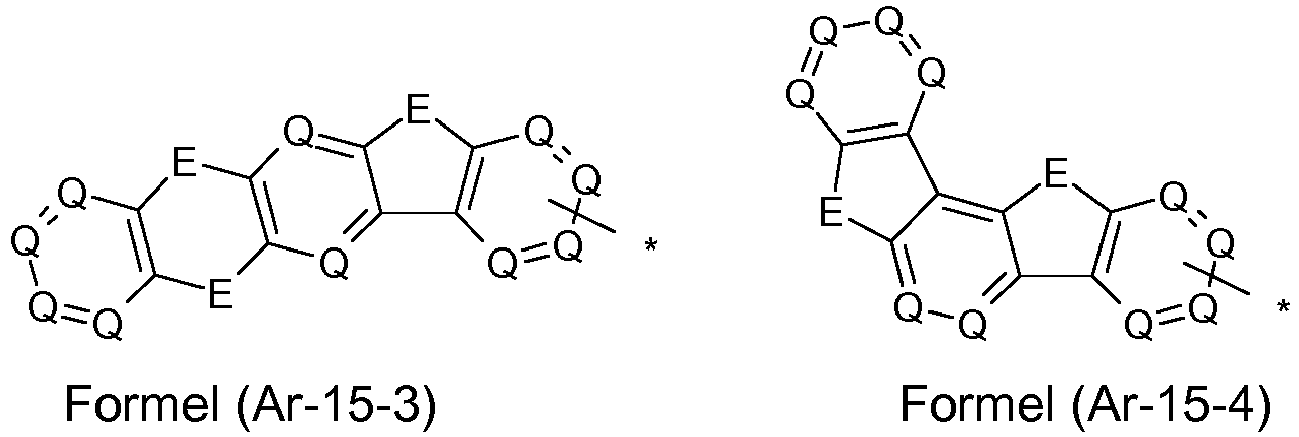
- Preferred embodiments of the formula (Ar-15) show the following formulas (Ar-15-1) to (Ar-15-7): where the symbols correspond to the symbols of the formula (Ar-15).
- Q is always particularly preferably CR 4 .
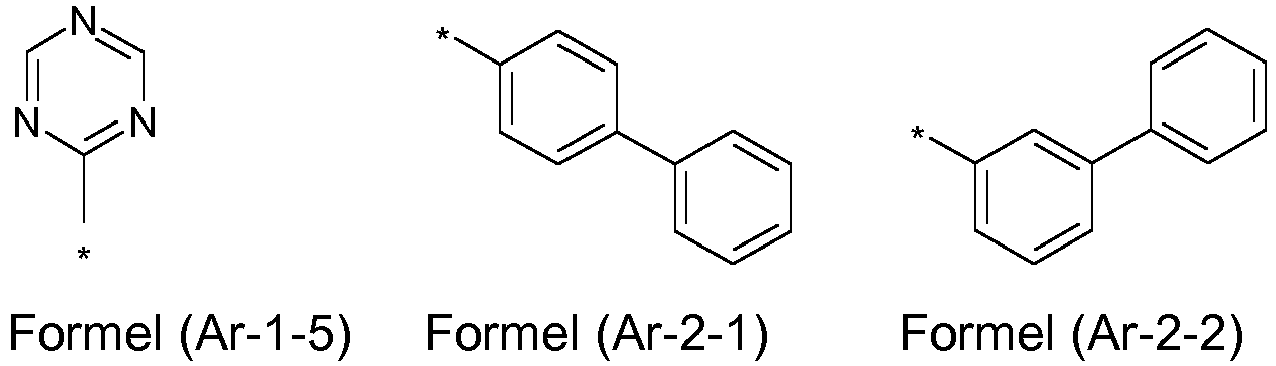
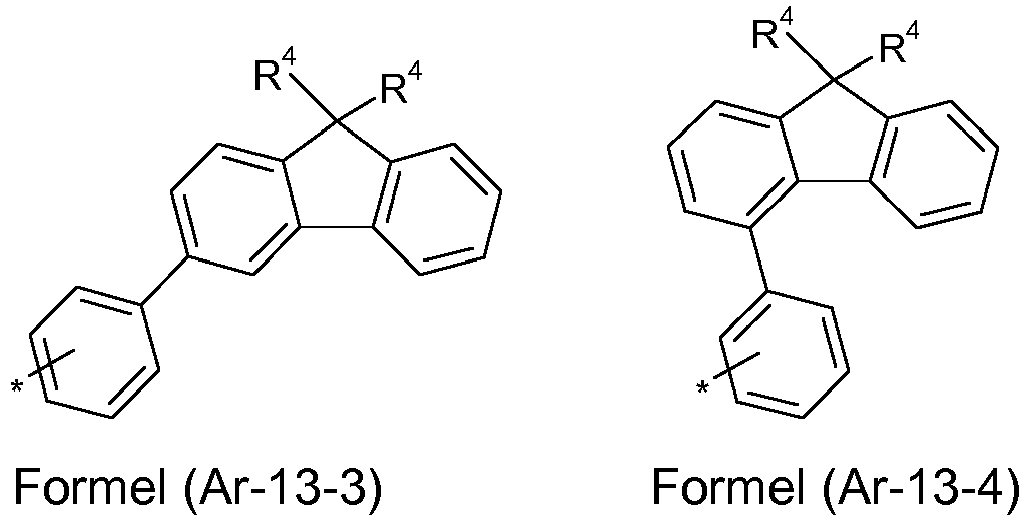
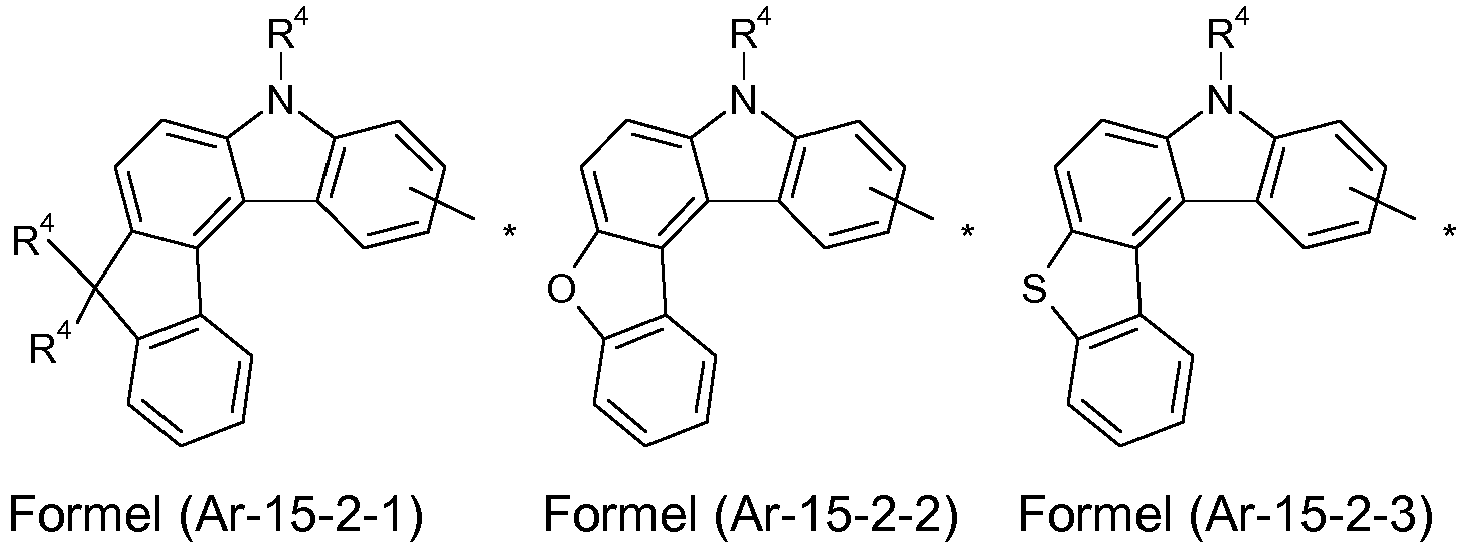
- the groups R 1 , R 2 and R 3 are the same or different with each occurrence and, in the case of an aromatic or heteroaromatic ring system, are selected with each occurrence selected from the groups with the structures of the formulas (Ar-1) to ( Ar-24), the general formulas being replaced by the particularly preferred embodiments in each case according to the following formulas (Ar-1-1) to (Ar-21-1) (for example, formula (Ar-1) is replaced by a of the formulas (Ar-1-1) to (Ar-1-9) replaced): where the symbols correspond to the symbols in formulas (Ar-1) to (Ar-26).
- the formulas can be substituted with R 4 at the free positions.
- the groups R 3 are selected from the groups of one of the following formulas (Ar1-1) to (Ar1-7), the general formulas being in each case corresponding to the following formulas (Ar1-1- 1) to (Ar1-6-1) are replaced (e.g. formula (Ar1-1) is replaced by formulas (Ar1-1-1)): where the symbols correspond to the symbols in the formulas (Ar1-1) to (Ar1-5).
- the formulas can be substituted with R 4 at the free positions.
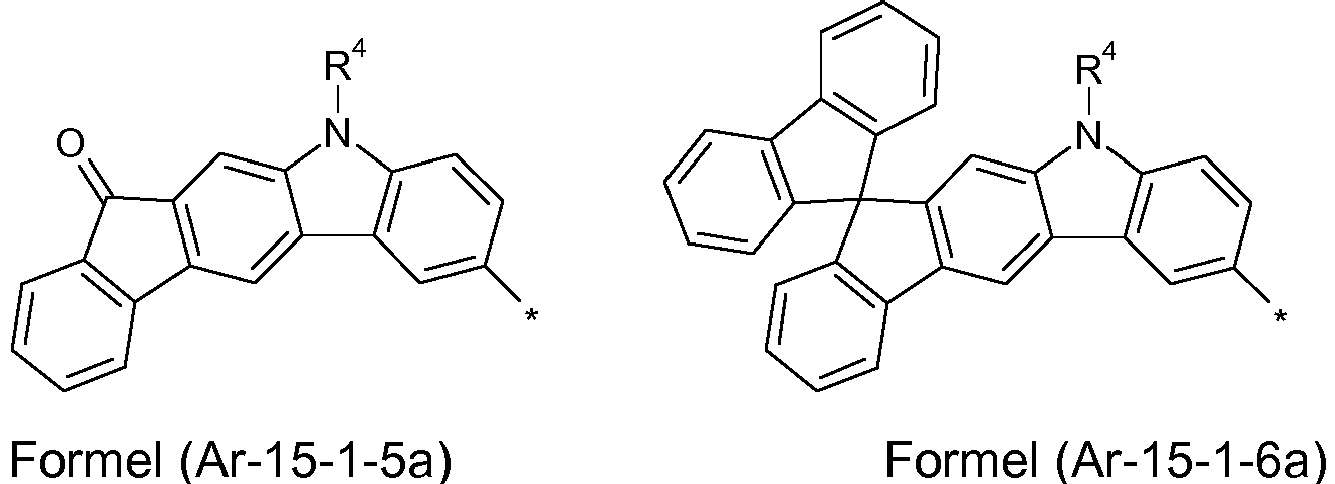
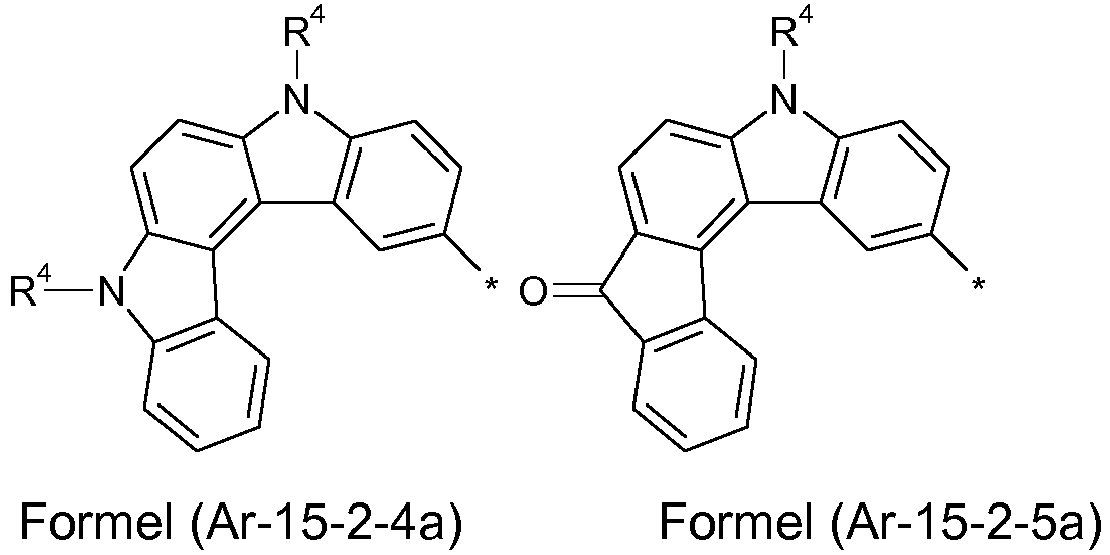
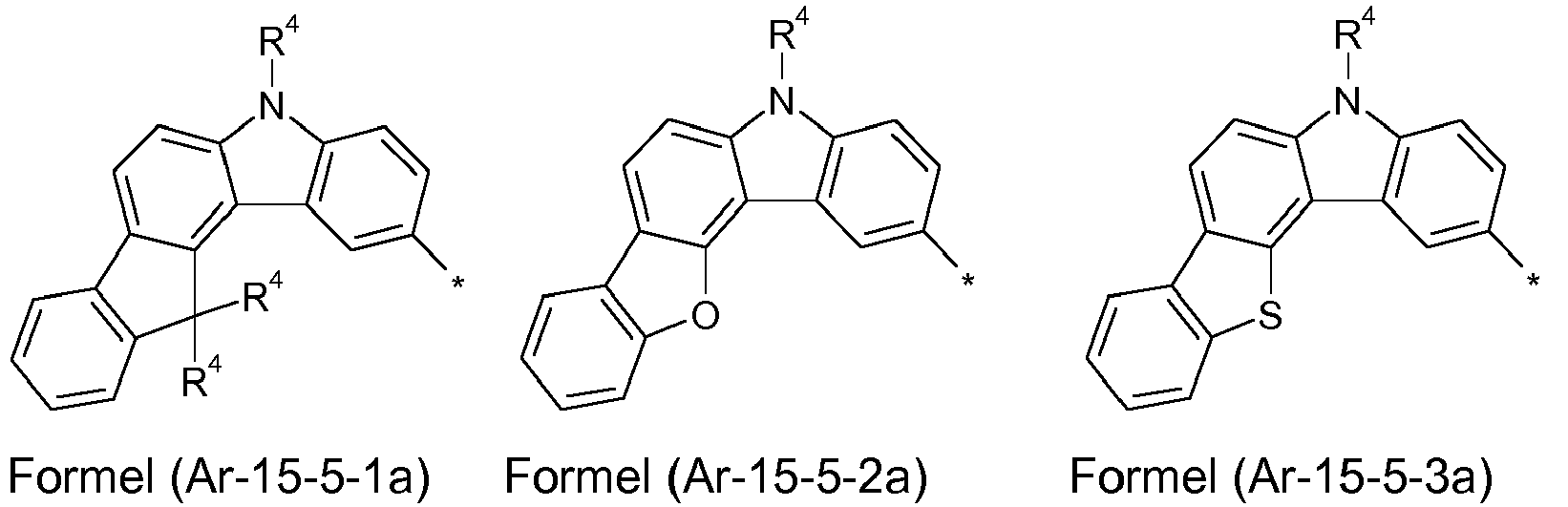
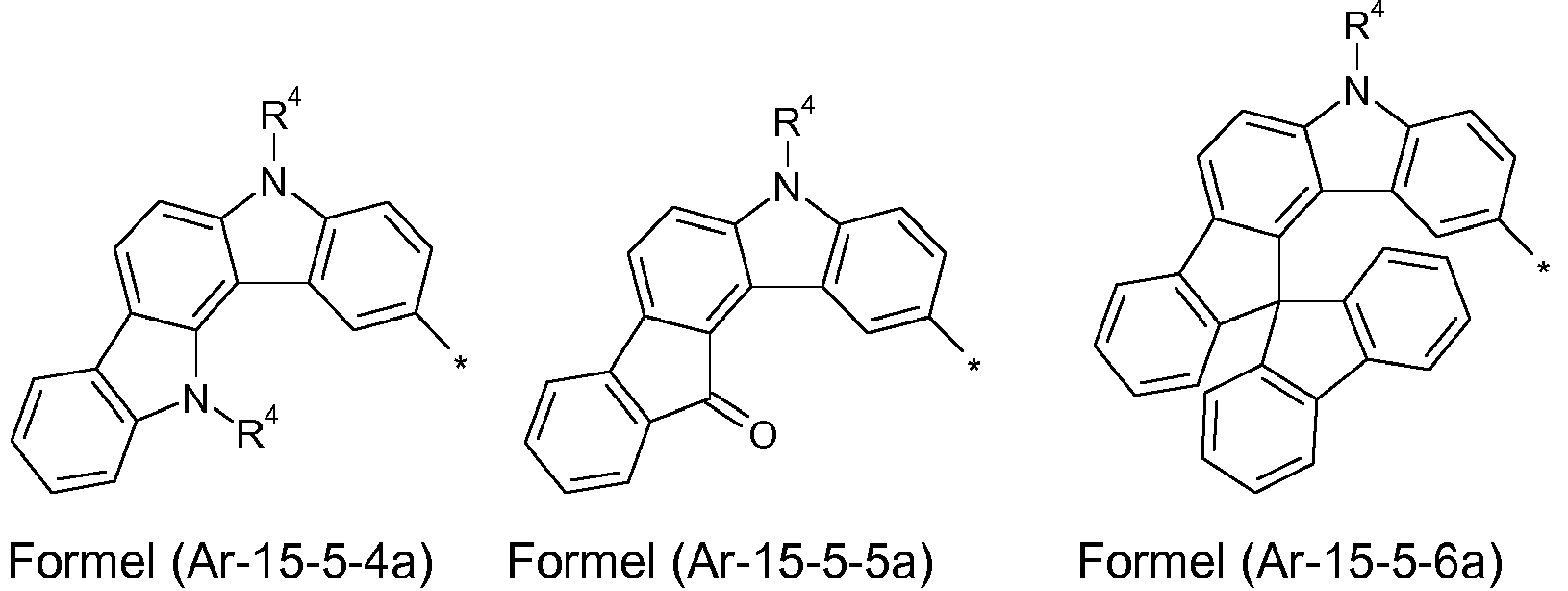
- the groups of the formula (Ar-15) or their preferred embodiments are selected from the groups of one of the formulas (Ar-15-1-1a) to (Ar-15-7-6a) where the symbols correspond to the symbols in formula (Ar-15).
- the formulas can be substituted with R 4 at the free positions.
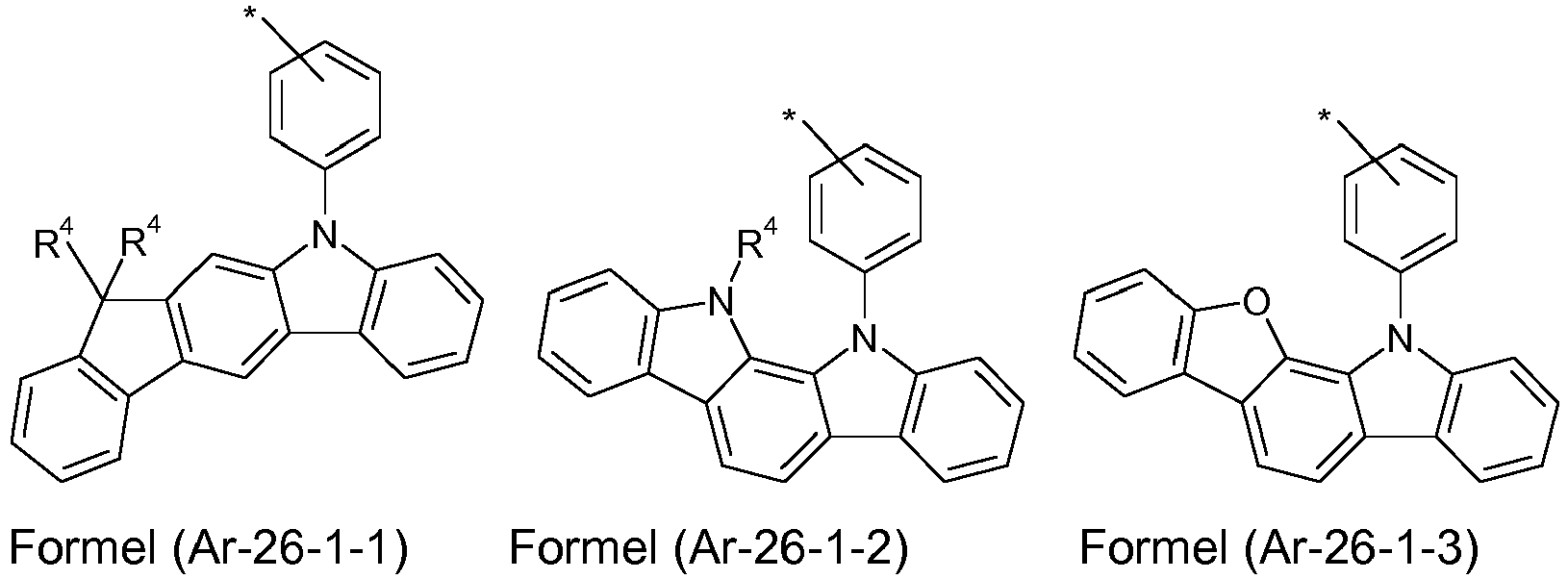
- the groups of the formula (Ar-26-1), or their preferred embodiments are selected from the groups of one of the formulas (Ar-26-1-1) to (Ar-26-1-6 ) where the symbols correspond to the symbols in formula (Ar-26).
- the formulas can be substituted with R 4 at the free positions.
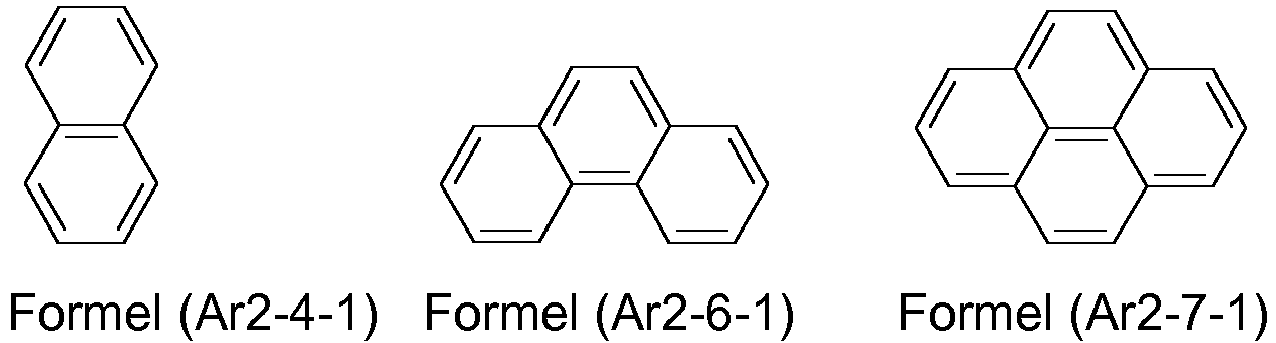
- the formulas (Ar2-1) to (Ar2-15) are replaced by their preferred embodiments from the formulas (Ar2-1-1) to (Ar2-9-5): where the symbols used correspond to the symbols for the formulas (Ar2-1) to (Ar2-15).
- the groups can be substituted at the free positions with R 4 . They are preferably unsubstituted.
- the groups Ar 1 in formula (Ar-22) are selected from one of the structures of the formula (Ar-1) to (Ar-25) or their preferred embodiments, wherein the symbols and indices correspond to the symbols and indices correspond to the formulas (Ar-1) to (Ar-25), with the additional requirement that * stands for the bond to N of the formula (Ar-22).
- R 3 in the case of an aromatic or heteroaromatic ring system is a structure selected from the formulas (Ar-1) to (Ar-27) and (Ar1-1) to (Ar1-7) or the respective preferred embodiments .
- R 4 which binds to a carbon bridge in an aromatic or heteroaromatic ring system, as for example in the formulas (Ar-12-1), (Ar-12-2), (Ar-12-3), (Ar-12-4), (Ar-13-1), (Ar-13-2), (Ar-13-3), (Ar-13-4), (Ar1-1-5-1), (Ar-15-3-1 a) or (Ar2-9-2), the same or different at each occurrence selected from the group consisting of a straight chain Alkyl group with 1 to 10 carbon atoms, a branched or cyclic alkyl group with 3 to 10 carbon atoms or an aromatic ring system with 6 to 30 carbon atoms, which is as defined above and which can be substituted with one or more radicals R 5 .
- the two groups R 4 can also form a ring system with one another, which can be aliphatic or, in addition to the definition of R 4 given above, also aromatic.
- a Spiro system is spanned by ring formation
- R 4 which binds to a nitrogen atom, is selected from the group consisting of a straight-chain alkyl group with 1 to 10 C atoms, a branched or cyclic alkyl group with 3 to 10 C atoms or an aromatic ring system with 6 up to 60 carbon atoms, in particular an aromatic ring system with 6 to 60 carbon atoms, which is as defined above and which can be substituted by one or more radicals R 5 .
- the compounds according to the invention can be synthesized by those skilled in the art, such as. B. bromination, Suzuki clutch, Ullmann clutch, Hartwig-Buchwald clutch, etc., are shown.
- the quinazolinone backbone is prepared, for example, from 4H-3,1-benzoxazine-2,4 (1 H ) -dione and reaction with an amine and an aldehyde, preferably with an aromatic amine and an aromatic aldehyde.
- the compound to the quinazolinone backbone is then oxidized. This can be done with conventional oxidizing agents, such as iodine or potassium permanganate.
- compounds of formula (2) can be obtained.
- compounds of one of the formulas (3) can be built up by one or more coupling reactions, rearrangements and / or cyclizations.
- the present invention therefore furthermore relates to a process for the preparation of a compound of the formula (3), the compound of the formula (3) being built up by one or more coupling reactions, rearrangements and / or cyclizations.
- Suitable reactive leaving groups are, for example, bromine, iodine, chlorine, boronic acids, boronic acid esters, amines, alkenyl or alkynyl groups with a terminal CC double bond or CC triple bond, oxiranes, oxetanes, groups which have a cycloaddition, for example a 1,3-dipolar cycloaddition , such as dienes or azides, carboxylic acid derivatives, alcohols and silanes.
- the invention therefore further relates to oligomers, polymers or dendrimers containing one or more compounds of the formula (3), it being possible for the bond (s) to the polymer, oligomer or dendrimer to be located at any free positions in formula (3).
- the compound is part of a side chain of the oligomer or polymer or part of the main chain.
- an oligomer is understood to mean a compound which is composed of at least three monomer units.
- a polymer is understood to mean a compound which is composed of at least ten monomer units.
- the polymers, oligomers or dendrimers according to the invention can be conjugated, partially conjugated or non-conjugated.
- the oligomers or polymers according to the invention can be linear, branched or dendritic.
- the units of the formula (3) can be linked directly to one another or they can be linked to one another via a bivalent group, for example via a substituted or unsubstituted alkylene group, via a hetero atom or via a bivalent aromatic or heteroaromatic group.
- 3 or more units of the formula (3) can be linked via a trivalent or higher-valent group, for example via a trivalent or higher-valent aromatic or heteroaromatic group, to form a branched or dendritic oligomer or polymer.
- the monomers according to the invention are homopolymerized or copolymerized with other monomers.
- Suitable and preferred comonomers are selected from fluorenes (e.g. according to EP 842208 or WO 2000/22026 ), Spirobifluorenes (e.g. according to EP 707020 , EP 894107 or WO 2006/061181 ), Paraphenylenes (e.g. according to WO 1992/18552 ), Carbazoles (e.g. according to WO 2004/070772 or WO 2004/113468 ), Thiophenes (e.g. according to EP 1028136 ), Dihydrophenanthrenes (e.g.
- cis- and trans-indenofluorenes e.g. according to WO 2004/041901 or WO 2004/113412
- Ketones e.g. according to WO2005 / 040302
- Phenanthrenes e.g. according to WO 2005/104264 or WO 2007/017066
- the polymers, oligomers and dendrimers usually contain further units, for example emitting (fluorescent or phosphorescent) units, such as.
- B. vinyl triarylamines e.g. according to WO 2007/068325
- phosphorescent metal complexes e.g. according to WO 2006/003000
- charge transport units especially those based on triarylamines.
- the polymers, oligomers and dendrimers according to the invention have advantageous properties, in particular long lifetimes, high efficiencies and good color coordinates.
- the present invention thus also relates to a process for the preparation of the polymers, oligomers and dendrimers according to the invention, which is characterized in that they are produced by polymerization according to SUZUKI, polymerization according to YAMAMOTO, polymerization according to STILLE or polymerization according to HARTWIG-BUCHWALD.
- the dendrimers according to the invention can be prepared by processes known to the person skilled in the art or in analogy thereto. Suitable methods are described in the literature, such as. B.
- Formulations of the compounds according to the invention are required for processing the compounds according to the invention from the liquid phase, for example by spin coating or by printing processes. These formulations can be, for example, solutions, dispersions or emulsions. It may be preferred to use mixtures of two or more solvents for this.
- Suitable and preferred solvents are, for example, toluene, anisole, o-, m- or p-xylene, methylbenzoate, mesitylene, tetralin, veratrol, THF, methyl-THF, THP, chlorobenzene, dioxane, phenoxytoluene, in particular 3-phenoxytoluene, (-) -Fenchone, 1,2,3,5-tetramethylbenzene, 1,2,4,5-tetramethylbenzene, 1-methylnaphthalene, 2-methylbenzothiazole, 2-phenoxyethanol, 2-pyrrolidinone, 3-methylanisole, 4-methylanisole, 3,4 -Dimethylanisole, 3,5-dimethylanisole, acetophenone, ⁇ -terpineol, benzothiazole, butylbenzoate, cumene, cyclohexanol, cyclohexanone, cyclohexylbenzene, decalin
- the invention therefore furthermore relates to a formulation, in particular a solution, dispersion or emulsion comprising at least one compound of the formula (3) or at least one polymer, oligomer or dendrimer containing at least one unit of the formula (3), and at least one phosphorescent dopant and and at least one solvent, preferably an organic solvent.
- a formulation in particular a solution, dispersion or emulsion comprising at least one compound of the formula (3) or at least one polymer, oligomer or dendrimer containing at least one unit of the formula (3), and at least one phosphorescent dopant and and at least one solvent, preferably an organic solvent.
- the mixtures according to the invention are suitable for use in an electronic device.
- An electronic device is understood to mean a device which contains at least one layer which contains at least one organic compound.
- the component can also contain inorganic materials or layers which are made entirely of inorganic materials.
- Another object of the present invention is therefore the use of the mixtures according to the invention in an electronic device, in particular in an organic electroluminescent device.
- Another object of the present invention is an electronic device containing at least one of the mixtures according to the invention described above.
- the preferences set out above for the connection also apply to the electronic devices.
- the electronic device is preferably selected from the group consisting of organic electroluminescent devices (OLEDs, PLEDs), organic integrated circuits (O-ICs), organic field-effect transistors (O-FETs), organic thin-film transistors (O-TFTs), organic light-emitting devices Transistors (O-LETs), organic solar cells (O-SCs), organic dye-sensitized solar cells, organic optical detectors, organic photoreceptors, organic field quench devices (O-FQDs), light-emitting electrochemical cells (LECs), organic laser diodes ( O laser) and " organic plasmon emitting devices "(DM Koller et al., Nature Photonics 2008, 1-4 ), preferably from organic electroluminescent devices (OLEDs, PLEDs), in particular phosphorescent OLEDs.
- OLEDs organic electroluminescent devices
- O-ICs organic integrated circuits
- O-FETs organic field-effect transistors
- OF-TFTs organic thin-film transistors
- the organic electroluminescent device contains cathode, anode and at least one emitting layer. In addition to these layers, it may also contain further layers, for example one or more hole injection layers, hole transport layers, hole blocking layers, electron transport layers, electron injection layers, exciton blocking layers, electron blocking layers and / or charge generation layers (charge generation layers). Interlayers (interlayers) which, for example, have an exciton-blocking function can also be introduced between two emitting layers. However, it should be pointed out that each of these layers does not necessarily have to be present.
- the organic electroluminescent device can contain one emitting layer, or it can contain several emitting layers.
- a plurality of emission layers are present, these preferably have a total of a plurality of emission maxima between 380 nm and 750 nm, so that white emission results overall, ie different emitting compounds are used in the emitting layers which can fluoresce or phosphoresce.
- Systems with three emitting layers are particularly preferred, the three layers showing blue, green and orange or red emission (for the basic structure see, for example, WO 2005/011013 ).
- These can be fluorescent or phosphorescent emission layers or hybrid systems in which fluorescent and phosphorescent emission layers are combined with one another.
- An organic electroluminescent device comprising a mixture according to the invention or a compound according to formula (3) or according to the preferred embodiments as matrix material for phosphorescent emitters.
- the preferred embodiments listed above also apply to the use of the materials in organic electronic devices.
- the compound of the formula (3) or, according to the preferred embodiments is used as a matrix material for a phosphorescent compound in an emitting layer.
- the organic electroluminescent device can contain one emitting layer or it can contain several emitting layers, at least one emitting layer containing at least one mixture according to the invention or a compound according to (3) as matrix material for a phosphorescent compound.
- Another preferred embodiment of the present invention is the use of the compound according to formula (3) or according to the preferred embodiments as a matrix material for a phosphorescent emitter in combination with a further matrix material.
- Particularly suitable matrix materials which can be used in combination with the compounds of the formula (3) or according to the preferred embodiments are aromatic ketones, aromatic phosphine oxides or aromatic sulfoxides or sulfones, e.g. B. according WO 2004/013080 , WO 2004/093207 , WO 2006/005627 or WO 2010/006680 , Triarylamines, carbazole derivatives, e.g. B.
- CBP N, N-biscarbazolylbiphenyl
- CBP indolocarbazole derivatives
- indolocarbazole derivatives e.g. B. according WO 2007/063754 or WO 2008/056746
- Indenocarbazole derivatives e.g. B. according WO 2010/136109 and WO 2011/000455
- Azacarbazole derivatives e.g. B. according EP 1617710 , EP 1617711 , EP 1731584 , JP 2005/347160
- bipolar matrix materials e.g. B.
- Silanes e.g. B. according WO 005/111172 , Azaborole or Boronester, z. B. according WO 2006/117052 , Triazine derivatives, e.g. B. according WO 2010/015306 , WO 2007/063754 or WO 2008/056746 , Zinc complexes, e.g. B. according EP 652273 or WO 2009/062578 , Diazasilol or tetraazasilol derivatives, e.g. B. according WO 2010/054729 , Diazaphosphole derivatives, e.g. B.
- bridged carbazole derivatives e.g. B. according US 2009/0136779 , WO 2010/050778 , WO 2011/042107 , WO 2011/088877 or WO 2012/143080 , Triphenylene derivatives, e.g. B. according WO 2012/048781 , or lactams, e.g. B. according WO 2011/116865 or WO 2011/137951 .
- a further phosphorescent emitter which emits shorter waves than the actual emitter, can be present as a co-host in the mixture.
- the mixture of the compound according to formula (3) or according to the preferred embodiments and the emitting compound contains between 99 and 1% by volume, preferably between 98 and 10% by volume, particularly preferably between 97 and 60% by volume , in particular between 95 and 80 vol .-% of the compound of formula (3) or according to the preferred embodiments based on the total mixture of emitter and matrix material. Accordingly, the mixture contains between 1 and 99% by volume, preferably between 2 and 90% by volume, particularly preferably between 3 and 40% by volume, in particular between 5 and 20% by volume, of the emitter, based on the total mixture Emitter and matrix material.
- phosphorescent dopants typically includes compounds in which the light is emitted by a spin-prohibited transition. They are compounds which show luminescence from an excited state with spin multiplicity> 1 at room temperature, for example by a transition from an excited triplet state or a state with a higher spin quantum number, for example a quintet state. Particularly suitable as phosphorescent dopants are compounds which, when suitably excited, emit light, preferably in the visible range, and also contain at least one atom of atomic number greater than 20, preferably greater than 38 and less than 84, particularly preferably greater than 56 and less than 80.
- Compounds which contain copper, molybdenum, tungsten, rhenium, ruthenium, osmium, rhodium, iridium, palladium, platinum, silver, gold and / or europium are preferably used as phosphorescent dopants, in particular compounds which contain iridium, platinum or copper.
- luminescent iridium, platinum or copper complexes are regarded as phosphorescent compounds.
- a bridge between the groups DCy and CCy can also be present here through the formation of ring systems between a plurality of R 4 radicals. Furthermore, by forming ring systems between several radicals R 4 , a bridge between two or three ligands CCy-DCy or between one or two ligands CCy-DCy and ligand A, or the two ligands DCy-DCy or DCy-DCy and DCy are present, so that it is a polydentate or polypodal ligand system. This is particularly preferred for the Pt complexes of the formula (D-4), the bridge between the two CCy-DCy ligands preferably being selected from NR 4 or C (R 4 ) 2 .
- B is preferably a phosphanyl or arsanyl radical (P (R 4 ) 2 or As (R 4 ) 2 ).
- the phosphorescent dopants can be present as a single compound or bound to polymers or oligomers.
- Examples of phosphorescent dopants can be found in the applications WO 2000/70655 , WO 2001/41512 , WO 2002/02714 , WO 2002/15645 , EP 1191613 , EP 1191612 , EP 1191614 , WO 2004/081017 , WO 2005/033244 , WO 2005/042550 , WO 2005/113563 , WO 2006/008069 , WO 2006/061182 , WO 2006/081973 , WO 2009/146770 , WO 2005/019373 and US 2005/0258742 be removed.
- Examples of phosphorescent dopants with copper can be found in WO 2013/007707 .
- Suitable phosphorescent dopants are listed in the following table.
- the organic electroluminescent device according to the invention does not contain a separate hole injection layer and / or hole transport layer and / or hole blocking layer and / or electron transport layer, ie the emitting layer directly adjoins the hole injection layer or the anode, and / or the emitting layer directly adjoins the electron transport layer or the electron injection layer or the cathode, as for example in WO 2005/053051 described.
- a metal complex which is the same or similar to the metal complex in the emitting layer, directly adjacent to the emitting layer as hole transport or hole injection material, such as. B. in WO 2009/030981 described.
- an organic electroluminescent device characterized in that one or more layers are coated using a sublimation process.
- the materials are evaporated in vacuum sublimation systems at an initial pressure of less than 10 -5 mbar, preferably less than 10 -6 mbar. However, it is also possible that the initial pressure is still lower or higher, for example less than 10 -7 mbar.
- An organic electroluminescent device is also preferred, characterized in that one or more layers are coated with the OVPD (Organic Vapor Phase Deposition) process or with the aid of a carrier gas sublimation.
- the materials are applied at a pressure between 10 -5 mbar and 1 bar.
- OVJP Organic Vapor Jet Printing
- the materials are applied directly through a nozzle and thus structured (e.g. MS Arnold et al., Appl. Phys. Lett. 2008, 92, 053301 ).
- an organic electroluminescent device characterized in that one or more layers of solution, such as. B. by spin coating, or with any printing method, such as. B. Ink-jet printing (inkjet printing), LITI (Light Induced Thermal Imaging, thermal transfer printing), screen printing, flexographic printing, offset printing or nozzle printing. Soluble compounds are required for this, which are obtained, for example, by suitable substitution. These processes are also particularly suitable for oligomers, dendrimers and polymers.
- Hybrid processes are also possible in which, for example, one or more layers are applied from solution and one or more further layers are vapor-deposited.
- Scheme 1 shows one Synthesis of the basic structure analogous to monthly magazines for chemistry, 141 (8), 877-881; 2010 .
- R stands for any residue and X for a leaving group such as.
- the introduced leaving groups can be implemented, for example, by organometallic coupling reactions.
- a Buchwald or Suzuki coupling is shown as an example in Scheme 2b.
- the compounds of the formula (2) can be built up by multiple coupling reactions.
- the OLEDs basically have the following layer structure: substrate / hole transport layer (HTL) / intermediate layer (IL) / electron blocking layer (EBL) / emission layer (EML) / optional hole blocking layer (HBL) / electron transport layer (ETL) and finally a cathode.
- the cathode is formed by a 100 nm thick aluminum layer.
- Table 1 A designation like "4a" in the table refers to the materials shown in the tables for the examples.
- the other materials required for producing the OLEDs are shown in Table 3.
- the emission layer always consists of at least one matrix material (host material, host material) and an emitting dopant (dopant, emitter), which is admixed to the matrix material or the matrix materials by cover vaporization in a certain volume fraction.
- An indication such as 4a: BIC1: TEG1 (30%: 60%: 10%) means that the material 4a in a volume fraction of 30%, BIC1 in a fraction of 60% and TEG1 in a fraction of 10% in the layer is present.
- the electron transport layer can also consist of a mixture of two materials.
- the OLEDs are characterized by default.
- the electroluminescence spectra are determined at a luminance of 1000 cd / m 2 and the CIE 1931 x and y color coordinates are calculated therefrom.
- the specification U1000 in table 2 denotes the voltage required for a luminance of 1000 cd / m 2 .
- SE1000 and LE1000 denote the current and power efficiency that can be achieved at 1000 cd / m 2 .
- EQE1000 describes the external quantum efficiency at an operating luminance of 1000 cd / m 2 .
Landscapes
- Chemical & Material Sciences (AREA)
- Engineering & Computer Science (AREA)
- Materials Engineering (AREA)
- Physics & Mathematics (AREA)
- Spectroscopy & Molecular Physics (AREA)
- Crystallography & Structural Chemistry (AREA)
- Inorganic Chemistry (AREA)
- Optics & Photonics (AREA)
- Organic Chemistry (AREA)
- Electroluminescent Light Sources (AREA)
- Nitrogen Condensed Heterocyclic Rings (AREA)
- Plural Heterocyclic Compounds (AREA)
Description
- Die vorliegende Erfindung beschreibt Mischungen von Quinazolinon-Derivaten und phosphoreszierende Dotanden, sowie die Verwendung von Quinazolinon-Derivaten und Triplettmatrixmaterialien in organischen Elektrolumineszenzvorrichtungen. Die Erfindung betrifft ferner ein Verfahren zur Herstellung der erfindungsgemäßen Verbindungen sowie elektronische Vorrichtungen enthaltend diese Verbindungen.
- Der Aufbau organischer Elektrolumineszenzvorrichtungen (OLEDs), in denen organische Halbleiter als funktionelle Materialien eingesetzt werden, ist beispielsweise in
US 4539507 ,US 5151629 ,EP 0676461 undWO 98/27136 - Die Eigenschaften von phosphoreszierenden OLEDs werden nicht nur von den eingesetzten Triplettemittern bestimmt. Hier sind insbesondere auch die anderen verwendeten Materialien wie zum Beispiel Matrixmaterialien von besonderer Bedeutung. Verbesserungen dieser Materialien können somit auch zu deutlichen Verbesserungen der OLED-Eigenschaften führen.
- Gemäß dem Stand der Technik werden unter anderem Indolocarbazolderivate (z. B. gemäß
WO 2007/063754 oderWO 2008/056746 ) oder Indenocarbazolderivate (z. B. gemäßWO 2010/136109 oderWO 2011/000455 ), insbesondere solche, die mit elektronenarmen Heteroaromaten wie Triazin substituiert sind, als Matrixmaterialien für phosphoreszierende Emitter verwendet. Weiterhin werden beispielsweise Bisdibenzofuranderivate (z. B. gemäßEP 2301926 ) als Matrixmaterialien für phosphoreszierende Emitter verwendet. Allerdings besteht bei Verwendung dieser Matrixmaterialien noch Verbesserungsbedarf, insbesondere in Bezug auf die Effizienz, die Lebensdauer und die Betriebsspannung der Vorrichtung. - Die Verwendung von Quinazolinonderivate als Materialien für fluoreszierende OLEDs wird in
JP2001250689A - Aufgabe der vorliegenden Erfindung ist die Bereitstellung von Verbindungen, welche sich für den Einsatz in phosphoreszierenden OLED eignen, insbesondere als Matrixmaterial. Insbesondere ist es die Aufgabe der vorliegenden Erfindung, Matrixmaterialien bereitzustellen, welche sich auch für grün und blau phosphoreszierende OLEDs eignen.
- Es wurde überraschend gefunden, dass eine Mischung umfassend mindestens einen phosphoreszierenden Dotanden, welche Kupfer, Molybdän, Wolfram, Rhenium, Ruthenium, Osmium, Rhodium, Iridium, Palladium, Platin, Silber, Gold und/oder Europium enthält, und mindestens eine Verbindung gemäß der folgenden Formeln (3), Verbesserungen gegenüber dem Stand der Technik aufweist, insbesondere beim Einsatz in organischen Elektrolumineszenz-vorrichtungen:

- R1, R2
- sind bei jedem Auftreten verschieden ausgewählt aus den Gruppen mit den folgenden Formeln (Ar-1) bis (Ar-27)
- Q
- ist bei jedem Auftreten gleich oder verschieden CR4 oder N, wobei maximal 3 Symbole Q pro Cyclus für N stehen;
- E
- ist bei jedem Auftreten gleich oder verschieden (CR4)2, NR4, O, S oder C=O;
- G
- ist bei jedem Auftreten eine Einfachbindung, (CR4)2, NR4, O, S oder C=O;
- Ar2
- ist bei jedem Auftreten gleich oder verschieden ein bivalentes aromatisches oder heteroaromatisches Ringsystem mit 5 bis 60
- Ar1
- aromatischen Ringatomen, welches durch einen oder mehrere Reste R4 substituiert sein kann; sind bei jedem Auftreten gleich oder verschieden ein aromatisches oder heteroaromatisches Ringsystem mit 6 bis 60 aromatischen Ringatomen, das jeweils auch mit einem oder mehreren Reste R4 substituiert sein kann, wobei beide Ar1 und/oder Ar1 mit Ar2 über je mindestens eine Brücke K verbunden sein können;
- K
- ist bei jedem Auftreten gleich oder verschieden gleich eine Einfachbindung oder eine bivalente Brücke, ausgewählt aus N(R4), B(R4), O,C=O, C(R4)2, Si(R4)2, und S; und
- *
- die Bindung zum Quinazolinon-Grundgerüst darstellt.
- R3
- ist bei jedem Auftreten gleich oder verschieden H, D, F, eine geradkettige Alkylgruppe mit 1 bis 10 C-Atomen oder eine verzweigte oder cyclische Alkylgruppe mit 3 bis 10 C-Atomen, die jeweils mit einem oder mehreren Resten R4 substituiert sein kann, oder ein aromatisches oder heteroaromatisches Ringsystem mit 6 bis 60 aromatischen Ringatomen, das jeweils durch einen oder mehrere Reste R4 substituiert sein kann;
- Ar
- ist bei jedem Auftreten gleich oder verschieden, ein aromatisches oder heteroaromatisches Ringsystem mit 6 bis 60 aromatischen Ringatomen, das jeweils auch mit einem oder mehreren Resten R4 substituiert sein kann,
- R4
- ist bei jedem Auftreten gleich oder verschieden H, D, F, Cl, Br, I, CHO, C(=O)R5, P(=O)(R5)2, S(=O)R5, S(=O)2R5, CN, NO2, Si(R5)3, B(OR5)2, OSO2R5, N(R5)2, eine geradkettige Alkyl-, Alkoxy- oder Thioalkoxygruppe mit 1 bis 40 C-Atomen oder eine verzweigte oder cyclische Alkyl-, Alkoxy- oder Thioalkoxygruppe mit 3 bis 40 C-Atomen, die jeweils mit einem oder mehreren Resten R5 substituiert sein kann, wobei eine oder mehrere nicht benachbarte CH2-Gruppen durch C=C , Si(R5)2, Ge(R5)2, Sn(R5)2, C=O, C=S, C=Se, P(=O)(R5), SO, SO2, O, S oder CONR5 ersetzt sein können und wobei ein oder mehrere H-Atome durch D, F, Cl, Br, I, CN oder NO2 ersetzt sein können, oder ein aromatisches oder heteroaromatisches Ringsystem mit 5 bis 60 aromatischen Ringatomen, das jeweils durch einen oder mehrere Reste R5 substituiert sein kann, oder eine Aryloxy- oder Heteroaryloxygruppe mit 5 bis 60 aromatischen Ringatomen, die durch einen oder mehrere Reste R5 substituiert sein kann, oder eine Kombination dieser Systeme; dabei können zwei oder mehrere benachbarte Substituenten R4 auch miteinander ein mono- oder polycyclisches, aliphatisches oder aromatisches Ringsystem bilden;
- R5
- ist bei jedem Auftreten gleich oder verschieden H, D, F, Cl, Br, I, N(R6)2, C(=O)R6, P(=O)(R6)2, S(=O)R6, S(=O)2R6, CR6=C(R6)2, CN, NO2, Si(R6)3, B(OR6)2, OSO2R6, N(R6)2, eine geradkettige Alkyl-, Alkoxy- oder Thioalkoxygruppe mit 1 bis 40 C-Atomen oder eine verzweigte oder cyclische Alkyl-, Alkoxy- oder Thioalkoxygruppe mit 3 bis 40 C-Atomen, die jeweils mit einem oder mehreren Resten R6 substituiert sein kann, wobei eine oder mehrere nicht benachbarte CH2-Gruppen durch R6C=CR6, C≡C, Si(R6)2, C=O, C=NR6, P(=O)(R6), SO, SO2, NR6, O, S oder CONR6 ersetzt sein können und wobei ein oder mehrere H-Atome durch D, F, Cl, Br, I, CN oder NO2 ersetzt sein können, oder ein aromatisches oder heteroaromatisches Ringsystem mit 5 bis 60 aromatischen Ringatomen, das jeweils durch einen oder mehrere Reste R6 substituiert sein kann, oder eine Aryloxy- oder Heteroaryloxygruppe mit 5 bis 60 aromatischen Ringatomen, die durch einen oder mehrere Reste R6 substituiert sein kann, oder eine Aralkyl- oder Heteroaralkylgruppe mit 5 bis 60 aromatischen Ringatomen, die durch einen oder mehrere Reste R6 substituiert sein kann, oder eine Kombination dieser Systeme; dabei können zwei oder mehrere benachbarte Substituenten R5 auch miteinander ein mono- oder polycyclisches, aliphatisches oder aromatisches Ringsystem bilden.
- Der Bicyclus in Formel (3) wird auch als das Quinazolinon-Grundgerüst bezeichnet, an das R1, R2 oder R3 binden.
- Eine Arylgruppe im Sinne dieser Erfindung enthält 6 bis 60 C-Atome; eine Heteroarylgruppe im Sinne dieser Erfindung enthält 2 bis 60 C-Atome und mindestens ein Heteroatom, mit der Maßgabe, dass die Summe aus C-Atomen und Heteroatomen mindestens 5 ergibt. Die Heteroatome sind bevorzugt ausgewählt aus N, O und/oder S. Dabei wird unter einer Arylgruppe bzw. Heteroarylgruppe entweder ein einfacher aromatischer Cyclus, also Benzol, bzw. ein einfacher heteroaromatischer Cyclus, beispielsweise Thiophen, etc., oder eine kondensierte (anellierte) Aryl- oder Heteroarylgruppe, beispielsweise Naphthalin, Anthracen, Phenanthren, Dibenzofuran, etc., verstanden. Miteinander durch Einfachbindung verknüpfte Aromaten, wie zum Beispiel Biphenyl, werden dagegen nicht als Aryl- oder Heteroarylgruppe, sondern als aromatisches Ringsystem bezeichnet.
- Ein aromatisches Ringsystem im Sinne dieser Erfindung enthält 6 bis 80 C-Atome im Ringsystem. Ein heteroaromatisches Ringsystem im Sinne dieser Erfindung enthält 2 bis 60 C-Atome und mindestens ein Heteroatom im Ringsystem, mit der Maßgabe, dass die Summe aus C-Atomen und Heteroatomen mindestens 5 ergibt. Die Heteroatome sind bevorzugt ausgewählt aus N, O und/oder S. Unter einem aromatischen oder heteroaromatischen Ringsystem im Sinne dieser Erfindung soll ein System verstanden werden, das nicht notwendigerweise nur Aryl- oder Heteroarylgruppen enthält, sondern in dem auch mehrere Aryl- oder Heteroarylgruppen durch eine nicht-aromatische Einheit (bevorzugt weniger als 10 % der von H verschiedenen Atome), wie z. B. ein C-, N- oder O-Atom, verbunden sein können. So sollen beispielsweise auch Systeme wie Fluoren, 9,9'-Spirobifluoren, 9,9-Diarylfluoren, Triarylamin, Diarylether, Stilben, etc. als aromatische Ringsysteme im Sinne dieser Erfindung verstanden werden, und ebenso Systeme, in denen zwei oder mehrere Arylgruppen beispielsweise durch eine kurze Alkylgruppe verbunden sind. Weiterhin werden miteinander durch Einfachbindung verknüpfte Aromaten, wie zum Beispiel Biphenyl, als aromatisches Ringsystem im Sinne dieser Anmeldung bezeichnet.
- Eine elektronenarme Heteroarylgruppe im Sinne der vorliegenden Erfindung ist definiert als 5-Ring-Heteroarylgruppe mit mindestens zwei Heteroatomen, beispielsweise Imidazol, Oxazol, Oxadiazol, etc., oder als 6-Ring-Heteroarylgruppe mit mindestens einem Heteroatom, beispielsweise Pyridin, Pyrimidin, Pyrazin, Triazin, etc.. Dabei können an diese Gruppen auch noch weitere 6-Ring-Aryl- oder 6-Ring-Heteroarylgruppen ankondensiert sein, wie beispielsweise in Benzimidazol oder Chinolin.
- Im Rahmen der vorliegenden Erfindung werden unter einem aliphatischen Kohlenwasserstoffrest bzw. einer Alkylgruppe bzw. einer Alkenyl- oder Alkinylgruppe, die typischerweise 1 bis 40 oder auch 1 bis 20 C-Atome enthalten kann, und in der auch einzelne H-Atome oder CH2-Gruppen durch die oben genannten Gruppen substituiert sein können, bevorzugt die Reste Methyl, Ethyl, n-Propyl, i-Propyl, n-Butyl, i-Butyl, s-Butyl, t-Butyl, 2-Methylbutyl, n-Pentyl, s-Pentyl, Cyclopentyl, n-Hexyl, Cyclohexyl, n-Heptyl, Cycloheptyl, n-Octyl, Cyclooctyl, 2-Ethylhexyl, Trifluormethyl, Pentafluorethyl, 2,2,2-Trifluorethyl, Ethenyl, Propenyl, Butenyl, Pentenyl, Cyclopentenyl, Hexenyl, Cyclohexenyl, Heptenyl, Cycloheptenyl, Octenyl, Cyclooctenyl, Ethinyl, Propinyl, Butinyl, Pentinyl, Hexinyl, Heptinyl oder Octinyl verstanden. Unter einer Alkoxygruppe mit 1 bis 40 C-Atomen werden bevorzugt Methoxy, Trifluormethoxy, Ethoxy, n-Propoxy, i-Propoxy, n-Butoxy, i-Butoxy, s-Butoxy, t-Butoxy, n-Pentoxy, s-Pentoxy, 2-Methylbutoxy, n-Hexoxy, Cyclohexyloxy, n-Heptoxy, Cycloheptyloxy, n-Octyloxy, Cyclooctyloxy, 2-Ethylhexyloxy, Pentafluorethoxy und 2,2,2-Trifluorethoxy verstanden. Unter einer Thioalkylgruppe mit 1 bis 40 C-Atomen werden insbesondere Methylthio, Ethylthio, n-Propylthio, i-Propylthio, n-Butylthio, i-Butylthio, s-Butylthio, t-Butylthio, n-Pentylthio, s-Pentylthio, n-Hexylthio, Cyclohexylthio, n-Heptylthio, Cycloheptylthio, n-Octylthio, Cyclooctylthio, 2-Ethylhexylthio, Trifluormethylthio, Pentafluorethylthio, 2,2,2-Trifluorethylthio, Ethenylthio, Propenylthio, Butenylthio, Pentenylthio, Cyclopentenylthio, Hexenylthio, Cyclohexenylthio, Heptenylthio, Cycloheptenylthio, Octenylthio, Cyclooctenylthio, Ethinylthio, Propinylthio, Butinylthio, Pentinylthio, Hexinylthio, Heptinylthio oder Octinylthio verstanden. Allgemein können Alkyl-, Alkenyl-, Alkinyl-, Alkoxy- oder Thioalkylgruppen gemäß der vorliegenden Erfindung geradkettig, verzweigt oder cyclisch sein, wobei eine oder mehrere nicht-benachbarte CH2-Gruppen durch die oben genannten Gruppen ersetzt sein können; weiterhin können auch ein oder mehrere H-Atome durch D, F, Cl, Br, I, CN oder NO2, bevorzugt F, Cl oder CN, weiter bevorzugt F oder CN, besonders bevorzugt CN ersetzt sein.
- Unter einem aromatischen oder heteroaromatischen Ringsystem mit 5 - 80 aromatischen Ringatomen, welches noch jeweils mit den oben genannten Resten substituiert sein kann und welches über beliebige Positionen am Aromaten bzw. Heteroaromaten verknüpft sein kann, werden insbesondere Gruppen verstanden, die abgeleitet sind von Benzol, Naphthalin, Anthracen, Benzanthracen, Phenanthren, Benzphenanthren, Pyren, Chrysen, Perylen, Fluoranthen, Naphthacen, Pentacen, Benzpyren, Biphenyl, Biphenylen, Terphenyl, Triphenylen, Fluoren, Spirobifluoren, Dihydrophenanthren, Dihydropyren, Tetrahydropyren, cis- oder trans-Indenofluoren, cis- oder trans-Indenocarbazol, cis- oder trans-Indolocarbazol, Truxen, Isotruxen, Spirotruxen, Spiroisotruxen, Furan, Benzofuran, Isobenzofuran, Dibenzofuran, Thiophen, Benzothiophen, Isobenzothiophen, Dibenzothiophen, Pyrrol, Indol, Isoindol, Carbazol, Pyridin, Chinolin, Isochinolin, Acridin, Phenanthridin, Benzo-5,6-chinolin, Benzo-6,7-chinolin, Benzo-7,8-chinolin, Phenothiazin, Phenoxazin, Pyrazol, Indazol, Imidazol, Benzimidazol, Naphthimidazol, Phenanthrimidazol, Pyridimidazol, Pyrazinimidazol, Chinoxalinimidazol, Oxazol, Benzoxazol, Naphthoxazol, Anthroxazol, Phenanthroxazol, Isoxazol, 1,2-Thiazol, 1,3-Thiazol, Benzothiazol, Pyridazin, Hexaazatriphenylen, Benzopyridazin, Pyrimidin, Benzpyrimidin, Chinoxalin, 1,5-Diazaanthracen, 2,7-Diazapyren, 2,3-Diazapyren, 1,6-Diazapyren, 1,8-Diazapyren, 4,5-Diazapyren, 4,5,9,10-Tetraazaperylen, Pyrazin, Phenazin, Phenoxazin, Phenothiazin, Fluorubin, Naphthyridin, Azacarbazol, Benzocarbolin, Phenanthrolin, 1,2,3-Triazol, 1,2,4-Triazol, Benzotriazol, 1,2,3-Oxadiazol, 1,2,4-Oxadiazol, 1,2,5-Oxadiazol, 1,3,4-Oxadiazol, 1,2,3-Thiadiazol, 1,2,4-Thiadiazol, 1,2,5-Thiadiazol, 1,3,4-Thiadiazol, 1,3,5-Triazin, 1,2,4-Triazin, 1,2,3-Triazin, Tetrazol, 1,2,4,5-Tetrazin, 1,2,3,4-Tetrazin, 1,2,3,5-Tetrazin, Purin, Pteridin, Indolizin und Benzothiadiazol oder Gruppen, die abgeleitet sind von Kombinationen dieser Systeme. Dabei können diese Gruppen jeweils durch die oben genannten Reste substituiert sein.
- Unter einer Aryloxygruppe gemäß der Definition der vorliegenden Erfindung wird eine Arylgruppe, wie oben definiert, verstanden, welche über ein Sauerstoffatom gebunden ist. Eine analoge Definition gilt für Heteroaryloxygruppen.
- Eine elektronenarme Heteroarylgruppe im Sinne der vorliegenden Erfindung ist definiert als 5-Ring-Heteroarylgruppe mit mindestens zwei Heteroatomen, beispielsweise Imidazol, Oxazol, Oxadiazol, etc., oder als 6-Ring-Heteroarylgruppe mit mindestens einem Heteroatom, beispielsweise Pyridin, Pyrimidin, Pyrazin, Triazin, etc. Dabei können an diese Gruppen auch noch weitere 6-Ring-Aryl- oder 6-Ring-Heteroarylgruppen ankondensiert sein, wie beispielsweise in Benzimidazol oder Chinolin.
- Unter der Formulierung, dass zwei oder mehr Reste miteinander einen Ring bilden können, soll im Rahmen der vorliegenden Beschreibung unter anderem verstanden werden, dass die beiden Reste miteinander durch eine chemische Bindung verknüpft sind. Dies wird durch das folgende Schema verdeutlicht.

- Weiterhin soll unter der oben genannten Formulierung aber auch verstanden werden, dass für den Fall, dass einer der beiden Reste Wasserstoff darstellt, der zweite Rest unter Bildung eines Rings an die Position, an die das Wasserstoffatom gebunden war, bindet. Dies soll durch das folgende Schema verdeutlicht werden:

- In einer weiteren Ausführungsform der Erfindung stehen maximal 1 X in Formel (1) oder in einem Quinazolinon-Grundgerüst in Formel (2) für N. Besonders bevorzugt steht kein X in Formel (1) oder Formel (2) für N.
- In einer bevorzugten Ausführungsform der Erfindung umfasst die Verbindung kein Arylgruppe oder Heteroarylgruppe mit mehr als 22 aromatischen Ringatomen.
- In einer bevorzugten Ausführungsform der Erfindung sind die Gruppen R1, R2 und R3 bei jedem Auftreten gleich oder verschieden und im Falle eines aromatischen oder heteroaromatischen Ringsystems bei jedem Auftreten ausgewählt aus den Gruppen mit den folgenden Formeln (Ar-1) bis (Ar-27)


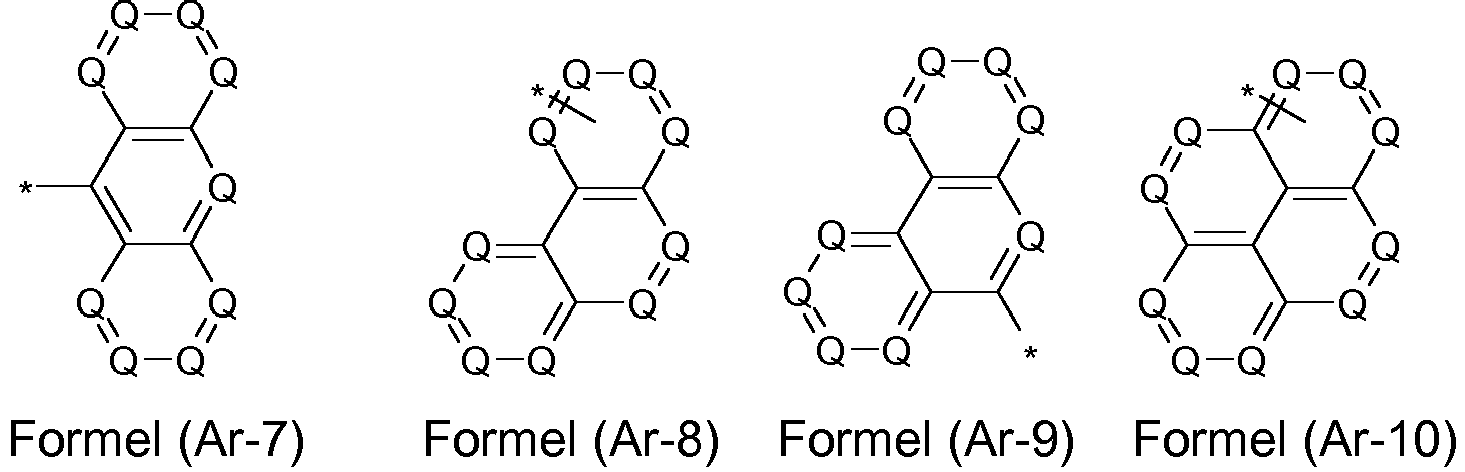




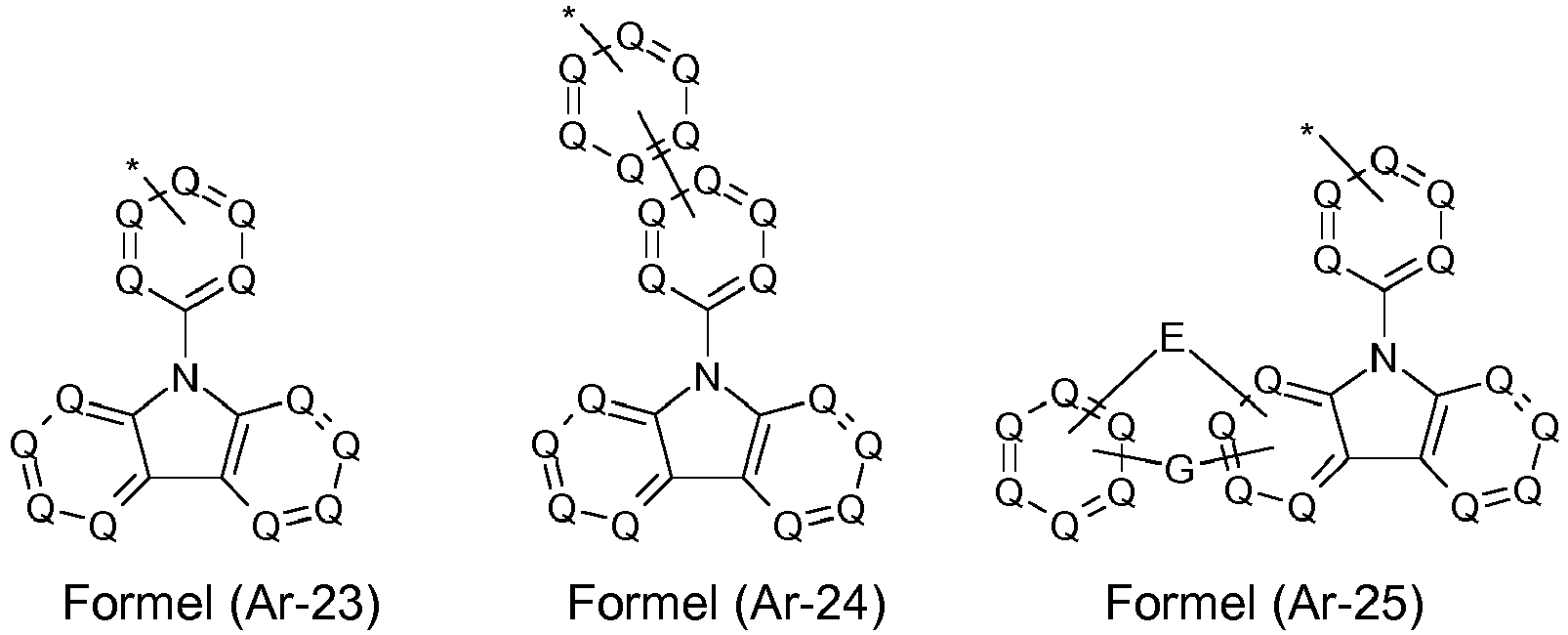

- Außerdem sind die Gruppen R3 ausgewählt aus den Gruppen einer der folgenden Formeln (Ar1-1) bis (Ar1-7):
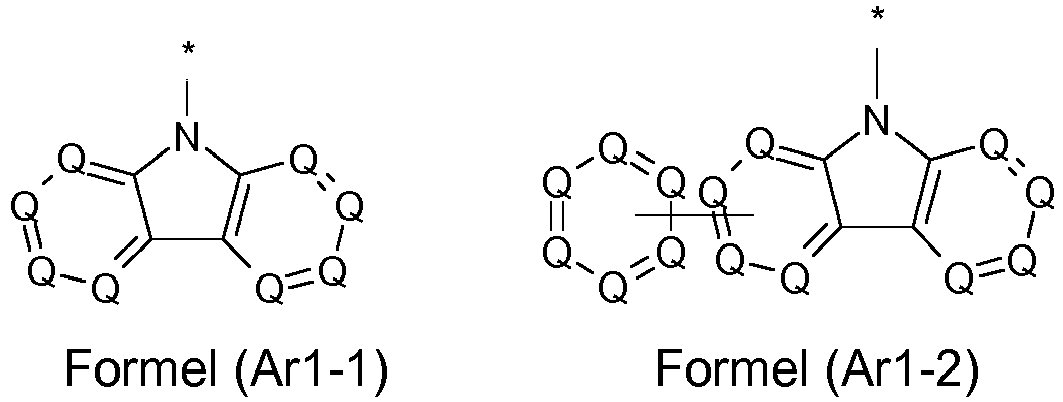
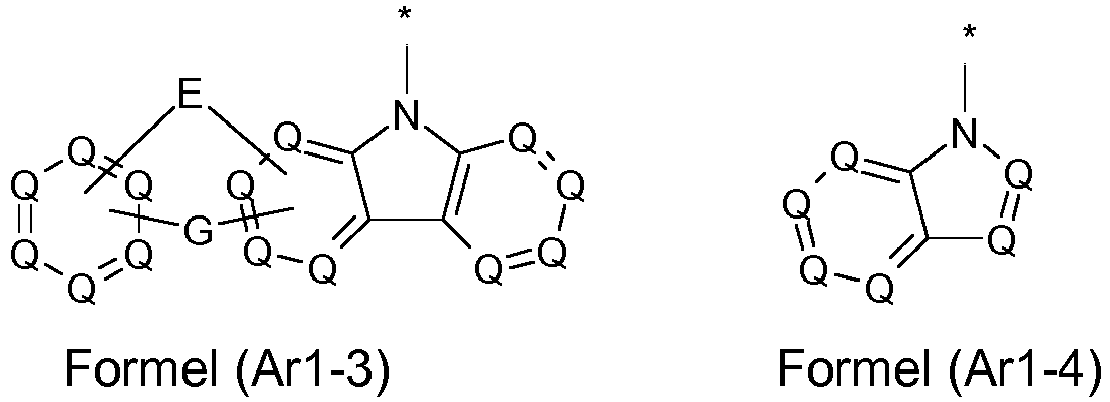

- Q
- ist bei jedem Auftreten gleich oder verschieden CR4 oder N, wobei maximal 2 Symbole Q pro Cyclus für N stehen;
- E
- ist bei jedem Auftreten gleich oder verschieden (CR4)2, NR4, O, S oder C=O;
- G
- ist bei jedem Auftreten eine Einfachbindung, (CR4)2, NR4, O, S oder C=O;
- n
- ist 0 oder 1, wobei n gleich 0 bedeutet, dass an dieser Position keine Gruppe E gebunden ist und an den entsprechenden Kohlenstoffatomen statt dessen Reste R4 gebunden sind;
- Ar1
- sind bei jedem Auftreten gleich oder verschieden ein aromatisches oder heteroaromatisches Ringsystem mit 6 bis 60 aromatischen Ringatomen, das jeweils auch mit einem oder mehreren Reste R4 substituiert sein kann, wobei beide Ar1 über je mindestens eine Brücke K verbunden sein können;
- K
- ist bei jedem Auftreten gleich oder verschieden gleich eine Einfachbindung oder eine bivalente Brücke, ausgewählt aus N(R4), B(R4), O,C=O, C(R4)2, Si(R4)2, und S; und
- *
- die Bindung zum Quinazolinon-Grundgerüst darstellt.
- In einer weiteren bevorzugten Ausführungsform stehen in der Formel (Ar-1) 0, 1, 2 oder 3 Symbole Q für N.
- Bevorzugte Ausführungsformen der Formel (Ar-15) zeigen die folgenden Formeln (Ar-15-1) bis (Ar-15-7):



- In einer weiteren bevorzugten Ausführungsform ist die Gruppen R1, R2 und R3 bei jedem Auftreten gleich oder verschieden und im Falle eines aromatischen oder heteroaromatischen Ringsystems bei jedem Auftreten ausgewählt ausgewählt aus den Gruppen mit den Strukturen der Formeln (Ar-1) bis (Ar-24), wobei die allgemeinen Formeln durch die besonders bevorzugten Ausführungsformen jeweils gemäß der folgenden Formeln (Ar-1-1) bis (Ar-21-1) ersetzt werden (z. B. wird Formel (Ar-1) durch eine der Formeln (Ar-1-1) bis (Ar-1-9) ersetzt):






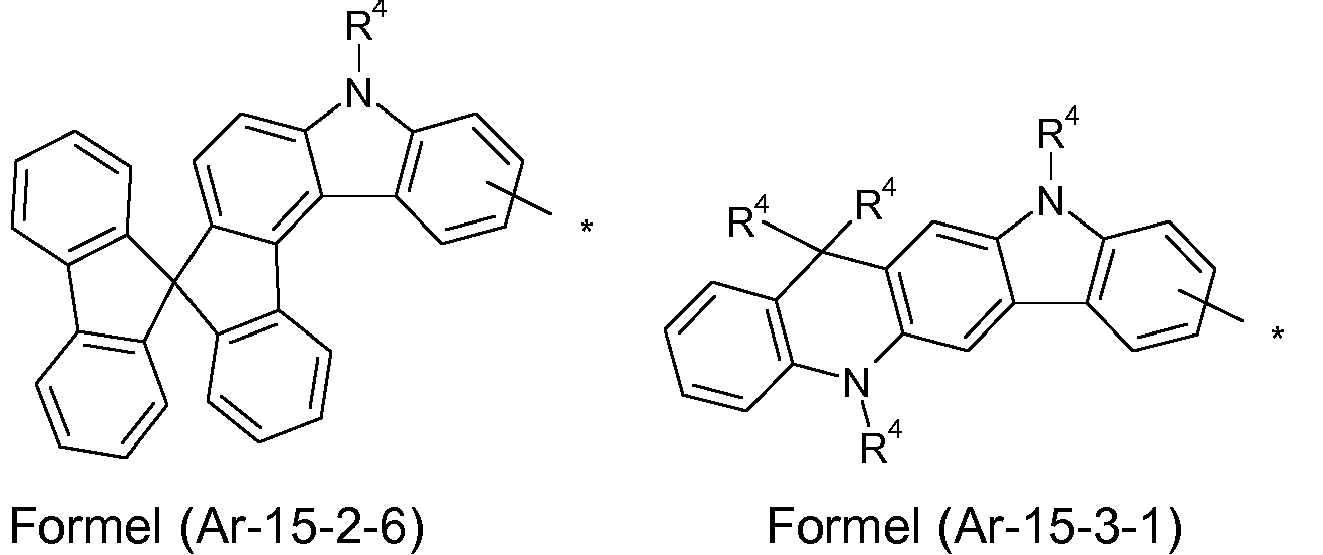


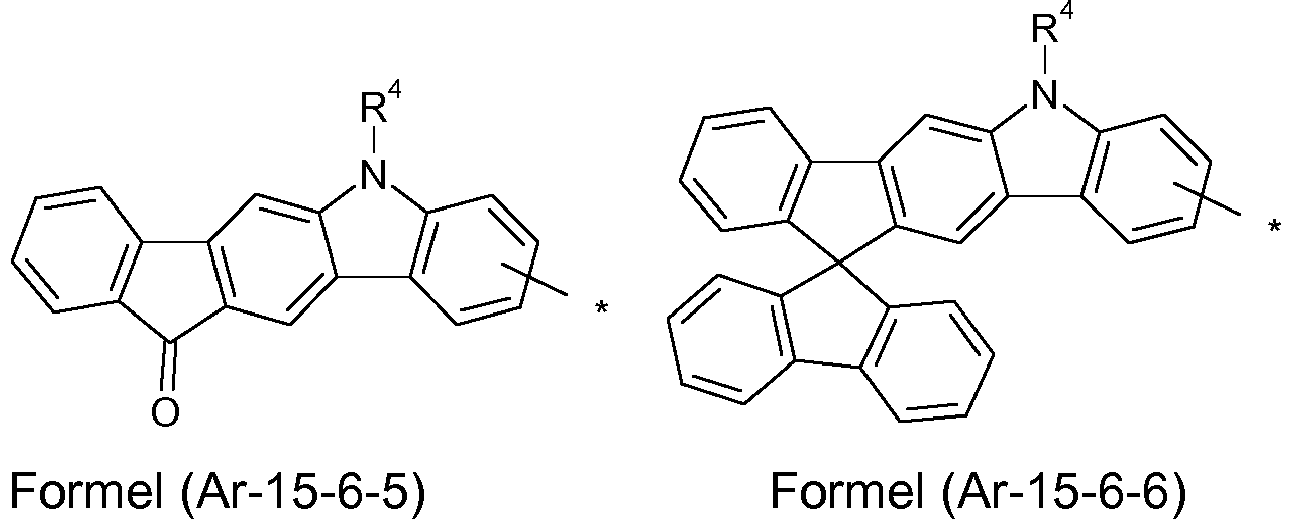


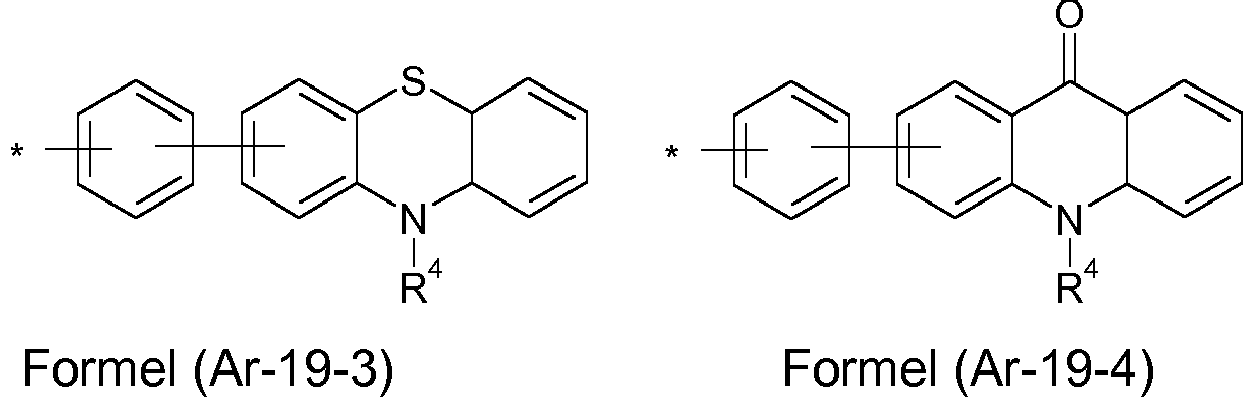


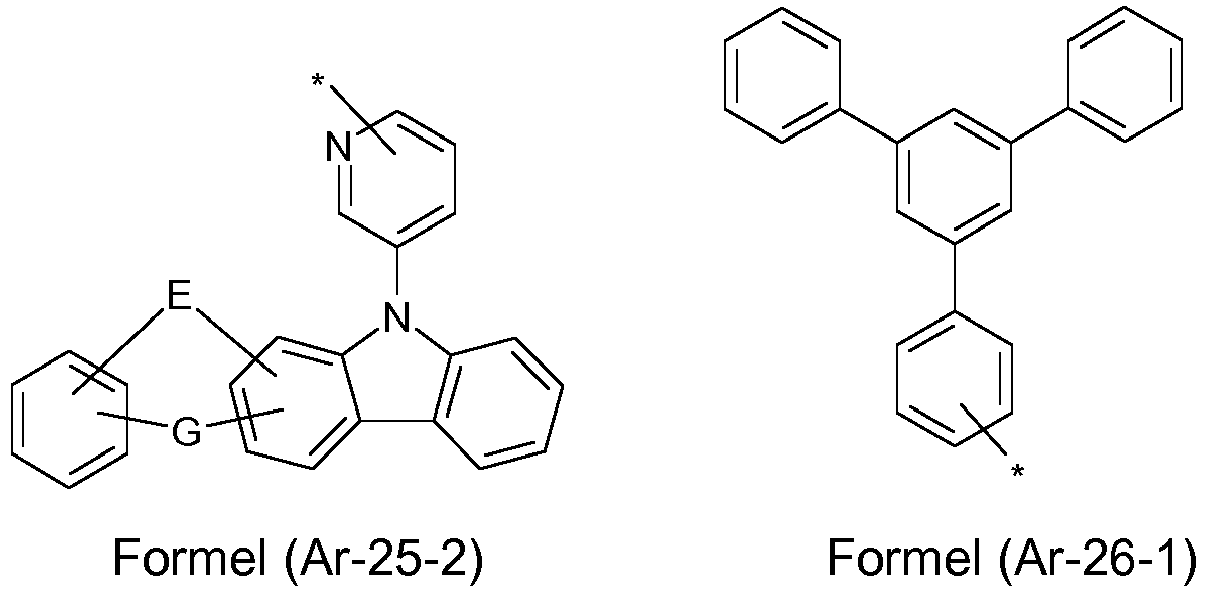


- In einer weiteren Ausführungsform der Erfindung sind die Gruppen R3 ausgewählt aus den Gruppen einer der folgenden Formeln (Ar1-1) bis (Ar1-7), wobei die allgemeinen Formeln durch die besonders bevorzugten Ausführungsformen jeweils gemäß der folgenden Formeln (Ar1-1-1) bis (Ar1-6-1) ersetzt werden (z. B. wird Formel (Ar1-1) durch die Formeln (Ar1-1-1) ersetzt):


- In einer weiteren Ausführungsform der Erfindung sind die Gruppen gemäß Formel (Ar-15), bzw. deren bevorzugte Ausführungsformen ausgewählt aus den Gruppen gemäß eine der Formeln (Ar-15-1-1a) bis (Ar-15-7-6a)







- In einer weiteren Ausführungsform der Erfindung sind die Gruppen gemäß Formel (Ar-26-1), bzw. deren bevorzugte Ausführungsformen ausgewählt aus den Gruppen gemäß einer der Formeln (Ar-26-1-1) bis (Ar-26-1-6)

- In einer weiteren Ausführungsform der Erfindung umfasst die Gruppe Ar2 in Formel (Ar-22) eine oder mehrere der Strukturen der Formeln (Ar2-1) bis (Ar2-15), wie unten beschrieben, bevorzugt (Ar2-1) bis (Ar2-14), oder ihren bevorzugten Ausführungsformen, wobei die Symbole und Indizes den Symbolen und Indizes der Formeln (Ar2-1) bis (Ar2-15) entsprechen, und im Falle von mehreren Strukturen diese über eine oder mehrere Einfachbindungen oder Heteroarome, wie O, NR4 oder S miteinander verbunden sind. Die Strukturen können an freien Positionen mit R4 substituiert sein. Ar2 ist dabei eine bivalente Gruppe. Dies bedeutet, dass sie eine Einfachbindung zum Quinazolinon-Grundgerüst und eine Bindung zum N der Formel (Ar-22) aufweist. Dabei ist die Bindung zum N der Formel (Ar-22) bevorzugt eine C-N-Einfachbindung:


- Q
- ist bei jedem Auftreten gleich oder verschieden CR4 oder N, wobei maximal 3 Symbole Q pro Cyclus für N stehen;
- E
- ist bei jedem Auftreten gleich oder verschieden (CR4)2, NR4, O, S oder C=O;
- G
- ist bei jedem Auftreten eine Einfachbindung, (CR4)2, NR4, O, S oder C=O;
- n
- ist 0 oder 1, wobei n gleich 0 bedeutet, dass an dieser Position keine Gruppe E gebunden ist und an den entsprechenden Kohlenstoffatomen stattdessen Reste R4 gebunden sind;
- Ar2
- ist bei jedem Auftreten gleich oder verschieden ein bivalentes aromatisches oder heteroaromatisches Ringsystem mit 5 bis 40 aromatischen Ringatomen, welches durch einen oder mehrere Reste R4 substituiert sein kann;
- Ar1
- sind bei jedem Auftreten gleich oder verschieden ein aromatisches oder heteroaromatisches Ringsystem mit 6 bis 60 aromatischen Ringatomen, das jeweils auch mit einem oder mehreren Reste R4 substituiert sein kann, wobei beide Ar1 und/oder Ar1 mit Ar2 über je mindestens eine Brücke K verbunden sein können;
- K
- ist bei jedem Auftreten gleich oder verschieden gleich eine Einfachbindung oder eine bivalente Brücke, ausgewählt aus N(R4), B(R4), O,C=O, C(R4)2, Si(R4)2, und S; und
- In einer weiteren Ausführungsform der Erfindung sind die Formeln (Ar2-1) bis (Ar2-15) ersetzt durch ihre bevorzugten Ausführungsformen aus den Formeln (Ar2-1-1) bis (Ar2-9-5):




- In einer weiteren Ausführungsform der Erfindung sind die Gruppen Ar1 in Formel (Ar-22) ausgewählt aus einer der Strukturen der Formel (Ar-1) bis (Ar-25) oder ihrere bevorzugten Ausführungsformen, wobei die Symbole und Indizes den Symbolen und Indizes der Formeln (Ar-1) bis (Ar-25) entsprechen, wobei zusätzlich gilt, dass * für die Bindung zum N der Formel (Ar-22) steht.
- In einer bevorzugten Ausführungsform der Erfindung ist R3 im Fall eines aromatischen oder heteroaromatischen Ringsystems eine Struktur ausgewählt aus den Formeln (Ar-1) bis (Ar-27) und (Ar1-1) bis (Ar1-7) oder den jeweiligen bevorzugten Ausführungsformen.
- In einer bevorzugten Ausführungsform der Erfindung ist R4 im Fall eines aromatischen oder heteroaromatischen Ringsystems eine Struktur ausgewählt aus den Formeln (Ar-1) bis (Ar-27) und (Ar1-1) bis (Ar1-7) oder den jeweiligen bevorzugten Ausführungsformen, wobei zusätzlich gilt:
- Q
- ist bei jedem Auftreten gleich oder verschieden CR5 oder N, wobei maximal 3 Symbole Q pro Cyclus für N stehen;
- E
- ist bei jedem Auftreten gleich oder verschieden (CR5)2, NR5, O, S oder C=O;
- G
- ist bei jedem Auftreten eine Einfachbindung, (CR5)2, NR5, O, S oder C=O;
- n
- ist 0 oder 1, wobei n gleich 0 bedeutet, dass an dieser Position keine Gruppe E gebunden ist und an den entsprechenden Kohlenstoffatomen stattdessen Reste R5 gebunden sind;
- Ar2
- ist bei jedem Auftreten gleich oder verschieden ein bivalentes aromatisches oder heteroaromatisches Ringsystem mit 5 bis 60 aromatischen Ringatomen, welches durch einen oder mehrere Reste R5 substituiert sein kann;
- Ar1
- sind bei jedem Auftreten gleich oder verschieden ein aromatisches oder heteroaromatisches Ringsystem mit 6 bis 60 aromatischen Ringatomen, das jeweils auch mit einem oder mehreren Reste R5 substituiert sein kann, wobei beide Ar1 und/oder Ar1 mit Ar2 über je mindestens eine Brücke K verbunden sein können;
- K
- ist bei jedem Auftreten gleich oder verschieden gleich eine Einfachbindung oder eine bivalente Brücke, ausgewählt aus N(R5), B(R5), O,C=O, C(R5)2, Si(R5)2, und S; und
- *
- die Bindung zur substituierten Position darstellt.
- In einer weiteren bevorzugten Ausführungsform ist R4, welcher an eine Kohlenstoffbrücke in einem aromatischen oder heteroaromatischen Ringsystem bindet, wie beispielsweise in den Formeln (Ar-12-1), (Ar-12-2), (Ar-12-3), (Ar-12-4), (Ar-13-1), (Ar-13-2), (Ar-13-3), (Ar-13-4), (Ar1-1-5-1), (Ar-15-3-1 a) oder (Ar2-9-2), gleich oder verschieden bei jedem Auftreten ausgewählt aus der Gruppe bestehend aus einer geradkettigen Alkylgruppe mit 1 bis 10 C-Atomen, einer verzweigten oder cyclischen Alkylgruppe mit 3 bis 10 C-Atomen oder einem aromatischen Ringsystem mit 6 bis 30 C-Atomen, das wie oben definiert ist und das mit einem oder mehreren Resten R5 substituiert sein kann. Dabei können die beiden Gruppen R4 auch miteinander ein Ringsystem bilden, welches aliphatisch oder zusätzlich zur oben gegebenen Definition von R4 auch aromatisch sein kann. Durch Ringbildung wird ein Spiro-System aufgespannt.
- In einer weiteren bevorzugten Ausführungsform ist R4, welcher an ein Stickstoffatom bindet, ausgewählt aus der Gruppe bestehend aus einer geradkettigen Alkylgruppe mit 1 bis 10 C-Atomen, einer verzweigten oder cyclischen Alkylgruppe mit 3 bis 10 C-Atomen oder einem aromatischen Ringsystem mit 6 bis 60 C-Atomen, insbesondere ein aromatisches Ringsystem mit 6 bis 60 C-Atomen, das wie oben definiert ist, und das mit einem oder mehreren Resten R5 substituiert sein kann.
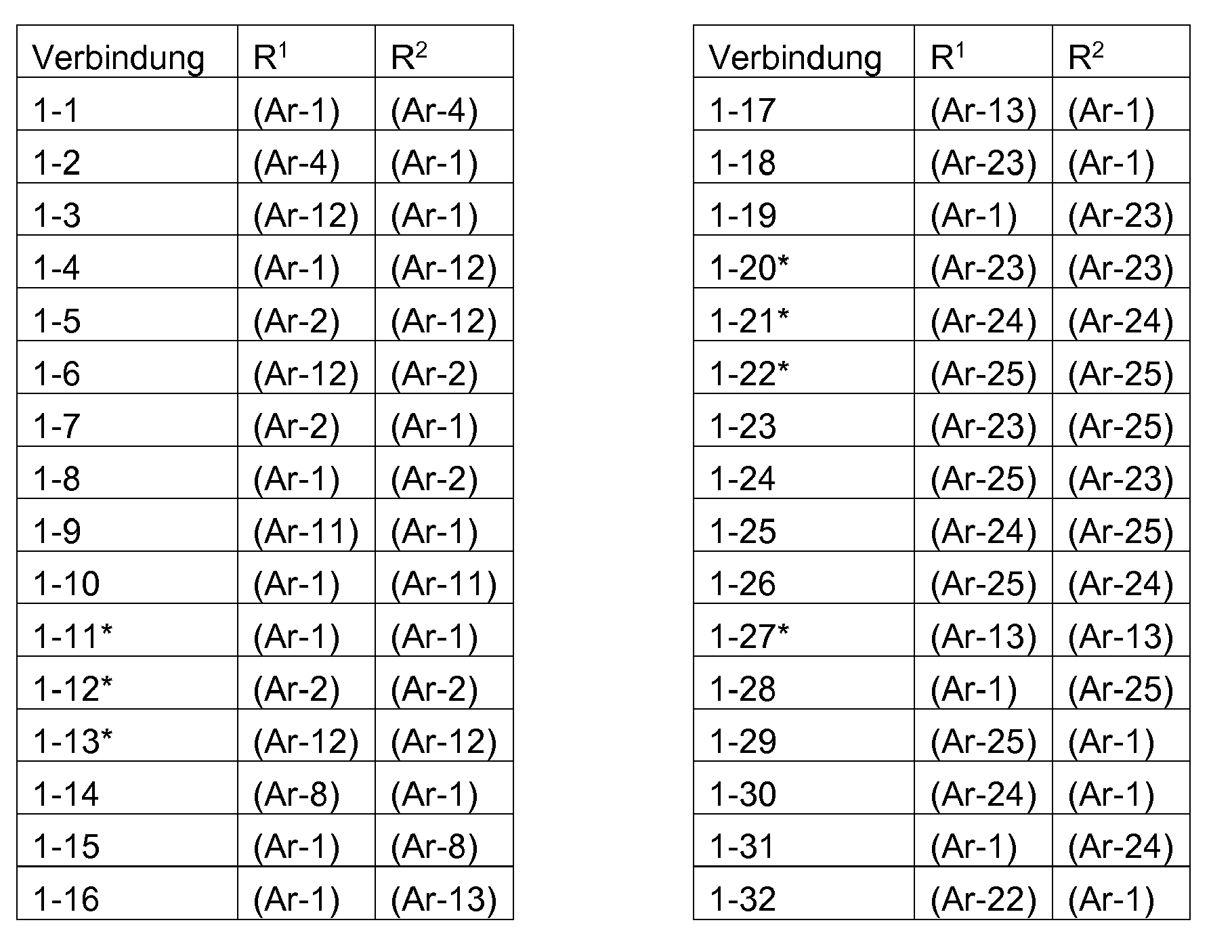
- Bevorzugte Kombinationen der Reste R1 und R2 für die Formeln (3) gibt die folgende Tabelle an:

- Die oben genannten Ausführungsformen können beliebig miteinander kombiniert werden. Insbesondere ist es bevorzugt, die oben aufgeführten bevorzugten Ausführungsformen miteinander zu kombinieren.
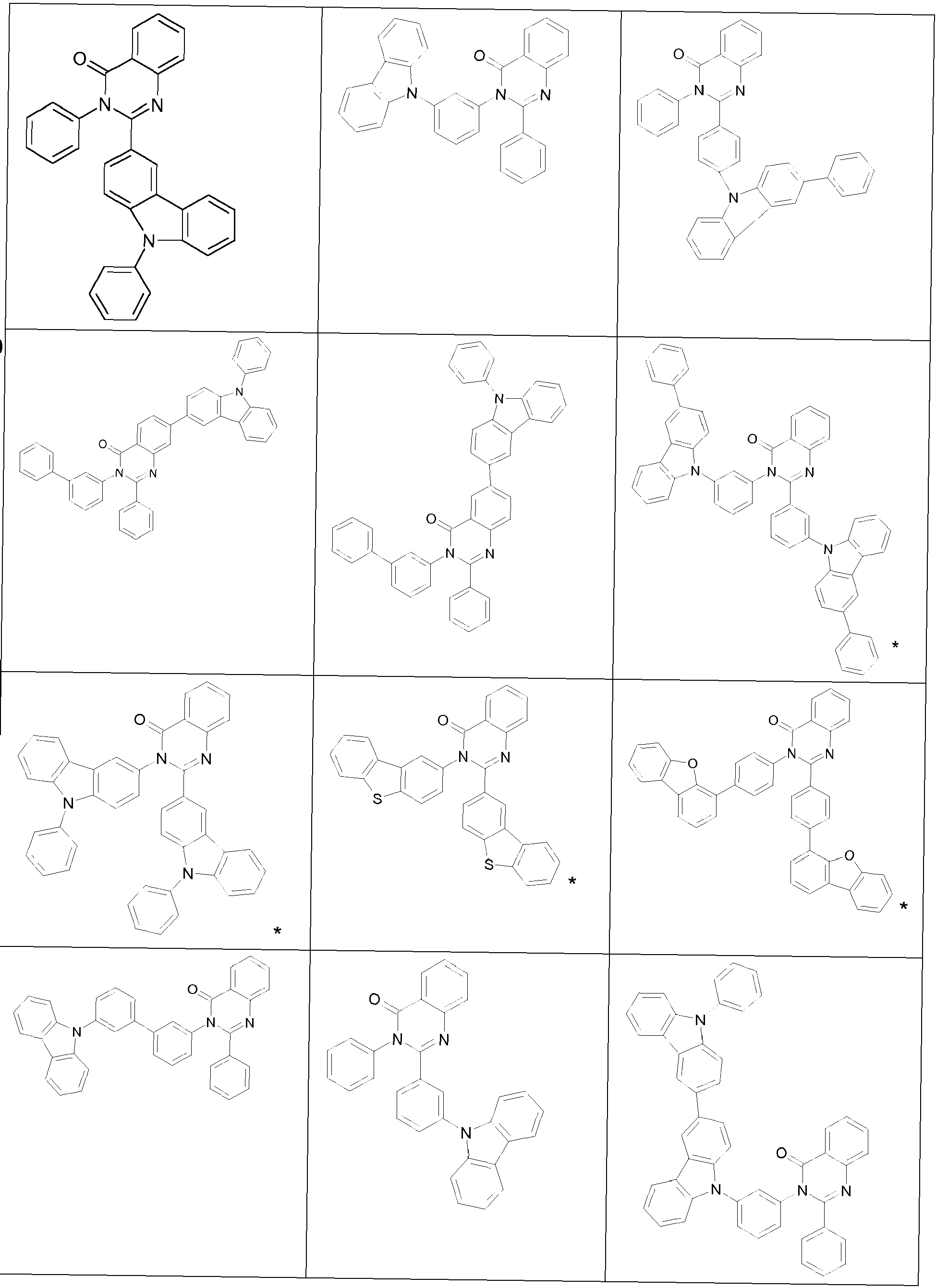
- Beispiele für bevorzugte Verbindungen gemäß den oben aufgeführten Ausführungsformen, wie sie bevorzugt in organischen elektronischen Vorrichtungen eingesetzt werden können, sind die folgenden Verbindungen:




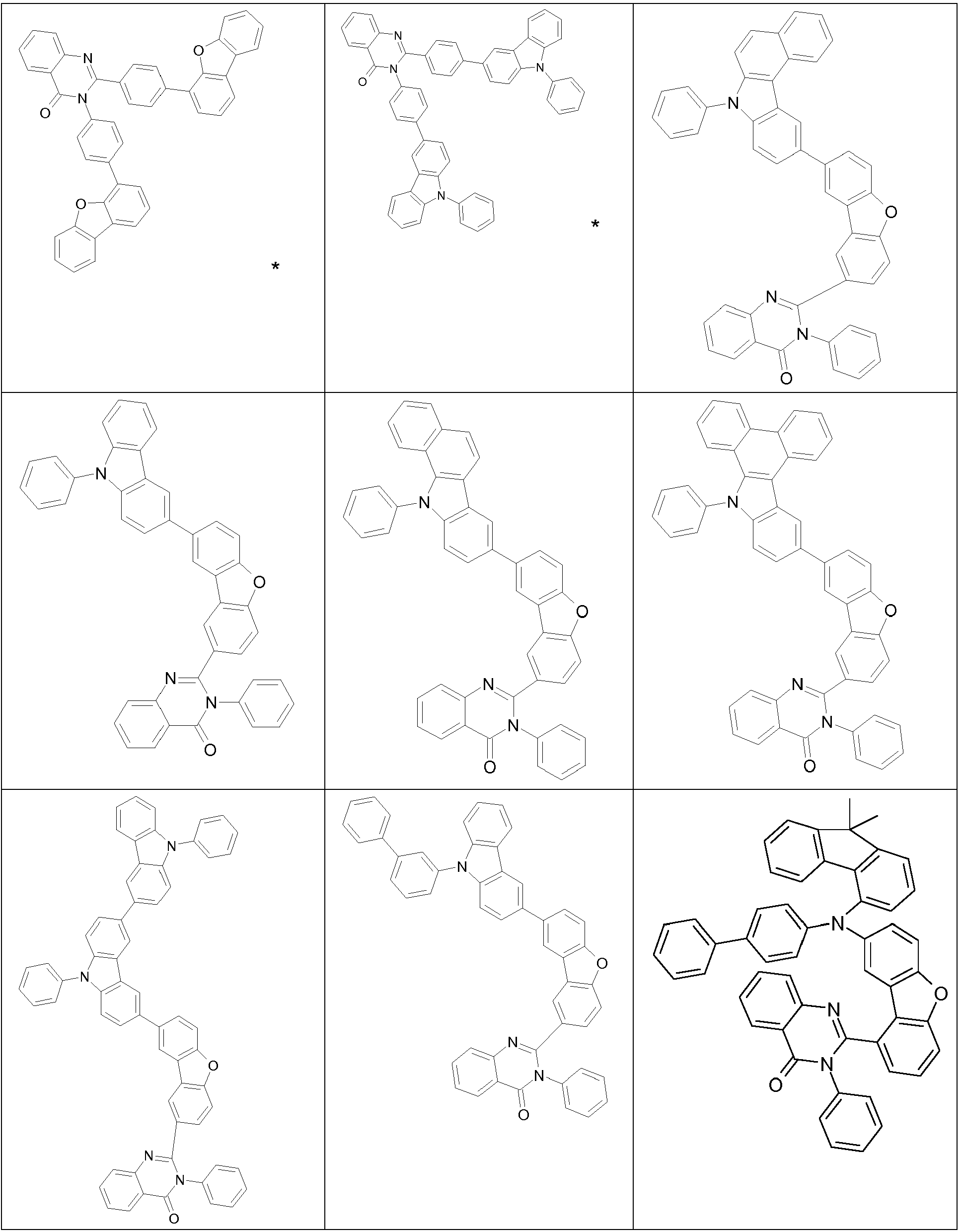
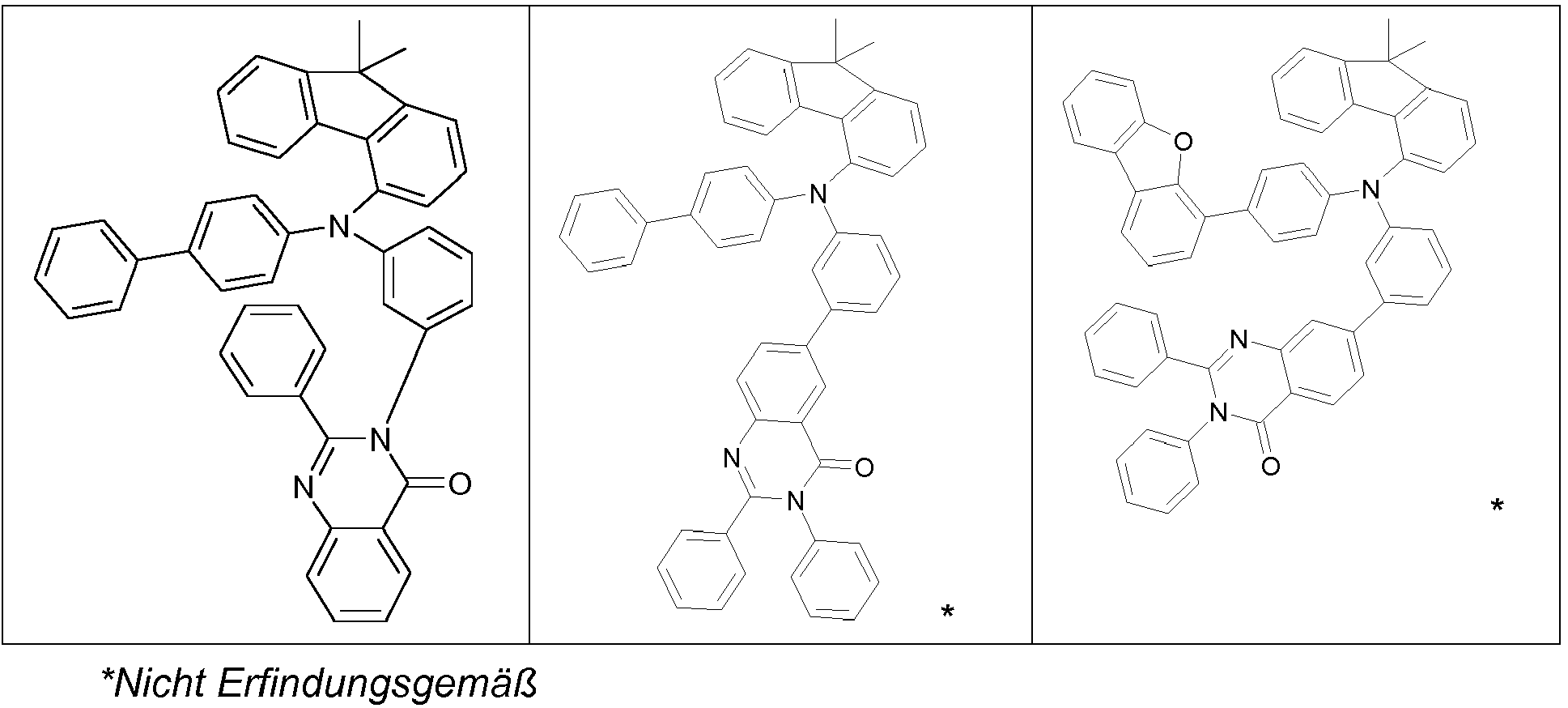
- Die erfindungsgemäßen Verbindungen können nach dem Fachmann bekannten Syntheseschritten, wie z. B. Bromierung, Suzuki-Kupplung, Ullmann-Kupplung, Hartwig-Buchwald-Kupplung, etc., dargestellt werden.
- Die Herstellung des Quinazolinon-Grundgerüsts erfolgt beispielsweise ausgehend von 4H-3,1-Benzoxazine-2,4(1H)-dion und Reaktion mit einem Amin und einem Aldehyd, bevorzugt mit einem aromatischen Amin und einem aromatischen Aldehyd. Danach wird die Verbindung zum Quinazolinon-Grundgerüst oxidiert. Dies kann mit üblichen Oxidationsmittel geschehen, wie Iod oder Kaliumpermanganat. Bei Verwendung einer Gruppe mit mehr als einer Amino- und/oder Aldehydgruppe können Verbindungen der Formel (2) erhalten werden.
- Wenn die eingesetzten Verbindungen weitere geeignete Gruppen aufweisen, können Verbindungen einer der Formeln (3) durch eine oder mehrere Kupplungsreaktionen, Umlagerungen und/oder Zyklisierungen aufgebaut werden.
- Ein weiterer Gegenstand der vorliegenden Erfindung ist daher ein Verfahren zur Herstellung einer Verbindung gemäß Formel (3) wobei die Verbindung der Formel (3) durch eine oder mehrere Kupplungsreaktionen, Umlagerungen und/oder Zyklisierungen aufgebaut wird.
- Die oben gezeigten Syntheseverfahren haben exemplarischen Charakter und können vom Fachmann auf dem Gebiet der organischen Synthese in geeigneter Weise abgewandelt werden, wenn dies für die Synthese bestimmter Ausführungsformen von erfindungsgemäßen Verbindungen vorteilhaft ist.
- Die oben beschriebenen erfindungsgemäßen Verbindungen, insbesondere Verbindungen, welche mit reaktiven Abgangsgruppen, wie Brom, Iod, Chlor, Boronsäure oder Boronsäureester, substituiert sind, können als Monomere zur Erzeugung entsprechender Oligomere, Dendrimere oder Polymere Verwendung finden. Geeignete reaktive Abgangsgruppen sind beispielsweise Brom, Iod, Chlor, Boronsäuren, Boronsäureester, Amine, Alkenyl- oder Alkinylgruppen mit endständiger C-C-Doppelbindung bzw. CC-Dreifachbindung, Oxirane, Oxetane, Gruppen, die eine Cycloaddition, beispielsweise eine 1,3-dipolare Cycloaddition, eingehen, wie beispielsweise Diene oder Azide, Carbonsäurederivate, Alkohole und Silane.
- Weiterere Gegenstände der Erfindung sind daher Oligomere, Polymere oder Dendrimere enthaltend eine oder mehrere Verbindungen gemäß Formel (3), wobei die Bindung(en) zum Polymer, Oligomer oder Dendrimer an beliebigen freien Positionen in Formel (3) lokalisiert sein können. Je nach Verknüpfung der erfindungsgemäßen Verbindung ist die Verbindung Bestandteil einer Seitenkette des Oligomers oder Polymers oder Bestandteil der Hauptkette.
- Unter einem Oligomer im Sinne dieser Erfindung wird eine Verbindung verstanden, welche aus mindestens drei Monomereinheiten aufgebaut ist. Unter einem Polymer im Sinne der Erfindung wird eine Verbindung verstanden, die aus mindestens zehn Monomereinheiten aufgebaut ist.
- Die erfindungsgemäßen Polymere, Oligomere oder Dendrimere können konjugiert, teilkonjugiert oder nicht-konjugiert sein. Die erfindungsgemäßen Oligomere oder Polymere können linear, verzweigt oder dendritisch sein.
- In den linear verknüpften Strukturen können die Einheiten gemäß Formel (3) direkt miteinander verknüpft sein oder sie können über eine bivalente Gruppe, beispielsweise über eine substituierte oder unsubstituierte Alkylengruppe, über ein Heteroatom oder über eine bivalente aromatische oder heteroaromatische Gruppe miteinander verknüpft sein.
- In verzweigten und dendritischen Strukturen können beispielsweise 3, 5 oder mehrere Einheiten gemäß Formel (3) über eine trivalente oder höhervalente Gruppe, beispielsweise über eine trivalente oder höhervalente aromatische oder heteroaromatische Gruppe, zu einem verzweigten bzw. dendritischen Oligomer oder Polymer verknüpft sein.
- Für die Wiederholeinheiten gemäß Formel (3) in Oligomeren, Dendrimeren und Polymeren gelten dieselben Bevorzugungen wie oben für die erfindungsgemäßen Verbindungen beschrieben.
- Zur Herstellung der Oligomere oder Polymere werden die erfindungsgemäßen Monomere homopolymerisiert oder mit weiteren Monomeren copolymerisiert. Geeignete und bevorzugte Comonomere sind gewählt aus Fluorenen (z. B. gemäß
EP 842208 WO 2000/22026 EP 707020 EP 894107 WO 2006/061181 ), Paraphenylenen (z. B. gemäßWO 1992/18552 WO 2004/070772 oderWO 2004/113468 ), Thiophenen (z. B. gemäßEP 1028136 ), Dihydrophenanthrenen (z. B. gemäßWO 2005/014689 oderWO 2007/006383 ), cis- und trans-Indenofluorenen (z. B. gemäßWO 2004/041901 oderWO 2004/113412 ), Ketonen (z. B. gemäßWO2005/040302 ), Phenanthrenen (z. B. gemäßWO 2005/104264 oderWO 2007/017066 ) oder auch mehreren dieser Einheiten. Die Polymere, Oligomere und Dendrimere enthalten üblicherweise noch weitere Einheiten, beispielsweise emittierende (fluoreszierende oder phosphoreszierende) Einheiten, wie z. B. Vinyltriarylamine (z. B. gemäßWO 2007/068325 ) oder phosphoreszierende Metallkomplexe (z. B. gemäßWO 2006/003000 ), und/oder Ladungstransporteinheiten, insbesondere solche basierend auf Triarylaminen. - Die erfindungsgemäßen Polymere, Oligomere und Dendrimere weisen vorteilhafte Eigenschaften, insbesondere hohe Lebensdauern, hohe Effizienzen und gute Farbkoordinaten auf.
- Die erfindungsgemäßen Polymere und Oligomere werden in der Regel durch Polymerisation von einer oder mehreren Monomersorten hergestellt, von denen mindestens ein Monomer im Polymer zu Wiederholungseinheiten der Formel (3) führt. Geeignete Polymerisationsreaktionen sind dem Fachmann bekannt und in der Literatur beschrieben. Besonders geeignete und bevorzugte Polymerisationsreaktionen, die zu C-C- bzw. C-N-Verknüpfungen führen, sind folgende:
- (A) SUZUKI-Polymerisation
- (B) YAMAMOTO-Polymerisation
- (C) STILLE-Polymerisation und
- (D) HARTWIG-BUCHWALD-Polymerisation.
- Wie die Polymerisation nach diesen Methoden durchgeführt werden kann und wie die Polymere dann vom Reaktionsmedium abgetrennt und aufgereinigt werden können, ist dem Fachmann bekannt und in der Literatur, beispielsweise in
WO 2003/048225 ,WO 2004/037887 undWO 2004/037887 , im Detail beschrieben. - Gegenstand der vorliegenden Erfindung ist somit auch ein Verfahren zur Herstellung der erfindungsgemäßen Polymere, Oligomere und Dendrimere, das dadurch gekennzeichnet ist, dass sie durch Polymerisation gemäß SUZUKI, Polymerisation gemäß YAMAMOTO, Polymerisation gemäß STILLE oder Polymerisation gemäß HARTWIG-BUCHWALD hergestellt werden. Die erfindungsgemäßen Dendrimere können durch dem Fachmann bekannte Verfahren oder in Analogie dazu hergestellt werden. Geeignete Verfahren sind in der Literatur beschrieben, wie z. B. in Frechet, Jean M. J.; Hawker, Craig J., "Hyperbranched polyphenylene and hyperbranched polyesters: new soluble, three-dimensional, reactive polymers", Reactive & Functional Polymers (1995), 26(1-3), 127-36; Janssen, H. M.; Meijer, E. W., "The synthesis and characterization of dendritic molecules", Materials Science and Technology (1999), 20 (Synthesis of Polymers), 403-458; Tomalia, Donald A., "Dendrimer molecules", Scientific American (1995), 272(5), 62-6;
WO 2002/067343 A1 undWO 2005/026144 A1 . - Für die Verarbeitung der erfindungsgemäßen Verbindungen aus flüssiger Phase, beispielsweise durch Spin-Coating oder durch Druckverfahren, sind Formulierungen der erfindungsgemäßen Verbindungen erforderlich. Diese Formulierungen können beispielsweise Lösungen, Dispersionen oder Emulsionen sein. Es kann bevorzugt sein, hierfür Mischungen aus zwei oder mehr Lösemitteln zu verwenden. Geeignete und bevorzugte Lösemittel sind beispielsweise Toluol, Anisol, o-, m- oder p-Xylol, Methylbenzoat, Mesitylen, Tetralin, Veratrol, THF, Methyl-THF, THP, Chlorbenzol, Dioxan, Phenoxytoluol, insbesondere 3-Phenoxytoluol, (-)-Fenchon, 1,2,3,5-Tetramethylbenzol, 1,2,4,5-Tetramethylbenzol, 1-Methylnaphthalin, 2-Methylbenzothiazol, 2-Phenoxyethanol, 2-Pyrrolidinon, 3-Methylanisol, 4-Methylanisol, 3,4-Dimethylanisol, 3,5-Dimethylanisol, Acetophenon, α-Terpineol, Benzothiazol, Butylbenzoat, Cumol, Cyclohexanol, Cyclohexanon, Cyclohexylbenzol, Decalin, Dodecylbenzol, Ethylbenzoat, Indan, Methylbenzoat, NMP, p-Cymol, Phenetol, 1,4-Diisopropylbenzol, Dibenzylether, Diethylenglycolbutylmethylether, Triethylenglycolbutylmethyl-ether, Diethylenglycoldibutylether, Triethylenglycoldimethylether, Diethylenglycolmonobutylether, Tripropylenglycoldimethylether, Tetraethylenglycoldimethylether, 2-Isopropylnaphthalin, Pentylbenzol, Hexylbenzol, Heptylbenzol, Octylbenzol, 1,1-Bis(3,4-Dimethylphenyl)ethan oder Mischungen dieser Lösemittel.
- Gegenstand der Erfindung ist daher weiterhin eine Formulierung, insbesondere eine Lösung, Dispersion oder Emulsion enthaltend mindestens eine Verbindung gemäß Formel (3) oder mindestens ein Polymer, Oligomer oder Dendrimer enthaltend mindestens eine Einheit gemäß Formel (3), sowie mindestens einem phosphoreszierenden Dotanden und sowie mindestens ein Lösungsmittel, bevorzugt ein organisches Lösungsmittel. Wie solche Lösungen hergestellt werden können, ist dem Fachmann bekannt und beispielsweise in
WO 2002/072714 ,WO 2003/019694 und der darin zitierten Literatur beschrieben. - Die erfindungsgemäßen Mischungen eignen sich für die Verwendung in einer elektronischen Vorrichtung. Dabei wird unter einer elektronischen Vorrichtung eine Vorrichtung verstanden, welche mindestens eine Schicht enthält, die mindestens eine organische Verbindung enthält. Das Bauteil kann dabei aber auch anorganische Materialien enthalten oder auch Schichten, welche vollständig aus anorganischen Materialien aufgebaut sind.
- Ein weiterer Gegenstand der vorliegenden Erfindung ist daher die Verwendung der erfindungsgemäßen Mischungen in einer elektronischen Vorrichtung, insbesondere in einer organischen Elektrolumineszenzvorrichtung.
- Nochmals ein weiterer Gegenstand der vorliegenden Erfindung ist eine elektronische Vorrichtung enthaltend mindestens eine der oben ausgeführten erfindungsgemäßen Mischungen. Dabei gelten die oben für die Verbindung ausgeführten Bevorzugungen auch für die elektronischen Vorrichtungen.
- Die elektronische Vorrichtung ist bevorzugt ausgewählt aus der Gruppe bestehend aus organischen Elektrolumineszenzvorrichtungen (OLEDs, PLEDs), organischen integrierten Schaltungen (O-ICs), organischen Feld-Effekt-Transistoren (O-FETs), organischen Dünnfilmtransistoren (O-TFTs), organischen lichtemittierenden Transistoren (O-LETs), organischen Solarzellen (O-SCs), organischen farbstoff-sensibilisierten Solarzellen, organischen optischen Detektoren, organischen Photorezeptoren, organischen Feld-Quench-Devices (O-FQDs), lichtemittierenden elektrochemischen Zellen (LECs), organischen Laserdioden (O-Laser) und "organic plasmon emitting devices" (D. M. Koller et al., Nature Photonics 2008, 1-4), bevorzugt aus organischen Elektrolumineszenzvorrichtungen (OLEDs, PLEDs), insbesondere phosphoreszierenden OLEDs.
- Die organische Elektrolumineszenzvorrichtung enthält Kathode, Anode und mindestens eine emittierende Schicht. Außer diesen Schichten kann sie noch weitere Schichten enthalten, beispielsweise jeweils eine oder mehrere Lochinjektionsschichten, Lochtransportschichten, Lochblockierschichten, Elektronentransportschichten, Elektroneninjektionsschichten, Exzitonenblockierschichten, Elektronenblockierschichten und/oder Ladungserzeugungsschichten (Charge-Generation Layers). Ebenso können zwischen zwei emittierende Schichten Zwischenschichten (Interlayer) eingebracht sein, welche beispielsweise eine exzitonenblockierende Funktion aufweisen. Es sei aber darauf hingewiesen, dass nicht notwendigerweise jede dieser Schichten vorhanden sein muss. Dabei kann die organische Elektrolumineszenzvorrichtung eine emittierende Schicht enthalten, oder sie kann mehrere emittierende Schichten enthalten. Wenn mehrere Emissionsschichten vorhanden sind, weisen diese bevorzugt insgesamt mehrere Emissionsmaxima zwischen 380 nm und 750 nm auf, sodass insgesamt weiße Emission resultiert, d. h. in den emittierenden Schichten werden verschiedene emittierende Verbindungen verwendet, die fluoreszieren oder phosphoreszieren können. Insbesondere bevorzugt sind Systeme mit drei emittierenden Schichten, wobei die drei Schichten blaue, grüne und orange oder rote Emission zeigen (für den prinzipiellen Aufbau siehe z. B.
WO 2005/011013 ). Es kann sich dabei um fluoreszierende oder um phosphoreszierende Emissionsschichten handeln oder um Hybrid-Systeme, bei denen fluoreszierende und phosphoreszierende Emissionsschichten miteinander kombiniert werden. - Die erfindungsgemäße Mischung gemäß den oben aufgeführten Ausführungsformen kann dabei in unterschiedlichen Schichten eingesetzt werden, je nach genauer Struktur. Bevorzugt ist eine organische Elektrolumineszenzvorrichtung, umfassend eine erfindungsgemäßt Mischung oder eine Verbindung gemäß Formel (3) oder gemäß den bevorzugten Ausführungsformen als Matrixmaterial für phosphoreszierende Emitter. Dabei gelten die oben aufgeführten bevorzugten Ausführungsformen auch für die Verwendung der Materialien in organischen elektronischen Vorrichtungen.
- In einer bevorzugten Ausführungsform der Erfindung wird die Verbindung gemäß Formel (3), bzw. gemäß den bevorzugten Ausführungsformen als Matrixmaterial für eine phosphoreszierende Verbindung in einer emittierenden Schicht eingesetzt. Dabei kann die organische Elektrolumineszenzvorrichtung eine emittierende Schicht enthalten, oder sie kann mehrere emittierende Schichten enthalten, wobei mindestens eine emittierende Schicht mindestens eine erfindungsgemäße Mischung oder eine Verbindung gemäß (3) als Matrixmaterial für eine phosphoreszierende Verbindung enthält.
- Eine weitere bevorzugte Ausführungsform der vorliegenden Erfindung ist der Einsatz der Verbindung gemäß Formel (3) bzw. gemäß den bevorzugten Ausführungsformen als Matrixmaterial für einen phosphoreszierenden Emitter in Kombination mit einem weiteren Matrixmaterial. Besonders geeignete Matrixmaterialien, welche in Kombination mit den Verbindungen gemäß Formel (3) bzw. gemäß den bevorzugten Ausführungsformen eingesetzt werden können, sind aromatische Ketone, aromatische Phosphinoxide oder aromatische Sulfoxide oder Sulfone, z. B. gemäß
WO 2004/013080 ,WO 2004/093207 ,WO 2006/005627 oderWO 2010/006680 , Triarylamine, Carbazolderivate, z. B. CBP (N,N-Biscarbazolylbiphenyl) oder die inWO 2005/039246 ,US 2005/0069729 ,JP 2004/288381 EP 1205527 oderWO 2008/086851 offenbarten Carbazolderivate, Indolocarbazolderivate, z. B. gemäßWO 2007/063754 oderWO 2008/056746 , Indenocarbazolderivate, z. B. gemäßWO 2010/136109 undWO 2011/000455 , Azacarbazolderivate, z. B. gemäßEP 1617710 ,EP 1617711 ,EP 1731584 ,JP 2005/347160 WO 2007/137725 , Silane, z. B. gemäßWO 005/111172 WO 2006/117052 , Triazinderivate, z. B. gemäßWO 2010/015306 ,WO 2007/063754 oderWO 2008/056746 , Zinkkomplexe, z. B. gemäßEP 652273 WO 2009/062578 , Diazasilol- bzw. Tetraazasilol-Derivate, z. B. gemäßWO 2010/054729 , Diazaphosphol-Derivate, z. B. gemäßWO 2010/054730 , überbrückte Carbazol-Derivate, z. B. gemäßUS 2009/0136779 ,WO 2010/050778 ,WO 2011/042107 ,WO 2011/088877 oderWO 2012/143080 , Triphenylenderivaten, z. B. gemäßWO 2012/048781 , oder Lactame, z. B. gemäßWO 2011/116865 oderWO 2011/137951 . Ebenso kann ein weiterer phosphoreszierender Emitter, welcher kürzerwellig als der eigentliche Emitter emittiert, als Co-Host in der Mischung vorhanden sein. - Die Mischung aus der Verbindung gemäß Formel (3) bzw. gemäß den bevorzugten Ausführungsformen und der emittierenden Verbindung enthält zwischen 99 und 1 Vol.-%, vorzugsweise zwischen 98 und 10 Vol.-%, besonders bevorzugt zwischen 97 und 60 Vol.-%, insbesondere zwischen 95 und 80 Vol.-% der Verbindung gemäß Formel (3) bzw. gemäß den bevorzugten Ausführungsformen bezogen auf die Gesamtmischung aus Emitter und Matrixmaterial. Entsprechend enthält die Mischung zwischen 1 und 99 Vol.-%, vorzugsweise zwischen 2 und 90 Vol.-%, besonders bevorzugt zwischen 3 und 40 Vol.-%, insbesondere zwischen 5 und 20 Vol.-% des Emitters bezogen auf die Gesamtmischung aus Emitter und Matrixmaterial.
- Vom Begriff phosphoreszierende Dotanden (Emitter) sind typischerweise Verbindungen umfasst, bei denen die Lichtemission durch einen spinverbotenen Übergang erfolgt. Es sind Verbindungen, welche bei Raumtemperatur Lumineszenz aus einem angeregten Zustand mit Spinmultiplizität > 1 zeigen, beispielsweise durch einen Übergang aus einem angeregten Triplettzustand oder einem Zustand mit einer höheren Spinquantenzahl, beispielsweise einem Quintett-Zustand. Als phosphoreszierende Dotanden eignen sich insbesondere Verbindungen, die bei geeigneter Anregung Licht, vorzugsweise im sichtbaren Bereich, emittieren und außerdem mindestens ein Atom der Ordnungszahl größer 20, bevorzugt größer 38 und kleiner 84, besonders bevorzugt größer 56 und kleiner 80 enthalten. Bevorzugt werden als phosphoreszierende Dotanden Verbindungen, die Kupfer, Molybdän, Wolfram, Rhenium, Ruthenium, Osmium, Rhodium, Iridium, Palladium, Platin, Silber, Gold und/oder Europium enthalten, verwendet, insbesondere Verbindungen, die Iridium, Platin oder Kupfer enthalten.
- Dabei werden im Sinne der vorliegenden Erfindung alle lumineszierenden Iridium-, Platin- oder Kupferkomplexe als phosphoreszierende Verbindungen angesehen.
- Besonders bevorzugte phosphoreszierende Dotanden sind Verbindungen ausgewählt aus den Formeln (D-1) bis (D-6),


- DCy
- ist gleich oder verschieden bei jedem Auftreten eine cyclische Gruppe, die mindestens ein Donoratom, bevorzugt Stickstoff, Kohlenstoff in Form eines Carbens oder Phosphor, enthält oder als Substituenten trägt, über welches die cyclische Gruppe an das Metall gebunden ist, und die wiederum einen oder mehrere Substituenten R4 tragen kann; die Gruppen DCy und CCy sind über eine kovalente Bindung miteinander verbunden;
- CCy
- ist gleich oder verschieden bei jedem Auftreten eine cyclische Gruppe, die ein Kohlenstoffatom enthält, über welches die cyclische Gruppe an das Metall gebunden ist und die wiederum einen oder mehrere Substituenten R4 tragen kann;
- A
- ist gleich oder verschieden bei jedem Auftreten ein mono-anionischer, zweizähnig chelatisierender Ligand, bevorzugt ein Diketonatiigand.
- B
- ist gleich oder verschieden bei jedem Auftreten eine Verbindung umfassend mindestens ein Donoratom, bevorzugt Stickstoff, Kohlenstoff in Form eines Carbens oder Phosphor, welches an das Metall bindet.
- Dabei kann durch Bildung von Ringsystemen zwischen mehreren Resten R4 auch eine Brücke zwischen den Gruppen DCy und CCy vorliegen. Weiterhin kann durch Bildung von Ringsystemen zwischen mehreren Resten R4 auch eine Brücke zwischen zwei oder drei Liganden CCy-DCy bzw. zwischen ein oder zwei Liganden CCy-DCy und dem Liganden A, bzw. den beiden Liganden DCy-DCy oder DCy-DCy und DCy vorliegen, so dass es sich um ein polydentates bzw. polypodales Ligandensystem handelt. Dies ist insbesondere bevorzugt bei den Pt-Komplexen der Formel (D-4), wobei die Brücke zwischen den beiden CCy-DCy-Liganden bevorzugt ausgewählt ist aus NR4 oder C(R4)2.
- Bevorzugt ist B ein Phosphanyl- oder Arsanylrest (P(R4)2 oder As(R4)2).
- Bevorzugt sind Verbindungen gemäß einer der Fomeln (D-1) bis (D-4).
- Die phosphoreszierende Dotanden können als Einzelverbindung oder gebunden an Polymere oder Oligomere vorliegen.
- Beispiele für phosphoreszierende Dotanden können den Anmeldungen
WO 2000/70655 WO 2001/41512 WO 2002/02714 WO 2002/15645 EP 1191613 ,EP 1191612 ,EP 1191614 ,WO 2004/081017 ,WO 2005/033244 ,WO 2005/042550 ,WO 2005/113563 ,WO 2006/008069 ,WO 2006/061182 ,WO 2006/081973 ,WO 2009/146770 ,WO 2005/019373 undUS 2005/0258742 entnommen werden. Beispiele für phosphoreszierende Dotanden mit Kupfer finden sich inWO 2013/007707 . Generell eignen sich alle phosphoreszierenden Komplexe, wie sie gemäß dem Stand der Technik für phosphoreszierende OLEDs verwendet werden und wie sie dem Fachmann auf dem Gebiet der organischen Elektrolumineszenzvorrichtungen bekannt sind, zur Verwendung in den erfindungsgemäßen Vorrichtungen. Auch kann der Fachmann ohne erfinderisches Zutun weitere phosphoreszierende Komplexe in Kombination mit den erfindungsgemäßen Verbindungen in OLEDs einsetzen. - Beispiele für geeignete phosphoreszierende Dotanden sind in der folgenden Tabelle aufgeführt.


- In einer weiteren Ausführungsform der Erfindung enthält die erfindungsgemäße organische Elektrolumineszenzvorrichtung keine separate Lochinjektionsschicht und/oder Lochtransportschicht und/oder Lochblockierschicht und/oder Elektronentransportschicht, d. h. die emittierende Schicht grenzt direkt an die Lochinjektionschicht oder die Anode an, und/ oder die emittierende Schicht grenzt direkt an die Elektronentransportschicht oder die Elektroneninjektionsschicht oder die Kathode an, wie zum Beispiel in
WO 2005/053051 beschrieben. Weiterhin ist es möglich, einen Metallkomplex, der gleich oder ähnlich dem Metallkomplex in der emittierenden Schicht ist, direkt angrenzend an die emittierende Schicht als Lochtransport- bzw. Lochinjektionsmaterial zu verwenden, wie z. B. inWO 2009/030981 beschrieben. - In den weiteren Schichten der erfindungsgemäßen organischen Elektrolumineszenzvorrichtung können alle Materialien verwendet werden, wie sie üblicherweise gemäß dem Stand der Technik eingesetzt werden. Der Fachmann kann daher ohne erfinderisches Zutun alle für organische Elektrolumineszenzvorrichtungen bekannten Materialien in Kombination mit den erfindungsgemäßen Mischungen umfassend die Verbindungen gemäß Formel (3) bzw. gemäß den bevorzugten Ausführungsformen verwenden.
- Weiterhin bevorzugt ist eine organische Elektrolumineszenzvorrichtung, dadurch gekennzeichnet, dass eine oder mehrere Schichten mit einem Sublimationsverfahren beschichtet werden. Dabei werden die Materialien in Vakuum-Sublimationsanlagen bei einem Anfangsdruck kleiner 10-5 mbar, bevorzugt kleiner 10-6 mbar aufgedampft. Es ist aber auch möglich, dass der Anfangsdruck noch geringer oder höher ist, beispielsweise kleiner 10-7 mbar.
- Bevorzugt ist ebenfalls eine organische Elektrolumineszenzvorrichtung, dadurch gekennzeichnet, dass eine oder mehrere Schichten mit dem OVPD (Organic Vapour Phase Deposition) Verfahren oder mit Hilfe einer Trägergassublimation beschichtet werden. Dabei werden die Materialien bei einem Druck zwischen 10-5 mbar und 1 bar aufgebracht. Ein Spezialfall dieses Verfahrens ist das OVJP (Organic Vapour Jet Printing) Verfahren, bei dem die Materialien direkt durch eine Düse aufgebracht und so strukturiert werden (z. B. M. S. Arnold et al., Appl. Phys. Lett. 2008, 92, 053301).
- Weiterhin bevorzugt ist eine organische Elektrolumineszenzvorrichtung, dadurch gekennzeichnet, dass eine oder mehrere Schichten aus Lösung, wie z. B. durch Spincoating, oder mit einem beliebigen Druckverfahren, wie z. B. Ink-Jet Druck (Tintenstrahldruck), LITI (Light Induced Thermal Imaging, Thermotransferdruck), Siebdruck, Flexodruck, Offsetdruck oder Nozzle-Printing hergestellt werden. Hierfür sind lösliche Verbindungen nötig, welche beispielsweise durch geeignete Substitution erhalten werden. Diese Verfahren eignen sich insbesondere auch für Oligomere, Dendrimere und Polymere.
- Weiterhin sind Hybridverfahren möglich, bei denen beispielsweise eine oder mehrere Schichten aus Lösung aufgebracht werden und eine oder mehrere weitere Schichten aufgedampft werden. So ist es beispielsweise möglich, die emittierende Schicht aus Lösung aufzubringen und die Elektronentransportschicht aufzudampfen.
- Diese Verfahren sind dem Fachmann generell bekannt und können von ihm ohne erfinderisches Zutun auf organische Elektrolumineszenzvorrichtungen enthaltend die erfindungsgemäßen Verbindungen angewandt werden.
- Die erfindungsgemäßen Mischungen weisen bei Verwendung in organischen Elektrolumineszenzvorrichtungen einen oder mehrere der folgenden überraschenden Vorteile gegenüber dem Stand der Technik auf:
- 1. Die Leistungseffizienz entsprechender Vorrichtungen wird höher im Vergleich zu Systemen gemäß dem Stand der Technik.
- 2. Die Stabilität entsprechender Vorrichtungen wird höher im Vergleich zu Systemen gemäß dem Stand der Technik, was sich vor allem in einer deutlich höheren Lebensdauer zeigt.
- 3. Die erfindungsgemäßen organische Elektrolumineszenzvorrichtungen weisen eine verringerte Betriebsspannung auf.
- 4. Wenn die erfindungsgemäßen Verbindungen als Matrixmaterial für phosphoreszierende Emitter verwendet werden, ist es möglich, mit nur einer geringen Emitterkonzentration im Bereich von weniger als 10 Vol.% bereits sehr gute Ergebnisse zu erzielen.
- 5. Die erfindungsgemäßen Verbindungen weisen eine sehr gute thermische Stabilität auf.
- Die Erfindung wird nun durch die nachfolgenden Beispiele näher erläutert, ohne sie dadurch einschränken zu wollen.
-

- Schema 1 zeigt eine Synthese des Grundgerüsts analog zu Monatshefte fuer Chemie, 141 (8), 877-881; 2010.
- Eine zweite Möglichkeit der Synthese zeigen die Schemata 2a, 2b und 2c:
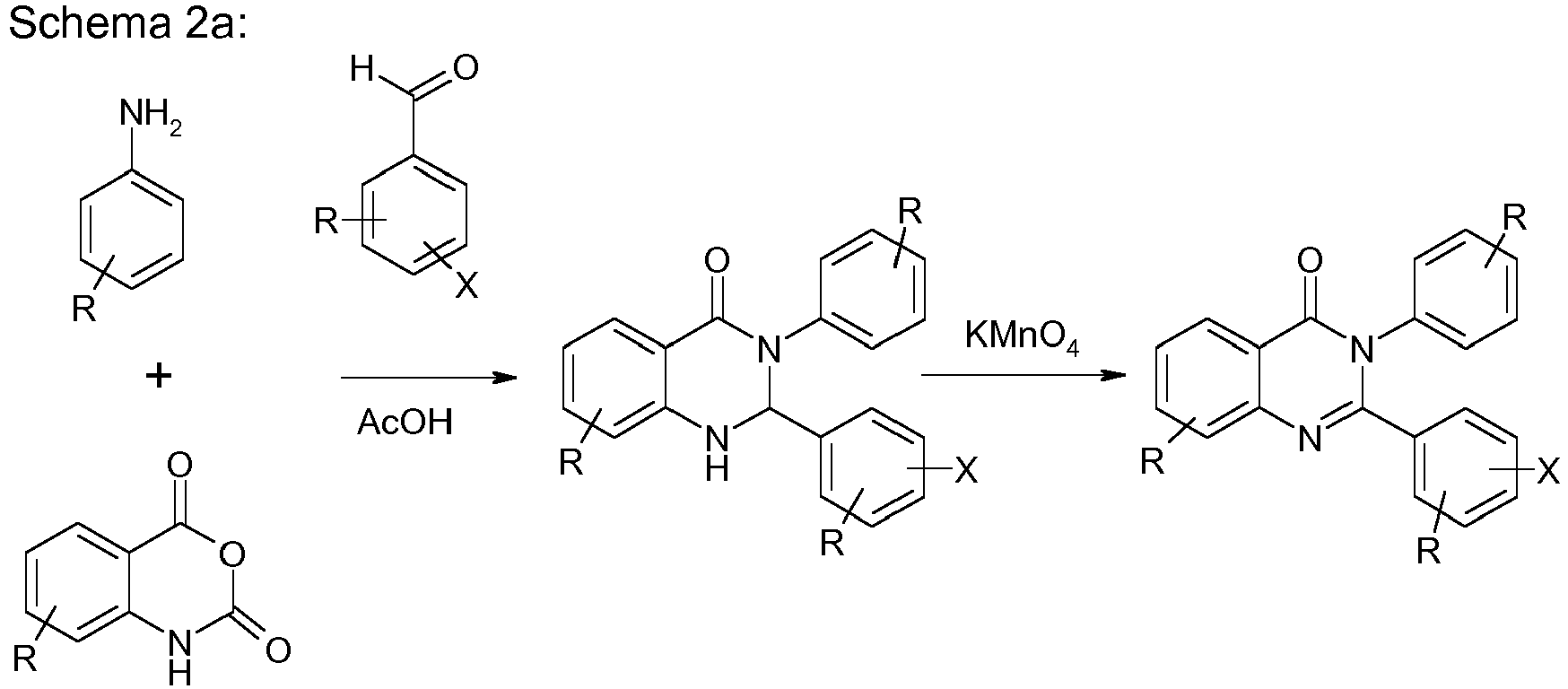
- Dabei steht R für einen beliebigen Rest und X für eine Abgangsgruppe wie z. B. eine Halogenid oder Tosylat.
- Zunächst wird ein 4H-3,1-Benzoxazine-2,4(1H)-dion mit einem Amin und einem Aldehyd unter Säurekatalyse umgesetzt. Man erhält das entsprechende 2,3-Dihydro-1 H-quinazolin-4-on. Dieses lässt sich mit Kaliumpermanganat zu dem Quinazolinon-Grundgerüst oxidieren. Aufgrund der milden Reaktionsbedingungen ist es möglich, substituierte Aromaten zu verwenden. Auf diese Weise lassen sich auf einfache Weise Gruppen einführen, welche weitere Kupplungsreaktionen erlauben.
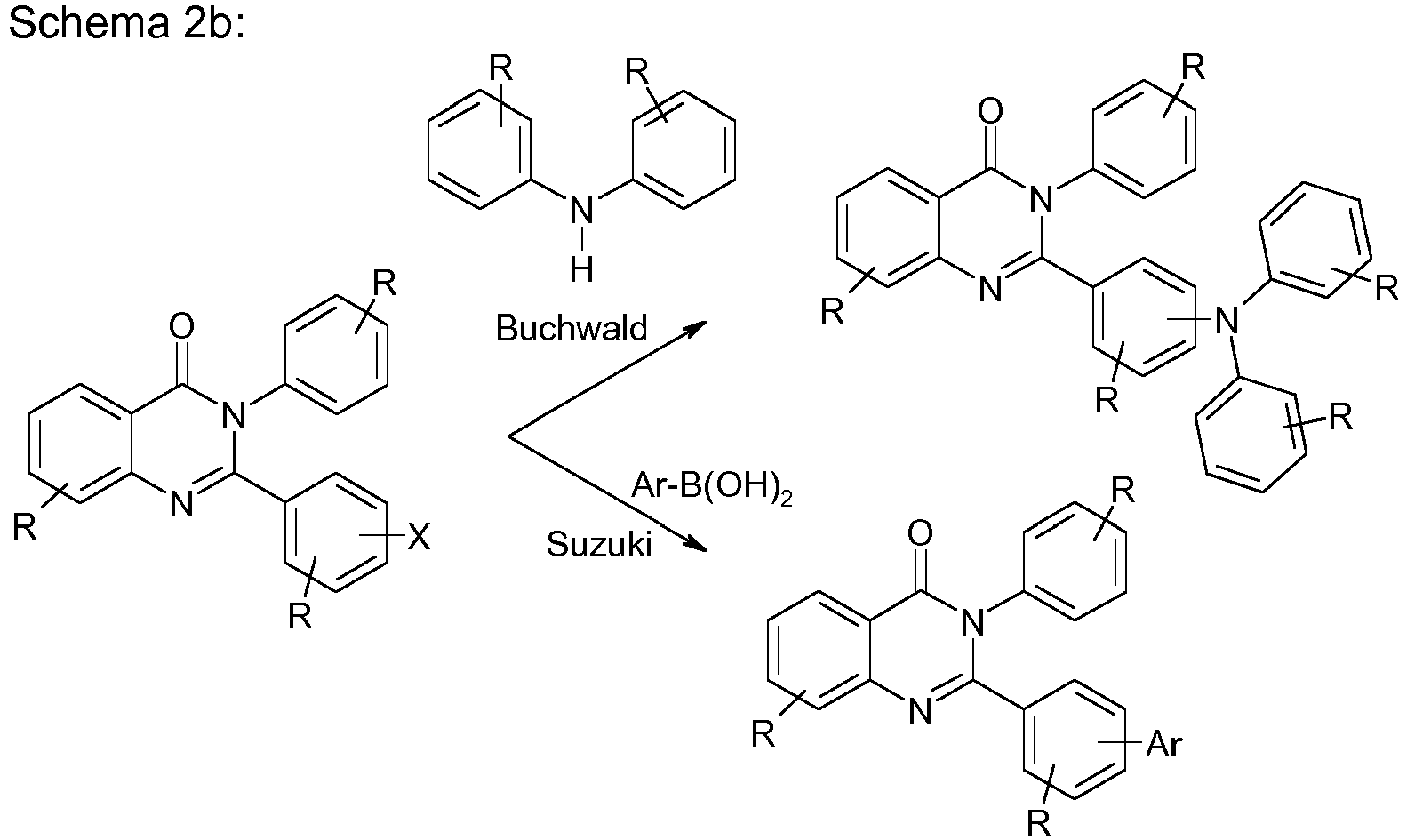
- Die eingeführten Abgangsgruppen lassen sich beispielsweise durch metallorganische Kupplungsreaktionen umsetzen. In Schema 2b sind als Beispiel eine Buchwald- oder eine Suzuki-Kupplung angeführt.
- Durch mehrfache Kupplungsreaktionen lassen sich die Verbindungen der Formel (2) aufbauen.

- Der Aufbau von Verbindungen der Formel (2) ist auch über die in Schema 2c angegebenen Methode möglich. Dabei wird analog zu Schema 2a ein 4H-3,1-Benzoxazine-2,4(1H)-dion-Derivat mit einem Amin und einem Aldehyd unter Säurekatalyse umgesetzt, wobei das Amin und/oder das Aldehyd mindestens eine weitere Amino- und/oder Aldehydgruppe aufweist. Bevorzugt sind an aromatische oder heteroaromatische Ringsysteme gebundene Amino- oder Aldehydgruppen. Dadurch werden mehrere 4H-3,1-Benzoxazine-2,4(1H)-dion-Derivate miteinander verknüpft. Die erhaltene Verbindung lässt sich mit Kaliumpermanganat zur Verbindung nach Formel (2) oxidieren.
-

- 11 ml (121 mmol) Phenylamin und 18 g (110 mmol) 4H-3,1-Benzoxazine-2,4(1H)-dion werden im 500 ml Essigsäure refluxiert. Nach 45 min. wird 22,4 g (121 mmol) 4-Brombenzaldehyd gelöst in Essigsäure zugegeben und über Nacht weiter unter Rückfluss gerührt. Nach Abkühlung wird die Lösung mit Wasser/Eis verdünnt und abgesaugt. Der Rückstand wird Heptan und Ethanol ausgerührt. Die Ausbeute beträgt 36 g (95 mmol) 86 % der Theorie.
- Analog können folgende Verbindungen erhalten werden:
Bsp. Edukt 1 Edukt 2 Edukt 3 Produkt Ausbeute [%] 1a 

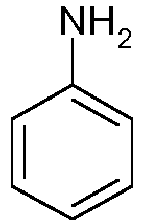

82 1b 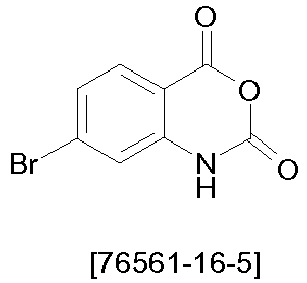


86 1c 


74 1d 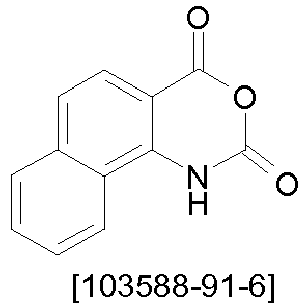


70 1e 


80 1f 


68 1g 


79 1h 

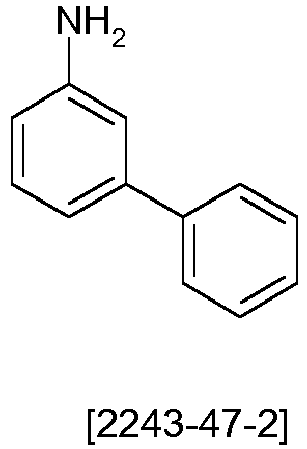

84 1j 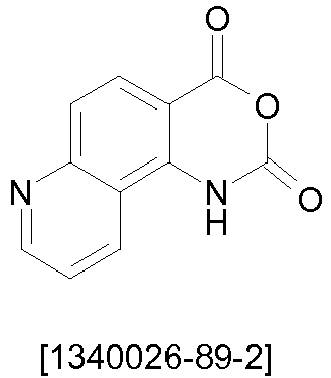
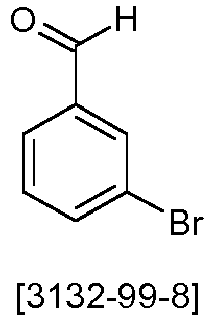

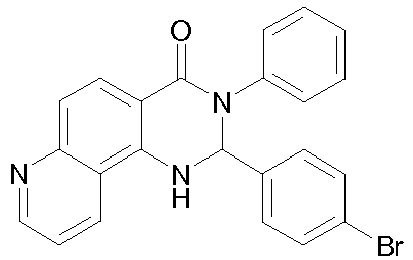
78 1i 


81 1k 


76 1l 
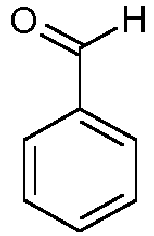


76 1m 


65 1n 


70 1o 
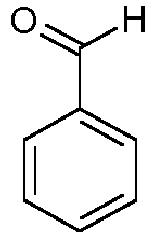


87 - Analog können beim Einsatz bifunktionellen Gruppen folgende Verbindungen erhalten werden:
Bsp. Edukt 1 Edukt 2 Edukt 3 Produkt Ausbeute [%] 1p 


67 1q 

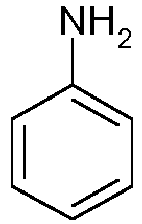

61 1r 


59 1s 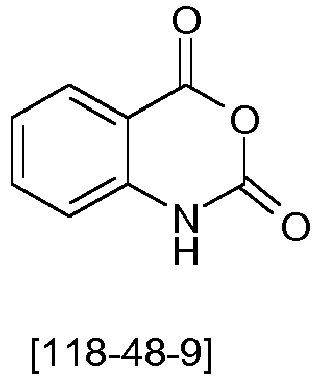


48 1t 


56 -

- 36 g (95 mmol) 2-(4-Bromo-phenyl)-3-phenyl-2,3-dihydro-1 H-quinazolin-4-on werden in 300 mL DMF gelöst. Zu dieser Lösung werden 15 g (95 mmol) Kaliumpermangenat portionsweise zugegeben und 3 Stunden bei Raumtemperatur gerührt. Nach dieser Zeit wird das restliche Kaliumpermangenat abfiltiert, die Lösung eingeengt und Chromatographisch gereinigt (Laufmittel: Heptan/Dichloromethan, 5:1). Der Rückstand wird aus Toluol und aus Dichlormethan / iso-Propanol umkristallisiert und abschließend im Hochvakuum sublimiert, Reinheit beträgt 99,9 %. Die Ausbeute beträgt 22 g (58 mmol) 61 % der Theorie.
- Analog können folgende Verbindungen erhalten werden:
Bsp. Edukt 3 Produkt Ausbeute [%] 2a 

82 2b 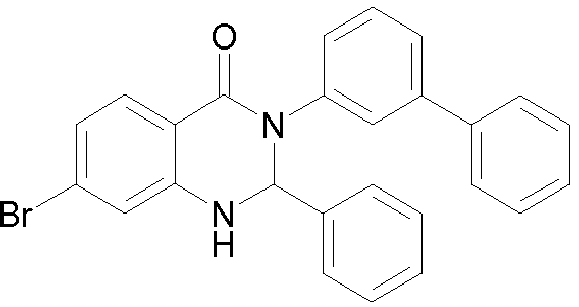

86 2c 
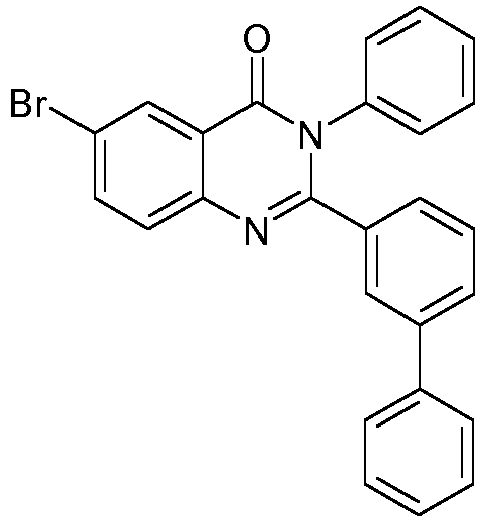
74 2d 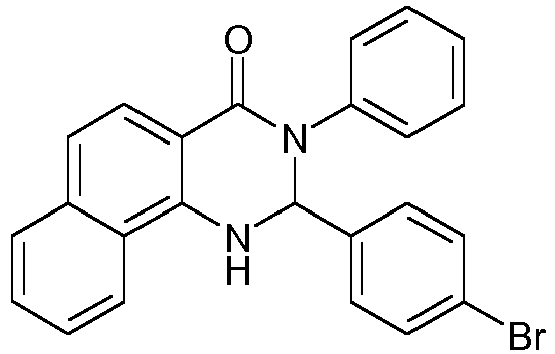

70 2e 

80 2f 

68 2g 

79 2h 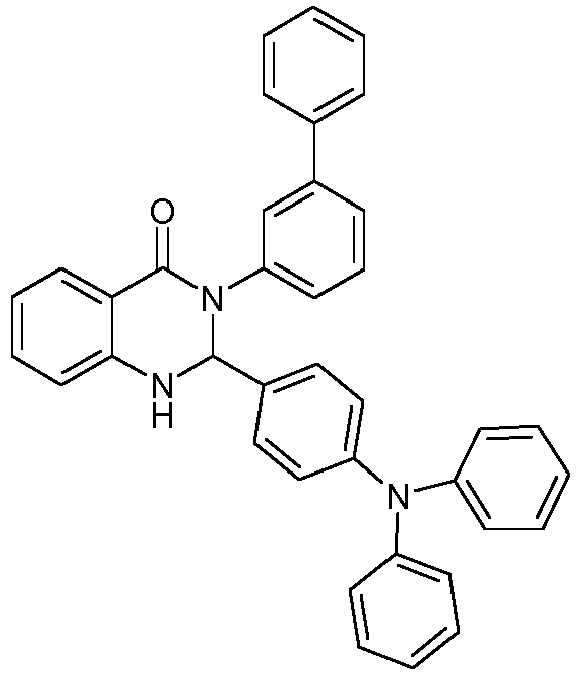

84 2j 

78 2i 

81 2k 

76 2l 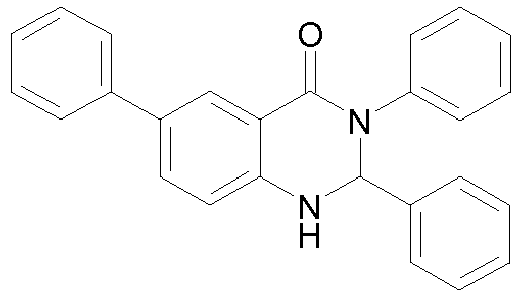
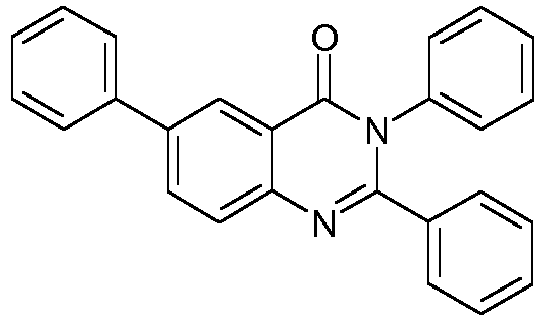
82 2m 

79 2n 

81 2o 

83 - Analog können beim Einsatz von 2 eq. KMnO4 folgende Verbindungen erhalten werden:
Bsp. Edukt 1 Produkt Ausbeute [%] 2p 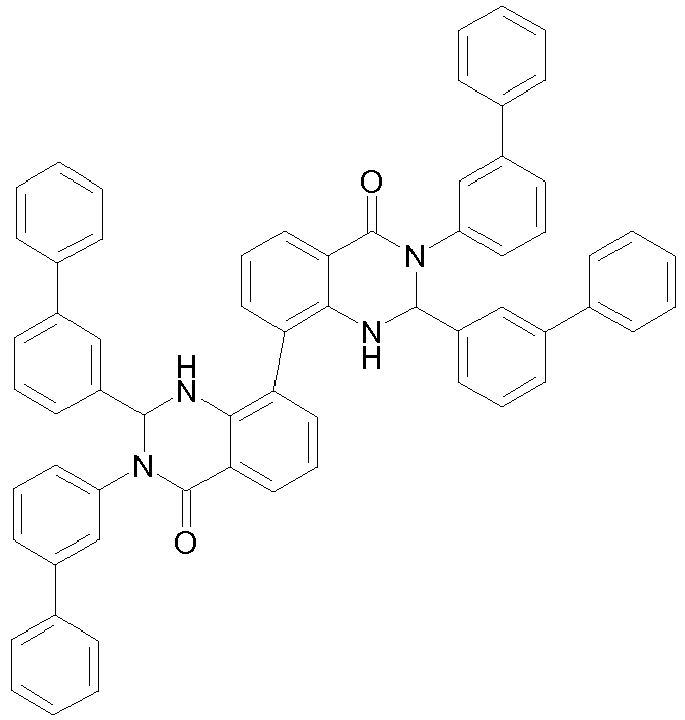

67 2q 

61 2r 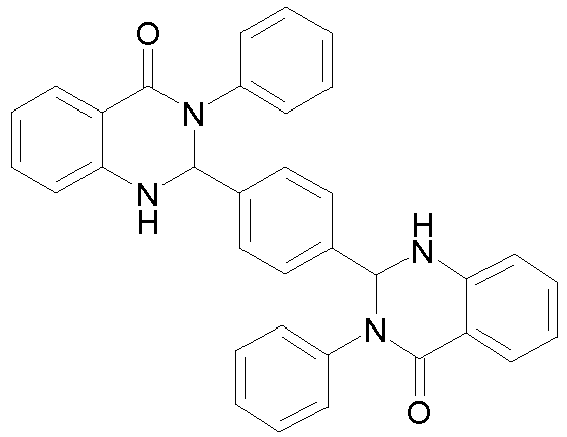

59 2s 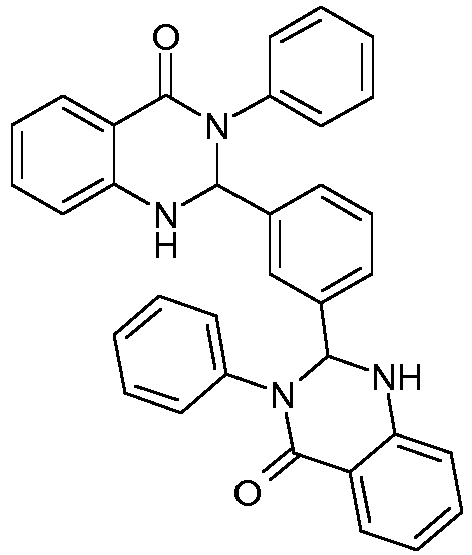

48 2t 

56 -

- 41,3 g (110,0 mmol) 4-dibenzofuranboronsäure, 41 g (110,0 mmol) 2-(4-Bromo-phenyl)-3-phenyl-3H-quinazolin-4-on und 44,6 g (210,0 mmol) Trikaliumphosphat werden in 500 mL Toulol, 500 mL Dioxan und 500 mL Wasser suspendiert. Zu dieser Suspension werden 913 mg (3,0 mmol) Trio-tolylphosphin und dann 112 mg (0,5 mmol) Palladium(ll)acetat gegeben, und die Reaktionsmischung wird 16 h unter Rückfluss erhitzt. Nach Erkalten wird die organische Phase abgetrennt, über Kieselgel filtriert, dreimal mit 200 mL Wasser gewaschen und anschließend zur Trockne eingeengt. Der Rückstand wird aus Toluol und aus Dichlormethan / iso-Propanol umkristallisiert und abschließend im Hochvakuum sublimiert, Reinheit beträgt 99,9 %. Die Ausbeute beträgt 41 g (90 mmol), entsprechend 82% der Theorie.
- Analog werden folgende Verbindungen erhalten:
Bsp. Edukt 1 Edukt 2 Produkt Ausbeute [%] 3a 


83 3b 


82 3c 


81 3d 


83 3e 


88 3f 
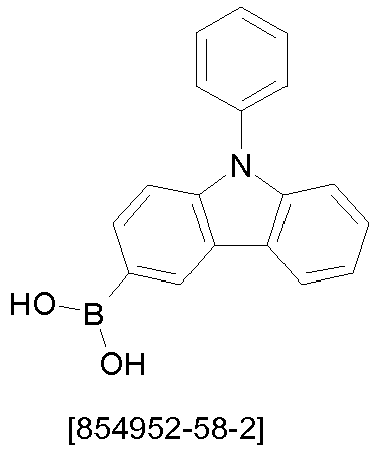

68 3g 


75 3h 


76 3j 
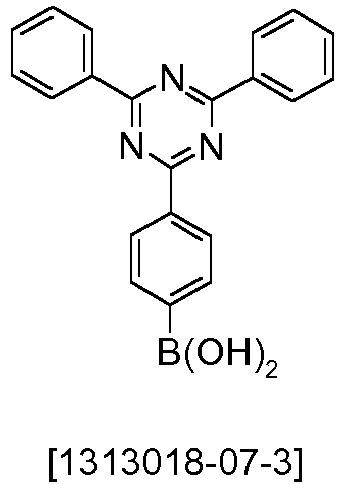

83 3i 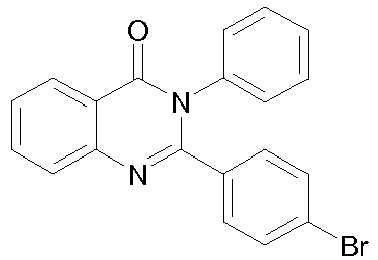


85 3k 

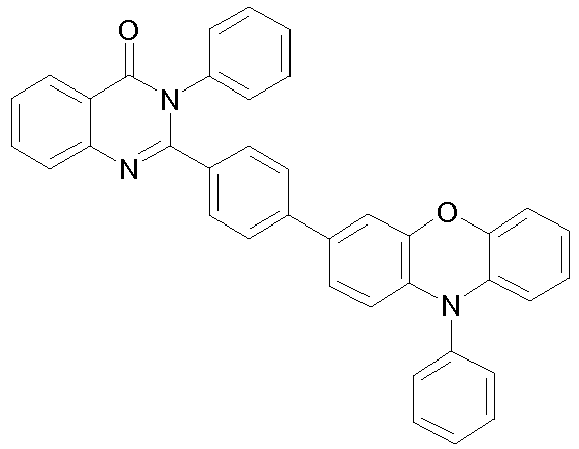
88 3l 

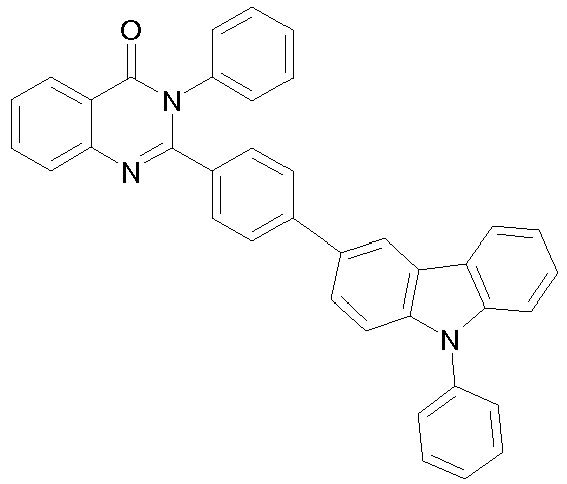
86 3m 


76 3n 


86 3o 

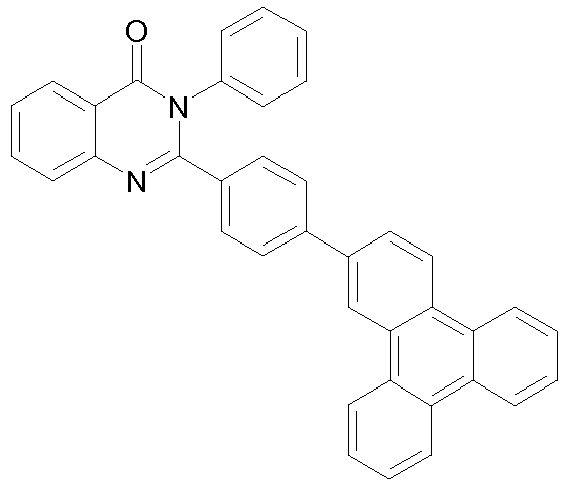
67 3p 

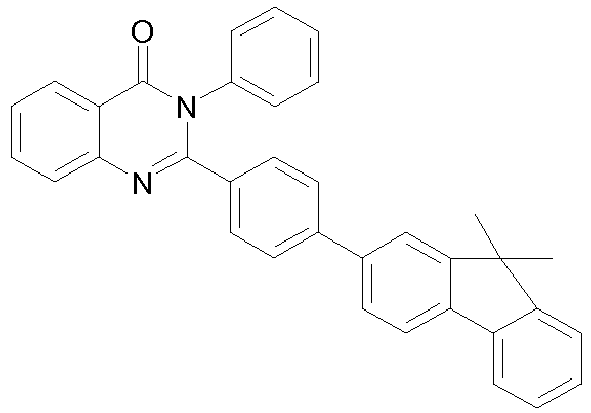
82 - Analog werden folgende Verbindungen mit 0,5 eq. Bor-Verbindung erhalten:
Bsp. Edukt 1 Edukt 2 Produkt Ausbeute [%] 3q 


86 3r 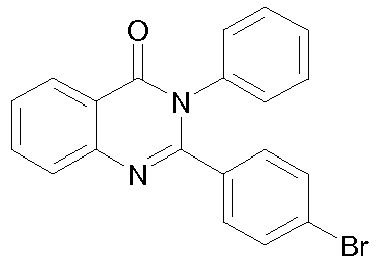


81 3s 


83 -

- 32 g (102,4 mmol) 3,6-Diphenyl-9H-carbazol, 42 g (112 mmol) 2-(4-Bromo-phenyl)-3-phenyl-3H-quinazolin-4-on und 2,3 g (10,2 mmol) 1,3-Di[2-pyridyl]-1,3-propandion, 28,3 g (204 mmol) Kaliumcarbonat und 1,9 g (10,2 mmol) Kupferiodid werden im 1000 ml DMF unter Rückfluss 90 h gerührt. Die Lösung wird mit Wasser verdünnt und mit Essigester zweimal extrahiert, die vereinigten organischen Phasen über Na2SO4 getrocknet und einrotiert und chromatographisch (EtOAc/Hexan: 2/3) gereinigt. Der Rückstand wird aus Toluol und aus Dichlormethan umkristallisiert und abschließend im Hochvakuum sublimiert, Reinheit beträgt 99,9 %. Die Ausbeute beträgt 47 g (77 mmol), entsprechend 69% der Theorie.
- Analog werden folgende Verbindungen erhalten:
Bsp. Edukt 1 Edukt 2 Produkt Ausbeute [%] 4a 


65 4b 


66 4c 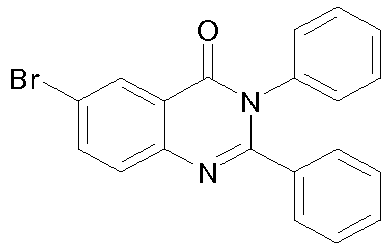
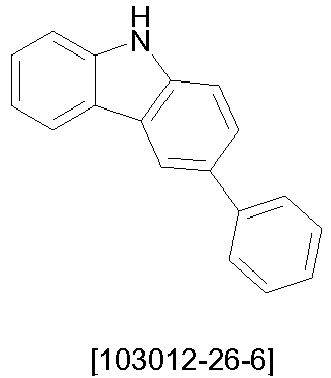

74 4d 


71 4e 


70 4f 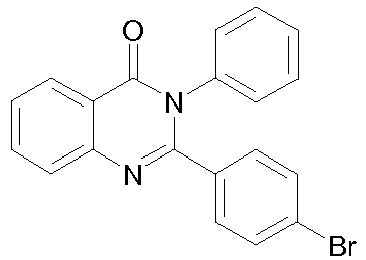


65 4g 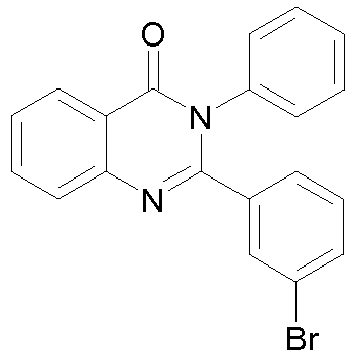


69 4h 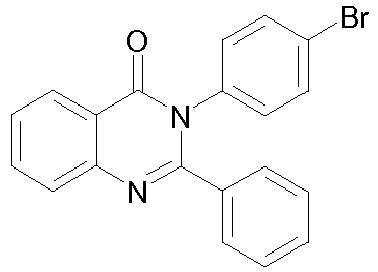


72 - In den folgenden Beispielen E1 bis E15 (siehe Tabellen 1 und 2) werden die Daten verschiedener OLEDs vorgestellt. Gereinigte Glasplättchen (Reinigung in Laborspülmaschine, Reiniger Merck Extran), die mit strukturiertem ITO (Indium Zinn Oxid) der Dicke 50 nm beschichtet sind werden 25 Minuten mit UV-Ozon vorbehandelt (UV-Ozon Generator PR-100, Firma UVP) und innerhalb 20min zur verbesserten Prozessierung mit 20nm PEDOT:PSS beschichtet (Poly(3,4-ethylenedioxythiophene) poly(styrenesulfonate), bezogen als CLEVIOS™ P VP AI 4083 von Heraeus Precious Metals GmbH Deutschland, aus wässriger Lösung aufge¬schleudert) und anschließend bei 180°C 10min lang ausgeheizt. Diese beschichteten Glasplättchen bilden die Substrate, auf welche die OLEDs aufgebracht werden.
- Die OLEDs haben prinzipiell folgenden Schichtaufbau: Substrat / Lochtransportschicht (HTL) / Zwischenschicht (IL) / Elektronenblockierschicht (EBL) / Emissionsschicht (EML) / Optionale Lochblockierschicht (HBL) / Elektronentransportschicht (ETL) und abschließend eine Kathode. Die Kathode wird durch eine 100 nm dicke Aluminiumschicht gebildet. Der genaue Aufbau der OLEDs ist Tabelle 1 zu entnehmen. Eine Bezeichnung wie "4a" in der Tabelle bezieht sich auf die in den Tabellen zu den Beispielen gezeigten Materialien. Die weiteren zur Herstellung der OLEDs benötigten Materialien sind in Tabelle 3 gezeigt.
- Alle Materialien werden in einer Vakuumkammer thermisch aufgedampft. Dabei besteht die Emissionsschicht immer aus mindestens einem Matrixmaterial (Hostmaterial, Wirtsmaterial) und einem emittierenden Dotierstoff (Dotand, Emitter), der dem Matrixmaterial bzw. den Matrixmaterialien durch Coverdampfung in einem bestimmten Volumenanteil beigemischt wird. Eine Angabe wie 4a:BIC1 :TEG1 (30%:60%:10%) bedeutet hierbei, dass das Material 4a in einem Volumenanteil von 30%, BIC1 in einem Anteil von 60% und TEG1 in einem Anteil von 10% in der Schicht vorliegt. Analog kann auch die Elektronentransportschicht aus einer Mischung von zwei Materialien bestehen.
- Die OLEDs werden standardmäßig charakterisiert. Hierfür werden die Elektrolumineszenzspektren, die Stromeffizienz (gemessen in cd/A), die Leistungseffizienz (gemessen in Im/W) und die externe Quanteneffizienz (EQE, gemessen in Prozent) in Abhängigkeit der Leuchtdichte, berechnet aus Strom-Spannungs-Leuchtdichte-Kennlinien (IUL-Kennlinien) unter Annahme einer lambertschen Abstrahlcharakteristik sowie die Lebensdauer bestimmt. Die Elektrolumineszenzspektren werden bei einer Leuchtdichte von 1000 cd/m2 bestimmt und daraus die CIE 1931 x und y Farbkoordinaten berechnet. Die Angabe U1000 in Tabelle 2 bezeichnet die Spannung, die für eine Leuchtdichte von 1000 cd/m2 benötigt wird. SE1000 und LE1000 bezeichnen die Strom- bzw. Leistungseffizienz, die bei 1000 cd/m2 erreicht werden. EQE1000 schließlich bezeichnet die externe Quanteneffizienz bei einer Betriebsleuchtdichte von 1000 cd/m2.
- Die Daten der verschiedenen OLEDs sind in Tabelle 2 zusammengefasst.
Tabelle 1: Aufbau der OLEDs Bsp. HTL IL EBL EML HBL ETL Dicke Dicke Dicke Dicke Dicke Dicke E1* SpA1 HATC SpMA1 2q:TEG1 (85%:15%) IC1 ST1:LiQ (50%:50%) 70nm N 5nm 90nm 30nm 10nm 30nm E2* SpA1 HATC SpMA1 2r:TEG1 (85%:15%) IC1 ST1:LiQ (50%:50%) 70nm N 5nm 90nm 30nm 10nm 30nm E3* SpA1 HATC SpMA1 2s:TEG1 (85%:15%) IC1 ST1:LiQ (50%:50%) 70nm N 5nm 90nm 30nm 10nm 30nm E4* SpA1 HATC SpMA1 2s:TEG1 (90%:10%) IC1 ST1:LiQ (50%:50%) 70nm N 5nm 90nm 30nm 10nm 30nm E5* SpA1 HATC SpMA1 2s:IC1:TEG1 (42%:42%:16%) IC1 ST1:LiQ (50%:50%) 70nm N 5nm 90nm 30nm 10nm 30nm E6 SpA1 HATC SpMA1 2f:TEG1 (90%:15%) IC1 ST1:LiQ (50%:50%) 70nm N 5nm 90nm 30nm 10nm 30nm E7 SpA1 HATC SpMA1 4:TEG1(90%:15%) IC1 ST1:LiQ (50%:50%) 70nm N 5nm 90nm 30nm 10nm 30nm E8 SpA1 HATC SpMA1 3d:TER1 (92%:8%) --- ST1:LiQ (50%:50%) 90nm N 5nm 130nm 40nm 40nm E9 SpA1 HATC SpMA1 3m:TEG1 (90%:15%) IC1 ST1:LiQ (50%:50%) 70nm N 5nm 90nm 30nm 10nm 30nm E10 SpA1 HATC SpMA1 4a:TEG1 (90%:10%) IC1 ST1:LiQ (50%:50%) 70nm N 5nm 90nm 30nm 10nm 30nm E11 SpA1 HATC SpMA1 4a:IC1:TEG1 (45%:45%:10%) IC1 ST1:LiQ (50%:50%) 70nm N 5nm 90nm 30nm 10nm 30nm E12 SpA1 HATC SpMA1 4a:BIC1 :TEG1 (30%:60%:10%) IC1 ST1:LiQ (50%:50%) 70nm N 5nm 90nm 30nm 10nm 30nm E13 SpA1 HATC SpMA1 4h:TEG1 (90%:10%) IC1 ST1:LiQ (50%:50%) 70nm N 5nm 90nm 30nm 10nm 30nm E14 SpA1 HATC SpMA1 4h:BIC1:TEG1 (60%:30%:10%) IC1 ST1:LiQ (50%:50%) 70nm N 5nm 90nm 30nm 10nm 30nm E15 SpA1 HATC SpMA1 4h:TEG2 (90%:15%) IC1 ST1:LiQ (50%:50%) 70nm N 5nm 90nm 30nm 10nm 30nm *Nicht erfindungsgemäß Tabelle 2: Daten der OLEDs Bsp. U1000 SE1000 LE1000 EQE CIE x/y bei (V) (cd/A) (lm/W) 1000 1000 cd/m2 E1 3.8 57 48 15.8% 0.32/0.63 E2 3.7 56 47 15.7% 0.33/0.62 E3 3.7 59 50 16.5% 0.32/0.62 E4 3.9 61 50 16.6% 0.32/0.63 E5 3.2 63 62 17.1% 0.33/0.63 E6 3.6 62 56 17.8% 0.32/0.62 E7 3.7 60 50 16.8% 0.32/0.63 E8 4.9 10.3 6.6 11.0% 0.67/0.33 E9 3.4 61 57 17.4% 0.34/0.62 E10 3.6 49 43 13.7% 0.34/0.62 E11 3.1 52 54 14.7% 0.33/0.62 E12 3.6 47 41 13.1% 0.32/0.63 E13 3.9 58 48 16.3% 0.32/0.63 E14 3.9 54 43 15.1% 0.33/0.62 E15 3.8 57 47 16.1% 0.34/0.61 Tabelle 3: Strukturformeln der Materialien für die OLEDs 

HATCN SpA1 
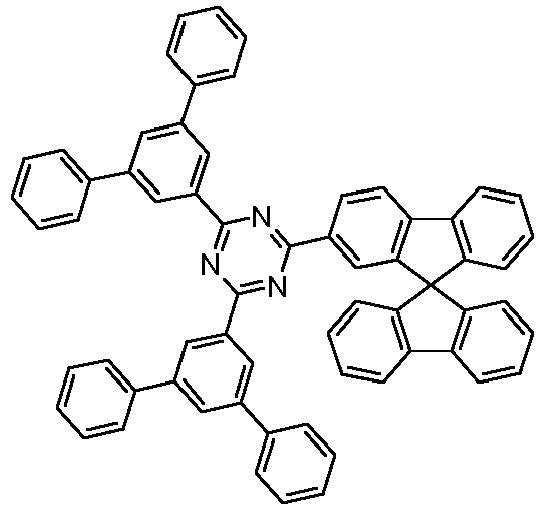
LiQ ST1 
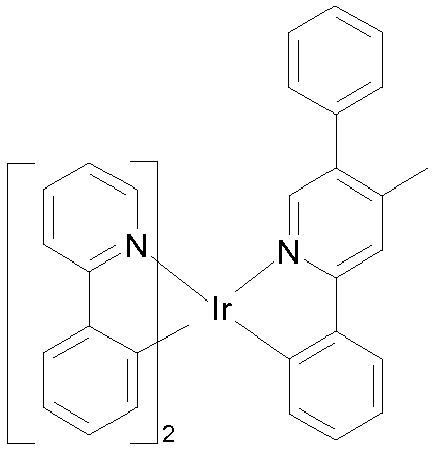
TEG1 TEG2 

IC1 SpMA1 

TER1 BIC1 
IC1 

2q* 2r* 

2s* 2f 
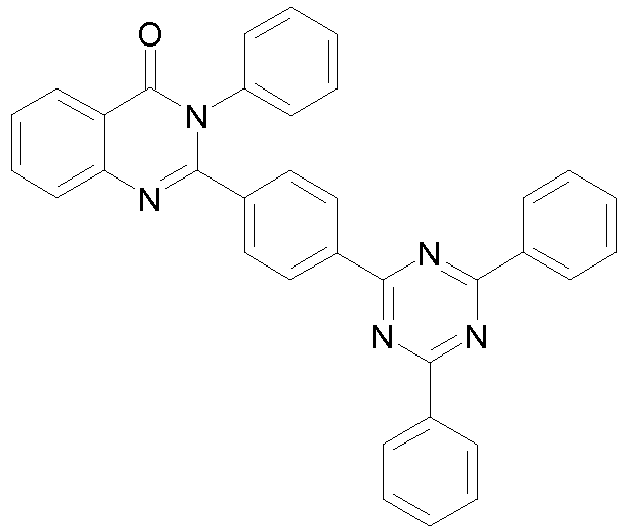
3d 3m 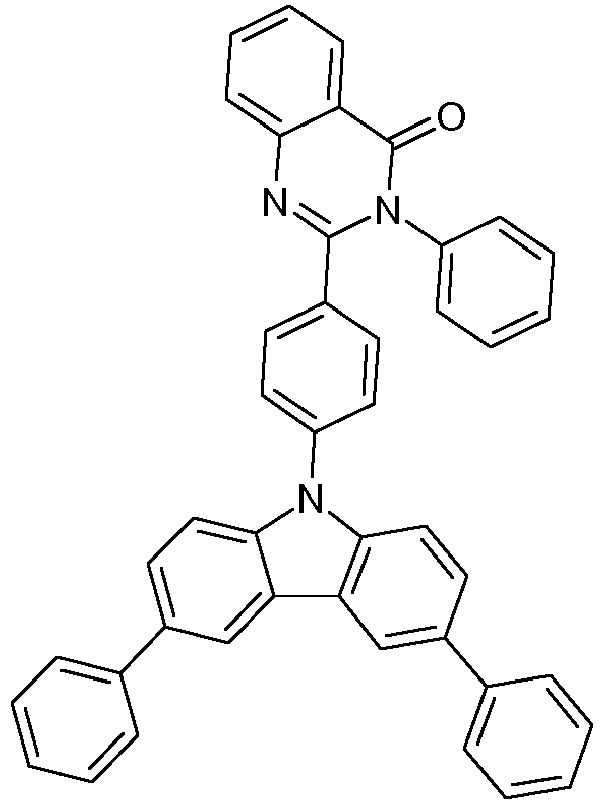

4 4a 
4h *Nicht erfindungsgemäß


Claims (8)
- Mischung umfassend mindestens einen phosphoreszierenden Dotanden, welche Kupfer, Molybdän, Wolfram, Rhenium, Ruthenium, Osmium, Rhodium, Iridium, Palladium, Platin, Silber, Gold und/oder Europium enthält, und mindestens eine Verbindung gemäß der Formel (3):
 R1, R2 sind bei jedem Auftreten verschieden ausgewählt aus den Gruppen mit den folgenden Formeln (Ar-1) bis (Ar-27)
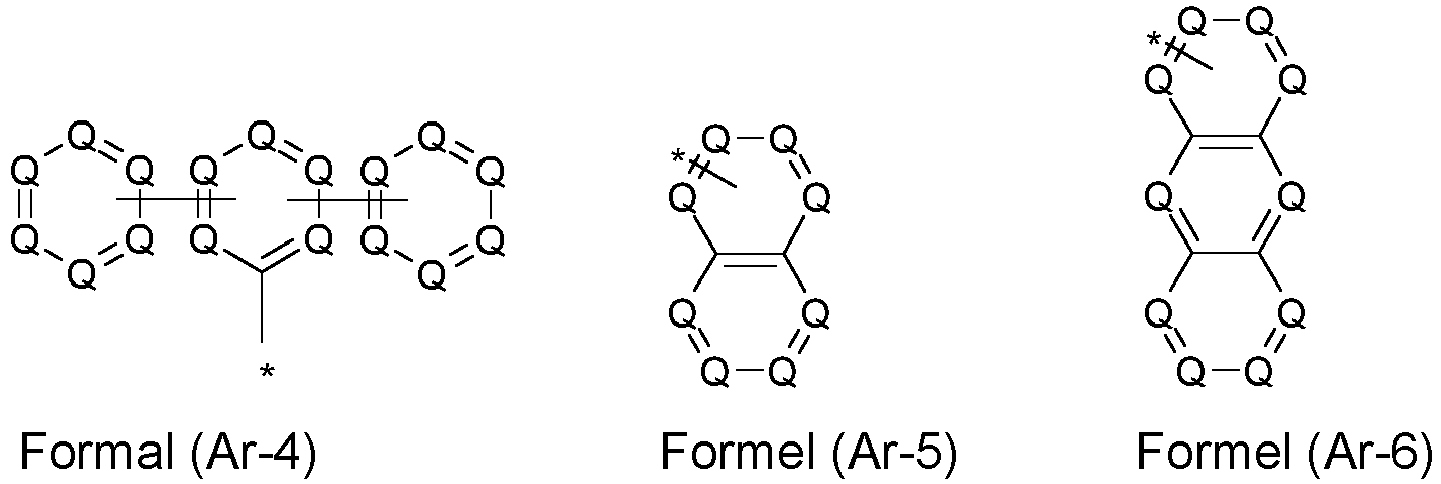





 Q ist bei jedem Auftreten gleich oder verschieden CR4 oder N, wobei maximal 3 Symbole Q pro Cyclus für N stehen;E ist bei jedem Auftreten gleich oder verschieden (CR4)2, NR4, O, S oder C=O;G ist bei jedem Auftreten eine Einfachbindung, (CR4)2, NR4, O, S oder C=O;Ar2 ist bei jedem Auftreten gleich oder verschieden ein bivalentes aromatisches oder heteroaromatisches Ringsystem mit 5 bis 60 aromatischen Ringatomen, welches durch einen oder mehrere Reste R4 substituiert sein kann;Ar1 sind bei jedem Auftreten gleich oder verschieden ein aromatisches oder heteroaromatisches Ringsystem mit 6 bis 60 aromatischen Ringatomen, das jeweils auch mit einem oder mehreren Reste R4 substituiert sein kann, wobei beide Ar1 und/oder Ar1 mit Ar2 über je mindestens eine Brücke K verbunden sein können;K ist bei jedem Auftreten gleich oder verschieden gleich eine Einfachbindung oder eine bivalente Brücke, ausgewählt aus N(R4), B(R4), O,C=O, C(R4)2, Si(R4)2, und S; und* die Bindung zum Quinazolinon-Grundgerüst darstellt.R3 ist bei jedem Auftreten gleich oder verschieden H, D, F, eine geradkettige Alkylgruppe mit 1 bis 10 C-Atomen oder eine verzweigte oder cyclische Alkylgruppe mit 3 bis 10 C-Atomen, die jeweils mit einem oder mehreren Resten R4 substituiert sein kann, oder ein aromatisches oder heteroaromatisches Ringsystem mit 6 bis 60 aromatischen Ringatomen, das jeweils durch einen oder mehrere Reste R4 substituiert sein kann;Ar ist bei jedem Auftreten gleich oder verschieden, ein aromatisches oder heteroaromatisches Ringsystem mit 6 bis 60 aromatischen Ringatomen, das jeweils auch mit einem oder mehreren Resten R4 substituiert sein kann,R4 ist bei jedem Auftreten gleich oder verschieden H, D, F, Cl, Br, I, CHO, C(=O)R5, P(=O)(R5)2, S(=O)R5, S(=O)2R5, CN, NO2, Si(R5)3, B(OR5)2, OSO2R5, N(R5)2, eine geradkettige Alkyl-, Alkoxy- oder Thioalkoxygruppe mit 1 bis 40 C-Atomen oder eine verzweigte oder cyclische Alkyl-, Alkoxy- oder Thioalkoxygruppe mit 3 bis 40 C-Atomen, die jeweils mit einem oder mehreren Resten R5 substituiert sein kann, wobei eine oder mehrere nicht benachbarte CH2-Gruppen durch C≡C , Si(R5)2, Ge(R5)2, Sn(R5)2, C=O, C=S, C=Se, P(=O)(R5), SO, SO2, O, S oder CONR5 ersetzt sein können und wobei ein oder mehrere H-Atome durch D, F, Cl, Br, I, CN oder NO2 ersetzt sein können, oder ein aromatisches oder heteroaromatisches Ringsystem mit 5 bis 60 aromatischen Ringatomen, das jeweils durch einen oder mehrere Reste R5 substituiert sein kann, oder eine Aryloxy- oder Heteroaryloxygruppe mit 5 bis 60 aromatischen Ringatomen, die durch einen oder mehrere Reste R5 substituiert sein kann, oder eine Kombination dieser Systeme; dabei können zwei oder mehrere benachbarte Substituenten R4 auch miteinander ein mono- oder polycyclisches, aliphatisches oder aromatisches Ringsystem bilden;R5 ist bei jedem Auftreten gleich oder verschieden H, D, F, Cl, Br, I, N(R6)2, C(=O)R6, P(=O)(R6)2, S(=O)R6, S(=O)2R6, CR6=C(R6)2, CN, NO2, Si(R6)3, B(OR6)2, OSO2R6, N(R6)2, eine geradkettige Alkyl-, Alkoxy- oder Thioalkoxygruppe mit 1 bis 40 C-Atomen oder eine verzweigte oder cyclische Alkyl-, Alkoxy- oder Thioalkoxygruppe mit 3 bis 40 C-Atomen, die jeweils mit einem oder mehreren Resten R6 substituiert sein kann, wobei eine oder mehrere nicht benachbarte CH2-Gruppen durch R6C=CR6, C≡C, Si(R6)2, C=O, C=NR6, P(=O)(R6), SO, SO2, NR6, O, S oder CONR6 ersetzt sein können und wobei ein oder mehrere H Atome durch D, F, Cl, Br, I, CN oder NO2 ersetzt sein können, oder ein aromatisches oder heteroaromatisches Ringsystem mit 5 bis 60 aromatischen Ringatomen, das jeweils durch einen oder mehrere Reste R6 substituiert sein kann, oder eine Aryloxy- oder Heteroaryloxy-gruppe mit 5 bis 60 aromatischen Ringatomen, die durch einen oder mehrere Reste R6 substituiert sein kann, oder eine Aralkyl- oder Heteroaralkylgruppe mit 5 bis 60 aromatischen Ringatomen, die durch einen oder mehrere Reste R6 substituiert sein kann, oder eine Kombination dieser Systeme; dabei können zwei oder mehrere benachbarte Substituenten R5 auch miteinander ein mono- oder polycyclisches, aliphatisches oder aromatisches Ringsystem bilden.
 - Mischung nach Anspruch 1, dadurch gekennzeichnet, dass der mindestens eine phosphoreszierende Dotand eine Verbindung umfasst ausgewählt aus den Formeln (D-1) bis (D-6),


 DCy ist gleich oder verschieden bei jedem Auftreten eine cyclische Gruppe, die mindestens ein Donoratom enthält oder als Substituenten trägt, über welches die cyclische Gruppe an das Metall gebunden ist, und die wiederum einen oder mehrere Substituenten R4 tragen kann; die Gruppen DCy und CCy sind über eine kovalente Bindung miteinander verbunden;CCy ist gleich oder verschieden bei jedem Auftreten eine cyclische Gruppe, die ein Kohlenstoffatom enthält, über welches die cyclische Gruppe an das Metall gebunden ist und die wiederum einen oder mehrere Substituenten R4 tragen kann;A ist gleich oder verschieden bei jedem Auftreten ein monoanionischer, zweizähnig chelatisierender Ligand.B ist gleich oder verschieden bei jedem Auftreten eine Verbindung umfassend mindestens ein Donoratom, welches an das Metall bindet.
 - Verfahren zur Herstellung einer Mischung nach Anspruch 1 oder 2, dadurch gekennzeichnet, dass die Verbindung der Formel (3) durch eine oder mehrere Kupplungsreaktionen und/oder Zyklisierungen aufgebaut wird.
- Formulierung, insbesondere eine Lösung, eine Suspension oder eine Miniemulsion, enthaltend mindestens eine Mischung nach Anspruch 1 oder 2 und ein oder mehrere Lösemittel.
- Verwendung einer Mischung nach Anspruch 1 oder 2 in einer elektronischen Vorrichtung.
- Verwendung einer Verbindung nach der Formel (3) gemäß Anspruch 1 als Matrixmaterial für eine phosphoreszierende Verbindung.
- Elektronische Vorrichtung, insbesondere ausgewählt aus der Gruppe bestehend aus organischen Elektrolumineszenzvorrichtungen, organischen integrierten Schaltungen, organischen Feld-Effekt-Transistoren, organischen Dünnfilmtransistoren, organischen lichtemittierenden Transistoren, organischen Solarzellen, organischen farbstoffsensibilisierten Solarzellen, organischen optischen Detektoren, organischen Photorezeptoren, organischen Feld-Quench-Devices, lichtemittierenden elektrochemischen Zellen, organischen Laserdioden und "organic plasmon emitting devices", enthaltend mindestens eine Mischung nach Anspruch 1 oder 2 .
- Elektronische Vorrichtung nach Anspruch 7, dadurch gekennzeichnet, dass es sich um eine organische Elektrolumineszenzvorrichtung handelt und die Mischung in einer emittierenden Schicht eingesetzt wird.
Applications Claiming Priority (2)
| Application Number | Priority Date | Filing Date | Title |
|---|---|---|---|
| EP14003299 | 2014-09-24 | ||
| PCT/EP2015/001733 WO2016045765A1 (de) | 2014-09-24 | 2015-08-25 | Materialien für organische elektrolumineszenzvorrichtungen |
Publications (2)
| Publication Number | Publication Date |
|---|---|
| EP3197982A1 EP3197982A1 (de) | 2017-08-02 |
| EP3197982B1 true EP3197982B1 (de) | 2020-05-06 |
Family
ID=51752963
Family Applications (1)
| Application Number | Title | Priority Date | Filing Date |
|---|---|---|---|
| EP15762485.9A Active EP3197982B1 (de) | 2014-09-24 | 2015-08-25 | Materialien für organische elektrolumineszenzvorrichtungen |
Country Status (4)
| Country | Link |
|---|---|
| US (1) | US10544360B2 (de) |
| EP (1) | EP3197982B1 (de) |
| JP (1) | JP6752780B2 (de) |
| WO (1) | WO2016045765A1 (de) |
Families Citing this family (10)
| Publication number | Priority date | Publication date | Assignee | Title |
|---|---|---|---|---|
| MX2021012208A (es) | 2013-10-04 | 2023-01-19 | Infinity Pharmaceuticals Inc | Compuestos heterocíclicos y usos de los mismos. |
| NZ724368A (en) | 2014-03-19 | 2023-07-28 | Infinity Pharmaceuticals Inc | Heterocyclic compounds for use in the treatment of pi3k-gamma mediated disorders |
| EP4585268A3 (de) | 2015-09-14 | 2025-10-15 | Twelve Therapeutics, Inc. | Feste formen von isochinolinonderivaten, herstellungsverfahren, zusammensetzungen damit und verfahren zur verwendung davon |
| CN108368088A (zh) * | 2015-12-08 | 2018-08-03 | 喜星素材株式会社 | 杂环化合物和使用其的有机发光器件 |
| KR102545509B1 (ko) * | 2016-06-02 | 2023-06-21 | 삼성디스플레이 주식회사 | 다환 화합물 및 이를 포함하는 유기 전계 발광 소자 |
| KR20220056223A (ko) | 2019-09-02 | 2022-05-04 | 메르크 파텐트 게엠베하 | 유기 전계발광 디바이스용 재료 |
| JP7834721B2 (ja) | 2020-08-28 | 2026-03-24 | アルビナス・オペレーションズ・インコーポレイテッド | 急速進行性線維肉腫タンパク質分解化合物及び関連する使用方法 |
| CN113801102A (zh) * | 2021-10-11 | 2021-12-17 | 上海交通大学 | 基于吩嗪基的化合物及其制备方法与应用 |
| EP4584258A1 (de) | 2022-09-07 | 2025-07-16 | Arvinas Operations, Inc. | Schnell beschleunigte fibrosarkom (raf)-abbauende verbindungen und zugehörige verfahren zur verwendung |
| WO2025137537A1 (en) * | 2023-12-22 | 2025-06-26 | Arrakis Therapeutics, Inc. | Compositions and methods for treating myc-mediated diseases |
Family Cites Families (14)
| Publication number | Priority date | Publication date | Assignee | Title |
|---|---|---|---|---|
| US3740402A (en) | 1971-03-01 | 1973-06-19 | American Cyanamid Co | Certain 2-(0-sulfonamidophenyl)-4(3h)-quinazolinones |
| US3892972A (en) | 1971-03-01 | 1975-07-01 | American Cyanamid Co | Method of producing a luminescent surface containing substituted sulfonamido and carboxamido phenyl quinazolones |
| JP3230314B2 (ja) * | 1993-02-04 | 2001-11-19 | 東洋インキ製造株式会社 | 有機エレクトロルミネッセンス素子 |
| JPH07292353A (ja) | 1994-04-27 | 1995-11-07 | Konica Corp | エレクトロルミネッセンス素子 |
| JP3770691B2 (ja) | 1997-04-17 | 2006-04-26 | 三井化学株式会社 | 有機電界発光素子 |
| JP3880200B2 (ja) | 1997-06-25 | 2007-02-14 | 三井化学株式会社 | 有機電界発光素子 |
| JP2001250689A (ja) * | 2000-03-07 | 2001-09-14 | Toray Ind Inc | 発光素子 |
| US20040219390A1 (en) | 2003-01-23 | 2004-11-04 | Honeywell International, Inc. | Benzoxazinone and quinazolinone derivatives |
| EP1717291A3 (de) * | 2003-04-15 | 2007-03-21 | Merck Patent GmbH | Mischungen von organischen, zur Emission befähigten Halbleitern und Maxtrixmaterialien, deren Verwendung und diese Mischungen enthaltende Elektronikbauteile |
| DE102008063490B4 (de) | 2008-12-17 | 2023-06-15 | Merck Patent Gmbh | Organische Elektrolumineszenzvorrichtung und Verfahren zum Einstellen des Farbortes einer weiß emittierenden Elektrolumineszenzvorrichtung |
| JP5560592B2 (ja) * | 2009-05-29 | 2014-07-30 | 三菱化学株式会社 | 含窒素複素環化合物、有機電界発光素子材料、有機電界発光素子用組成物、有機電界発光素子、有機elディスプレイ及び有機el照明 |
| KR20110013220A (ko) * | 2009-07-31 | 2011-02-09 | 다우어드밴스드디스플레이머티리얼 유한회사 | 신규한 유기 발광 화합물 및 이를 포함하는 유기 전계 발광 소자 |
| US8919250B2 (en) * | 2010-08-02 | 2014-12-30 | Goss International Americas, Inc. | Printing press and method for positioning cylinders therein |
| KR101562207B1 (ko) | 2014-01-21 | 2015-10-22 | 나노씨엠에스(주) | 근자외선 여기 발광 화합물 및 이의 제조방법 |
-
2015
- 2015-08-25 EP EP15762485.9A patent/EP3197982B1/de active Active
- 2015-08-25 US US15/513,808 patent/US10544360B2/en active Active
- 2015-08-25 JP JP2017516395A patent/JP6752780B2/ja not_active Expired - Fee Related
- 2015-08-25 WO PCT/EP2015/001733 patent/WO2016045765A1/de not_active Ceased
Non-Patent Citations (1)
| Title |
|---|
| None * |
Also Published As
| Publication number | Publication date |
|---|---|
| EP3197982A1 (de) | 2017-08-02 |
| US10544360B2 (en) | 2020-01-28 |
| WO2016045765A1 (de) | 2016-03-31 |
| US20180230378A1 (en) | 2018-08-16 |
| JP6752780B2 (ja) | 2020-09-09 |
| JP2017531916A (ja) | 2017-10-26 |
Similar Documents
| Publication | Publication Date | Title |
|---|---|---|
| EP3744155B1 (de) | Materialien für organische elektrolumineszenzvorrichtungen | |
| EP3227269B1 (de) | Materialien für organische elektrolumineszenzvorrichtungen | |
| EP3080229B1 (de) | Materialien für elektronische vorrichtungen | |
| EP2791105B1 (de) | Verbindungen für elektronische vorrichtungen | |
| EP3573985B1 (de) | Materialien für organische elektrolumineszenzvorrichtungen | |
| DE112010004381B4 (de) | Materialien für elektronische Vorrichtungen | |
| EP2705552B1 (de) | Verbindungen für elektronische vorrichtungen | |
| EP2935276B1 (de) | Materialien für organische elektrolumineszenzvorrichtungen | |
| EP3197982B1 (de) | Materialien für organische elektrolumineszenzvorrichtungen | |
| EP3160954B1 (de) | Materialien für organische elektrolumineszenzvorrichtungen | |
| EP2931698B1 (de) | Materialien für elektronische vorrichtungen | |
| EP3016952B1 (de) | Spirokondensierte lactamverbindungen für organische elektrolumineszenzvorrichtungen | |
| EP3060623B1 (de) | Materialien für elektronische vorrichtungen | |
| EP3218368B1 (de) | Materialien für organische elektrolumineszenzvorrichtungen | |
| EP3107977B1 (de) | Materialien für organische elektrolumineszenzvorrichtungen | |
| EP3423543A1 (de) | Materialien für organische elektrolumineszenzvorrichtungen | |
| EP2926385B1 (de) | Elektronische vorrichtung | |
| EP2737554A1 (de) | Verbindungen für elektronische vorrichtungen | |
| EP2892876A1 (de) | Verbindungen für elektronische vorrichtungen | |
| DE102010033548A1 (de) | Materialien für elektronische Vorrichtungen | |
| EP3110796B1 (de) | Materialien für organische elektrolumineszenzvorrichtungen | |
| WO2015154843A1 (de) | Materialien für organische elektrolumineszenzvorrichtungen | |
| EP3347354B1 (de) | Materialien für organische elektrolumineszenzvorrichtungen | |
| EP3094703B1 (de) | Materialien für organische elektrolumineszenzvorrichtungen | |
| DE112011102056B4 (de) | Verbindungen für elektronische Vorrichtungen |
Legal Events
| Date | Code | Title | Description |
|---|---|---|---|
| STAA | Information on the status of an ep patent application or granted ep patent |
Free format text: STATUS: THE INTERNATIONAL PUBLICATION HAS BEEN MADE |
|
| PUAI | Public reference made under article 153(3) epc to a published international application that has entered the european phase |
Free format text: ORIGINAL CODE: 0009012 |
|
| STAA | Information on the status of an ep patent application or granted ep patent |
Free format text: STATUS: REQUEST FOR EXAMINATION WAS MADE |
|
| 17P | Request for examination filed |
Effective date: 20170310 |
|
| AK | Designated contracting states |
Kind code of ref document: A1 Designated state(s): AL AT BE BG CH CY CZ DE DK EE ES FI FR GB GR HR HU IE IS IT LI LT LU LV MC MK MT NL NO PL PT RO RS SE SI SK SM TR |
|
| AX | Request for extension of the european patent |
Extension state: BA ME |
|
| RIN1 | Information on inventor provided before grant (corrected) |
Inventor name: LINGE, ROUVEN Inventor name: EBERLE, THOMAS Inventor name: PFLUMM, CHRISTOF Inventor name: KROEBER, JONAS VALENTIN Inventor name: JATSCH, ANJA Inventor name: PARHAM, AMIR HOSSAIN |
|
| RIN1 | Information on inventor provided before grant (corrected) |
Inventor name: PFLUMM, CHRISTOF Inventor name: PARHAM, AMIR HOSSAIN Inventor name: EBERLE, THOMAS Inventor name: JATSCH, ANJA Inventor name: KROEBER, JONAS VALENTIN Inventor name: LINGE, ROUVEN |
|
| DAV | Request for validation of the european patent (deleted) | ||
| DAX | Request for extension of the european patent (deleted) | ||
| STAA | Information on the status of an ep patent application or granted ep patent |
Free format text: STATUS: EXAMINATION IS IN PROGRESS |
|
| 17Q | First examination report despatched |
Effective date: 20180717 |
|
| GRAP | Despatch of communication of intention to grant a patent |
Free format text: ORIGINAL CODE: EPIDOSNIGR1 |
|
| STAA | Information on the status of an ep patent application or granted ep patent |
Free format text: STATUS: GRANT OF PATENT IS INTENDED |
|
| INTG | Intention to grant announced |
Effective date: 20200102 |
|
| GRAS | Grant fee paid |
Free format text: ORIGINAL CODE: EPIDOSNIGR3 |
|
| GRAJ | Information related to disapproval of communication of intention to grant by the applicant or resumption of examination proceedings by the epo deleted |
Free format text: ORIGINAL CODE: EPIDOSDIGR1 |
|
| GRAL | Information related to payment of fee for publishing/printing deleted |
Free format text: ORIGINAL CODE: EPIDOSDIGR3 |
|
| STAA | Information on the status of an ep patent application or granted ep patent |
Free format text: STATUS: EXAMINATION IS IN PROGRESS |
|
| GRAR | Information related to intention to grant a patent recorded |
Free format text: ORIGINAL CODE: EPIDOSNIGR71 |
|
| STAA | Information on the status of an ep patent application or granted ep patent |
Free format text: STATUS: GRANT OF PATENT IS INTENDED |
|
| GRAA | (expected) grant |
Free format text: ORIGINAL CODE: 0009210 |
|
| STAA | Information on the status of an ep patent application or granted ep patent |
Free format text: STATUS: THE PATENT HAS BEEN GRANTED |
|
| INTC | Intention to grant announced (deleted) | ||
| AK | Designated contracting states |
Kind code of ref document: B1 Designated state(s): AL AT BE BG CH CY CZ DE DK EE ES FI FR GB GR HR HU IE IS IT LI LT LU LV MC MK MT NL NO PL PT RO RS SE SI SK SM TR |
|
| INTG | Intention to grant announced |
Effective date: 20200331 |
|
| REG | Reference to a national code |
Ref country code: GB Ref legal event code: FG4D Free format text: NOT ENGLISH |
|
| REG | Reference to a national code |
Ref country code: CH Ref legal event code: EP Ref country code: AT Ref legal event code: REF Ref document number: 1266699 Country of ref document: AT Kind code of ref document: T Effective date: 20200515 |
|
| REG | Reference to a national code |
Ref country code: DE Ref legal event code: R096 Ref document number: 502015012534 Country of ref document: DE |
|
| REG | Reference to a national code |
Ref country code: IE Ref legal event code: FG4D Free format text: LANGUAGE OF EP DOCUMENT: GERMAN |
|
| REG | Reference to a national code |
Ref country code: LT Ref legal event code: MG4D |
|
| REG | Reference to a national code |
Ref country code: NL Ref legal event code: MP Effective date: 20200506 |
|
| PG25 | Lapsed in a contracting state [announced via postgrant information from national office to epo] |
Ref country code: LT Free format text: LAPSE BECAUSE OF FAILURE TO SUBMIT A TRANSLATION OF THE DESCRIPTION OR TO PAY THE FEE WITHIN THE PRESCRIBED TIME-LIMIT Effective date: 20200506 Ref country code: SE Free format text: LAPSE BECAUSE OF FAILURE TO SUBMIT A TRANSLATION OF THE DESCRIPTION OR TO PAY THE FEE WITHIN THE PRESCRIBED TIME-LIMIT Effective date: 20200506 Ref country code: FI Free format text: LAPSE BECAUSE OF FAILURE TO SUBMIT A TRANSLATION OF THE DESCRIPTION OR TO PAY THE FEE WITHIN THE PRESCRIBED TIME-LIMIT Effective date: 20200506 Ref country code: IS Free format text: LAPSE BECAUSE OF FAILURE TO SUBMIT A TRANSLATION OF THE DESCRIPTION OR TO PAY THE FEE WITHIN THE PRESCRIBED TIME-LIMIT Effective date: 20200906 Ref country code: PT Free format text: LAPSE BECAUSE OF FAILURE TO SUBMIT A TRANSLATION OF THE DESCRIPTION OR TO PAY THE FEE WITHIN THE PRESCRIBED TIME-LIMIT Effective date: 20200907 Ref country code: GR Free format text: LAPSE BECAUSE OF FAILURE TO SUBMIT A TRANSLATION OF THE DESCRIPTION OR TO PAY THE FEE WITHIN THE PRESCRIBED TIME-LIMIT Effective date: 20200807 Ref country code: NO Free format text: LAPSE BECAUSE OF FAILURE TO SUBMIT A TRANSLATION OF THE DESCRIPTION OR TO PAY THE FEE WITHIN THE PRESCRIBED TIME-LIMIT Effective date: 20200806 |
|
| PG25 | Lapsed in a contracting state [announced via postgrant information from national office to epo] |
Ref country code: RS Free format text: LAPSE BECAUSE OF FAILURE TO SUBMIT A TRANSLATION OF THE DESCRIPTION OR TO PAY THE FEE WITHIN THE PRESCRIBED TIME-LIMIT Effective date: 20200506 Ref country code: LV Free format text: LAPSE BECAUSE OF FAILURE TO SUBMIT A TRANSLATION OF THE DESCRIPTION OR TO PAY THE FEE WITHIN THE PRESCRIBED TIME-LIMIT Effective date: 20200506 Ref country code: BG Free format text: LAPSE BECAUSE OF FAILURE TO SUBMIT A TRANSLATION OF THE DESCRIPTION OR TO PAY THE FEE WITHIN THE PRESCRIBED TIME-LIMIT Effective date: 20200806 Ref country code: HR Free format text: LAPSE BECAUSE OF FAILURE TO SUBMIT A TRANSLATION OF THE DESCRIPTION OR TO PAY THE FEE WITHIN THE PRESCRIBED TIME-LIMIT Effective date: 20200506 |
|
| PG25 | Lapsed in a contracting state [announced via postgrant information from national office to epo] |
Ref country code: NL Free format text: LAPSE BECAUSE OF FAILURE TO SUBMIT A TRANSLATION OF THE DESCRIPTION OR TO PAY THE FEE WITHIN THE PRESCRIBED TIME-LIMIT Effective date: 20200506 Ref country code: AL Free format text: LAPSE BECAUSE OF FAILURE TO SUBMIT A TRANSLATION OF THE DESCRIPTION OR TO PAY THE FEE WITHIN THE PRESCRIBED TIME-LIMIT Effective date: 20200506 |
|
| PG25 | Lapsed in a contracting state [announced via postgrant information from national office to epo] |
Ref country code: CZ Free format text: LAPSE BECAUSE OF FAILURE TO SUBMIT A TRANSLATION OF THE DESCRIPTION OR TO PAY THE FEE WITHIN THE PRESCRIBED TIME-LIMIT Effective date: 20200506 Ref country code: ES Free format text: LAPSE BECAUSE OF FAILURE TO SUBMIT A TRANSLATION OF THE DESCRIPTION OR TO PAY THE FEE WITHIN THE PRESCRIBED TIME-LIMIT Effective date: 20200506 Ref country code: IT Free format text: LAPSE BECAUSE OF FAILURE TO SUBMIT A TRANSLATION OF THE DESCRIPTION OR TO PAY THE FEE WITHIN THE PRESCRIBED TIME-LIMIT Effective date: 20200506 Ref country code: RO Free format text: LAPSE BECAUSE OF FAILURE TO SUBMIT A TRANSLATION OF THE DESCRIPTION OR TO PAY THE FEE WITHIN THE PRESCRIBED TIME-LIMIT Effective date: 20200506 Ref country code: SM Free format text: LAPSE BECAUSE OF FAILURE TO SUBMIT A TRANSLATION OF THE DESCRIPTION OR TO PAY THE FEE WITHIN THE PRESCRIBED TIME-LIMIT Effective date: 20200506 Ref country code: EE Free format text: LAPSE BECAUSE OF FAILURE TO SUBMIT A TRANSLATION OF THE DESCRIPTION OR TO PAY THE FEE WITHIN THE PRESCRIBED TIME-LIMIT Effective date: 20200506 Ref country code: DK Free format text: LAPSE BECAUSE OF FAILURE TO SUBMIT A TRANSLATION OF THE DESCRIPTION OR TO PAY THE FEE WITHIN THE PRESCRIBED TIME-LIMIT Effective date: 20200506 |
|
| REG | Reference to a national code |
Ref country code: DE Ref legal event code: R097 Ref document number: 502015012534 Country of ref document: DE |
|
| PG25 | Lapsed in a contracting state [announced via postgrant information from national office to epo] |
Ref country code: SK Free format text: LAPSE BECAUSE OF FAILURE TO SUBMIT A TRANSLATION OF THE DESCRIPTION OR TO PAY THE FEE WITHIN THE PRESCRIBED TIME-LIMIT Effective date: 20200506 Ref country code: PL Free format text: LAPSE BECAUSE OF FAILURE TO SUBMIT A TRANSLATION OF THE DESCRIPTION OR TO PAY THE FEE WITHIN THE PRESCRIBED TIME-LIMIT Effective date: 20200506 |
|
| PLBE | No opposition filed within time limit |
Free format text: ORIGINAL CODE: 0009261 |
|
| STAA | Information on the status of an ep patent application or granted ep patent |
Free format text: STATUS: NO OPPOSITION FILED WITHIN TIME LIMIT |
|
| PG25 | Lapsed in a contracting state [announced via postgrant information from national office to epo] |
Ref country code: MC Free format text: LAPSE BECAUSE OF FAILURE TO SUBMIT A TRANSLATION OF THE DESCRIPTION OR TO PAY THE FEE WITHIN THE PRESCRIBED TIME-LIMIT Effective date: 20200506 |
|
| REG | Reference to a national code |
Ref country code: CH Ref legal event code: PL |
|
| 26N | No opposition filed |
Effective date: 20210209 |
|
| GBPC | Gb: european patent ceased through non-payment of renewal fee |
Effective date: 20200825 |
|
| PG25 | Lapsed in a contracting state [announced via postgrant information from national office to epo] |
Ref country code: LI Free format text: LAPSE BECAUSE OF NON-PAYMENT OF DUE FEES Effective date: 20200831 Ref country code: LU Free format text: LAPSE BECAUSE OF NON-PAYMENT OF DUE FEES Effective date: 20200825 Ref country code: CH Free format text: LAPSE BECAUSE OF NON-PAYMENT OF DUE FEES Effective date: 20200831 |
|
| REG | Reference to a national code |
Ref country code: BE Ref legal event code: MM Effective date: 20200831 |
|
| PG25 | Lapsed in a contracting state [announced via postgrant information from national office to epo] |
Ref country code: SI Free format text: LAPSE BECAUSE OF FAILURE TO SUBMIT A TRANSLATION OF THE DESCRIPTION OR TO PAY THE FEE WITHIN THE PRESCRIBED TIME-LIMIT Effective date: 20200506 |
|
| PG25 | Lapsed in a contracting state [announced via postgrant information from national office to epo] |
Ref country code: FR Free format text: LAPSE BECAUSE OF NON-PAYMENT OF DUE FEES Effective date: 20200831 |
|
| PG25 | Lapsed in a contracting state [announced via postgrant information from national office to epo] |
Ref country code: IE Free format text: LAPSE BECAUSE OF NON-PAYMENT OF DUE FEES Effective date: 20200825 Ref country code: GB Free format text: LAPSE BECAUSE OF NON-PAYMENT OF DUE FEES Effective date: 20200825 Ref country code: BE Free format text: LAPSE BECAUSE OF NON-PAYMENT OF DUE FEES Effective date: 20200831 |
|
| REG | Reference to a national code |
Ref country code: AT Ref legal event code: MM01 Ref document number: 1266699 Country of ref document: AT Kind code of ref document: T Effective date: 20200825 |
|
| PG25 | Lapsed in a contracting state [announced via postgrant information from national office to epo] |
Ref country code: AT Free format text: LAPSE BECAUSE OF NON-PAYMENT OF DUE FEES Effective date: 20200825 |
|
| PG25 | Lapsed in a contracting state [announced via postgrant information from national office to epo] |
Ref country code: TR Free format text: LAPSE BECAUSE OF FAILURE TO SUBMIT A TRANSLATION OF THE DESCRIPTION OR TO PAY THE FEE WITHIN THE PRESCRIBED TIME-LIMIT Effective date: 20200506 Ref country code: MT Free format text: LAPSE BECAUSE OF FAILURE TO SUBMIT A TRANSLATION OF THE DESCRIPTION OR TO PAY THE FEE WITHIN THE PRESCRIBED TIME-LIMIT Effective date: 20200506 Ref country code: CY Free format text: LAPSE BECAUSE OF FAILURE TO SUBMIT A TRANSLATION OF THE DESCRIPTION OR TO PAY THE FEE WITHIN THE PRESCRIBED TIME-LIMIT Effective date: 20200506 |
|
| PG25 | Lapsed in a contracting state [announced via postgrant information from national office to epo] |
Ref country code: MK Free format text: LAPSE BECAUSE OF FAILURE TO SUBMIT A TRANSLATION OF THE DESCRIPTION OR TO PAY THE FEE WITHIN THE PRESCRIBED TIME-LIMIT Effective date: 20200506 |
|
| P01 | Opt-out of the competence of the unified patent court (upc) registered |
Effective date: 20230518 |
|
| PGFP | Annual fee paid to national office [announced via postgrant information from national office to epo] |
Ref country code: DE Payment date: 20250724 Year of fee payment: 11 |