EP3733307B1 - Procédé et dispositif de production d'une surface décorative - Google Patents
Procédé et dispositif de production d'une surface décorative Download PDFInfo
- Publication number
- EP3733307B1 EP3733307B1 EP19208738.5A EP19208738A EP3733307B1 EP 3733307 B1 EP3733307 B1 EP 3733307B1 EP 19208738 A EP19208738 A EP 19208738A EP 3733307 B1 EP3733307 B1 EP 3733307B1
- Authority
- EP
- European Patent Office
- Prior art keywords
- layer
- manipulation
- brush
- removal
- workpiece
- Prior art date
- Legal status (The legal status is an assumption and is not a legal conclusion. Google has not performed a legal analysis and makes no representation as to the accuracy of the status listed.)
- Active
Links
Images




Classifications
-
- A—HUMAN NECESSITIES
- A46—BRUSHWARE
- A46B—BRUSHES
- A46B13/00—Brushes with driven brush bodies or carriers
- A46B13/001—Cylindrical or annular brush bodies
-
- A—HUMAN NECESSITIES
- A46—BRUSHWARE
- A46B—BRUSHES
- A46B5/00—Brush bodies; Handles integral with brushware
- A46B5/06—Brush bodies; Handles integral with brushware in the form of tapes, chains, flexible shafts, springs, mats or the like
-
- B—PERFORMING OPERATIONS; TRANSPORTING
- B05—SPRAYING OR ATOMISING IN GENERAL; APPLYING FLUENT MATERIALS TO SURFACES, IN GENERAL
- B05B—SPRAYING APPARATUS; ATOMISING APPARATUS; NOZZLES
- B05B1/00—Nozzles, spray heads or other outlets, with or without auxiliary devices such as valves, heating means
- B05B1/02—Nozzles, spray heads or other outlets, with or without auxiliary devices such as valves, heating means designed to produce a jet, spray, or other discharge of particular shape or nature, e.g. in single drops, or having an outlet of particular shape
-
- B—PERFORMING OPERATIONS; TRANSPORTING
- B05—SPRAYING OR ATOMISING IN GENERAL; APPLYING FLUENT MATERIALS TO SURFACES, IN GENERAL
- B05D—PROCESSES FOR APPLYING FLUENT MATERIALS TO SURFACES, IN GENERAL
- B05D1/00—Processes for applying liquids or other fluent materials
- B05D1/02—Processes for applying liquids or other fluent materials performed by spraying
-
- B—PERFORMING OPERATIONS; TRANSPORTING
- B05—SPRAYING OR ATOMISING IN GENERAL; APPLYING FLUENT MATERIALS TO SURFACES, IN GENERAL
- B05D—PROCESSES FOR APPLYING FLUENT MATERIALS TO SURFACES, IN GENERAL
- B05D1/00—Processes for applying liquids or other fluent materials
- B05D1/32—Processes for applying liquids or other fluent materials using means for protecting parts of a surface not to be coated, e.g. using stencils, resists
-
- B—PERFORMING OPERATIONS; TRANSPORTING
- B05—SPRAYING OR ATOMISING IN GENERAL; APPLYING FLUENT MATERIALS TO SURFACES, IN GENERAL
- B05D—PROCESSES FOR APPLYING FLUENT MATERIALS TO SURFACES, IN GENERAL
- B05D1/00—Processes for applying liquids or other fluent materials
- B05D1/40—Distributing applied liquids or other fluent materials by members moving relatively to surface
- B05D1/42—Distributing applied liquids or other fluent materials by members moving relatively to surface by non-rotary members
-
- B—PERFORMING OPERATIONS; TRANSPORTING
- B05—SPRAYING OR ATOMISING IN GENERAL; APPLYING FLUENT MATERIALS TO SURFACES, IN GENERAL
- B05D—PROCESSES FOR APPLYING FLUENT MATERIALS TO SURFACES, IN GENERAL
- B05D3/00—Pretreatment of surfaces to which liquids or other fluent materials are to be applied; After-treatment of applied coatings, e.g. intermediate treating of an applied coating preparatory to subsequent applications of liquids or other fluent materials
- B05D3/007—After-treatment
-
- B—PERFORMING OPERATIONS; TRANSPORTING
- B05—SPRAYING OR ATOMISING IN GENERAL; APPLYING FLUENT MATERIALS TO SURFACES, IN GENERAL
- B05D—PROCESSES FOR APPLYING FLUENT MATERIALS TO SURFACES, IN GENERAL
- B05D3/00—Pretreatment of surfaces to which liquids or other fluent materials are to be applied; After-treatment of applied coatings, e.g. intermediate treating of an applied coating preparatory to subsequent applications of liquids or other fluent materials
- B05D3/04—Pretreatment of surfaces to which liquids or other fluent materials are to be applied; After-treatment of applied coatings, e.g. intermediate treating of an applied coating preparatory to subsequent applications of liquids or other fluent materials by exposure to gases
-
- B—PERFORMING OPERATIONS; TRANSPORTING
- B05—SPRAYING OR ATOMISING IN GENERAL; APPLYING FLUENT MATERIALS TO SURFACES, IN GENERAL
- B05D—PROCESSES FOR APPLYING FLUENT MATERIALS TO SURFACES, IN GENERAL
- B05D3/00—Pretreatment of surfaces to which liquids or other fluent materials are to be applied; After-treatment of applied coatings, e.g. intermediate treating of an applied coating preparatory to subsequent applications of liquids or other fluent materials
- B05D3/06—Pretreatment of surfaces to which liquids or other fluent materials are to be applied; After-treatment of applied coatings, e.g. intermediate treating of an applied coating preparatory to subsequent applications of liquids or other fluent materials by exposure to radiation
- B05D3/061—Pretreatment of surfaces to which liquids or other fluent materials are to be applied; After-treatment of applied coatings, e.g. intermediate treating of an applied coating preparatory to subsequent applications of liquids or other fluent materials by exposure to radiation using U.V.
- B05D3/065—After-treatment
- B05D3/067—Curing or cross-linking the coating
-
- B—PERFORMING OPERATIONS; TRANSPORTING
- B05—SPRAYING OR ATOMISING IN GENERAL; APPLYING FLUENT MATERIALS TO SURFACES, IN GENERAL
- B05D—PROCESSES FOR APPLYING FLUENT MATERIALS TO SURFACES, IN GENERAL
- B05D3/00—Pretreatment of surfaces to which liquids or other fluent materials are to be applied; After-treatment of applied coatings, e.g. intermediate treating of an applied coating preparatory to subsequent applications of liquids or other fluent materials
- B05D3/12—Pretreatment of surfaces to which liquids or other fluent materials are to be applied; After-treatment of applied coatings, e.g. intermediate treating of an applied coating preparatory to subsequent applications of liquids or other fluent materials by mechanical means
-
- B—PERFORMING OPERATIONS; TRANSPORTING
- B05—SPRAYING OR ATOMISING IN GENERAL; APPLYING FLUENT MATERIALS TO SURFACES, IN GENERAL
- B05D—PROCESSES FOR APPLYING FLUENT MATERIALS TO SURFACES, IN GENERAL
- B05D5/00—Processes for applying liquids or other fluent materials to surfaces to obtain special surface effects, finishes or structures
- B05D5/02—Processes for applying liquids or other fluent materials to surfaces to obtain special surface effects, finishes or structures to obtain a matt or rough surface
-
- B—PERFORMING OPERATIONS; TRANSPORTING
- B08—CLEANING
- B08B—CLEANING IN GENERAL; PREVENTION OF FOULING IN GENERAL
- B08B1/00—Cleaning by methods involving the use of tools
- B08B1/20—Cleaning of moving articles, e.g. of moving webs or of objects on a conveyor
-
- B—PERFORMING OPERATIONS; TRANSPORTING
- B08—CLEANING
- B08B—CLEANING IN GENERAL; PREVENTION OF FOULING IN GENERAL
- B08B1/00—Cleaning by methods involving the use of tools
- B08B1/30—Cleaning by methods involving the use of tools by movement of cleaning members over a surface
-
- B—PERFORMING OPERATIONS; TRANSPORTING
- B08—CLEANING
- B08B—CLEANING IN GENERAL; PREVENTION OF FOULING IN GENERAL
- B08B3/00—Cleaning by methods involving the use or presence of liquid or steam
- B08B3/02—Cleaning by the force of jets or sprays
- B08B3/022—Cleaning travelling work
-
- B—PERFORMING OPERATIONS; TRANSPORTING
- B08—CLEANING
- B08B—CLEANING IN GENERAL; PREVENTION OF FOULING IN GENERAL
- B08B5/00—Cleaning by methods involving the use of air flow or gas flow
- B08B5/02—Cleaning by the force of jets, e.g. blowing-out cavities
- B08B5/023—Cleaning travelling work
-
- B—PERFORMING OPERATIONS; TRANSPORTING
- B24—GRINDING; POLISHING
- B24B—MACHINES, DEVICES, OR PROCESSES FOR GRINDING OR POLISHING; DRESSING OR CONDITIONING OF ABRADING SURFACES; FEEDING OF GRINDING, POLISHING, OR LAPPING AGENTS
- B24B21/00—Machines or devices using grinding or polishing belts; Accessories therefor
- B24B21/04—Machines or devices using grinding or polishing belts; Accessories therefor for grinding plane surfaces
-
- B—PERFORMING OPERATIONS; TRANSPORTING
- B24—GRINDING; POLISHING
- B24B—MACHINES, DEVICES, OR PROCESSES FOR GRINDING OR POLISHING; DRESSING OR CONDITIONING OF ABRADING SURFACES; FEEDING OF GRINDING, POLISHING, OR LAPPING AGENTS
- B24B53/00—Devices or means for dressing or conditioning abrasive surfaces
- B24B53/003—Devices or means for dressing or conditioning abrasive surfaces using at least two conditioning tools
-
- B—PERFORMING OPERATIONS; TRANSPORTING
- B24—GRINDING; POLISHING
- B24B—MACHINES, DEVICES, OR PROCESSES FOR GRINDING OR POLISHING; DRESSING OR CONDITIONING OF ABRADING SURFACES; FEEDING OF GRINDING, POLISHING, OR LAPPING AGENTS
- B24B7/00—Machines or devices designed for grinding plane surfaces on work, including polishing plane glass surfaces; Accessories therefor
- B24B7/10—Single-purpose machines or devices
- B24B7/18—Single-purpose machines or devices for grinding floorings, walls, ceilings or the like
-
- B—PERFORMING OPERATIONS; TRANSPORTING
- B24—GRINDING; POLISHING
- B24B—MACHINES, DEVICES, OR PROCESSES FOR GRINDING OR POLISHING; DRESSING OR CONDITIONING OF ABRADING SURFACES; FEEDING OF GRINDING, POLISHING, OR LAPPING AGENTS
- B24B7/00—Machines or devices designed for grinding plane surfaces on work, including polishing plane glass surfaces; Accessories therefor
- B24B7/10—Single-purpose machines or devices
- B24B7/19—Single-purpose machines or devices for grinding plane decorative patterns
-
- B—PERFORMING OPERATIONS; TRANSPORTING
- B24—GRINDING; POLISHING
- B24C—ABRASIVE OR RELATED BLASTING WITH PARTICULATE MATERIAL
- B24C1/00—Methods for use of abrasive blasting for producing particular effects; Use of auxiliary equipment in connection with such methods
- B24C1/04—Methods for use of abrasive blasting for producing particular effects; Use of auxiliary equipment in connection with such methods for treating only selected parts of a surface, e.g. for carving stone or glass
-
- B—PERFORMING OPERATIONS; TRANSPORTING
- B24—GRINDING; POLISHING
- B24C—ABRASIVE OR RELATED BLASTING WITH PARTICULATE MATERIAL
- B24C3/00—Abrasive blasting machines or devices; Plants
- B24C3/08—Abrasive blasting machines or devices; Plants essentially adapted for abrasive blasting of travelling stock or travelling workpieces
-
- B—PERFORMING OPERATIONS; TRANSPORTING
- B24—GRINDING; POLISHING
- B24C—ABRASIVE OR RELATED BLASTING WITH PARTICULATE MATERIAL
- B24C9/00—Appurtenances of abrasive blasting machines or devices, e.g. working chambers, arrangements for handling used abrasive material
-
- B—PERFORMING OPERATIONS; TRANSPORTING
- B27—WORKING OR PRESERVING WOOD OR SIMILAR MATERIAL; NAILING OR STAPLING MACHINES IN GENERAL
- B27D—WORKING VENEER OR PLYWOOD
- B27D1/00—Joining wood veneer with any material; Forming articles thereby; Preparatory processing of surfaces to be joined, e.g. scoring
- B27D1/04—Joining wood veneer with any material; Forming articles thereby; Preparatory processing of surfaces to be joined, e.g. scoring to produce plywood or articles made therefrom; Plywood sheets
-
- B—PERFORMING OPERATIONS; TRANSPORTING
- B29—WORKING OF PLASTICS; WORKING OF SUBSTANCES IN A PLASTIC STATE IN GENERAL
- B29C—SHAPING OR JOINING OF PLASTICS; SHAPING OF MATERIAL IN A PLASTIC STATE, NOT OTHERWISE PROVIDED FOR; AFTER-TREATMENT OF THE SHAPED PRODUCTS, e.g. REPAIRING
- B29C59/00—Surface shaping of articles, e.g. embossing; Apparatus therefor
- B29C59/02—Surface shaping of articles, e.g. embossing; Apparatus therefor by mechanical means, e.g. pressing
-
- B—PERFORMING OPERATIONS; TRANSPORTING
- B29—WORKING OF PLASTICS; WORKING OF SUBSTANCES IN A PLASTIC STATE IN GENERAL
- B29C—SHAPING OR JOINING OF PLASTICS; SHAPING OF MATERIAL IN A PLASTIC STATE, NOT OTHERWISE PROVIDED FOR; AFTER-TREATMENT OF THE SHAPED PRODUCTS, e.g. REPAIRING
- B29C59/00—Surface shaping of articles, e.g. embossing; Apparatus therefor
- B29C59/16—Surface shaping of articles, e.g. embossing; Apparatus therefor by wave energy or particle radiation, e.g. infrared heating
-
- B—PERFORMING OPERATIONS; TRANSPORTING
- B41—PRINTING; LINING MACHINES; TYPEWRITERS; STAMPS
- B41M—PRINTING, DUPLICATING, MARKING, OR COPYING PROCESSES; COLOUR PRINTING
- B41M5/00—Duplicating or marking methods; Sheet materials for use therein
- B41M5/0041—Digital printing on surfaces other than ordinary paper
-
- B—PERFORMING OPERATIONS; TRANSPORTING
- B44—DECORATIVE ARTS
- B44C—PRODUCING DECORATIVE EFFECTS; MOSAICS; TARSIA WORK; PAPERHANGING
- B44C1/00—Processes, not specifically provided for elsewhere, for producing decorative surface effects
- B44C1/22—Removing surface-material, e.g. by engraving, by etching
-
- B—PERFORMING OPERATIONS; TRANSPORTING
- B44—DECORATIVE ARTS
- B44C—PRODUCING DECORATIVE EFFECTS; MOSAICS; TARSIA WORK; PAPERHANGING
- B44C1/00—Processes, not specifically provided for elsewhere, for producing decorative surface effects
- B44C1/22—Removing surface-material, e.g. by engraving, by etching
- B44C1/222—Removing surface-material, e.g. by engraving, by etching using machine-driven mechanical means
-
- B—PERFORMING OPERATIONS; TRANSPORTING
- B44—DECORATIVE ARTS
- B44C—PRODUCING DECORATIVE EFFECTS; MOSAICS; TARSIA WORK; PAPERHANGING
- B44C3/00—Processes, not specifically provided for elsewhere, for producing ornamental structures
- B44C3/005—Removing selectively parts of at least the upper layer of a multi-layer article
-
- B—PERFORMING OPERATIONS; TRANSPORTING
- B44—DECORATIVE ARTS
- B44C—PRODUCING DECORATIVE EFFECTS; MOSAICS; TARSIA WORK; PAPERHANGING
- B44C3/00—Processes, not specifically provided for elsewhere, for producing ornamental structures
- B44C3/02—Superimposing layers
- B44C3/025—Superimposing layers to produce ornamental relief structures
-
- B—PERFORMING OPERATIONS; TRANSPORTING
- B44—DECORATIVE ARTS
- B44D—PAINTING OR ARTISTIC DRAWING, NOT OTHERWISE PROVIDED FOR; PRESERVING PAINTINGS; SURFACE TREATMENT TO OBTAIN SPECIAL ARTISTIC SURFACE EFFECTS OR FINISHES
- B44D5/00—Surface treatment to obtain special artistic surface effects or finishes
-
- B—PERFORMING OPERATIONS; TRANSPORTING
- B08—CLEANING
- B08B—CLEANING IN GENERAL; PREVENTION OF FOULING IN GENERAL
- B08B15/00—Preventing escape of dirt or fumes from the area where they are produced; Collecting or removing dirt or fumes from that area
- B08B15/04—Preventing escape of dirt or fumes from the area where they are produced; Collecting or removing dirt or fumes from that area from a small area, e.g. a tool
-
- B—PERFORMING OPERATIONS; TRANSPORTING
- B08—CLEANING
- B08B—CLEANING IN GENERAL; PREVENTION OF FOULING IN GENERAL
- B08B7/00—Cleaning by methods not provided for in a single other subclass or a single group in this subclass
- B08B7/0035—Cleaning by methods not provided for in a single other subclass or a single group in this subclass by radiant energy, e.g. UV, laser, light beam or the like
- B08B7/0057—Cleaning by methods not provided for in a single other subclass or a single group in this subclass by radiant energy, e.g. UV, laser, light beam or the like by ultraviolet radiation
-
- B—PERFORMING OPERATIONS; TRANSPORTING
- B24—GRINDING; POLISHING
- B24B—MACHINES, DEVICES, OR PROCESSES FOR GRINDING OR POLISHING; DRESSING OR CONDITIONING OF ABRADING SURFACES; FEEDING OF GRINDING, POLISHING, OR LAPPING AGENTS
- B24B29/00—Machines or devices for polishing surfaces on work by means of tools made of soft or flexible material with or without the application of solid or liquid polishing agents
- B24B29/005—Machines or devices for polishing surfaces on work by means of tools made of soft or flexible material with or without the application of solid or liquid polishing agents using brushes
-
- B—PERFORMING OPERATIONS; TRANSPORTING
- B29—WORKING OF PLASTICS; WORKING OF SUBSTANCES IN A PLASTIC STATE IN GENERAL
- B29C—SHAPING OR JOINING OF PLASTICS; SHAPING OF MATERIAL IN A PLASTIC STATE, NOT OTHERWISE PROVIDED FOR; AFTER-TREATMENT OF THE SHAPED PRODUCTS, e.g. REPAIRING
- B29C59/00—Surface shaping of articles, e.g. embossing; Apparatus therefor
- B29C59/02—Surface shaping of articles, e.g. embossing; Apparatus therefor by mechanical means, e.g. pressing
- B29C2059/027—Grinding; Polishing
Definitions
- the present invention relates to a method and a device for machining a surface of a workpiece, in particular for producing a decorative surface.
- the EP 3 109 056 A1 describes, for example, a method for producing a structure on a surface. To do this, a liquid layer is applied to a workpiece. A manipulation agent in the form of droplets is then sprayed onto the liquid layer, whereby the droplets displace the liquid layer so that depressions are formed in it, which together form a structure in the liquid layer. This layer is then fixed. In this way, a surface can be created on the layer that has, for example, a wood or tile look.
- the EP 3 415 316 A1 discloses a method in which a manipulation agent is applied to the liquid layer in the form of droplets or fine droplets, the manipulation agent having the property of at least partially absorbing electromagnetic radiation.
- a manipulation agent When the liquid layer is irradiated, for example with an excimer laser, polymerization takes place on the surface of the liquid layer, causing micro-folding there, which later results in a matte surface.
- the manipulation agent on the surface of the The liquid layer absorbs the radiation at least partially, so that polymerization takes place less strongly here. As a result, these areas are shinier than the areas where no manipulation agent was present.
- the US 2016 / 0 114 619 A1 shows several methods and devices for producing structured surfaces.
- a production step is disclosed in which parts of the surface of a synthetic material layer or an applied manipulation agent are removed by means of suction.
- the temporarily applied manipulation agent must be removed again after the method has been carried out.
- the problem here is that the manipulation agent, especially if it has bonded to the layer, must be removed reliably and as completely as possible. It is therefore the object of the present invention to solve this problem.
- a further object of this present invention is to enable partial removal of the previously applied layer, in particular at the locations where the manipulation agent has been applied.
- a manipulation agent is applied to and/or into an at least partially liquid layer located on a workpiece.
- the manipulation agent is preferably applied to partial areas or partial regions of the liquid layer and/or the workpiece.
- parts of the layer are removed. The removal takes place mechanical and/or contactless, especially fluidic.
- the layer is at least partially cured together with the manipulation agent before the removal of parts of the layer is carried out, so that in particular the viscosity of the layer increases.
- process steps can be provided in a process for producing a decorative surface on a workpiece.
- process steps can also be a time pause between the removal of parts of the layer and the previously carried out process steps, so that it can also be an independent process, especially the removal of parts of the layer.
- the parts of the layer that are removed also include parts of the manipulation means located on or in the layer.
- this is exclusively the manipulation means. If the manipulation means is removed from the layer, this can be done partially, so that a residue of the manipulation means remains on and/or in the layer. However, the removal can also be done completely, so that the manipulation means is completely removed.
- removing parts of the layer can mean that material from the layer itself is removed.
- only the manipulation device can be removed from the layer.
- both material from the layer itself and material from the manipulation device can also be removed.
- the mechanical removal of parts of the layer is carried out with a removal device which has a contact element which is in contact with the surface of the layer, wherein the surface of the layer and the contact element move relative to each other during removal.
- a parallel movement or a different relative movement can also occur.
- the contact element preferably has a stationary and/or moving brush and/or a grinding and/or a planing element, wherein the contact element is provided in a moving or stationary manner relative to the workpiece.
- the brush preferably has at least as a moving brush a disk brush and/or a roller brush and/or a brush belt and/or as a stationary brush a bar with brush trim.
- the grinding and/or planing element is preferably designed to remove parts of the layer again in order to expose manipulation means enclosed therein.
- the manipulation means can then be removed by means of the grinding and/or planing element or by means of other methods described here.
- the grinding element can preferably comprise a belt grinder.
- the contact element can have a stationary and/or a moving element.
- the contact element is further preferably designed as a cyclically operating contact element, which has, for example, a grinding belt or a roller brush.
- the contact element advantageously has sections that are not cyclically in contact with the layer during removal. These sections can be cleaned at this moment, as described further below.
- the contact element in particular the brush, preferably comprises textile and/or plastic fibers, in particular nylon fibers, and/or metal, in particular steel, brass or copper.
- fibers containing an abrasive can also be used. These are preferably fibers with Anderlon. These fibers or materials are preferably contained in the bristles of the brush. This means that brush designs with metal or plastic bristles are possible.
- the brush preferably has bristles which have a diameter of 0.05 to 2 mm, preferably 0.1 to 1.2 mm, more preferably 0.2 to 0.7 mm, particularly preferably 0.2 to 0.3 mm.
- the removal of parts of the layer comprises suctioning off the parts by means of negative pressure, preferably by means of a suction device.
- the removal of parts of the layer includes heating the layer and/or the manipulation means.
- the heating is carried out by supplying heat to at least partially liquefy the parts of the layer, in particular the manipulation means.
- the heat can preferably be supplied by a heater or an IR radiator.
- the contact element is moved in a controlled and/or regulated manner.
- This can be, for example, the positioning of the contact element relative to the layer, or an adjustment of the rotational speed or the rotational speed of the disc brushes or the brush belt.
- the contact element removes parts of the layer
- the contact element can become clogged by the removed material of the layer and/or the manipulation means. In the case of a brush, this means that the removed material becomes stuck in the bristles.
- a grinding and/or planing element can also be affected by clogging under certain circumstances.
- a further step can therefore be provided in which the contact element is cleaned. The entire process for cleaning the contact element, which is described below, can also be carried out independently of the process described in this application.
- Cleaning can preferably be carried out by mechanically stripping the material on a stripping edge and/or by suction using negative pressure, for example by the suction device mentioned above or another suction device.
- a supply of heat to the contact element can also be provided here.
- the heat supply can preferably be carried out by a heater or an IR radiator.
- the heater can be provided in the contact element, for example.
- the cleaning of the contact element can include irradiating the contact element with radiation, in particular electromagnetic radiation and/or electron radiation, during the removal of the manipulation agent and/or parts of the previously applied layer.
- radiation in particular electromagnetic radiation and/or electron radiation
- This in particular ensures that the material and/or the manipulation agent that had adhered to the contact element is at least partially or completely hardened and is then in a hard and brittle form.
- the hardening of the material preferably ensures that it can be easily detached from the contact element, in particular from the bristles if a brush is provided. This material can be removed from the contact element again by mechanical stripping and/or suction.
- a stripping edge can be provided, for example, along which the added contact element can be guided, whereby the manipulation means and/or the removed part of the layer can be stripped off. If the contact element has a brush, for example, the bristles of the brush can come into contact with the stripping edge.
- the material that clogs the contact element is in particular material of the layer and/or the manipulation means, in principle any process can be used that in particular involves hardening or a change in the viscosity of these materials. Therefore, reference is made to the options described in this application.
- the material and/or the manipulation agent has a proportion of more than 70% of acrylates, which crosslink through the formation of chemical bonds when exposed to electromagnetic radiation, thus reducing the viscosity and thus also the stickiness of the material and/or the manipulation agent and increasing the brittleness. Therefore, the embodiment of cleaning the contact element described above is well suited to ensuring long-term and less susceptible to failure operation of an industrial plant producing according to the method according to the invention.
- the material and/or the manipulation means may also comprise or be formed from other components, such as an aqueous mixture with binders, pigments and other additives.
- the removal of parts of the layer comprises passing a fluid stream, in particular an air stream, over the surface of the layer and/or the manipulation means.
- the manipulation means in particular can be removed without contact, which is advantageously gentle on the surface of the layer.
- workpieces can also be processed that have elements that can be damaged by non-contact methods, for example by contact with a brush described above.
- a workpiece 1 is shown in the form of a pre-milled plank with a layer 2 applied to the workpiece surface.
- the workpiece 1 has a connecting element 1a, which can engage in a groove of another workpiece as a tongue in the sense of a tongue-and-groove connection in order to join several workpieces together, for example as a floor covering.
- so-called "click profiles" are now used instead of tongue and groove for laying floorboards, which are used, for example, in the EP 2 280 130 A2
- These areas, or the transition area from the connecting element to layer 2 should not be subjected to unnecessary mechanical stress during production. Contactless removal of parts of the layer is therefore particularly advantageous here.
- the process can preferably also be used for surfaces outside of the floor covering, e.g. for furniture, wall, ceiling surfaces or also for external facade elements or other applications.
- the fluid flow impinges on the surface of the layer and/or the manipulation means in a correspondingly shaped manner so that it extends over the entire width of the layer.
- the length of the impact surface of the fluid flow in the direction of movement of the workpiece is preferably 1% to 20%, particularly preferably 5% to 15%, in particular 10% to 12%, of the length of the fluid flow transverse to the direction of movement.
- a fluid flow that is as thin as possible is preferably used, in particular in the sense of an "air blade” or an "air knife”.
- a liquid flow, in particular containing water can also be used as the fluid flow.
- the fluid flow hits the layer and/or the manipulation agent at an angle that is less than 45°, preferably less than 30°, particularly preferably less than 15°.
- a flat flow is useful in order to achieve detachment from the layer, for example if only the manipulation agent is to be removed.
- a steeper angle of the fluid flow may also be useful, for example to blow out manipulation agent contained in depressions in the layer.
- the angle is changed while the method is being carried out, particularly preferably changed periodically. The change can preferably also be made depending on the currently detected amount of the manipulation agent removed. This amount is preferably detected by a detection device that, for example, detects the weight of the manipulation agent that was removed.
- the fluid flow can also hit the surface of the layer through so-called rotating nozzles.
- the rotating nozzles which direct the fluid flow onto the surface, rotate around a central axis, with a total diameter of the rotating nozzles of preferably 2-120 mm, particularly preferably 5-50 mm. This directs a temporally variable fluid flow onto the surface.
- the fluid flow also contains solids that improve the removal of parts of the layer.
- this can contain sand or a similar substance that acts on the surface of the layer and/or the manipulation means in addition to the fluid flow.
- the fluid flow can therefore also be used to remove material from the layer in addition to the manipulation means.
- the solid bodies preferably have a diameter of 0.0001 to 1 mm, preferably 0.001 to 0.5 mm, particularly preferably 0.005 to 0.3 mm.
- the solid bodies are designed to liquefy or evaporate after hitting the layer and/or the manipulation means.
- This can be achieved, for example, by the solid bodies having the property of evaporating at the ambient temperature to which the workpiece with the layer is exposed.
- this can be achieved using solid bodies made of dry ice.
- These can be applied to the surface of the layer and/or the manipulation means in particular using a dry ice blaster. This advantageously ensures that the solid bodies do not remain on and/or in the layer. This means that subsequent removal of the solid bodies from the layer is not necessary.
- the solid bodies are exposed to a liquid, in particular water, during the generation of the fluid flow.
- a liquid in particular water
- the exposure can be achieved, for example, by This can be done by moving the solids with the fluid flow through a mist of liquid.
- the solids then act as condensation nuclei to which components of the mist adhere, which ultimately causes the solid to be exposed to the liquid.
- the solids can specifically include grains of sand, dry ice (solid CO2), water ice (frozen water), sodium bicarbonate, or mixtures of these solids.
- the layer and/or the manipulation means are preferably designed to be polymerizable by means of electromagnetic radiation.
- the applied manipulation agent can also be completely or partially removed together with the last step (removal of parts of the layer).
- the manipulation agent preferably comprises water.
- the manipulation agent consists exclusively of water.
- the layer and/or the manipulation means comprises acrylate-containing material.
- the workpiece When carrying out the method, the workpiece is preferably moved in one direction of movement and is thus fed successively to elements of a device which are designed to carry out the individual method steps. Alternatively or additionally, it can also be provided that the elements of the device move in relation to the workpiece.
- the process can be carried out, for example, by applying the layer in liquid form to the surface of the workpiece.
- the manipulation agent is then applied to and/or into the layer.
- the process can, however, also be designed in such a way that the manipulation agent is first applied to the surface of the workpiece.
- the layer is then applied.
- the manipulation agent preferably functions as a placeholder so that areas of the surface of the workpiece do not come into contact with the layer. If the manipulation agent is removed after the layer has hardened, these areas remain as depressions or recesses in the layer.
- the manipulation agent is applied both before and after the layer is applied. It is also possible to repeat the application of the layer and/or the manipulation agent several times. If the manipulation agent is used as a placeholder, the manipulation agent is preferably hardened before the liquid layer is applied.
- the liquid layer Before the manipulation agent is applied, the liquid layer can be dried or cured, preferably with electromagnetic radiation with a wavelength of 200 to 400 nm, in order to influence in particular the viscosity of the liquid layer.
- the manipulation agent is applied to parts of the liquid layer.
- the manipulation agent and the at least partially liquid layer are irradiated with electromagnetic radiation, preferably with a wavelength of 180 to 400 nm.
- Curing can also be carried out several times.
- the layer can be cured for the first time until it is at least partially cured before the manipulation agent is applied.
- the desired viscosity of the layer can be set so that, for example, a structure created by applying the manipulation agent lasts for a desired time before the structure runs away again.
- the curing includes irradiation of the layer and/or the manipulation means with electromagnetic radiation, preferably with UV radiation, and/or irradiation with electron radiation.
- Curing can preferably take place at the same time as removing parts of the layer.
- the part of the layer that is currently in contact with the contact element can be irradiated with UV radiation at the same time, which causes curing.
- UV radiation can be irradiated with UV radiation at the same time, which causes curing.
- the manipulation agent that covers parts of the layer can cause the covered part of the layer not to harden to the same extent as exposed parts during curing. This can in particular be the methods of curing described here. After removing parts of the layer, a final curing of the remaining layer and/or the remaining manipulation agent is then preferably carried out.
- curing includes active and/or passive drying.
- Active drying is understood to mean any type of drying in which the liquid layer is dried by creating special conditions.
- the liquid layer and/or the manipulation means can be dried in particular by means of a flow of a fluid, in particular air, and/or by supplying heat, in particular by means of IR radiation or by using a heater.
- Passive drying is preferably characterized by the liquid layer and/or the manipulation means curing on its own and without further processing. This can be done, for example, by transporting the workpiece on a free section of a belt conveyor and/or by laying the workpiece down.
- the curing is carried out by means of reaction curing, for example by a two-component system, which cures by chemical reaction between the components of the layer and/or the manipulation agent within less than 30 minutes, preferably less than 5 minutes.
- reaction curing for example by a two-component system, which cures by chemical reaction between the components of the layer and/or the manipulation agent within less than 30 minutes, preferably less than 5 minutes.
- the layer is cured in such a way that the viscosity of the areas of the layer where the manipulation agent was applied differs from the viscosity of the areas where the manipulation agent was not applied.
- the difference preferably corresponds to at least a factor of 1.5, particularly preferably at least a factor of 2.
- the viscosity is lower at areas where the manipulation agent was applied than at areas where the manipulation agent was not applied. In the case of radiation curing, this is due to the fact that the layer beneath the manipulation agent was at least partially shielded from the radiation, whereby the layer was exposed to a lower level of radiation here and thus cured less strongly.
- the curing of the layer is carried out after removing parts of the layer until the layer is finally cured.
- the liquid layer is preferably applied to the workpiece using a digital and/or analogue method.
- the liquid layer is particularly preferably applied to the entire surface of the workpiece.
- the application can be carried out using an application roller or a casting machine that creates a liquid curtain made of the material of the layer through which the workpiece is moved.
- An application roller and a casting machine have the advantage that the layer can be applied to as wide an area of the workpiece as possible with relatively little effort.
- the application is carried out using digital printing technology. for example with a digital print head or digital nozzle bar. This means that the layer can also be applied to only parts of the workpiece.
- the manipulation agent is preferably applied to the workpiece and/or to the liquid layer using a digital process.
- Digital printing technology is used for this, for example with a digital print head or digital nozzle bar. This allows the manipulation agent to be applied to be used particularly economically and precisely.
- analog technology such as a pouring device, is also conceivable.
- the application of the manipulation agent preferably comprises applying the manipulation agent in the form of droplets and/or in the form of fine droplets.
- the application of the manipulation agent in the form of droplets to the layer is preferably carried out in such a way that the droplet speed and/or the droplet volume are controlled such that depressions are introduced into the layer by the droplets, the depressions preferably having a depth of preferably 2 ⁇ m to 100 ⁇ m, particularly preferably 3 ⁇ m to 50 ⁇ m.
- the release of the fine droplets is preferably controlled in such a way that their momentum when they hit the surface of the liquid layer is not sufficient to at least partially overcome the surface tension and/or the viscosity forces of the liquid layer, so that the fine droplets preferably come to rest on the surface of the liquid layer.
- the manipulation agent is particularly preferably applied to the surface of the layer in the form of fine droplets as a mist, so that it forms closed areas in particular that cover the surface of the layer.
- the fine droplets have in particular a volume of 0.1 pl to 1 pl, preferably of 0.3 pl to 0.8 pl, particularly preferably of 0.5 to 0.6 pl.
- the droplets have in particular a volume of 1 pl to 80 pl, preferably 3 pl to 12 pl, particularly preferably 5 pl to 10 pl.
- the speed of the droplets and/or the fine droplets is in particular between 0.5 m/s and 12 m/s, preferably between 3 m/s and 7 m/s, particularly preferably between 5 m/s and 6 m/s.
- the speed and/or volume of the droplets and/or the fine droplets can be varied.
- the release of the droplets is preferably controlled in such a way that their momentum when they hit the surface of the liquid layer is sufficient to at least partially overcome the surface tension and/or the viscosity forces of the liquid layer, so that the droplets displace the liquid layer, whereby depressions and in particular a structure with a height difference of 10 to 50 ⁇ m can be introduced into the liquid layer.
- the manipulation means is preferably designed to at least partially absorb incident electromagnetic radiation, with preferably at least 10%, particularly preferably at least 30%, in particular at least 50% of the incident electromagnetic radiation being absorbed. In this way, it is possible to at least partially shield the surface of the layer from electromagnetic radiation, so that, particularly when the liquid layer hardens, the electromagnetic radiation has a different effect on the surface of the layer. At the points on the layer that are covered with the manipulation means, the electromagnetic radiation has a weaker effect than at exposed points.
- a wavelength of less than 300 nm, preferably less than 250 nm, particularly preferably less than 200 nm is used, a micro-fold can be created on the surface of the layer, which is weaker at the points on the layer that are covered with the manipulation means than at the exposed points. As a result, the points that were not covered will then appear optically duller than the points that were covered with the manipulation means during this irradiation.
- a wavelength of 185 nm is used here.
- the irradiation preferably takes place in a protective gas atmosphere, in particular in a N 2 atmosphere.
- the manipulation means and the layer are designed not to bond to one another during curing. This makes it significantly easier to remove the manipulation means, particularly without leaving any residue.
- the device can in particular have device features or designs that were described above in the explanation of the method.
- the transport device has a belt transport on which the workpiece can be transported to the other elements of the device.
- the transport device can also be provided that at least one of the elements of the device is moved to the workpiece.
- the curing device preferably has a radiation source for electromagnetic radiation, wherein the wavelength of the emitted radiation is preferably variable.
- the emitted radiation is particularly preferably UV radiation.
- the curing device has a blower which is designed to blow a fluid stream, in particular an air stream, onto the layer and/or onto the manipulation means in order to carry out drying of the layer and/or manipulation means.
- a blower which is designed to blow a fluid stream, in particular an air stream, onto the layer and/or onto the manipulation means in order to carry out drying of the layer and/or manipulation means.
- the removal device for mechanical removal comprises a contact element which is designed to come into contact with the surface of the layer and/or the manipulation means in order to remove parts of the layer.
- the removal device has a nozzle which is designed to allow a fluid stream, preferably an air stream, to flow onto the surface of the layer in order to remove the part of the layer, in particular the manipulation agent.
- the fluid stream is preferably designed as described above.
- the nozzle is preferably designed to be movable in order to be able to vary the angle at which the fluid stream hits the surface of the layer.
- the removal device preferably has a suction device which is designed to suck the manipulation agent from the layer using negative pressure and/or to suck up parts of the layer which have already been detached, in particular the manipulation agent.
- the suction device preferably has a suction nozzle which is particularly preferably designed to be movable and can be brought closer to the surface of the layer in order to suck up the manipulation agent.
- the device has a chamber in which at least the nozzle and/or the suction nozzle are provided to collect detached parts of the manipulation means.
- the removal device has a heating device which is designed to heat the surface of the layer and/or the manipulation means.
- the heating device can be designed to transfer heat to the contact element in order to prevent clogging of the contact element, as described above. It can also be provided that the contact element has the heating device.
- the heating device has an IR radiator.
- the contact element preferably has a stationary and/or moving brush and/or a grinding and/or planing element.
- the contact element in particular the brush, preferably has textile and/or plastic fibers, in particular nylon fibers, and/or metal, in particular steel, brass or copper. Otherwise, the contact element can be designed as described above. Furthermore, the contact element can also have fibers that contain an abrasive.
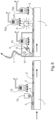
- Fig.1 shows an embodiment of the invention in which the removal of parts of the layer, here specifically the manipulation means, is carried out fluidically.
- a flat workpiece 1 is shown, which is moved from right to left in the drawing.
- the workpiece 1 is coated with a liquid layer 2, which forms the surface of the workpiece 1 after it has completely hardened.
- a manipulation means 3 has been introduced into the liquid layer 2 at some points in order to displace the liquid layer 2.
- the workpiece 1 is moved into a chamber 4, for example by a transport device of a device according to the invention.
- the chamber 4 initially has a curing device 5, which comprises a UV radiation source, which emits UV radiation onto the liquid layer 2 in order to harden it, so that the viscosity of the layer 2 changes.
- the UV radiation has a wavelength of 200 to 400 nm.
- the workpiece 1 is then fed to a nozzle 6, which emits a fluid flow against the direction of movement of the workpiece 1 at an angle to the surface of the layer 2.
- the angle is a maximum of 45° or less.
- the angle is adjusted between 0° and 45°. This adjustment can be made, for example, depending on the manipulation device that has been removed.
- the fluid flow is formed through the nozzle 6 in such a way that it exerts a flow pressure on the manipulation means 3 which is so high that the manipulation means 3 detaches from the layer 2 as part 13 of the layer 2.
- the pressure of the fluid flow then drives the detached parts 13 of the manipulation means 3 (framed in dashed lines) to the right, where they are caught by a suction device 7 by negative pressure and removed from the chamber 4.
- the fluid flow is designed such that it extends over the entire width of the workpiece 1, i.e. in a direction of extension of the workpiece 1 perpendicular to the plane of the drawing. In this way, it is ensured that all parts of the manipulation means 3 are covered by the fluid flow, which makes the targeted flow to individual areas of the surface of the layer 2 superfluous, particularly in the case of chaotic or irregularly introduced manipulation means 3.
- a liquid or a gaseous substance is used as the fluid.
- Water and/or air can also be used as the fluid.
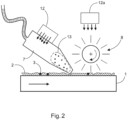
- Fig. 2 shows an embodiment of the invention in which the removal of parts of the layer is carried out mechanically.
- a flat workpiece 1 is shown, which is moved from left to right in the drawing.
- the workpiece 1 is coated with a liquid layer 2, which forms the surface of the workpiece 1 after it has completely hardened.
- a manipulation means 3 has been introduced into the liquid layer 2 at some points in order to displace the liquid layer 2.
- the workpiece 1 is moved, for example, by a transport device of a device according to the invention.
- a suction device 7 is arranged first, which is designed to suck up parts 13 of the layer 2 that have been released by means of negative pressure, in particular the released manipulation agent 3.
- the suction nozzle of the suction device 7 is aligned close to the surface of the layer 2.
- a brush 8, which is designed as a roller brush, is arranged downstream of the suction device 7. This extends perpendicular to the plane of the drawing, transverse to the direction of movement of the workpiece 1. In this embodiment, the roller brush is rotated in the opposite direction to the direction of movement of the workpiece 1.
- the suction device 7 also has a radiation source 12.
- This is designed to emit electromagnetic radiation, such as UV radiation, to harden the sucked-up parts 13 of the layer 2, whereby within the Suction device 7 hardens the parts 13 so that they do not run the risk of sticking within the suction device 7 and clogging it.
- electromagnetic radiation such as UV radiation
- parts 13 of the layer 2, in particular the manipulation means 3, are brushed out of the layer 2 and transported in the direction of the suction device 7. This takes up the detached parts 13 (outlined in dashed lines).
- a further radiation source 12a is shown, which is designed to emit electromagnetic radiation, in particular UV radiation, onto the brush 8 in order to harden and/or embrittle material adhering thereto from parts of the layer 2 in order to clean the brush 8, as described above.
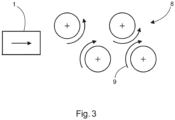
- Fig.3 shows an embodiment of brushes for mechanical removal of parts of the layer.
- a workpiece 1 and several brushes 8 are shown in a top view.
- the workpiece 1 is moved from left to right under the brushes 8.
- the brushes 8 are designed here as disc brushes that rotate about a respective axis in the rotation directions 9 shown. If the workpiece 1, on which a layer with or without a manipulation means (neither shown) is located, is moved under the brushes 8, parts of the layer, in particular the manipulation means, are mechanically removed by contact with the brushes 8 moving relative to the workpiece 1.
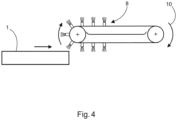
- Fig.4 shows a further embodiment of brushes for the mechanical removal of parts of the layer, in particular the manipulation agent.
- a workpiece 1 with a layer with or without a manipulation device (both not shown) and a brush belt are shown in side view.
- the workpiece 1 is moved from left to right.
- the brush belt is equipped with several brushes 8.
- the brush belt rotates cyclically in the direction of rotation 10 shown, so that the brushes 8, which are currently located on the underside of the brush belt, move from right to left against the movement of the workpiece 1.
- a further relative movement component is added, so that the force with which the bristles of the brushes 8 act on the layer or on the manipulation means is increased.
- Fig.5 shows a further embodiment of brushes for the mechanical removal of parts of the layer, in particular the manipulation agent.
- a workpiece 1 is shown in plan view, which is moved from left to right under a beam 11, which has brushes on its side facing the workpiece 1, which can come into contact with the workpiece 1 or with the layer and/or the manipulation means on it (neither shown).
- the beam 11 extends at least over the entire extent of the workpiece 1, i.e. from top to bottom in the drawing.
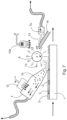
- Fig.7 shows a way to clean the contact element.
- a flat workpiece 1 is shown, which is moved from left to right in the drawing.
- the workpiece 1 is coated with a liquid layer 2, which forms the surface of the workpiece 1 after it has completely hardened.
- a manipulation means 3 has been introduced into the liquid layer 2 at some points in order to displace the liquid layer 2.
- the workpiece 1 is moved, for example, by a transport device of a device according to the invention.
- a suction device 7 is first arranged, which is designed to suck up parts 13 of the layer 2 that have been released by means of negative pressure, in particular the released manipulation agent 3.
- the suction nozzle of the suction device 7 is aligned close to the surface of the layer 2.
- a brush 8, which is designed as a roller brush, is arranged downstream of the suction device 7. This extends perpendicular to the plane of the drawing, transversely to the direction of movement of the workpiece 1. In this embodiment, the roller brush is rotated in the opposite direction to the direction of movement of the workpiece 1.
- the suction device 7 also has a radiation source 12. This is designed to emit electromagnetic radiation, such as UV radiation, to harden the sucked-up parts 13 of the layer 2, whereby the parts 13 harden within the suction device 7, so that there is no risk of them sticking within the suction device 7 and clogging it.
- a radiation source 12a which emits UV radiation onto the brush 8 and thus onto the parts 13 of the layer 2 adhering to the bristles of the brush 8, which can comprise material of the layer 2 as well as material of the manipulation means 3.
- the bristles of the brush 8 After being irradiated by the radiation source 12a, encounter a stripping edge 14.
- the stripping edge 14 extends to the bottom right in the drawing and has a surface that is shaped in such a way that parts 13 of the layer 2 that have been detached from the bristles are directed in the direction of a suction device 7a that is located on this surface.
- the suction device 7a is designed to pick up the detached parts 13 of the layer 2 and to suck them away using negative pressure.
- the cleaning function of brush 8 is as follows: Within a cycle, i.e. within one rotation of the brush 8, the bristles of the brush 8 first hit the surface of the layer 2, whereby parts 13 of the layer 2 are removed. Parts 13 that are detached and do not become stuck in the bristles of the brush 8 are conveyed by the brush in the direction of the suction device 7, which sucks them up using negative pressure. Parts 13 that have become stuck in the bristles of the brush 8 are irradiated by the radiation source 12a as the brush 8 continues to rotate, causing them to harden. The irradiation of the radiation source 12a can also be so strong that the parts 13 that have become stuck in the bristles of the brush 8 become brittle.
- Fig.8 shows a device in the form of a production line.
- Two workpieces 1 are shown which are moved one after the other in the direction of movement from left to right.
- a transport device (not shown) is provided for this purpose.
- the workpiece 1 has a liquid layer 2 on its surface.
- a manipulation means 3 is contained in and/or on the layer 2.
- the following elements are arranged one after the other from left to right in the direction of movement.
- a stationary contact element in the form of a brush 15 is arranged, which is designed to come into contact with the surface of the layer 2 in order to mechanically remove parts of the layer 2. This particularly ensures that the manipulation means 3 enclosed in the layer 2 is exposed.
- Downstream of the brush 15 is a radiation source 12 which is designed to emit UV radiation in the direction of the workpiece 1 or the layer 2 in order to at least partially harden the layer 2.
- the chamber 4 initially has a nozzle 6 in the direction of movement which emits a fluid flow at an angle to the surface of the layer 2 against the direction of movement of the workpiece 1.
- the angle is a maximum of 90° or less.
- the angle is preferably adjusted between 0° and 30°. This adjustment can be made, for example, depending on the material of the manipulation means removed and/or depending on the material of the layer 2 removed.
- the fluid flow has solid bodies as described above in order to remove parts 13 of the layer 2.
- the chamber also has a suction device 7 which is designed to suck up detached parts 13 of the layer 2.
- a radiation source 12 which is designed to irradiate the layer 2 with radiation in order to partially harden it, so that the viscosity of the layer 2 changes.
- the radiation can, for example, be UV radiation with a wavelength of 200 to 400 nm.
- the fluid flow is designed such that it extends over the entire width of the workpiece 1, i.e. in an extension direction of the workpiece 1 perpendicular to the plane of the drawing. In this way, it is ensured that all areas of the layer 2 are covered by the fluid flow.
- a liquid or a gaseous substance is used as the fluid.
- Water and/or air can also be used as the fluid.
- a contact element with a brush 8 in the form of a roller brush is arranged downstream of the chamber 4.
- the brush 8 is designed to mechanically remove parts of the layer 2.
- a radiation source 12a is arranged above the brush, which emits UV radiation onto the brush 8, for example.
- the cleaning of the brush 8 can be carried out essentially as described in Fig.7 take place.
- a further radiation source 12b is arranged downstream of the brush 8 in the direction of movement. This emits UV radiation, for example, onto the layer 2 and possibly desired manipulation agent 3 in order to carry out final hardening.
- Fig.9 shows an exemplary flow chart of the procedure.
- step S10 a liquid layer is applied to a workpiece, which then forms the surface of the workpiece when hardened. This can be done, for example, using a digital or analogue method.
- step S12 a manipulation agent is applied to and/or into a part of the liquid layer that is located on a workpiece. If step S12 is carried out before step S10, a manipulation agent can also be applied to the workpiece, with step S10 being carried out subsequently so that the manipulation agent is enclosed by the liquid layer.
- step S14 the layer is fixed to the workpiece using the manipulation device.
- the layer can be fixed.
- step S18 parts of the layer, which may also include material of the manipulation means, are removed. This is done as described above.
- the procedure can be further developed by swapping, omitting and/or repeating individual steps as well as by adding further steps.
- the invention is not limited to the embodiments shown here. Rather, other devices and/or methods can be obtained which also correspond to the invention by combining, exchanging or omitting individual features.
- the configuration can be Fig.7 into the production line Fig.8 be additionally integrated, or be provided instead of the chamber 4 and/or the brush 8 shown here.
- All nozzles 6 that are in the Figures 1 and 8th may be designed to deliver a fluid stream with or without solids as described above.
- the fluid stream may contain a gas and/or a liquid, specifically containing air and/or water.
- the radiation sources shown in all figures can be designed to emit other radiation, such as electron beams, as an alternative or in addition to electromagnetic radiation, in particular UV radiation.
- the type of radiation and/or the corresponding wavelength are selected depending on the material composition of the layer 2 and/or the manipulation means 3 and/or depending on the desired effect of the radiation on the layer 2 and/or the manipulation means 3. For example, a different wavelength and/or radiation can be used for complete curing than if only the viscosity of the layer 2 is to be changed in a preceding step, for example to prevent the depressions introduced by the manipulation means 3 from running.
- All of the embodiments of the invention shown here, which have at least one brush 8, can also be designed such that the at least one brush 8 is provided in a movable manner. This is to be understood as meaning that the at least one brush 8 can be actively moved by a predetermined movement pattern.
- a disc brush can be provided on a pivotable suspension.
Landscapes
- Engineering & Computer Science (AREA)
- Mechanical Engineering (AREA)
- Life Sciences & Earth Sciences (AREA)
- Toxicology (AREA)
- Health & Medical Sciences (AREA)
- Wood Science & Technology (AREA)
- Manufacturing & Machinery (AREA)
- Forests & Forestry (AREA)
- Physics & Mathematics (AREA)
- Plasma & Fusion (AREA)
- Application Of Or Painting With Fluid Materials (AREA)
- Grinding Of Cylindrical And Plane Surfaces (AREA)
- Chemically Coating (AREA)
- Turning (AREA)
- Physical Or Chemical Processes And Apparatus (AREA)
Claims (15)
- Procédé de fabrication d'une surface décorative sur une pièce à fabriquer (1), comprenant les étapes suivantes :- appliquer (S10) une couche liquide (2) au moins sur une partie d'une surface de la pièce à fabriquer (1) ;- appliquer (S12) un moyen de manipulation (3) au moins sur et/ou dans une partie de la couche liquide (2) qui se trouve sur la pièce à fabriquer (1) ;- durcir (S14) la couche (2) et le moyen de manipulation (3) au moins jusqu'au durcissement partiel ;- enlever (S18) des parties (13) de la couche (2), dans lequell'enlèvement (S18) est effectué mécaniquement et/ou sans contact, en particulier de manière fluidique,caractérisé en ce quel'enlèvement (S18) comprend un chauffage de la couche (2) et/ou du moyen de manipulation (3),dans lequel le chauffage de la couche (2) et/ou du moyen de manipulation (3) est effectué au moyen de l'apport de chaleur, pour la liquéfaction au moins partielle des parties (13).
- Procédé selon la revendication 1, dans lequel
les parties (13) de la couche (2) comprennent également des parties du moyen de manipulation (3) se trouvant sur ou dans la couche (2) ou se composent exclusivement du moyen de manipulation (3). - Procédé selon la revendication 1 ou 2, dans lequel
l'enlèvement (S18) est effectué mécaniquement au moyen d'un dispositif d'enlèvement qui présente un élément de contact qui est en contact avec la surface de la couche (2), dans lequel la surface de la couche (2) et l'élément de contact se déplacent l'un par rapport à l'autre lors de l'enlèvement (S18). - Procédé selon la revendication 3, dans lequell'élément de contact présente une brosse fixe et/ou mobile (8) et/ou un élément de meulage et/ou un élément de rabotage, dans lequel, de préférence, la brosse (8) présente au moins en tant que brosse mobile (8) une brosse à disque et/ou une brosse à rouleau et/ou une bande de brosse et/ou en tant que brosse fixe (8) une barre (11) avec garniture de brosse, et/ou dans lequell'élément de contact, en particulier la brosse (8), présente des fibres textiles et/ou plastiques, en particulier des fibres de nylon, de l'anderlon, et/ou du métal, en particulier de l'acier, du laiton ou du cuivre, en tant que soies.
- Procédé selon l'une quelconque des revendications précédentes, dans lequel
l'enlèvement (S18) comprend une aspiration des parties (13) par dépression, de préférence au moyen d'un dispositif d'aspiration, et/ou dans lequel le chauffage de la couche (2) et/ou du moyen de manipulation (3) est effectué au moyen de l'apport de chaleur, pour la liquéfaction au moins partielle du moyen de manipulation (3). - Procédé selon l'une quelconque des revendications 3 ou 4, dans lequel
une étape de nettoyage de l'élément de contact est effectuée. - Procédé selon l'une quelconque des revendications précédentes, dans lequel
l'enlèvement (S18) comprend l'affluage de la surface de la couche (2) et/ou du moyen de manipulation (3) avec un flux de fluide, en particulier avec un flux d'air. - Procédé selon la revendication 7, dans lequelle flux de fluide percute en forme correspondante contre la surface de la couche (2) et/ou du moyen de manipulation (3) de sorte qu'il s'étende sur toute la largeur de la couche (2), et/ou dans lequelle flux de fluide percute contre la couche (2) et/ou le moyen de manipulation (3) sous un angle qui est inférieur à 45°, de préférence inférieur à 30°, de manière particulièrement préférée inférieur à 15°.
- Procédé selon la revendication 7 ou 8, dans lequel
le flux de fluide présente des corps solides qui présentent un diamètre de 0,0001 à 1 mm, de préférence de 0,001 à 0,5 mm, de manière particulièrement préférée de 0,005 à 0,3 mm, et/ou qui sont réalisés pour se liquéfier ou se vaporiser après avoir percuté contre la couche (2), et/ou qui sont exposés à un liquide lors de la distribution. - Procédé selon l'une quelconque des revendications précédentes, dans lequel
la couche (2) est au moins partiellement durcie avant l'application (S12) du moyen de manipulation (3), dans lequel on utilise à cet effet de préférence un rayonnement électromagnétique, en particulier un rayonnement UV. - Procédé selon l'une quelconque des revendications précédentes, dans lequelle durcissement (S14) comprend une irradiation de la couche (2) et/ou du moyen de manipulation (3) par un rayonnement électromagnétique, de préférence par un rayonnement UV, et/ou une irradiation par un rayonnement électronique, et/ou dans lequelle durcissement (S14) comprend un séchage actif et/ou passif et/ou un durcissement par réaction, de préférence par un système à deux composants, et/ou dans lequelle durcissement (S14) est effectué après l'enlèvement (S18) jusqu'au durcissement final de la couche (2).
- Procédé selon l'une quelconque des revendications précédentes, dans lequel
le moyen de manipulation (3) et la couche (2) sont réalisés de telle sorte qu'ils ne se lient pas l'un à l'autre pendant le durcissement (S14). - Dispositif pour la mise en oeuvre des procédés selon l'une quelconque des revendications 1 à 12, présentant :- un dispositif de transport, qui est conçu pour transporter une pièce à fabriquer (1) vers d'autres éléments du dispositif, et/ou pour déplacer au moins un autre élément du dispositif vers la pièce à fabriquer (1) ;- en tant qu'autre élément, un dispositif d'application (15), en particulier présentant un dispositif d'impression numérique, qui est conçu pour appliquer un moyen de manipulation (3) sur une couche (2) au moins partiellement liquide se trouvant sur la pièce à fabriquer (1) ;- en tant qu'autre élément, un dispositif de durcissement, qui est conçu pour durcir la couche liquide (2) et le moyen de manipulation (3) ;- en tant qu'autre élément, un dispositif d'enlèvement, qui est conçu pour enlever des parties (13) de la couche (2) mécaniquement et/ou de manière fluidique,caractérisé en ce quele dispositif comprend en outre un moyen de commande, qui est conçu pour commander le dispositif de transport et les autres éléments du dispositif, afin de mettre en oeuvre le procédé selon l'une quelconque des revendications 1 à 12, et en ce quele dispositif d'enlèvement présente un dispositif de chauffage, qui est conçu pour chauffer la surface de la couche (2) et/ou le moyen de manipulation (3), afin d'obtenir une liquéfaction des parties de la couche (13).
- Dispositif selon la revendication 13, dans lequelle dispositif de transport présente un transport par bande, et/ou dans lequelle dispositif de durcissement présente une source de rayonnement (12), de préférence pour un rayonnement électromagnétique, dans laquele la longueur d'onde du rayonnement émis peut de préférence être modifiée, et/ou dans lequelle dispositif de durcissement présente un ventilateur, qui est conçu pour souffler un flux de fluide, en particulier un flux d'air, sur la couche (2) et/ou le moyen de manipulation (3) ; et/ou dans lequelle dispositif d'enlèvement pour l'enlèvement mécanique présente un élément de contact, qui est conçu pour entrer en contact avec la surface de la couche (2) afin d'enlever des parties (13) de la couche (2) ; et/ou dans lequelle dispositif d'enlèvement présente une buse (6), qui est conçue pour laisser s'affluer un flux de fluide, de préférence un flux d'air, sur la surface de la couche (2) afin d'enlever le moyen de manipulation (3), dans lequel le flux de fluide présente de préférence des corps solides qui présentent un diamètre de 0,0001 à 1 mm, de préférence de 0,001 à 0,5 mm, de manière particulièrement préférée de 0,005 à 0,3 mm ; et/ou dans lequelle dispositif d'enlèvement présente un dispositif d'aspiration (7), qui est conçu pour aspirer le moyen de manipulation (3) de la couche (2) au moyen d'une dépression et/ou pour aspirer le moyen de manipulation (3) déjà dissous.
- Dispositif selon la revendication 14, dans lequell'élément de contact présente une brosse fixe et/ou mobile (8) et/ou un élément de meulage et/ou un élément de rabotage, et/ou dans lequell'élément de contact, en particulier la brosse (8), présente des fibres textiles et/ou plastiques, en particulier des fibres de nylon, et/ou de l'anderlon et/ou du métal, en particulier de l'acier, du laiton ou du cuivre, en tant que soies.
Priority Applications (4)
| Application Number | Priority Date | Filing Date | Title |
|---|---|---|---|
| US16/865,356 US20200346395A1 (en) | 2019-05-03 | 2020-05-03 | Method and device for producing a decorative surface |
| CN202080002842.4A CN112188936B (zh) | 2019-05-03 | 2020-05-04 | 用于形成装饰表面的方法和装置 |
| PCT/EP2020/062321 WO2020225214A1 (fr) | 2019-05-03 | 2020-05-04 | Procédé et dispositif pour produire une surface décorative |
| KR1020217036059A KR102798285B1 (ko) | 2019-05-03 | 2020-05-04 | 장식면을 제조하는 방법 및 장치 |
Applications Claiming Priority (1)
| Application Number | Priority Date | Filing Date | Title |
|---|---|---|---|
| DE102019206431.0A DE102019206431A1 (de) | 2019-05-03 | 2019-05-03 | Verfahren zum Herstellen einer Struktur auf einer Oberfläche |
Publications (3)
| Publication Number | Publication Date |
|---|---|
| EP3733307A1 EP3733307A1 (fr) | 2020-11-04 |
| EP3733307B1 true EP3733307B1 (fr) | 2024-07-31 |
| EP3733307C0 EP3733307C0 (fr) | 2024-07-31 |
Family
ID=68581334
Family Applications (5)
| Application Number | Title | Priority Date | Filing Date |
|---|---|---|---|
| EP23159373.2A Pending EP4212254A1 (fr) | 2019-05-03 | 2019-11-12 | Procédé et dispositif de traitement de surface |
| EP19208741.9A Active EP3733308B1 (fr) | 2019-05-03 | 2019-11-12 | Procédé et dispositif d'usinage de surfaces |
| EP19208738.5A Active EP3733307B1 (fr) | 2019-05-03 | 2019-11-12 | Procédé et dispositif de production d'une surface décorative |
| EP20724447.6A Pending EP3752296A2 (fr) | 2019-05-03 | 2020-05-04 | Procédé pour réaliser une structure sur une surface |
| EP23160613.8A Pending EP4215282A1 (fr) | 2019-05-03 | 2020-05-04 | Procédé de fabrication d'une structure sur une surface |
Family Applications Before (2)
| Application Number | Title | Priority Date | Filing Date |
|---|---|---|---|
| EP23159373.2A Pending EP4212254A1 (fr) | 2019-05-03 | 2019-11-12 | Procédé et dispositif de traitement de surface |
| EP19208741.9A Active EP3733308B1 (fr) | 2019-05-03 | 2019-11-12 | Procédé et dispositif d'usinage de surfaces |
Family Applications After (2)
| Application Number | Title | Priority Date | Filing Date |
|---|---|---|---|
| EP20724447.6A Pending EP3752296A2 (fr) | 2019-05-03 | 2020-05-04 | Procédé pour réaliser une structure sur une surface |
| EP23160613.8A Pending EP4215282A1 (fr) | 2019-05-03 | 2020-05-04 | Procédé de fabrication d'une structure sur une surface |
Country Status (8)
| Country | Link |
|---|---|
| US (4) | US20200346484A1 (fr) |
| EP (5) | EP4212254A1 (fr) |
| KR (1) | KR102798285B1 (fr) |
| CN (3) | CN114174076A (fr) |
| DE (1) | DE102019206431A1 (fr) |
| ES (2) | ES2964229T3 (fr) |
| PL (2) | PL3733308T3 (fr) |
| WO (3) | WO2020225215A2 (fr) |
Families Citing this family (16)
| Publication number | Priority date | Publication date | Assignee | Title |
|---|---|---|---|---|
| ES2971866T3 (es) | 2017-06-13 | 2024-06-10 | Hymmen Gmbh Maschinen & Anlagenbau | Procedimiento y dispositivo de producción de una superficie estructurada |
| WO2019226885A1 (fr) * | 2018-05-25 | 2019-11-28 | Corning Incorporated | Procédés de modification d'un substrat par déformation élastocapillaire |
| AU2019333292B2 (en) | 2018-08-30 | 2023-11-23 | Interface, Inc. | Digital printing for flooring and decorative structures |
| DE102019206431A1 (de) | 2019-05-03 | 2020-11-05 | Hymmen GmbH Maschinen- und Anlagenbau | Verfahren zum Herstellen einer Struktur auf einer Oberfläche |
| PL4049851T3 (pl) * | 2021-02-26 | 2024-11-25 | Jesús Francisco Barberan Latorre | Sposób i system wytwarzania reliefu na podłożu |
| CN113021192A (zh) * | 2021-03-02 | 2021-06-25 | 超安(广州)五金有限公司 | 一种控制金属原子活动性的节能环保硅片处理设备 |
| DE102021113681A1 (de) | 2021-05-27 | 2022-12-01 | Homag Gmbh | Vorrichtung und Verfahren zum Veredeln eines Werkstücks |
| JP2024522676A (ja) * | 2021-06-25 | 2024-06-21 | クンディグ アクチエンゲゼルシャフト | エアブレードにより吹き飛ばしを行うことによる研磨ベルトの清掃方法、およびエアブレード |
| EP4129711B1 (fr) | 2021-08-05 | 2026-04-08 | Unilin, BV | Procédé de fabrication d'un produit comprenant une couche de surface décorative |
| EP4201696A1 (fr) | 2021-12-22 | 2023-06-28 | Flooring Industries Limited, SARL | Procédé de création d'une couche texturée sur un panneau décoratif |
| EP4215382B1 (fr) | 2022-01-24 | 2026-01-21 | Unilin, BV | Un procédé de fabrication d'un panneau |
| IT202200008756A1 (it) | 2022-05-02 | 2023-11-02 | Cefla Soc Cooperativa | Metodo e apparato per formare una struttura superficiale |
| CN120202085A (zh) * | 2022-09-15 | 2025-06-24 | 阿莱恩技术有限公司 | 用于对增材制造对象的表面进行改性的系统和方法 |
| LU504519B1 (en) | 2023-06-15 | 2024-12-16 | Tarkett Gdl Sa | Surface covering panel with transitional edge |
| LU504655B1 (en) | 2023-07-03 | 2025-01-03 | Tarkett Gdl Sa | Decorative surface coverings digitally embossed |
| LU506092B1 (en) | 2024-01-12 | 2025-07-14 | Tarkett Gdl Sa | Three-Dimensional Surface Texturing |
Citations (5)
| Publication number | Priority date | Publication date | Assignee | Title |
|---|---|---|---|---|
| EP1101542A2 (fr) * | 1999-11-15 | 2001-05-23 | WANDRES GmbH MICRO-CLEANING | Procédé et dispositif pour enlever des contaminants de surfaces contaminées par un liquide |
| US20070235410A1 (en) * | 2006-03-31 | 2007-10-11 | Palo Alto Research Center Incorporated | Method of forming a darkfield etch mask |
| EP3109056A1 (fr) * | 2015-06-25 | 2016-12-28 | Hymmen GmbH Maschinen- und Anlagenbau | Procede et dispositif de fabrication d'une structure sur une surface |
| WO2018069874A1 (fr) * | 2016-10-13 | 2018-04-19 | Giorgio Macor | Procédé et appareil de génération d'une structure superficielle |
| EP3415316A1 (fr) * | 2017-06-13 | 2018-12-19 | Hymmen GmbH Maschinen- und Anlagenbau | Procédé et dispositif de fabrication d'une surface structurée |
Family Cites Families (182)
| Publication number | Priority date | Publication date | Assignee | Title |
|---|---|---|---|---|
| US692701A (en) | 1901-01-15 | 1902-02-04 | Bradley & Hubbard Mfg Co | Lamp-burner. |
| US3308227A (en) | 1964-04-20 | 1967-03-07 | Formica Corp | Process for making embossed laminates |
| US3580768A (en) * | 1967-11-29 | 1971-05-25 | Stanley Kukla | Method of forming decorative three dimensional effect designs and coatings |
| FR2017059A1 (en) | 1968-08-28 | 1970-05-15 | Cartiere Ambrogio Binda Spa | Impregnated paper coatings for wooden surface |
| US3676963A (en) | 1971-03-08 | 1972-07-18 | Chemotronics International Inc | Method for the removal of unwanted portions of an article |
| GB1405643A (en) | 1972-10-26 | 1975-09-10 | Formica Int | Decorative sheet material and process for producing same |
| DE2919847B1 (de) | 1979-05-16 | 1980-10-16 | Lissmann Alkor Werk | Flaechengebilde mit Holzmaserung und Verfahren zu dessen Herstellung |
| US4439480A (en) | 1980-10-01 | 1984-03-27 | Tarkett Ab | Radiation cured coating and process therefor |
| DE3107798A1 (de) | 1981-02-28 | 1982-09-16 | wf rational Anbauküchen GmbH + Co, 4520 Melle | Gedruckte nachbildung von naturholzstreifen und verfahren zur herstellung von eindruecken |
| DE3247146C1 (de) | 1982-12-21 | 1984-03-22 | Held, Kurt, 7218 Trossingen | Verfahren und Vorrichtung zur kontinuierlichen Herstellung von Schichtpress-Stoffen |
| JPS59169575A (ja) * | 1983-03-16 | 1984-09-25 | Kyushu Hitachi Maxell Ltd | 塗料の剥離方法 |
| DE3331391A1 (de) * | 1983-08-31 | 1985-03-07 | Dieter 6636 Berus Schmitt | Verfahren zum herstellen von metallisch wirkenden ueberzuegen auf oberflaechen aus polystyrol |
| US4513299A (en) | 1983-12-16 | 1985-04-23 | International Business Machines Corporation | Spot size modulation using multiple pulse resonance drop ejection |
| DE3510415A1 (de) | 1985-03-22 | 1986-09-25 | Schering AG, 1000 Berlin und 4709 Bergkamen | Verwendung von polyamidharzen fuer den reliefdruck |
| DE3527404C1 (de) | 1985-07-31 | 1987-01-02 | Kurz Leonhard Fa | Verfahren zur Herstellung einer eine texturierte Lackschicht aufweisenden Folie |
| AT387621B (de) | 1987-03-10 | 1989-02-27 | Dana Tuerenindustrie | Verfahren zur herstellung eines tuerblattes mit insbesondere linienartigen verzierungen |
| US5178928A (en) | 1988-09-22 | 1993-01-12 | Dai Nippon Insatsu Kabushiki Kaisha | Decorative materials |
| EP0372097A1 (fr) | 1988-11-30 | 1990-06-13 | Siemens Aktiengesellschaft | Dispositif pour la formation de gouttelettes d'encre dans une imprimante à gouttelettes d'encre |
| EP0428628A1 (fr) | 1989-06-12 | 1991-05-29 | General Electric Company | Unite d'impression laminaire de rev tement de substrats plats |
| EP0499720B1 (fr) | 1991-02-20 | 1996-05-22 | Agfa-Gevaert N.V. | Système pour réduire la contamination de rouleaux et/ou de supports |
| ES1018178Y (es) | 1991-05-03 | 1992-08-01 | Barberan, S.A. | Equipo de recuperacion y limpieza para el transportador de una instalacion de proyeccion de tintes o barnices. |
| DE4139961A1 (de) | 1991-12-04 | 1993-06-09 | Basf Ag, 6700 Ludwigshafen, De | Traenkharzloesung zum impraegnieren von papierbahnen |
| JPH0767800B2 (ja) * | 1991-12-16 | 1995-07-26 | ニッカ株式会社 | 印刷シリンダの洗浄装置 |
| JP3133476B2 (ja) * | 1992-04-03 | 2001-02-05 | 大日本印刷株式会社 | エンボス版、該エンボス版を用いて製造した化粧材及び該エンボス版の製造方法 |
| JPH0775889B2 (ja) * | 1992-10-06 | 1995-08-16 | 日本ボールドウィン株式会社 | シリンダ洗浄装置 |
| US5621022A (en) * | 1992-11-25 | 1997-04-15 | Tektronix, Inc. | Use of polymeric dyes in hot melt ink jet inks |
| JPH06270372A (ja) | 1993-03-17 | 1994-09-27 | Dainippon Printing Co Ltd | 凹凸模様を有する化粧材 |
| US5498460A (en) * | 1993-03-24 | 1996-03-12 | Tingley; Daniel A. | Surface treated synthetic reinforcement for structural wood members |
| DE4421559C2 (de) | 1994-06-20 | 1998-05-20 | Osmetric Entwicklungs Und Prod | Verfahren zum Herstellen einer Beschichtung, die eine Struktur aufweist, auf einem Substrat sowie Beschichtung |
| CN1082444C (zh) | 1994-12-29 | 2002-04-10 | 佳能株式会社 | 采用具有多个喷墨加热器的喷墨头的喷墨设备 |
| DE19532819A1 (de) | 1995-09-06 | 1997-03-13 | Hofa Homann Verwaltungsgesells | Verfahren zur Herstellung einer Holzwerkstoffplatte |
| JPH09323434A (ja) | 1996-04-02 | 1997-12-16 | Toray Ind Inc | 建材のプリント装置及びプリントずみ建材の製造方法 |
| JP3122370B2 (ja) | 1996-05-29 | 2001-01-09 | 株式会社伸興 | 除塵装置 |
| JP2000516872A (ja) | 1996-08-27 | 2000-12-19 | トパーズ・テクノロジーズ・インコーポレイテッド | 可変体積のインク滴を生成するインクジェットプリントヘッド |
| EP1332876B1 (fr) | 1996-09-09 | 2006-03-22 | Seiko Epson Corporation | Imprimante à jet d'encre et méthode d'impression |
| US5779779A (en) | 1996-09-27 | 1998-07-14 | Dataproducts Corporation | UV-blocking hot melt inks |
| SE9703281L (sv) | 1997-09-11 | 1999-03-12 | Perstorp Ab | Förfarande för framställning av härdplastlaminat |
| DE19810455C2 (de) | 1998-03-11 | 2000-02-24 | Michael Bisges | Kaltlicht-UV-Bestrahlungsvorrichtung |
| EP1089986B1 (fr) | 1998-06-22 | 2005-03-30 | Ciba SC Holding AG | Absorbeurs de lumiere ultraviolette a base de poly-trisaryl-1,3,5-triazine carbamate |
| US6150009A (en) | 1998-08-07 | 2000-11-21 | Surface Technologies, Inc. | Decorative structural panel |
| GB9825359D0 (en) | 1998-11-20 | 1999-01-13 | Xaar Technology Ltd | Methods of inkjet printing |
| US6120845A (en) | 1999-01-20 | 2000-09-19 | Pease; Scott Norton | Method for applying a decorative finish to the surface of an object |
| JP3223901B2 (ja) | 1999-01-25 | 2001-10-29 | 日本電気株式会社 | インクジェット記録ヘッドの駆動方法及びその回路 |
| US6193361B1 (en) | 1999-06-03 | 2001-02-27 | Eastman Kodak Company | Apparatus for forming textured layers over images |
| IL130458A (en) | 1999-06-14 | 2006-07-05 | Kodak Il Ltd | Digital imaging method for creating the web for use in web printing |
| JP3446686B2 (ja) | 1999-10-21 | 2003-09-16 | セイコーエプソン株式会社 | インクジェット式記録装置 |
| US8209928B2 (en) | 1999-12-13 | 2012-07-03 | Faus Group | Embossed-in-registration flooring system |
| SE516696C2 (sv) | 1999-12-23 | 2002-02-12 | Perstorp Flooring Ab | Förfarande för framställning av ytelement vilka innefattar ett övre dekorativt skikt samt ytelement framställda enlit förfarandet |
| US6431676B2 (en) | 2000-01-28 | 2002-08-13 | Seiko Epson Corporation | Generation of driving waveforms to actuate driving elements of print head |
| EP1149712A1 (fr) | 2000-04-25 | 2001-10-31 | Tarkett Sommer S.A. | Procédé de production de revêtements de sols et de murs à effet de décor de brillance différentiel et produits obtenus |
| PT1676720E (pt) | 2000-06-13 | 2011-02-28 | Flooring Ind Ltd | Revestimento de pavimentos |
| DE10031030B4 (de) | 2000-06-26 | 2005-08-04 | Bauer, Jörg R. | Verfahren und Vorrichtung zum Herstellen flächiger Bauteile mit vorbestimmtem Oberflächenaussehen und flächiges Bauteil, insbesondere Frontplatte eines Küchenelements |
| DE10035961A1 (de) | 2000-07-24 | 2002-02-07 | Basf Ag | Verfahren zum Beschichten von Substraten |
| GB2367788A (en) | 2000-10-16 | 2002-04-17 | Seiko Epson Corp | Etching using an ink jet print head |
| AU2002239731A1 (en) * | 2000-11-13 | 2002-06-03 | Imaging Alternatives, Inc. | Wood surface inkjet receptor medium and method of making and using same |
| ITPS20010006A1 (it) | 2001-02-23 | 2002-08-23 | Canti & Figli Srl | Procedimento e macchina atti ad ottenere goffrature su superfici verniciate di pannelli o di pellicole di rivestimento ed elementi ottenuti |
| DE10134188A1 (de) | 2001-07-13 | 2003-01-23 | Heidelberger Druckmasch Ag | Tintenstrahl-Drucksystem |
| JP3996418B2 (ja) | 2002-03-28 | 2007-10-24 | アトミクス株式会社 | 塗膜層の作製方法 |
| KR100958753B1 (ko) | 2002-04-03 | 2010-05-19 | 메이소나이트 코오포레이션 | 물품에 상을 만드는 방법 및 장치 그리고 인쇄된 물품 |
| KR100455546B1 (ko) | 2002-04-19 | 2004-11-06 | 신현덕 | 인쇄 나무 마루판 |
| US7067241B2 (en) | 2002-05-08 | 2006-06-27 | Unaxis Balzers Aktiengesellschaft | Method for producing a unit having a three-dimensional surface patterning, and use of this method |
| DE10224128A1 (de) | 2002-05-29 | 2003-12-18 | Schmid Rhyner Ag Adliswil | Verfahren zum Auftrag von Beschichtungen auf Oberflächen |
| JP4157336B2 (ja) | 2002-07-15 | 2008-10-01 | 東芝テック株式会社 | インクジェット記録装置 |
| DE60200552T3 (de) | 2002-07-26 | 2012-02-09 | Banque Nationale De Belgique S.A. | Verfahren um latente Bilder zu drucken |
| JP4689155B2 (ja) | 2002-08-29 | 2011-05-25 | 株式会社半導体エネルギー研究所 | 半導体装置の作製方法 |
| US20040086678A1 (en) | 2002-11-01 | 2004-05-06 | Chen Hao A. | Surface covering panel |
| EP1449667A1 (fr) | 2003-02-21 | 2004-08-25 | Agfa-Gevaert | Procédé et dispositif pour imprimer des images à échelle de gris |
| DE10310199B4 (de) | 2003-03-06 | 2007-09-20 | Kronotec Ag | Holzfaserplatte und Verfahren zu deren Herstellung |
| DE10316695B4 (de) | 2003-04-10 | 2006-12-28 | Theodor Hymmen Holding Gmbh | Verfahren und Vorrichtung zur Herstellung eines Laminats |
| US7419716B2 (en) | 2003-05-30 | 2008-09-02 | Awi Licensing Company | Multiple gloss level surface coverings and method of making |
| US7470455B2 (en) | 2003-11-18 | 2008-12-30 | Art Guitar, Llc | Decorating guitars |
| CA2568440C (fr) | 2004-05-28 | 2015-05-05 | Kronotec Ag | Panneau en materiau derive du bois presentant un revetement de surface |
| KR20060004828A (ko) | 2004-07-10 | 2006-01-16 | (주)아도니스마루 | 마루판 및 그 제조방법 |
| ES2545665T3 (es) | 2004-10-05 | 2015-09-14 | Fritz Egger Gmbh & Co. Og | Procedimiento para producir una superficie estructurada y una placa con una superficie estructurada |
| US20060075917A1 (en) | 2004-10-08 | 2006-04-13 | Edwards Paul A | Smooth finish UV ink system and method |
| EP1652686B1 (fr) | 2004-10-29 | 2008-06-25 | Agfa Graphics N.V. | Impression d'encres durcissables par rayonnement sur une couche liquide durcissable par rayonnement |
| BRPI0519338A2 (pt) | 2004-12-16 | 2009-01-20 | Flooring Ind Ltd | painel de piso e mÉtodo para fabricar um painel de piso |
| DE102005003839A1 (de) | 2005-01-27 | 2006-08-03 | Koenig & Bauer Ag | Sicherheitsmarkierung |
| JP5046387B2 (ja) | 2005-01-27 | 2012-10-10 | 国立大学法人北海道大学 | ハニカム構造体の製造方法 |
| BE1016464A3 (nl) * | 2005-02-23 | 2006-11-07 | Flooring Ind Ltd | Werkwijze voor het vervaardigen van vloerpanelen, alsmede vloerpaneel dat door middel van zulke werkwijze is verkregen. |
| JP4720226B2 (ja) | 2005-03-15 | 2011-07-13 | 富士ゼロックス株式会社 | 液滴吐出記録ヘッドの駆動方法及び液滴吐出記録装置 |
| JP4631506B2 (ja) | 2005-03-30 | 2011-02-16 | セイコーエプソン株式会社 | 液体噴射装置 |
| US7575293B2 (en) | 2005-05-31 | 2009-08-18 | Xerox Corporation | Dual drop printing mode using full length waveforms to achieve head drop mass differences |
| GB0517931D0 (en) | 2005-09-02 | 2005-10-12 | Xaar Technology Ltd | Method of printing |
| RU2306228C2 (ru) | 2005-10-19 | 2007-09-20 | Производственное общество с ограниченной ответственностью "ФОКС" | Способ получения декоративного изображения |
| JP2007175962A (ja) | 2005-12-27 | 2007-07-12 | Fujifilm Corp | 撥液性構造体およびその製造方法、液体吐出ヘッドならびに保護フィルム |
| DE102006003798A1 (de) | 2006-01-25 | 2007-07-26 | Man Roland Druckmaschinen Ag | Verfahren und Einrichtung zum Erzeugen von betrachtungswinkelabhängig veränderbaren Bildeffekten auf einen Bedruckstoff |
| FI20065083A0 (fi) | 2006-02-03 | 2006-02-03 | Upm Kymmene Wood Oy | Menetelmä puulevyn pinnoittamiseksi ja puulevy |
| US7918062B2 (en) | 2006-06-08 | 2011-04-05 | Mannington Mills, Inc. | Methods and systems for decorating bevel and other surfaces of laminated floorings |
| JP4907419B2 (ja) | 2006-06-21 | 2012-03-28 | 富士フイルム株式会社 | インクジェット記録方法及びインクジェット記録装置 |
| ITMI20061227A1 (it) | 2006-06-26 | 2007-12-27 | Dante Frati | Procedimento per stampare superfici di elementi piani a base di legno |
| CN100548602C (zh) | 2006-08-17 | 2009-10-14 | 宁波大榭开发区达因圣马克家俱有限公司 | 一种装饰板的加工方法 |
| DE102006042063B4 (de) | 2006-09-05 | 2022-04-07 | Wilhelm Taubert GmbH | Verfahren zur Einstellung des Glanzgrades und der Haptik von dekorativen und funktionellen Oberflächen |
| JP4903618B2 (ja) | 2006-09-25 | 2012-03-28 | 富士フイルム株式会社 | インクジェット記録方法及びインクジェット記録装置 |
| JP4813413B2 (ja) | 2006-09-28 | 2011-11-09 | 富士フイルム株式会社 | インクジェット記録方法及びインクジェット記録装置 |
| JP4907414B2 (ja) | 2006-09-29 | 2012-03-28 | 富士フイルム株式会社 | インクジェット記録方法及びインクジェット記録装置 |
| JP2008093910A (ja) | 2006-10-10 | 2008-04-24 | Hokusan Kk | インクジェット印刷されてなる化粧材 |
| ES2421155T3 (es) | 2006-10-12 | 2013-08-29 | Agfa Graphics N.V. | Método para operar un cabezal de impresión por inyección de tinta |
| US7988247B2 (en) | 2007-01-11 | 2011-08-02 | Fujifilm Dimatix, Inc. | Ejection of drops having variable drop size from an ink jet printer |
| EP1952998B1 (fr) | 2007-02-01 | 2011-04-06 | FUJIFILM Corporation | Appareil d'enregistrement à jet d'encre |
| US8541063B2 (en) | 2007-02-06 | 2013-09-24 | Fujifilm Corporation | Undercoat solution, ink-jet recording method and ink-jet recording device |
| BE1018432A5 (nl) | 2007-03-14 | 2010-11-09 | Flooring Ind Ltd | Werkwijzen voor het vervaardigen van laminaat, inrichting hierbij aangewend, laminaat hierbij verkregen, werkwijze voor het ommantelen van substraten en ommanteld substraat hierbij verkregen. |
| JP2008246993A (ja) * | 2007-03-30 | 2008-10-16 | Fujifilm Corp | インクジェット記録装置及びインクジェット記録方法 |
| JP2008254237A (ja) | 2007-04-02 | 2008-10-23 | Toppan Cosmo Inc | 化粧材 |
| DE102007019871A1 (de) * | 2007-04-25 | 2008-10-09 | Theodor Hymmen Holding Gmbh | Verfahren und Vorrichtung zur Erzeugung einer dünnen dreidimensional strukturierten Oberfläche auf plattenförmigen Werkstoffen |
| EP1990204B1 (fr) | 2007-05-10 | 2015-12-02 | Homag Holzbearbeitungssysteme AG | Procédé et dispositif de revêtement d'une surface |
| CN101314981A (zh) | 2007-05-29 | 2008-12-03 | 汪宏伟 | Uv饰面装饰板及其制作工艺 |
| CN101342844B (zh) | 2007-07-10 | 2013-06-19 | 豪迈木材加工系统公司 | 工件表面装饰装置 |
| JP4898618B2 (ja) | 2007-09-28 | 2012-03-21 | 富士フイルム株式会社 | インクジェット記録方法 |
| US8574678B2 (en) * | 2007-10-16 | 2013-11-05 | Dallaire Industries Ltd. | Method of texturing synthetic material extrusions |
| DE202007014736U1 (de) | 2007-10-19 | 2007-12-20 | Robert Bürkle GmbH | Vorrichtung zum Herstellen einer strukturierten Oberfläche einer lackierten Werkstoffplatte |
| DE102007055053A1 (de) | 2007-11-16 | 2009-05-20 | Hueck Engraving Gmbh & Co. Kg | Verfahren zur Bearbeitung einer strukturierten Oberfläche |
| KR101064427B1 (ko) | 2007-12-20 | 2011-09-14 | (주)엘지하우시스 | 모자이크 인쇄층을 갖는 마루바닥재 |
| JP2009208348A (ja) | 2008-03-04 | 2009-09-17 | Fujifilm Corp | 画像形成装置及び画像形成方法 |
| ES2340456B1 (es) | 2008-03-18 | 2011-02-02 | Jesus Fco. Barberan Latorre | Procedimiento de impresion por inyeccion de tinta sobre substrato humedo. |
| JP4990207B2 (ja) | 2008-03-31 | 2012-08-01 | 富士フイルム株式会社 | 多孔フィルムの製造方法 |
| DE102008024149B4 (de) | 2008-05-19 | 2011-06-22 | Institut für Oberflächenmodifizierung e.V., 04318 | Vorrichtung zur Ermittlung der Faltungskinetik und der Faltungsgeschwindigkeit strahlenhärtbarer Farben und Lacke während des Prozesses der photochemische Mikrofaltung initiiert durch kurzwellige monochromatische Excimer-UV-Strahlung |
| JP4758497B2 (ja) | 2008-07-10 | 2011-08-31 | 株式会社リコー | 洗浄装置及び洗浄方法 |
| JP5016716B2 (ja) | 2008-08-21 | 2012-09-05 | ローランドディー.ジー.株式会社 | インクジェット式記録装置およびコンピュータプログラム |
| JP5294770B2 (ja) | 2008-09-17 | 2013-09-18 | 株式会社秀峰 | 立体感のある色彩被覆の作成方法およびそれによる立体的色彩印刷体 |
| FR2937181B1 (fr) | 2008-10-10 | 2011-01-14 | Commissariat Energie Atomique | Structuration en surface de couches minces par ejection localisee de liquide immiscible. |
| FR2936965A1 (fr) | 2008-10-10 | 2010-04-16 | Commissariat Energie Atomique | Formation de via traversant des couches minces par ejection localisee de liquide immiscible. |
| EP2181860B1 (fr) | 2008-10-22 | 2013-03-20 | Fritz Egger GmbH & Co. OG | Composant en matière dérivée du bois doté de propriétés tactiles particulières et procédé de fabrication d'un tel composant |
| KR101616593B1 (ko) | 2008-12-19 | 2016-05-12 | 플로어링 인더스트리즈 리미티드 에스에이알엘 | 코팅 패널 및 이러한 패널의 제조 방법 |
| KR101679171B1 (ko) | 2008-12-19 | 2016-11-23 | 플로어링 인더스트리즈 리미티드 에스에이알엘 | 코팅 패널 및 이러한 패널의 제조 방법 |
| DE102009004482B4 (de) | 2009-01-09 | 2012-03-29 | Fritz Egger Gmbh & Co. | Bauelement aus Holzwerkstoff mit aufgedrucktem Dekor und unterschiedlichem Glanzgrad |
| ES2349527B1 (es) | 2009-03-31 | 2011-10-27 | Tecser Print. S.L.L. | Procedimiento para la impresion con efecto brillante. |
| KR20100120434A (ko) | 2009-05-06 | 2010-11-16 | 엘지이노텍 주식회사 | 다중 금속 증착을 이용한 장식재 및 그 제조 방법 |
| ES2350546B1 (es) | 2009-05-14 | 2011-09-22 | Jesus Francisco Barberan Latorre | Sistema para aplicar barnizados con relieve. |
| FR2946959B1 (fr) | 2009-06-19 | 2014-02-07 | Oreal | Procede de fabrication d'un recipient presentant partiellement un effet de surface |
| US20170333936A1 (en) * | 2009-08-07 | 2017-11-23 | Fas Holdings Group, Llc | Segmented or selected-area coating |
| DE102009043812B4 (de) | 2009-08-19 | 2021-11-25 | Hymmen GmbH Maschinen- und Anlagenbau | Verfahren zum Herstellen einer bedruckten Oberfläche auf einem flächigen Werkstück |
| DE102009040359A1 (de) | 2009-09-07 | 2011-03-10 | Heidelberger Druckmaschinen Ag | Verfahren zum Erzeugen eines drucktechnischen Merkmals auf einem Substrat eines Druckprodukts |
| DE102009044802B4 (de) | 2009-11-30 | 2017-11-23 | Hymmen GmbH Maschinen- und Anlagenbau | Verfahren und Vorrichtung zur Erzeugung einer dreidimensionalen Oberflächenstruktur auf einem Werkstück |
| JP5097787B2 (ja) * | 2010-02-25 | 2012-12-12 | 東京エレクトロン株式会社 | 塗布装置及びノズル洗浄方法 |
| EP2301762B9 (fr) | 2010-03-11 | 2013-12-25 | Flooring Technologies Ltd. | Procédé et un dispositif d'application d'une structure sur une plaque en matériau dérivé du bois |
| JP5990868B2 (ja) | 2010-04-09 | 2016-09-14 | 株式会社リコー | インクジェット法による膜の作製方法及び膜 |
| DE102010026490A1 (de) | 2010-07-07 | 2012-01-12 | Basf Se | Verfahren zur Herstellung von feinstrukturierten Oberflächen |
| AT510217B1 (de) | 2010-08-13 | 2013-12-15 | Hueck Folien Gmbh | Verfahren zur partiellen mattierung von uv-lackschichten |
| CZ302636B6 (cs) * | 2010-09-10 | 2011-08-10 | Capka@Vlastimil | Zpusob úpravy povrchu plochého skla a zarízení k provádení tohoto zpusobu |
| DE102010052518A1 (de) * | 2010-11-26 | 2012-05-31 | Brillux Gmbh & Co. Kg | Beschichtungsmasse mit Funkeleffekt |
| KR101083320B1 (ko) | 2011-03-11 | 2011-11-14 | 한국기계연구원 | 경화 시스템 및 그 방법 |
| EA029849B1 (ru) | 2011-12-16 | 2018-05-31 | Герберт Енниссен | Основа со структурированной поверхностью, способ изготовления такой основы, а также способ определения ее смачиваемости |
| US8662649B2 (en) * | 2012-01-18 | 2014-03-04 | Xerox Corporation | Method and system for printing recycled ink with process black neutralization |
| JP6127380B2 (ja) | 2012-04-27 | 2017-05-17 | セイコーエプソン株式会社 | 印刷装置及び印刷方法 |
| US10369837B2 (en) | 2012-04-30 | 2019-08-06 | Valinge Innovation Ab | Method for forming a decorative design on an element of a wood-based material |
| US20140017452A1 (en) | 2012-07-13 | 2014-01-16 | Floor Iptech Ab | Digital coating and printing |
| CN103035983B (zh) | 2013-01-06 | 2014-12-03 | 电子科技大学 | 一种太赫兹辐射吸收层及其制备方法 |
| CN105263531B (zh) * | 2013-03-18 | 2018-11-13 | 传感器电子技术股份有限公司 | 紫外线消毒盒 |
| CN103192656A (zh) | 2013-03-29 | 2013-07-10 | 苏州国昊壁纸有限公司 | 一种角度式图案变化仿真装饰膜 |
| DE102013005741B3 (de) | 2013-04-05 | 2014-05-22 | IOT - Innovative Oberflächentechnologien GmbH | Vorrichtung zur Inertisierung bei UV-Bestrahlung in offenen Durchlaufanlagen |
| EP2996853A1 (fr) | 2013-05-14 | 2016-03-23 | UPM-Kymmene Corporation | Structure composite ayant une rugosité de surface |
| JP2015046328A (ja) * | 2013-08-28 | 2015-03-12 | 富士フイルム株式会社 | 導光板、これを含むバックライトユニットおよび液晶表示装置、ならびに光学シート |
| EP3038471A1 (fr) * | 2013-08-30 | 2016-07-06 | Intercontinental Great Brands LLC | Impression en direct utilisable dans le cadre de la fabrication de gomme et produits associés |
| JP6080813B2 (ja) * | 2013-08-30 | 2017-02-15 | キヤノン株式会社 | 光インプリント用組成物、これを用いた、膜の製造方法、光学部品の製造方法、回路基板の製造方法、電子部品の製造方法 |
| TR201811685T4 (tr) | 2013-10-07 | 2018-09-21 | Flooring Technologies Ltd | Süper mat yüzeye sahip panel. |
| EP2873535A1 (fr) | 2013-11-15 | 2015-05-20 | Flooring Technologies Ltd. | Pièces dotées d'une surface de décor structuré |
| EP2873536B1 (fr) | 2013-11-15 | 2020-04-22 | Franco Lastrego | Pneu de secours de petite taille particulièrement compact, à montage rapide pour une roue de véhicule, ayant un pneu perforé ou éventuellement endommagé de manière irréparable |
| EP3006219A1 (fr) | 2013-11-29 | 2016-04-13 | Tritron GmbH | Couches ou films de prise de couleur liquides pour l'impression d'encre ou l'impression à jet d'encre directe |
| BE1021743B1 (nl) | 2013-12-10 | 2016-01-14 | Unilin Bvba | Vloerkleding en werkwijze voor het vervaardigen |
| CN103737464A (zh) * | 2013-12-13 | 2014-04-23 | 宋芬 | 毛刷打磨机 |
| DE102013227186B4 (de) | 2013-12-27 | 2016-08-18 | Federal-Mogul Wiesbaden Gmbh | Gleitlackbeschichtung und Gleitlager-Schichtverbundwerkstoff mit einer solchen |
| EP2894047B1 (fr) * | 2014-01-10 | 2019-08-14 | Unilin, BVBA | Procédé de fabrication des panneaux avec une surface décorative |
| KR101592735B1 (ko) | 2014-07-14 | 2016-02-12 | 현대자동차주식회사 | 잉크 조성물 및 이를 이용한 엠보 무늬 형성방법 |
| AU2015292702B2 (en) | 2014-07-22 | 2020-03-05 | Sun Chemical Corporation | Digitally printed color swatches with textured effect |
| FR3033506B1 (fr) | 2015-03-11 | 2020-02-21 | Reydel Automotive B.V. | Procede et installation de revetement d'un corps avec formation d'une surface structuree |
| ES2586981B1 (es) | 2015-04-15 | 2017-06-14 | Jesús Francisco Barberán Latorre | Procedimiento de impresión para conseguir un efecto óptico de relieve e instalación para llevar a cabo dicho procedimiento |
| DE102015107259A1 (de) | 2015-05-08 | 2016-11-10 | Robert Bürkle GmbH | Plattenförmiges Werkstück mit einer Oberfläche mit Glanzgradunterschieden, Verfahren zum Erzeugen einer solchen Oberfläche und Anlage zur Durchführung des Verfahrens |
| DE102015110268A1 (de) | 2015-06-25 | 2016-12-29 | Hymmen GmbH Maschinen- und Anlagenbau | Verfahren zur Herstellung eines Strukturgebermaterials sowie Strukturgebermaterial |
| US10174205B2 (en) * | 2015-10-19 | 2019-01-08 | Xerox Corporation | Printing process |
| WO2017076901A2 (fr) | 2015-11-02 | 2017-05-11 | Schmid Rhyner Ag | Procédé pour générer des effets de surface, en particulier dans des couches durcissables par uv, dispositif pour réaliser ces effets et article ainsi obtenu |
| JP2017200740A (ja) | 2016-05-06 | 2017-11-09 | 株式会社リコー | 液体吐出ユニット及び液体吐出装置 |
| EP3466677A4 (fr) | 2016-05-26 | 2019-12-11 | Toppan Printing Co., Ltd. | Matériau décoratif |
| KR101874493B1 (ko) | 2017-03-17 | 2018-07-05 | 명화공업주식회사 | 워터펌프 |
| EP3415317B2 (fr) | 2017-06-13 | 2023-09-06 | Hymmen GmbH Maschinen- und Anlagenbau | Procédé et dispositif de fabrication d'une surface décorative |
| DE102017113035B4 (de) | 2017-06-13 | 2019-10-31 | Hymmen GmbH Maschinen- und Anlagenbau | Verfahren und Vorrichtung zur Herstellung einer dekorativen Oberfläche |
| EP3415318B1 (fr) * | 2017-06-13 | 2020-02-26 | Hymmen GmbH Maschinen- und Anlagenbau | Procédé et dispositif de fabrication d'une pièce à usiner décorative et pièce à usiner |
| CN207211033U (zh) * | 2017-08-16 | 2018-04-10 | 湖南通高环保设备有限公司 | 垃圾清扫车的吸嘴装置 |
| US12083735B2 (en) | 2018-08-22 | 2024-09-10 | Giorgio Macor | Method and apparatus for generating a superficial structure |
| CN109395925A (zh) * | 2018-10-22 | 2019-03-01 | 陈金贵 | 新型环保数控玻璃喷漆机 |
| JP7229583B2 (ja) | 2018-10-31 | 2023-02-28 | ラトーレ, イエズス フランシスコ バルベラン | 平らな板状材の表面に三次元構造を製造するための方法、結果として生じる板状材、及びその方法により板状材を製造するための装置 |
| DE102019206431A1 (de) | 2019-05-03 | 2020-11-05 | Hymmen GmbH Maschinen- und Anlagenbau | Verfahren zum Herstellen einer Struktur auf einer Oberfläche |
-
2019
- 2019-05-03 DE DE102019206431.0A patent/DE102019206431A1/de active Pending
- 2019-11-12 PL PL19208741.9T patent/PL3733308T3/pl unknown
- 2019-11-12 EP EP23159373.2A patent/EP4212254A1/fr active Pending
- 2019-11-12 EP EP19208741.9A patent/EP3733308B1/fr active Active
- 2019-11-12 ES ES19208741T patent/ES2964229T3/es active Active
- 2019-11-12 PL PL19208738.5T patent/PL3733307T3/pl unknown
- 2019-11-12 ES ES19208738T patent/ES2986175T3/es active Active
- 2019-11-12 EP EP19208738.5A patent/EP3733307B1/fr active Active
-
2020
- 2020-05-03 US US16/865,358 patent/US20200346484A1/en active Pending
- 2020-05-03 US US16/865,355 patent/US11559824B2/en active Active
- 2020-05-03 US US16/865,356 patent/US20200346395A1/en active Pending
- 2020-05-04 EP EP20724447.6A patent/EP3752296A2/fr active Pending
- 2020-05-04 WO PCT/EP2020/062322 patent/WO2020225215A2/fr not_active Ceased
- 2020-05-04 CN CN202080002843.9A patent/CN114174076A/zh active Pending
- 2020-05-04 WO PCT/EP2020/062316 patent/WO2020225210A2/fr not_active Ceased
- 2020-05-04 KR KR1020217036059A patent/KR102798285B1/ko active Active
- 2020-05-04 CN CN202080002842.4A patent/CN112188936B/zh active Active
- 2020-05-04 CN CN202080002829.9A patent/CN112399922B/zh active Active
- 2020-05-04 WO PCT/EP2020/062321 patent/WO2020225214A1/fr not_active Ceased
- 2020-05-04 EP EP23160613.8A patent/EP4215282A1/fr active Pending
-
2023
- 2023-01-02 US US18/092,347 patent/US20230144445A1/en active Pending
Patent Citations (5)
| Publication number | Priority date | Publication date | Assignee | Title |
|---|---|---|---|---|
| EP1101542A2 (fr) * | 1999-11-15 | 2001-05-23 | WANDRES GmbH MICRO-CLEANING | Procédé et dispositif pour enlever des contaminants de surfaces contaminées par un liquide |
| US20070235410A1 (en) * | 2006-03-31 | 2007-10-11 | Palo Alto Research Center Incorporated | Method of forming a darkfield etch mask |
| EP3109056A1 (fr) * | 2015-06-25 | 2016-12-28 | Hymmen GmbH Maschinen- und Anlagenbau | Procede et dispositif de fabrication d'une structure sur une surface |
| WO2018069874A1 (fr) * | 2016-10-13 | 2018-04-19 | Giorgio Macor | Procédé et appareil de génération d'une structure superficielle |
| EP3415316A1 (fr) * | 2017-06-13 | 2018-12-19 | Hymmen GmbH Maschinen- und Anlagenbau | Procédé et dispositif de fabrication d'une surface structurée |
Also Published As
| Publication number | Publication date |
|---|---|
| WO2020225210A3 (fr) | 2021-02-04 |
| WO2020225210A2 (fr) | 2020-11-12 |
| EP3733308C0 (fr) | 2023-09-13 |
| ES2964229T3 (es) | 2024-04-04 |
| ES2986175T3 (es) | 2024-11-08 |
| US20200346395A1 (en) | 2020-11-05 |
| EP3733308A3 (fr) | 2020-12-09 |
| CN112399922B (zh) | 2023-05-26 |
| EP3733308B1 (fr) | 2023-09-13 |
| WO2020225215A2 (fr) | 2020-11-12 |
| US20230144445A1 (en) | 2023-05-11 |
| US20200346484A1 (en) | 2020-11-05 |
| WO2020225214A1 (fr) | 2020-11-12 |
| CN112399922A (zh) | 2021-02-23 |
| DE102019206431A1 (de) | 2020-11-05 |
| EP3733307C0 (fr) | 2024-07-31 |
| CN114174076A (zh) | 2022-03-11 |
| KR102798285B1 (ko) | 2025-04-21 |
| EP4215282A1 (fr) | 2023-07-26 |
| PL3733308T3 (pl) | 2024-03-18 |
| EP3752296A2 (fr) | 2020-12-23 |
| PL3733307T3 (pl) | 2024-10-14 |
| EP3733308A2 (fr) | 2020-11-04 |
| CN112188936A (zh) | 2021-01-05 |
| US20200346246A1 (en) | 2020-11-05 |
| KR20210149794A (ko) | 2021-12-09 |
| WO2020225215A3 (fr) | 2021-01-28 |
| EP4212254A1 (fr) | 2023-07-19 |
| EP3733307A1 (fr) | 2020-11-04 |
| US11559824B2 (en) | 2023-01-24 |
| CN112188936B (zh) | 2024-01-09 |
Similar Documents
| Publication | Publication Date | Title |
|---|---|---|
| EP3733307B1 (fr) | Procédé et dispositif de production d'une surface décorative | |
| EP2132001B1 (fr) | Procédé de meulage et de polissage de matériaux dérivés du bois | |
| EP2460624A1 (fr) | Dispositif de ponçage pour le ponçage mécanique de lames de rotor pour éoliennes | |
| WO2012025598A1 (fr) | Dispositif de meulage pour le meulage en machine de pales de rotors pour des installations éoliennes | |
| DE60311152T2 (de) | Verfahren zum selektiven entfernen eines in einer oder mehreren schichten auf einem gegenstand vorhandenen materials und vorrichtung zur durchführung dieses verfahrens | |
| WO2020239774A1 (fr) | Dispositif de nettoyage de tête d'impression pour une imprimante 3d et imprimante 3d comprenant un dispositif de nettoyage de tête d'impression ainsi qu'utilisation du dispositif de nettoyage de tête d'impression et procédé de nettoyage d'une tête d'impression d'une imprimante 3d | |
| EP1208945B1 (fr) | Procédé de fabrication d'outils abrasifs | |
| EP3686028A1 (fr) | Procédé de fabrication d'une plaque résistante à l'abrasion en matériau dérivé du bois | |
| DE4124423A1 (de) | Thermisches spritzschichtverfahren und anlage zu dessen durchfuehrung | |
| EP2623263B1 (fr) | Dispositif d'épaississement d'une surface et nettoyage d'un composant métallique | |
| DE102018104734A1 (de) | Verfahren und Vorrichtung zum Behandeln eines Fahrzeugs | |
| DE69319878T2 (de) | Verfahren und Vorrichtung zum Herstellen eines biegsamen Honwerkzeugs | |
| EP4086052B1 (fr) | Agencement et procédé d'usinage d'un bord d'un panneau de meuble | |
| DE102004014387B4 (de) | Reinigungsverfahren für Magnetische Fremdkörper auf der Oberfläche von Gegenständen | |
| EP0656514B1 (fr) | Procédé et dispositif de séchage de couches de vernis et d'un matériau de base | |
| WO2019233839A1 (fr) | Dispositif et procédé de matage d'une surface | |
| EP2711117B1 (fr) | Dispositif de coupe doté d'un dispositif de protection contre les projections et procédé de coupe de pièces à usiner | |
| DE102022106559A1 (de) | Verfahren und vorrichtung zur vorbehandlung eines bauteils vor einem beschichtungsprozess | |
| DE102017111177B4 (de) | Vorrichtung und Verfahren zum kontinuierlichen Aufbringen eines Benetzungsmittels auf ein sich bewegendes Substrat | |
| AT411233B (de) | Vorrichtung mit zumindest einem endlosen band aus stahl und verfahren zum thermischen beaufschlagen von plastischen massen | |
| EP3822023B1 (fr) | Dispositif de traitement des surfaces avec de la neige carbonique et procédé de traitement des surfaces | |
| EP1925462A2 (fr) | Procédé de production d'informations en couleur, par ex. des motifs sur un support, en particulier en verre | |
| EP2943314A1 (fr) | Procédé et dispositif de traitement de la surface d'objets | |
| DE3505468A1 (de) | Verfahren und vorrichtung zum entschichten von lackbeschichtungen | |
| DE102008060776A1 (de) | Industrielle Anlage zum Behandeln eines Werkstücks |
Legal Events
| Date | Code | Title | Description |
|---|---|---|---|
| PUAI | Public reference made under article 153(3) epc to a published international application that has entered the european phase |
Free format text: ORIGINAL CODE: 0009012 |
|
| STAA | Information on the status of an ep patent application or granted ep patent |
Free format text: STATUS: THE APPLICATION HAS BEEN PUBLISHED |
|
| AK | Designated contracting states |
Kind code of ref document: A1 Designated state(s): AL AT BE BG CH CY CZ DE DK EE ES FI FR GB GR HR HU IE IS IT LI LT LU LV MC MK MT NL NO PL PT RO RS SE SI SK SM TR |
|
| AX | Request for extension of the european patent |
Extension state: BA ME |
|
| STAA | Information on the status of an ep patent application or granted ep patent |
Free format text: STATUS: REQUEST FOR EXAMINATION WAS MADE |
|
| 17P | Request for examination filed |
Effective date: 20210504 |
|
| RBV | Designated contracting states (corrected) |
Designated state(s): AL AT BE BG CH CY CZ DE DK EE ES FI FR GB GR HR HU IE IS IT LI LT LU LV MC MK MT NL NO PL PT RO RS SE SI SK SM TR |
|
| STAA | Information on the status of an ep patent application or granted ep patent |
Free format text: STATUS: EXAMINATION IS IN PROGRESS |
|
| 17Q | First examination report despatched |
Effective date: 20210817 |
|
| REG | Reference to a national code |
Ref legal event code: R079 Ipc: B05D0005020000 Ref country code: DE Ref legal event code: R079 Ref document number: 502019011776 Country of ref document: DE Free format text: PREVIOUS MAIN CLASS: B05D0003040000 Ipc: B05D0005020000 |
|
| GRAP | Despatch of communication of intention to grant a patent |
Free format text: ORIGINAL CODE: EPIDOSNIGR1 |
|
| STAA | Information on the status of an ep patent application or granted ep patent |
Free format text: STATUS: GRANT OF PATENT IS INTENDED |
|
| RIC1 | Information provided on ipc code assigned before grant |
Ipc: B08B 15/04 20060101ALN20231207BHEP Ipc: B08B 7/00 20060101ALN20231207BHEP Ipc: B08B 1/02 20060101ALN20231207BHEP Ipc: B08B 1/00 20060101ALN20231207BHEP Ipc: B24C 9/00 20060101ALN20231207BHEP Ipc: B24C 3/08 20060101ALN20231207BHEP Ipc: B24C 1/04 20060101ALN20231207BHEP Ipc: B44C 1/22 20060101ALI20231207BHEP Ipc: B24B 29/00 20060101ALI20231207BHEP Ipc: B24B 7/18 20060101ALI20231207BHEP Ipc: B05D 3/00 20060101ALI20231207BHEP Ipc: B05D 3/12 20060101ALI20231207BHEP Ipc: B05D 3/06 20060101ALI20231207BHEP Ipc: B05D 3/04 20060101ALI20231207BHEP Ipc: B08B 3/02 20060101ALI20231207BHEP Ipc: A46B 5/06 20060101ALI20231207BHEP Ipc: B08B 5/02 20060101ALI20231207BHEP Ipc: B05D 5/02 20060101AFI20231207BHEP |
|
| INTG | Intention to grant announced |
Effective date: 20231220 |
|
| GRAJ | Information related to disapproval of communication of intention to grant by the applicant or resumption of examination proceedings by the epo deleted |
Free format text: ORIGINAL CODE: EPIDOSDIGR1 |
|
| STAA | Information on the status of an ep patent application or granted ep patent |
Free format text: STATUS: EXAMINATION IS IN PROGRESS |
|
| GRAP | Despatch of communication of intention to grant a patent |
Free format text: ORIGINAL CODE: EPIDOSNIGR1 |
|
| STAA | Information on the status of an ep patent application or granted ep patent |
Free format text: STATUS: GRANT OF PATENT IS INTENDED |
|
| INTC | Intention to grant announced (deleted) | ||
| RIC1 | Information provided on ipc code assigned before grant |
Ipc: B08B 1/30 20240101ALN20240402BHEP Ipc: B08B 1/20 20240101ALN20240402BHEP Ipc: B08B 15/04 20060101ALN20240402BHEP Ipc: B08B 7/00 20060101ALN20240402BHEP Ipc: B24C 9/00 20060101ALN20240402BHEP Ipc: B24C 3/08 20060101ALN20240402BHEP Ipc: B24C 1/04 20060101ALN20240402BHEP Ipc: B08B 5/02 20060101ALI20240402BHEP Ipc: B08B 3/02 20060101ALI20240402BHEP Ipc: B05D 3/06 20060101ALI20240402BHEP Ipc: B24B 29/00 20060101ALI20240402BHEP Ipc: B24B 7/18 20060101ALI20240402BHEP Ipc: B44C 1/22 20060101ALI20240402BHEP Ipc: A46B 5/06 20060101ALI20240402BHEP Ipc: B05D 3/00 20060101ALI20240402BHEP Ipc: B05D 3/12 20060101ALI20240402BHEP Ipc: A46B 13/00 20060101ALI20240402BHEP Ipc: B05D 3/04 20060101ALI20240402BHEP Ipc: B05D 5/02 20060101AFI20240402BHEP |
|
| INTG | Intention to grant announced |
Effective date: 20240419 |
|
| GRAS | Grant fee paid |
Free format text: ORIGINAL CODE: EPIDOSNIGR3 |
|
| GRAA | (expected) grant |
Free format text: ORIGINAL CODE: 0009210 |
|
| STAA | Information on the status of an ep patent application or granted ep patent |
Free format text: STATUS: THE PATENT HAS BEEN GRANTED |
|
| AK | Designated contracting states |
Kind code of ref document: B1 Designated state(s): AL AT BE BG CH CY CZ DE DK EE ES FI FR GB GR HR HU IE IS IT LI LT LU LV MC MK MT NL NO PL PT RO RS SE SI SK SM TR |
|
| REG | Reference to a national code |
Ref country code: CH Ref legal event code: EP Ref country code: GB Ref legal event code: FG4D Free format text: NOT ENGLISH |
|
| REG | Reference to a national code |
Ref country code: DE Ref legal event code: R096 Ref document number: 502019011776 Country of ref document: DE |
|
| REG | Reference to a national code |
Ref country code: IE Ref legal event code: FG4D Free format text: LANGUAGE OF EP DOCUMENT: GERMAN |
|
| U01 | Request for unitary effect filed |
Effective date: 20240731 |
|
| U07 | Unitary effect registered |
Designated state(s): AT BE BG DE DK EE FI FR IT LT LU LV MT NL PT SE SI Effective date: 20240808 |
|
| REG | Reference to a national code |
Ref country code: ES Ref legal event code: FG2A Ref document number: 2986175 Country of ref document: ES Kind code of ref document: T3 Effective date: 20241108 |
|
| U20 | Renewal fee for the european patent with unitary effect paid |
Year of fee payment: 6 Effective date: 20241126 |
|
| PG25 | Lapsed in a contracting state [announced via postgrant information from national office to epo] |
Ref country code: NO Free format text: LAPSE BECAUSE OF FAILURE TO SUBMIT A TRANSLATION OF THE DESCRIPTION OR TO PAY THE FEE WITHIN THE PRESCRIBED TIME-LIMIT Effective date: 20241031 |
|
| PG25 | Lapsed in a contracting state [announced via postgrant information from national office to epo] |
Ref country code: IS Free format text: LAPSE BECAUSE OF FAILURE TO SUBMIT A TRANSLATION OF THE DESCRIPTION OR TO PAY THE FEE WITHIN THE PRESCRIBED TIME-LIMIT Effective date: 20241130 |
|
| PG25 | Lapsed in a contracting state [announced via postgrant information from national office to epo] |
Ref country code: HR Free format text: LAPSE BECAUSE OF FAILURE TO SUBMIT A TRANSLATION OF THE DESCRIPTION OR TO PAY THE FEE WITHIN THE PRESCRIBED TIME-LIMIT Effective date: 20240731 |
|
| PG25 | Lapsed in a contracting state [announced via postgrant information from national office to epo] |
Ref country code: RS Free format text: LAPSE BECAUSE OF FAILURE TO SUBMIT A TRANSLATION OF THE DESCRIPTION OR TO PAY THE FEE WITHIN THE PRESCRIBED TIME-LIMIT Effective date: 20241031 |
|
| PG25 | Lapsed in a contracting state [announced via postgrant information from national office to epo] |
Ref country code: RS Free format text: LAPSE BECAUSE OF FAILURE TO SUBMIT A TRANSLATION OF THE DESCRIPTION OR TO PAY THE FEE WITHIN THE PRESCRIBED TIME-LIMIT Effective date: 20241031 Ref country code: NO Free format text: LAPSE BECAUSE OF FAILURE TO SUBMIT A TRANSLATION OF THE DESCRIPTION OR TO PAY THE FEE WITHIN THE PRESCRIBED TIME-LIMIT Effective date: 20241031 Ref country code: IS Free format text: LAPSE BECAUSE OF FAILURE TO SUBMIT A TRANSLATION OF THE DESCRIPTION OR TO PAY THE FEE WITHIN THE PRESCRIBED TIME-LIMIT Effective date: 20241130 Ref country code: HR Free format text: LAPSE BECAUSE OF FAILURE TO SUBMIT A TRANSLATION OF THE DESCRIPTION OR TO PAY THE FEE WITHIN THE PRESCRIBED TIME-LIMIT Effective date: 20240731 |
|
| PG25 | Lapsed in a contracting state [announced via postgrant information from national office to epo] |
Ref country code: SM Free format text: LAPSE BECAUSE OF FAILURE TO SUBMIT A TRANSLATION OF THE DESCRIPTION OR TO PAY THE FEE WITHIN THE PRESCRIBED TIME-LIMIT Effective date: 20240731 |
|
| PG25 | Lapsed in a contracting state [announced via postgrant information from national office to epo] |
Ref country code: CZ Free format text: LAPSE BECAUSE OF FAILURE TO SUBMIT A TRANSLATION OF THE DESCRIPTION OR TO PAY THE FEE WITHIN THE PRESCRIBED TIME-LIMIT Effective date: 20240731 |
|
| PG25 | Lapsed in a contracting state [announced via postgrant information from national office to epo] |
Ref country code: SK Free format text: LAPSE BECAUSE OF FAILURE TO SUBMIT A TRANSLATION OF THE DESCRIPTION OR TO PAY THE FEE WITHIN THE PRESCRIBED TIME-LIMIT Effective date: 20240731 |
|
| PLBE | No opposition filed within time limit |
Free format text: ORIGINAL CODE: 0009261 |
|
| STAA | Information on the status of an ep patent application or granted ep patent |
Free format text: STATUS: NO OPPOSITION FILED WITHIN TIME LIMIT |
|
| REG | Reference to a national code |
Ref country code: CH Ref legal event code: PL |
|
| PG25 | Lapsed in a contracting state [announced via postgrant information from national office to epo] |
Ref country code: MC Free format text: LAPSE BECAUSE OF FAILURE TO SUBMIT A TRANSLATION OF THE DESCRIPTION OR TO PAY THE FEE WITHIN THE PRESCRIBED TIME-LIMIT Effective date: 20240731 |
|
| 26N | No opposition filed |
Effective date: 20250501 |
|
| REG | Reference to a national code |
Ref country code: CH Ref legal event code: PL |
|
| GBPC | Gb: european patent ceased through non-payment of renewal fee |
Effective date: 20241112 |
|
| PG25 | Lapsed in a contracting state [announced via postgrant information from national office to epo] |
Ref country code: CH Free format text: LAPSE BECAUSE OF NON-PAYMENT OF DUE FEES Effective date: 20241130 |
|
| PG25 | Lapsed in a contracting state [announced via postgrant information from national office to epo] |
Ref country code: GB Free format text: LAPSE BECAUSE OF NON-PAYMENT OF DUE FEES Effective date: 20241112 |
|
| PG25 | Lapsed in a contracting state [announced via postgrant information from national office to epo] |
Ref country code: IE Free format text: LAPSE BECAUSE OF NON-PAYMENT OF DUE FEES Effective date: 20241112 |
|
| PG25 | Lapsed in a contracting state [announced via postgrant information from national office to epo] |
Ref country code: RO Free format text: LAPSE BECAUSE OF FAILURE TO SUBMIT A TRANSLATION OF THE DESCRIPTION OR TO PAY THE FEE WITHIN THE PRESCRIBED TIME-LIMIT Effective date: 20240731 |
|
| U20 | Renewal fee for the european patent with unitary effect paid |
Year of fee payment: 7 Effective date: 20251125 |
|
| PGFP | Annual fee paid to national office [announced via postgrant information from national office to epo] |
Ref country code: TR Payment date: 20251106 Year of fee payment: 7 |
|
| PGFP | Annual fee paid to national office [announced via postgrant information from national office to epo] |
Ref country code: PL Payment date: 20251029 Year of fee payment: 7 |
|
| PGFP | Annual fee paid to national office [announced via postgrant information from national office to epo] |
Ref country code: ES Payment date: 20251212 Year of fee payment: 7 |
|
| PG25 | Lapsed in a contracting state [announced via postgrant information from national office to epo] |
Ref country code: HU Free format text: LAPSE BECAUSE OF FAILURE TO SUBMIT A TRANSLATION OF THE DESCRIPTION OR TO PAY THE FEE WITHIN THE PRESCRIBED TIME-LIMIT; INVALID AB INITIO Effective date: 20191112 |
|
| PG25 | Lapsed in a contracting state [announced via postgrant information from national office to epo] |
Ref country code: CY Free format text: LAPSE BECAUSE OF FAILURE TO SUBMIT A TRANSLATION OF THE DESCRIPTION OR TO PAY THE FEE WITHIN THE PRESCRIBED TIME-LIMIT; INVALID AB INITIO Effective date: 20191112 |