EP2006381B1 - Procédé de régulation de la pharmacocinétique sanguine des anticorps - Google Patents
Procédé de régulation de la pharmacocinétique sanguine des anticorps Download PDFInfo
- Publication number
- EP2006381B1 EP2006381B1 EP07740474.7A EP07740474A EP2006381B1 EP 2006381 B1 EP2006381 B1 EP 2006381B1 EP 07740474 A EP07740474 A EP 07740474A EP 2006381 B1 EP2006381 B1 EP 2006381B1
- Authority
- EP
- European Patent Office
- Prior art keywords
- antibody
- amino acid
- antibodies
- blood
- humanized
- Prior art date
- Legal status (The legal status is an assumption and is not a legal conclusion. Google has not performed a legal analysis and makes no representation as to the accuracy of the status listed.)
- Revoked
Links
Images



Classifications
-
- C—CHEMISTRY; METALLURGY
- C12—BIOCHEMISTRY; BEER; SPIRITS; WINE; VINEGAR; MICROBIOLOGY; ENZYMOLOGY; MUTATION OR GENETIC ENGINEERING
- C12N—MICROORGANISMS OR ENZYMES; COMPOSITIONS THEREOF; PROPAGATING, PRESERVING, OR MAINTAINING MICROORGANISMS; MUTATION OR GENETIC ENGINEERING; CULTURE MEDIA
- C12N15/00—Mutation or genetic engineering; DNA or RNA concerning genetic engineering, vectors, e.g. plasmids, or their isolation, preparation or purification; Use of hosts therefor
- C12N15/09—Recombinant DNA-technology
-
- C—CHEMISTRY; METALLURGY
- C07—ORGANIC CHEMISTRY
- C07K—PEPTIDES
- C07K16/00—Immunoglobulins [IG], e.g. monoclonal or polyclonal antibodies
- C07K16/40—Immunoglobulins [IG], e.g. monoclonal or polyclonal antibodies against enzymes
-
- A—HUMAN NECESSITIES
- A61—MEDICAL OR VETERINARY SCIENCE; HYGIENE
- A61K—PREPARATIONS FOR MEDICAL, DENTAL OR TOILETRY PURPOSES
- A61K39/00—Medicinal preparations containing antigens or antibodies
- A61K39/395—Antibodies; Immunoglobulins; Immune serum, e.g. antilymphocytic serum
-
- C—CHEMISTRY; METALLURGY
- C12—BIOCHEMISTRY; BEER; SPIRITS; WINE; VINEGAR; MICROBIOLOGY; ENZYMOLOGY; MUTATION OR GENETIC ENGINEERING
- C12N—MICROORGANISMS OR ENZYMES; COMPOSITIONS THEREOF; PROPAGATING, PRESERVING, OR MAINTAINING MICROORGANISMS; MUTATION OR GENETIC ENGINEERING; CULTURE MEDIA
- C12N1/00—Microorganisms; Compositions thereof; Processes of propagating, maintaining or preserving microorganisms or compositions thereof; Processes of preparing or isolating a composition containing a microorganism; Culture media therefor
- C12N1/14—Fungi; Culture media therefor
-
- C—CHEMISTRY; METALLURGY
- C12—BIOCHEMISTRY; BEER; SPIRITS; WINE; VINEGAR; MICROBIOLOGY; ENZYMOLOGY; MUTATION OR GENETIC ENGINEERING
- C12N—MICROORGANISMS OR ENZYMES; COMPOSITIONS THEREOF; PROPAGATING, PRESERVING, OR MAINTAINING MICROORGANISMS; MUTATION OR GENETIC ENGINEERING; CULTURE MEDIA
- C12N1/00—Microorganisms; Compositions thereof; Processes of propagating, maintaining or preserving microorganisms or compositions thereof; Processes of preparing or isolating a composition containing a microorganism; Culture media therefor
- C12N1/20—Bacteria; Culture media therefor
-
- C—CHEMISTRY; METALLURGY
- C07—ORGANIC CHEMISTRY
- C07K—PEPTIDES
- C07K2317/00—Immunoglobulins specific features
- C07K2317/20—Immunoglobulins specific features characterized by taxonomic origin
- C07K2317/24—Immunoglobulins specific features characterized by taxonomic origin containing regions, domains or residues from different species, e.g. chimeric, humanized or veneered
-
- C—CHEMISTRY; METALLURGY
- C07—ORGANIC CHEMISTRY
- C07K—PEPTIDES
- C07K2317/00—Immunoglobulins specific features
- C07K2317/30—Immunoglobulins specific features characterized by aspects of specificity or valency
- C07K2317/31—Immunoglobulins specific features characterized by aspects of specificity or valency multispecific
-
- C—CHEMISTRY; METALLURGY
- C07—ORGANIC CHEMISTRY
- C07K—PEPTIDES
- C07K2317/00—Immunoglobulins specific features
- C07K2317/50—Immunoglobulins specific features characterized by immunoglobulin fragments
- C07K2317/56—Immunoglobulins specific features characterized by immunoglobulin fragments variable (Fv) region, i.e. VH and/or VL
Definitions
- the present disclosure relates to methods for modifying antibodies to control pharmacokinetics of the antibodies in blood, and to pharmaceutical compositions comprising as an active ingredient an antibody whose pharmacokinetics in blood is controlled.
- the present invention relates to methods for producing modified antibodies having a prolonged or reduced half-life as compared to before the modification of the antibody.
- Non-patent Documents 1 and 2 IgG type antibody pharmaceuticals available on the market and many such are currently under development.
- technologies for enhancing the effector function and such have been developed to produce second-generation antibody pharmaceuticals.
- ADCC antibody-dependent cell-mediated cytotoxicity
- CDC complement-dependent cytotoxicity
- the half-life in blood can be prolonged by modifying the Fc domain through amino acid substitutions that increase the affinity for the neonatal Fc receptor known as the IgG salvage receptor.
- the half-life in blood can be prolonged by shuffling the constant region CH1, CH2, and CH3 domains (Non-patent Document 6).
- the amino acid sequences of constant regions of an IgG antibody are conserved in humans, and therefore it is best to keep the number of artificial amino acid substitutions in the constant regions to a minimum from the viewpoint of immunogenicity.
- Non-patent Document 7 Reported techniques for substituting amino acids in IgG antibody variable regions include not only humanization (Non-patent Document 7) but also affinity maturation to enhance binding activity using amino acid substitutions in complementarity determining regions (CDRs) (Non-patent Document 8) and improvement of physicochemical stability through amino acid substitutions in frameworks (FRs) (Non-patent Document 9).
- CDRs complementarity determining regions
- FRs frameworks
- amino acid substitution in variable regions is a general technique for improving function and properties of an antibody. Since the CDR amino acid sequences of a humanized antibody are derived from a nonhuman animal, the risk of immunogenicity need not be regarded as a problem.
- the immunogenicity risk is thought to be low.
- the immunogenicity risk is thought to be low.
- the above-described amino acid substitutions in the constant region Fc are so far available as methods for improving the half-life of IgG antibodies in blood. There is no report on a method for improving the half-life of IgG antibody in blood using amino acid substitution in a variable region where the risk of immunogenicity is lower.
- Non-patent Document 10 The reason is that it was considered that half-life of IgG in blood strongly depends on its binding to the neonatal Fc receptor, the salvage receptor, and antigen-dependent IgG elimination (Non-patent Document 10), and variable regions have no significant influence on this half-life in blood. Meanwhile, the isoelectric point (pI) of IgG is decreased when IgG is anionized through succination (Non-patent Document 11), or the pI of IgG is increased when the antibody is cationized through modification using a polyamine (Non-patent Document 12). However, in both cases, the half-life in blood is shortened rather than prolonged. Thus, improvement of the half-life in blood has not been achieved by changing the pI through modification.
- minibodies low molecular weight antibodies
- IgG which is a whole antibody. Therefore, the half-life of minibodies in blood can be prolonged by modification using a polymer such as polyethylene glycol to reduce its renal excretion (Non-patent Document 13).
- a shift of the isoelectric point (pI) has also been reported to modify the pharmacokinetics of minibodies in blood.
- Non-patent Document 14 described that modification of anti-Tac Fab with an organic acid decreased its pI, resulting in improvement of AUC (Area Under Curve).
- Non-patent Documents 15 and 16 described that modification of anti-Tac dsFv with an organic acid decreased its pI, resulting in reduction of AUC.
- Non-patent Document 17 demonstrated that the half-life (t1/2) and AUC of anti-Tac-scFv toxin were reduced when its pI was decreased by modifying its variable regions through amino acid substitutions.
- Non-patent Document 18 describes that there was almost no change in the AUC of an scFv when its pI was decreased by adding amino acids to the C terminus.
- the AUC of a minibody may be increased or decreased when its pI is decreased by modification or amino acid substitution. Accordingly, the half-life of minibodies in blood cannot be exactly controlled as intended by shifting the pI.
- the present invention relates to the embodiments as defined in the claims.
- the present invention is directed to a method for producing a modified IgG antibody, whose half-life in blood is prolonged or reduced as compared to before the modification of the antibody, wherein the method comprises (a) selecting amino acid residues that can be exposed on the surface of the antibody within amino acids in the H chain or L chain variable regions of the antibody; (b) modifying a nucleic acid encoding the antibody to change the charge of at least one amino acid residue selected in step (a), wherein the change of charge is achieved by amino acid substitution; (c) culturing a host cell to express the nucleic acid; and (d) collecting the antibody from the host cell culture.
- the present invention is also directed to a method for prolonging or reducing the half-life of an IgG antibody, wherein the method comprises (a) selecting amino acid residues that can be exposed on the surface of the antibody within amino acids in the H chain or L chain variable regions of the antibody; and (b) modifying at least one amino acid residue selected in step (a) by substitution to change its charge.
- An objective of the present disclosure is to provide methods for controlling the blood half-life of polypeptides comprising an FcRn-binding domain, such as IgG antibodies, by modifying the polypeptides through substitution of amino acid residues exposed on their surface; pharmaceutical compositions that comprise polypeptides comprising an FcRn-binding domain, whose half-life in blood is controlled by amino acid substitutions; and methods for producing the pharmaceutical compositions.
- the present inventors conducted dedicated studies on methods for controlling the blood half-life of polypeptides comprising an FcRn-binding domain through amino acid substitutions. As a result, the present inventors developed methods for controlling the half-life of IgG antibodies by controlling the surface charge through modification of residues exposed on the surface in the variable regions of the IgG antibodies, polypeptides comprising an FcRn-binding domain. Specifically, the present inventors discovered modification sites in variable regions to control the surface charge and the half-life of IgG antibodies in blood without influencing antibody structure and function. Furthermore, the present inventors confirmed that antibodies whose half-life in blood is controlled by the present invention actually retain their activity.
- the methods of the present disclosure are widely applicable to polypeptides comprising an FcRn-binding domain, such as IgGs, which are recycled via the FcRn salvage pathway, and whose major metabolic pathway is not renal excretion.
- the present disclosure relates to methods for controlling the blood half-life of polypeptides comprising an FcRn-binding domain, such as IgG antibodies, by modifying the polypeptides through substitution of amino acid residues exposed on their surface; pharmaceutical compositions that comprise polypeptides comprising an FcRn-binding domain, whose half-life in blood is controlled by amino acid substitutions; and methods for producing the pharmaceutical compositions.
- the present disclosure relates to the following:
- the present disclosure provides methods for controlling pharmacokinetics of polypeptides comprising an FcRn-binding domain in blood.
- the methods of the present invention comprise changing the charge of at least one amino acid residue that can be exposed on the surface of such polypeptides.
- pharmacokinetics of these polypeptides in blood can be controlled by shifting their isoelectric point (pI) by changing the charge of their amino acid residues.
- Non-patent Documents 19 to 22 describe that renal filtration efficiency in renal excretion is lower if protein charge is more negative, while others report that protein charge has no influence on renal filtration efficiency.
- Non-patent Documents 14 to 18 report that the half-life of a minibody in blood can be prolonged by decreasing its pI, while others report that it can be shortened by decreasing its pI. Proteins filtered through the kidney are reabsorbed by the proximal tubule. This reabsorption can become more suppressed when the charge of a protein is more negative. This suggests that the half-life of a minibody cannot be exactly controlled as intended by shifting the pI.
- IgG antibodies with Fc are known to be recycled via the FcRn salvage pathway expressed in the endothelial cells of blood vessels and such, and thereby have a long half-life. IgG is assumed to be metabolized primarily in endothelial cells (Non-patent Document 23). Accordingly, it has been speculated that free IgG molecules are metabolized while IgG molecules non-specifically incorporated into endothelial cells are recycled via binding to FcRn.
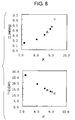
- Example 8 herein demonstrates that when IgGs share the same Fc domain, the IgG half-life correlates to pI showing a high correlation coefficient regardless of the type of target antigen, and that the half-life in blood of two types of antibodies against different antigens can actually be controlled by modifying the pIs of their variable regions without modifying Fc.
- the rate of nonspecific antibody uptake by endothelial cells is assumed to depend on the physicochemical Coulomb interaction between an IgG and a negatively charged cell surface. Therefore, it is thought that a decrease (an increase) in the pI of IgG reduces (enhances) the Coulomb interaction, and this is followed by a reduction (an increase) in nonspecific uptake by endothelial cells, leading to a decrease (an increase) in metabolism in these cells, and as a result, pharmacokinetics in blood can be controlled. Since the Coulomb interaction between negatively-charged cell surface of the endothelial cells is a physicochemical interaction, the interaction is assumed not to depend on the target antigen.
- the methods of the present disclosure for controlling pharmacokinetics in blood are widely applicable to polypeptides such as arbitrary IgGs comprising an FcRn-binding domain which are recycled via the FcRn salvage pathway and whose major metabolic pathway is not renal excretion, regardless of the type of antigen.
- polypeptides disclosed herein comprising an FcRn-binding domain are not limited to IgG antibodies, but may be any protein that can bind (has binding activity or affinity) to an Fc receptor (FcRn).
- the polypeptides disclosed herein comprising an FcRn-binding domain are not particularly limited; however, they are preferably proteins comprising an antibody Fc domain or Fc-like domain.
- the polypeptides disclosed herein comprising an FcRn-binding domain include, for example, IgG antibodies.
- the polypeptides disclosed herein comprising an FcRn-binding domain include modified forms of antibodies (proteins) as long as they can bind to FcRn.
- the most preferred examples of polypeptides of the present invention comprising an FcRn-binding domain are IgG antibodies.
- an IgG antibody when used as a polypeptide comprising an FcRn-binding domain in the present invention, it may be of any IgG subtype or a bispecific IgG antibody.
- Bispecific antibodies are antibodies specific to two different epitopes, and include antibodies that recognize different antigens and those that recognize different epitopes on a single antigen.
- the antibody when the antibody is a minibody such as scFv or Fab, whose major metabolic pathway is renal excretion, its pharmacokinetics in blood cannot be controlled by shifting pI, as described above.
- the present disclosure is applicable to any type of antibody, as long as it is an Fc-binding protein whose major metabolic pathway is not renal excretion, for example, scFv-Fc, dAb-Fc, and Fc fusion proteins. Since renal excretion is not the major metabolic pathway of these molecules, their pharmacokinetics in blood can be controlled by shifting the pI using the methods of the present invention.
- Antibody molecules to which the present disclosure is applicable may be antibody-like molecules.
- Antibody-like molecules refer to molecules that exert their functions by binding to target molecules (Non-patent Document 30), and include, for example, DARPins, Affibodies, and Avimers.
- the phrase "pharmacokinetics in blood is controlled” indicates that pharmacokinetics in blood is shifted in a desired direction when compared between before and after modification of a polypeptide comprising an FcRn-binding domain.
- the control of pharmacokinetics in blood means prolongation of the half-life in blood.
- the control of pharmacokinetics in blood refers to reduction of the half-life in blood.
- control of pharmacokinetics in blood includes the control of any parameter such as half-life in blood, mean residence time in blood, or blood clearance (Pharmacokinetics: Enshu niyoru Rikai (Understanding through Exercises), Nanzando).
- control of pharmacokinetics in blood can be assessed by appropriate noncompartmental analysis using in vivo kinetics analysis software, WinNonlin (Pharsight), according to the attached instruction manual.
- amino acids that can be exposed on the surface generally means amino acids which constitute a polypeptide comprising an FcRn-binding domain and which are present on the polypeptide surface.
- the side chains of an amino acid that is present on the polypeptide surface can contact solvent molecules (typically, water molecules). However, not the whole side chain has to be in contact with solvent molecules. When even a portion of the side chains contacts solvent molecules, the amino acid is judged to be present on the polypeptide surface.
- solvent molecules typically, water molecules
- solvent molecules typically, water molecules
- amino acids that can be exposed on the surface are not particularly limited; however, they are preferably outside an FcRn-binding domain of a polypeptide comprising such a domain.
- An FcRn-binding domain includes, for example, Fc and Fc-like domains.
- variable regions include complementarity determining regions (CDRs) and framework regions (FRs).
- Such surface amino acids include, for example, amino acids at H1, H3, H5, H8, H10, H12, H13, H15, H16, H19, H23, H25, H26, H39, H42, H43, H44, H46, H68, H71, H72, H73, H75, H76, H81, H82b, H83, H85, H86, H105, H108, H110, and H112 in an H chain FR region, but are not limited thereto in the present disclosure.
- those skilled in the art can also select surface amino acids in an H chain CDR region using homology models.
- the amino acid at H97 is exposed on the surface in almost all antibodies.
- Surface amino acids in an L chain FR region include, for example, the amino acids at L1, L3, L7, L8, L9, L11, L12, L16, L17, L18, L20, L22, L38, L39, L41, L42, L43, L45, L46, L49, L57, L60, L63, L65, L66, L68, L69, L70, L74, L76, L77, L79, L80, L81, L85, L100, L103, L105, L106, L107, and L108, but are not limited thereto in the present disclosure.
- those skilled in art can also select surface amino acids in an L chain CDR region using homology models.
- modification of an amino acid residue specifically refers to substitution of the original amino acid residue with a different amino acid residue, deletion of the original amino acid residue, addition of another amino acid residue, and so on.
- the modification preferably means substitution of the original amino acid residue with a different amino acid residue.
- modification of the charge of an amino acid residue preferably includes amino acid substitutions.
- the above-described "changing the charge of an amino acid residue” includes, for example, changing the charge of at least one amino acid residue selected from the group consisting of amino acid residues at positions 10, 12, 23, 39, 43, and 105 according to the Kabat's numbering system in a heavy chain of the IgG antibody.
- amino acid residues at the positions indicated above amino acid residues other than the amino acid residues whose charges have been modified need not be modified as long as the pharmacokinetics in blood have been controlled as intended.
- the amino acids can be modified to have a charge of the same type as that of modified amino acid residues or not to have any charge.
- Amino acids are known to include charged amino acids. Generally known amino acids with a positive charge (positively-charged amino acids) include lysine (K), arginine (R), and histidine (H). Known amino acids with a negative charge (negatively-charged amino acids) include aspartic acid (D) and glutamic acid (E). Amino acids other than these are known as uncharged amino acids.
- modified amino acid residues are appropriately selected from amino acid residues of either group (a) or (b) indicated below; however, the modified amino acids are not particularly limited thereto.
- modification of the amino acid into an uncharged amino acid is also a preferred embodiment of the present disclosure.
- the modification in the present invention includes:
- amino acid residues in polypeptides comprising an FcRn-binding domain are modified to shift the isoelectric point (pI).
- pI isoelectric point
- the number of amino acid residues to be modified in the methods of the present invention is not particularly limited. However, when an antibody variable region is modified for instance, only a minimum number of amino acid residues required to achieve the blood pharmacokinetics controlled as intended are preferably modified so as not to reduce the antigen-binding activity and not to increase the immunogenicity.
- the amino acid sequence after modification is preferably a human sequence so as not to increase the immunogenicity; however, the present disclosure is not limited thereto. Furthermore, mutations may be introduced at sites other than those where modifications have been made for shifting the isoelectric point, so that the respective FRs (FR1, FR2, FR3, and FR4) after modification are human sequences. Such a method for substituting each FR with a human sequence has been reported in a non-patent document ( Ono K et al., Mol Immunol. 1999 Apr; 36(6): 387-395 ).
- each FR may be modified into another human FR with a different isoelectric point (for example, FR3 may be substituted by another human FR with a lower isoelectric point).
- FR3 may be substituted by another human FR with a lower isoelectric point.
- a desired polypeptide comprising an FcRn-binding domain whose pharmacokinetics in blood is controlled, can be obtained by repeating surface charge modifications and assessment of pharmacokinetics in blood.
- Non-patent Document 24 reports on a comparison of blood pharmacokinetics between chimeric EP5C7.g4, a chimeric antibody (IgG4), and HuEP5C7.g4, a humanized antibody (IgG4), both of which are derived from an anti-E, P-Selectin antibody, which found that the pharmacokinetics were comparable to each other.
- Non-patent Document 25 describes a comparison of blood pharmacokinetics in cynomolgus monkeys between ch5d8, a chimeric antibody, and Hu5c8, a humanized antibody, both of which are derived from an anti-CD154 antibody, which found the pharmacokinetics to be comparable to each other.
- Non-patent Document 26 demonstrates that blood pharmacokinetics in mice of cCC49, a chimeric antibody, was comparable to that of HuCC49, a humanized antibody. Furthermore, Non-patent Documents 27 and 28 reports that pharmacokinetics and distribution in blood of mouse antibodies were comparable to those of humanized antibodies when assessed using mice. Since both mouse Fcs and human Fcs are reactive to mouse FcRn, the above findings suggest that pharmacokinetics and distribution in blood of chimeric antibodies are comparable to those of the humanized antibodies described above. As shown by these examples, pharmacokinetics of chimeric antibodies in blood are comparable to that of humanized antibodies.
- Humanized antibodies whose pharmacokinetics in blood is controlled can be produced by shifting their pIs through modification of surface amino acids at the time of humanization of chimeric antibodies, using the methods discovered by the present invention.
- the modification of surface amino acids to control pharmacokinetics in blood may be made at the time of humanization or after humanization.
- Non-patent Document 29 describes that pharmacokinetics in blood of three types of humanized antibodies, trastuzumab, bevacizumab, and pertuzumab, obtained through humanization using the same FR sequence of a human antibody, was nearly the same. Specifically, pharmacokinetics in blood is nearly the same when humanization is performed using the same FR sequence. The blood concentration can be controlled only when the pIs of antibodies are shifted by modifying surface amino acids using the methods discovered by the present invention, in addition to the above-described humanization process.
- human antibodies whose pharmacokinetics in blood is controlled can be produced by shifting the pIs of human antibodies prepared from human antibody libraries or mice producing human antibodies and such, through modification of surface amino acids.
- the "antibodies" of the present disclosure include antibodies obtained by further introducing amino acid substitutions, deletions, additions and/or insertions and such into the amino acid sequences of antibodies that have been already modified to change the charges of their amino acid residues as described above.
- the antibodies of the present disclosure also include antibodies obtained by further changing the charge of the amino acid residues in antibodies whose amino acid sequences have been already modified by amino acid substitutions, deletions, additions and/or insertions, chimerization, humanization or such.
- amino acid modifications such as amino acid substitutions, deletions, additions and/or insertions, and chimerization and humanization, can be achieved by methods known to those skilled in the art.
- amino acid sequences of antibody constant and variable regions that are used to produce antibodies disclosed herein as recombinant antibodies may also be modified by amino acid substitutions, deletions, additions and/or insertions, or chimerization, humanization or such.
- the antibodies disclosed herein may be antibodies derived from any animal such as a mouse, human, rat, rabbit, goat, or camel. Furthermore, the antibodies may be modified antibodies, for example, chimeric antibodies and in particular, humanized antibodies that comprise amino acid substitutions in their sequence. The antibodies also include antibody modification products linked to various molecules.
- Chimeric antibodies are antibodies prepared by combining sequences derived from different animals. Chimeric antibodies include, for example, antibodies comprising heavy and light chain variable (V) regions from a mouse antibody and heavy and light chain constant (C) regions from a human antibody. Chimeric antibodies can be prepared by known methods, for example, by the following procedure: a DNA encoding an antibody V region is ligated with a DNA encoding a human antibody C region; the resulting ligation product is inserted into an expression vector; and the construct can be introduced into a host to produce a chimeric antibody.
- V heavy and light chain variable
- C heavy and light chain constant
- Humanized antibodies are also referred to as reshaped human antibodies, and can be obtained by substituting the complementarity determining regions (CDRs) of a human antibody for the CDRs of an antibody derived from a nonhuman mammal, for example, a mouse.
- CDRs complementarity determining regions
- Methods for identifying CDRs are known ( Kabat et al., Sequence of Proteins of Immunological Interest (1987), National Institute of Health, Bethesda, Md .; Chothia et al., Nature (1989) 342: 877 ).
- General genetic recombination techniques for the above procedure are also known (see European Patent Application Publication No. EP 125023 , and WO 96/02576 ).
- the CDRs of a mouse antibody are determined by known methods, and a DNA is prepared so that it encodes an antibody in which the CDRs are linked to the framework regions (FRs) of a human antibody.
- a humanized antibody can then be produced by a system using a conventional expression vector.
- DNAs can be synthesized by PCR using as primers several oligonucleotides designed to comprise portions that overlap the ends of both the CDR and FR regions (see the method described in WO 98/13388 ).
- Human antibody FRs linked via CDRs are selected such that the CDRs can form a suitable antigen binding site.
- amino acids in the FRs of an antibody variable region may be modified so that the CDRs of a reshaped human antibody can form a suitable antigen binding site ( Sato, K. et al., Cancer Res. (1993) 53: 851-856 ).
- Modifiable amino acid residues in the FRs include portions that directly bind to an antigen via noncovalent bonds ( Amit et al., Science (1986) 233: 747-53 ), portions that have an impact or effect on the CDR structure ( Chothia et al., J. Mol. Biol. (1987) 196: 901-17 ), and portions involved in the interaction between VH and VL ( EP 239400 ).
- the C regions of these antibodies are preferably derived from human antibodies.
- C ⁇ 1, C ⁇ 2, C ⁇ 3, and C ⁇ 4 can be used for the H chains, and C ⁇ and C ⁇ can be used for the L chains.
- the human antibody C regions may be modified as required to improve antibody or production stability.
- a chimeric antibody of the present invention preferably comprises a variable region of an antibody derived from a nonhuman mammal and a constant region derived from a human antibody.
- a humanized antibody of the present invention preferably comprises CDRs of an antibody derived from a nonhuman mammal and FRs and C regions derived from a human antibody.
- Constant regions of human antibodies comprise amino acid sequences specific to each antibody isotype, for example, IgG (IgG1, IgG2, IgG3, and IgG4), IgM, IgA, IgD, and IgE.
- the constant regions used to prepare the humanized antibodies disclosed herein may be the constant regions of antibodies of any isotype.
- a constant region of a human IgG is preferably used, but the constant regions are not limited thereto.
- FRs derived from a human antibody, which are used to prepare humanized antibodies are not particularly limited, and thus may be derived from an antibody of any isotype.
- variable and constant regions of chimeric or humanized antibodies disclosed herein may be modified by deletions, substitutions, insertions, and/or additions, as long as the antibodies exhibit the same binding specificity as that of the original antibodies.
- Chimeric and humanized antibodies using human-derived sequences are expected to be useful when administered to humans for therapeutic purposes or such, since their immunogenicity in the human body has been reduced.
- genes encoding the H chain or L chain of antibodies before introduction of mutations by methods of the present invention can be used as genes encoding the H chain or L chain of antibodies before introduction of mutations by methods of the present invention (herein, they may be simply referred to as "antibodies of the present invention"), or the genes can be obtained by methods known to those skilled in the art. For example, they may be obtained from an antibody library, or by cloning genes encoding the antibodies from hybridomas producing monoclonal antibodies.
- antibody libraries many antibody libraries are already well known, and since methods for producing antibody libraries are known, those skilled in the art can appropriately obtain antibody libraries.
- antibody phage libraries one can refer to the literature such as Clackson et al., Nature 1991, 3 52: 624-8 ; Marks et al., J. Mol. Biol. 1991, 222: 581-97 ; Waterhouses et al., Nucleic Acids Res. 1993, 21: 2265-6 ; Griffiths et al., EMBO J. 1994, 13: 3245-60 ; Vaughan et al., Nature Biotechnology 1996, 14: 309-14 ; and Japanese Patent Kohyo Publication No.
- variable regions of human antibodies can be expressed on the surface of phages as single chain antibodies (scFvs) using phage display methods, and phages that bind to antigens can be selected. Genetic analysis of the selected phages can determine the DNA sequences encoding the variable regions of human antibodies that bind to the antigens.
- suitable expression vectors can be produced based on these sequences to obtain human antibodies. These methods are already well known, and one can refer to WO92/01047 , WO92/20791 , WO93/06213 , WO93/11236 , WO93/19172 , WO95/01438 , and WO95/15388 .
- known techniques may be used, involving the use of desired antigens or cells expressing the desired antigens as sensitizing antigens, using these to perform immunizations according to conventional immunization methods, fusing the immune cells thus obtained with known parent cells by ordinary cell fusion methods, screening monoclonal antibody producing cells (hybridomas) by ordinary screening methods, synthesizing cDNAs of antibody variable regions (V regions) from mRNAs of the obtained hybridomas using a reverse transcriptase, and linking them to DNAs encoding the desired antibody constant regions (C regions).
- V regions antibody variable regions
- sensitizing antigens for obtaining the above-mentioned antibody genes encoding the H chains and L chains include both complete antigens with immunogenicity and incomplete antigens comprising haptens and such that do not show immunogenicity.
- full-length proteins and partial peptides of proteins of interest can be used.
- substances composed of polysaccharides, nucleic acids, lipids and such may become antigens.
- Antigens can be prepared by methods known to those skilled in the art, and they can be prepared, for example, by the methods using baculoviruses (for example, see WO98/46777 ).
- Hybridomas can be produced, for example, by the method of Milstein et al. ( G. Kohler and C. Milstein, Methods Enzymol. 1981, 73: 3-46 ).
- an antigen When the immunogenicity of an antigen is low, it can be linked to a macromolecule that has immunogenicity, such as albumin, and then used for immunization.
- antigens By linking antigens to other molecules if necessary, they can be converted into soluble antigens.
- transmembrane molecules such as receptors are used as antigens, portions of the extracellular regions of the receptors can be used as fragments, or cells expressing transmembrane molecules on their cell surface may be used as immunogens.
- Antibody-producing cells can be obtained by immunizing animals using the suitable sensitizing antigens described above. Alternatively, antibody-producing cells can be prepared by in vitro immunization of lymphocytes that can produce antibodies. Various mammals can be used as the animals for immunization, where rodents, lagomorphas, and primates are generally used. Examples of such animals include mice, rats, and hamsters for rodents, rabbits for lagomorphas, and monkeys including cynomolgus monkeys, rhesus monkeys, hamadryas, and chimpanzees for primates.
- transgenic animals carrying human antibody gene repertoires are also known, and human antibodies can be obtained by using these animals (see WO96/34096 ; Mendez et al., Nat. Genet. 1997, 15: 146-56 ).
- desired human antibodies having binding activity to desired antigens can be obtained by sensitizing in vitro human lymphocytes with the desired antigens or cells expressing the desired antigens, and then fusing the sensitized lymphocytes with human myeloma cells such as U266 (see Japanese Patent Application Kokoku Publication No. H1-59878 (examined, approved Japanese patent application published for opposition)).
- desired human antibodies can be obtained by immunizing transgenic animals carrying a complete repertoire of human antibody genes, with desired antigens (see WO93/12227 , WO92/03918 , WO94/02602 , WO96/34096 , and WO96/33735 ).
- Animal immunization can be carried out by appropriately diluting and suspending a sensitizing antigen in Phosphate-Buffered Saline (PBS), physiological saline or such, and forming an emulsion by mixing an adjuvant if necessary, followed by an intraperitoneal or subcutaneous injection into animals. After that, the sensitizing antigen mixed with Freund's incomplete adjuvant is preferably administered several times every four to 21 days. Antibody production can be confirmed by measuring the target antibody titer in animal sera using conventional methods.
- PBS Phosphate-Buffered Saline
- Antibody-producing cells obtained from lymphocytes or animals immunized with a desired antigen can be fused with myeloma cells using conventional fusing agents (for example, polyethylene glycol) to generate hybridomas ( Goding, Monoclonal Antibodies: Principles and Practice, Academic Press, 1986, 59-103 ).
- hybridoma cells can be cultured and grown, and the binding specificity of the antibodies produced from these hybridomas can be measured using known analysis methods such as immunoprecipitation, radioimmunoassay (RIA), and enzyme-linked immunosorbent assay (ELISA). Thereafter, hybridomas that produce antibodies in which specificity, affinity, or activity of interest has been determined can be subcloned by methods such as limiting dilution.
- genes encoding the selected antibodies can be cloned from hybridomas or antibody-producing cells (sensitized lymphocytes and such) using probes that can specifically bind to the antibodies (for example, oligonucleotides complementary to sequences encoding the antibody constant regions). Cloning from mRNAs using RT-PCR is also possible.
- Immunoglobulins are classified into five different classes, IgA, IgD, IgE, IgG, and IgM. These classes are further divided into several subclasses (isotypes) (for example, IgG-1, IgG-2, IgG-3, and IgG-4; and IgA-1 and IgA-2).
- H chains and L chains used in the present disclosure to produce antibodies are not particularly limited and may derive from antibodies belonging to any of these classes or subclasses; however, IgGs are particularly preferred.
- H-chain-encoding genes and L-chain-encoding genes using genetic engineering techniques.
- Genetically modified antibodies such as chimeric antibodies and humanized antibodies that have been artificially modified to decrease heterologous immunogenicity against humans, and such, can be appropriately produced if necessary for antibodies such as mouse antibodies, rat antibodies, rabbit antibodies, hamster antibodies, sheep antibodies, and camel antibodies.
- Chimeric antibodies are antibodies composed of H chain and L chain variable regions of a nonhuman mammal antibody such as mouse antibody, and the H chain and L chain constant regions of a human antibody.
- a humanized antibody which is also called a reshaped human antibody, can be obtained as follows: A DNA sequence designed to link the complementarity determining regions (CDRs) of an antibody of a nonhuman mammal such as a mouse is synthesized by PCR from a number of oligonucleotides produced so that they have overlapping portions at the ends of the sequence. The obtained DNA can be linked to a DNA encoding a human antibody constant region.
- CDRs complementarity determining regions
- the linked DNA can be incorporated into an expression vector, and the vector can be introduced into a host to produce the antibody (see EP239400 and WO96/02576 ).
- Human antibody FRs that are linked via the CDRs are selected so that the CDRs form a favorable antigen-binding site. If necessary, amino acids in the framework regions of antibody variable regions may be substituted such that the CDRs of a reshaped human antibody form an appropriate antigen-binding site ( K. Sato et al., Cancer Res. 1993, 53: 851-856 ).
- antibodies may be modified to improve their biological properties, for example, binding activity to an antigen. Modifications in the present disclosure can be carried out using methods such as site-directed mutagenesis (see, for example, Kunkel (1985) Proc. Natl. Acad. Sci. USA 82: 488 ), PCR mutagenesis, and cassette mutagenesis.
- mutant antibodies whose biological properties have been improved show amino acid sequence homology and/or similarity of 70% or higher, more preferably 80% or higher, and even more preferably 90% or higher (for example, 95% or higher, 97%, 98%, 99% and so on), when compared to the amino acid sequences of the original antibody variable regions.
- sequence homology and/or similarity is defined as the ratio of amino acid residues that are homologous (same residue) or similar (amino acid residues classified into the same group based on the general properties of amino acid side chains) to the original antibody residues, after the sequence homology value has been maximized by sequence alignment and gap introduction, if necessary.
- amino acid residues are classified into groups based on the characteristics of their side chains: (1) hydrophobic: alanine, isoleucine, valine, methionine, and leucine; (2) neutral hydrophilic: asparagine, glutamine, cysteine, threonine, and serine; (3) acidic: aspartic acid and glutamic acid; (4) basic: arginine, histidine, and lysine; (5) residues that affect the orientation of the chain: glycine and proline; and (6) aromatic: tyrosine, tryptophan, and phenylalanine.
- CDRs complementarity determining regions
- H chain and L chain variable regions interact to form the antigen binding site(s) of an antibody.
- CDRs complementarity determining regions
- Even one of these variable regions is known to have the ability to recognize and bind to the antigen, although the affinity will be lower than when all binding sites are included. Therefore, antibody genes of the present disclosure encoding H chains and L chains only have to encode fragment portions having each of the antigen binding sites of H chains and L chains, and polypeptides encoded by these genes only have to maintain binding activity to the desired antigens.
- Heavy chain variable regions are ordinarily composed of three CDR regions and four FR regions as described above.
- amino acid residues subjected to "modification” can be appropriately selected from among amino acid residues positioned in the CDR regions or FR regions.
- modification of the amino acid residues in the CDR regions can decrease the binding activity to antigens. Therefore, in the present invention, amino acid residues subjected to "modification” are not particularly limited but are preferred to be appropriately selected from among amino acid residues positioned in the FR regions. Even amino acid residues in the CDRs may be selected, as long as modifications of these residues have been confirmed not to reduce the binding activity.
- variable region FRs of the antibodies of organisms can be appropriately obtained by those skilled in the art using public databases.
- the present disclosure also relates to polypeptides comprising an FcRn-binding domain whose pharmacokinetics in blood is controlled by a method of the present invention.
- the present disclosure provides humanized antibodies whose pharmacokinetics in blood is controlled by a method of the present invention.
- the human antibodies are humanized antibodies comprising complementarity determining regions (CDRs) derived from a nonhuman animal, framework regions (FRs) derived from a human, and human constant regions, with at least one amino acid residue in the CDRs or FRs, which can be exposed on antibody surface, has a charge different from that of the corresponding amino acid residue in the wild-type CDRs or FRs, and whose variable regions are derived from an antibody of the nonhuman animal and pharmacokinetics in blood is controlled as compared to corresponding chimeric antibodies having the same constant regions.
- CDRs complementarity determining regions
- FRs framework regions
- variable regions are derived from an antibody of the nonhuman animal and pharmacokinetics in blood is controlled as compared to corresponding chimeric antibodies having the same constant regions.
- human constant region preferably refers to a region comprising a wild-type human Fc domain; however, it may be a modified Fc.
- the present disclosure also relates to methods for producing polypeptides comprising an FcRn-binding domain, whose pharmacokinetics in blood is controlled by using the methods disclosed herein. Specifically, the present disclosure provides methods for producing polypeptides comprising an FcRn-binding domain, whose pharmacokinetics in blood is controlled. The present disclosure also includes polypeptides comprising an FcRn-binding domain, which are produced by the methods disclosed herein.
- the production methods disclosed herein are methods for producing polypeptides comprising an FcRn-binding domain, whose pharmacokinetics in blood is controlled, and which comprise:
- modifying nucleic acids in the above-mentioned methods refers to modifying nucleic acids so that they correspond to amino acid residues introduced by the "modifications" disclosed herein. More specifically, it refers to modifying the nucleic acids encoding the original (pre-modified) amino acid residues to the nucleic acids encoding the amino acid residues that are to be introduced by the modification. Ordinarily, it means performing a gene manipulation or a mutation treatment that would result in at least one nucleotide insertion, deletion, or substitution to an original nucleic acid so that codons encoding amino acid residues of interest is formed.
- codons encoding the original amino acid residues are substituted with codons encoding the amino acid residues that are to be introduced by the modification.
- Such nucleic acid modifications can be suitably performed by those skilled in the art using known techniques such as site-directed mutagenesis and PCR mutagenesis.
- nucleic acids disclosed herein are usually carried by (inserted into) suitable vectors and then introduced into host cells. These vectors are not particularly limited so long as the inserted nucleic acids are stably maintained.
- the cloning vector is preferably pBluescript vector (Stratagene) and such, but various commercially available vectors may be used.
- Expression vectors are particularly useful as vectors for producing the polypeptides disclosed herein. Expression vectors are not particularly limited so long as they can express polypeptides in test tubes, E. coli , cultured cells, or individual organisms. For example, preferred vectors include pBEST vector (Promega) for expression in test tubes, pET vector (Invitrogen) for E.
- coli coli , pME18S-FL3 vector (GenBank Accession No. AB009864) for cultured cells, and pME18S vector ( Mol. Cell Biol. 8: 466-472 (1998 )) for individual organisms. Insertion of a DNA disclosed herein into vectors can be performed by standard methods such as ligase reactions using restriction enzyme sites (Current protocols in Molecular Biology edit. Ausubel et al. (1987) Publish. John Wiley & Sons. Section 11.4-11.11 ).
- the above-mentioned host cells are not particularly limited, and various host cells can be used, depending on the purpose.
- Cells used for expressing the polypeptides include bacterial cells (for example, Streptococcus, Staphylococcus, E. coli, Streptomyces, and Bacillus subtilis ), fungal cells (for example, yeast and Aspergillus ), insect cells (for example, Drosophila S2 and Spodoptera SF9), animal cells (for example, CHO, COS, HeLa, C127, 3T3, BHK, HEK293, and Bowes melanoma cell), and plant cells.
- bacterial cells for example, Streptococcus, Staphylococcus, E. coli, Streptomyces, and Bacillus subtilis
- fungal cells for example, yeast and Aspergillus
- insect cells for example, Drosophila S2 and Spodoptera SF9
- animal cells for example, CHO, COS, HeLa, C
- Vectors can be introduced into host cells using known methods such as the calcium phosphate precipitation method, electroporation method (Current protocols in Molecular Biology edit. Ausubel et al. (1987) Publish. John Wiley & Sons. Section 9.1-9.9 ), lipofection method, and microinjection method.
- suitable secretion signals can be incorporated into the polypeptides of interest. These signals may be intrinsic or foreign to the polypeptides of interest.
- the polypeptides disclosed herein When the polypeptides disclosed herein are secreted into the culture media, the polypeptides produced by the above-mentioned methods can be harvested by collecting the media. When the polypeptides disclosed herein are produced inside cells, first, the cells are lysed, and then these polypeptides are collected.
- polypeptides disclosed herein can be collected and purified from recombinant cell cultures by using known methods, including ammonium sulfate or ethanol precipitation, acidic extraction, anion or cation exchange chromatography, phosphocellulose chromatography, hydrophobic interaction chromatography, affinity chromatography, hydroxyapatite chromatography, and lectin chromatography.
- compositions which comprise polypeptides (for example, IgG antibodies) comprising an FcRn-binding domain, whose pharmacokinetics in blood is controlled by the methods disclosed herein, and pharmaceutically acceptable carriers.
- polypeptides for example, IgG antibodies
- FcRn-binding domain an FcRn-binding domain
- compositions usually refer to pharmaceutical agents for treating or preventing, or testing and diagnosing diseases.
- compositions disclosed herein can be formulated by methods known to those skilled in the art.
- such pharmaceutical compositions can be used parenterally, as injections which are sterile solutions or suspensions including the compositions along with water or another pharmaceutically acceptable liquid.
- such compositions may be formulated as unit doses that meet the requirements for the preparation of pharmaceuticals by appropriately combining the compositions with pharmaceutically acceptable carriers or media, specifically with sterile water, physiological saline, a vegetable oil, emulsifier, suspension, surfactant, stabilizer, flavoring agent, excipient, vehicle, preservative, binder or such.
- the amount of active ingredient is adjusted such that an appropriate dose that falls within a pre-determined range can be obtained.
- Sterile compositions for injection can be formulated using vehicles such as distilled water for injection, according to standard protocols for formulation.
- Aqueous solutions for injection include, for example, physiological saline and isotonic solutions containing dextrose or other adjuvants (for example, D-sorbitol, D-mannose, D-mannitol, and sodium chloride).
- dextrose or other adjuvants for example, D-sorbitol, D-mannose, D-mannitol, and sodium chloride.
- solubilizers for example, alcohols (ethanol and such), polyalcohols (propylene glycol, polyethylene glycol, and such), nonionic surfactants (polysorbate 80 TM , HCO-50, and such), may be used in combination.
- Oils include sesame and soybean oils.
- Benzyl benzoate and/or benzyl alcohol can be used in combination as solubilizers.
- Buffers for example, phosphate buffer and sodium acetate buffer
- soothing agents for example, procaine hydrochloride
- stabilizers for example, benzyl alcohol and phenol
- antioxidants can also be combined. Prepared injections are generally filled into appropriate ampules.
- compositions disclosed herein are preferably administered parenterally.
- the compositions may be injections, transnasal compositions, transpulmonary compositions or transdermal compositions.
- such compositions can be administered systemically or locally by intravenous injection, intramuscular injection, intraperitoneal injection, subcutaneous injection or such.
- the administration methods can be appropriately selected considering the patient's age and symptoms.
- the dose of a pharmaceutical composition comprising an antibody or a polynucleotide encoding an antibody may be, for example, from 0.0001 to 1000 mg/kg for each administration. Alternatively, the dose may be, for example, from 0.001 to 100,000 mg per patient. However, the doses disclosed herein are not limited to the ranges described above.
- the doses and administration methods vary depending on a patient's weight, age, symptoms and such. Those skilled in the art can select appropriate doses and administration methods considering the factors described above.
- the present disclosure also provides nucleic acids encoding polypeptides that comprise polypeptides (for example, humanized antibodies) comprising an FcRn-binding domain, whose pharmacokinetics in blood is controlled by the methods disclosed herein. Furthermore, vectors carrying these nucleic acids are encompassed by the present disclosure.
- the present disclosure also provides host cells carrying the above described nucleic acids.
- the host cells are not particularly limited and include, for example, E. coli and various animal cells.
- the host cells may be used, for example, as a production system to produce and express the antibodies or the polypeptides disclosed herein.
- In vitro and in vivo production systems are available for polypeptide production systems. Production systems that use eukaryotic cells or prokaryotic cells are examples of in vitro production systems.
- Eukaryotic cells that can be used as a host cell include, for example, animal cells, plant cells, and fungal cells.
- Animal cells include mammalian cells such as CHO ( J. Exp. Med. (1995) 108: 945 ), COS, HEK293, 3T3, myeloma, BHK (baby hamster kidney), HeLa, and Vero; amphibian cells such as Xenopus laevis oocytes ( Valle, et al. (1981) Nature 291: 338-340 ); and insect cells such as Sf9, Sf21, and Tn5.
- mammalian cells such as CHO ( J. Exp. Med. (1995) 108: 945 ), COS, HEK293, 3T3, myeloma, BHK (baby hamster kidney), HeLa, and Vero
- amphibian cells such as Xenopus laevis oocytes ( Valle, et al. (1981) Nature 291: 3
- CHO-DG44, CHO-DX11B, COS7 cells, HEK293 cells, and BHK cells can be suitably used.
- animal cells CHO cells are particularly preferable for large-scale expression.
- Vectors can be introduced into a host cell by, for example, calcium phosphate methods, DEAE-dextran methods, methods using cationic liposome DOTAP (Boehringer-Mannheim), electroporation methods, or lipofection methods.
- Plant cells include, for example, Nicotiana tabacum -derived cells and duckweed ( Lemna minor ) known as a protein production system. Calluses can be cultured from these cells to produce the antibodies of the present invention.
- Known protein production systems are those using fungal cells including yeast cells, for example, cells of genus Saccharomyces (such as Saccharomyces cerevisiae and Saccharomyces pombe ); and cells of filamentous fungi, for example, genus Aspergillus (such as Aspergillus niger ). These cells can be used as a host to produce the antibodies of the present invention.
- Bacterial cells can be used in prokaryotic production systems. Examples of bacterial cells include Bacillus subtilis as well as E. coli described above. Such cells can be used to produce the antibodies of the present invention.
- the polynucleotide encoding an antibody of the present invention may be expressed by culturing the host cell transformed with an expression vector containing the polynucleotide.
- the culture can be performed using known methods. For example, when using animal cells as a host, DMEM, MEM, RPMI 1640, or IMDM may be used as the culture medium, and may be used with or without serum supplements such as FBS or fetal calf serum (FCS).
- the preferred pH is about 6 to 8 during the culture.
- the culture is carried out typically at a temperature of about 30 to 40°C for about 15 to 200 hours. Medium is exchanged, aerated, or agitated, as necessary.
- production systems using animals or plants may be used as systems for producing polypeptides in vivo.
- a polynucleotide of interest is introduced into an animal or plant and the polypeptide is produced in the body of the animal or plant and then collected.
- the "hosts” disclosed herein include such animals and plants.
- Animals to be used for production systems include mammals and insects. Mammals such as goats, pigs, sheep, mice, and cattle may be used ( Vicki Glaser SPECTRUM Biotechnology Applications (1993 )). Alternatively, the mammals may be transgenic animals.
- a polynucleotide encoding an antibody of the present invention may be prepared as a fusion gene with a gene encoding a polypeptide specifically produced in milk, such as the goat ⁇ -casein gene.
- Polynucleotide fragments containing the fusion gene are injected into goat embryos, which are then transplanted into female goats.
- the desired antibody can be obtained from milk produced by the transgenic goats born from the goats that received the embryos, or from their offspring.
- Appropriate hormones may be administered to the transgenic goats to increase the volume of milk containing the antibody produced by the goats ( Ebert et al., Bio/Technology 12: 699-702 (1994 )).
- Insects such as silkworms, may also be used for producing the antibodies of the present invention.
- Baculoviruses carrying a polynucleotide encoding an antibody of interest can be used to infect silkworms, and the antibody of interest can be obtained from the body fluids of the silkworms ( Susumu et al., Nature 315: 592-594 (1985 )).
- Plants used for producing the antibodies of the present invention include, for example, tobacco.
- a polynucleotide encoding an antibody of interest is inserted into a plant expression vector, for example, pMON 530, and then the vector is introduced into a bacterium such as Agrobacterium tumefaciens.
- the bacteria are then used to infect tobacco such as Nicotiana tabacum , and the desired antibody can be obtained from the leaves ( Ma et al., Eur. J. Immunol. 24: 131-138 (1994 )).
- duckweed Lemna minor
- the desired antibody can be obtained from the cloned duckweed cells ( Cox KM et al. Nat. Biotechnol. 2006 Dec; 24(12): 1591-1597 ).
- the resulting antibody may be isolated from the inside or outside (such as the medium and milk) of host cells, and purified as a substantially pure and homogenous antibody.
- Methods for isolating and purifying antibodies are not limited to any specific method and any standard method for isolating and purifying polypeptides may be used.
- Antibodies can be isolated and purified, by appropriately selecting or combining, for example, chromatographic columns, filtration, ultrafiltration, salting out, solvent precipitation, solvent extraction, distillation, immunoprecipitation, SDS-polyacrylamide gel electrophoresis, isoelectric focusing, dialysis, recrystallization, and others.
- Chromatographies include, for example, affinity chromatographies, ion exchange chromatographies, hydrophobic chromatographies, gel filtrations, reverse-phase chromatographies, and adsorption chromatographies (Strategies for Protein Purification and Characterization: A Laboratory Course Manual. Ed Daniel R. Marshak et al., Cold Spring Harbor Laboratory Press, 1996 ). These chromatographies can be carried out using liquid phase chromatographies such as HPLC and FPLC. Examples of affinity chromatography columns include protein A columns and protein G columns. Examples of the proteins A columns include Hyper D, POROS, and Sepharose F. F. (Pharmacia).
- An antibody can be modified freely and peptide portions can be deleted from it by treating the antibody with an appropriate protein modifying enzyme before or after antibody purification, as necessary.
- protein modifying enzymes include, for example, trypsins, chymotrypsins, lysyl endopeptidases, protein kinases, and glucosidases.
- a bispecific antibody consisting of the combination of the anti-Factor IXa antibody A69-VH, anti-Factor X antibody B26-VH, and hybrid L chain (BBA), which was found to be most effective in shortening blood coagulation time in Japanese Patent Application No. 2005-112514 , was humanized as described below.
- CDRs complementarity determining regions
- Twelve synthetic oligoDNAs of about 50 bases were prepared from a nucleotide sequence encoding the amino acid sequence from a secretory signal sequence to an antibody variable region, such that about 20 bases of their 3'-end anneal with each other.
- the synthetic oligoDNAs were designed so that the 5'-terminal nucleotides encode a human sequence, the 3'-terminal nucleotides encode a mouse sequence, or all nucleotides encode human sequences.
- a primer annealing to the 5'-end of an antibody variable region gene and having the XhoI cleavage sequence and a primer annealing to the 3'-end of an antibody variable region gene, having the SfiI cleavage sequence and also encoding the 5'-end sequence of an intron sequence were prepared.
- the H-chain variable region fragment-inserted plasmid and the L-chain variable region fragment-inserted plasmid, each of which was confirmed to have a correct humanized antibody variable region gene sequence, were digested with XhoI and SfiI, and EcoRI respectively.
- the reaction solution was subjected to 1% agarose gel electrophoresis.
- DNA fragments having the size of interest (approximately 400 bp) were purified using QIAquick Gel Extraction Kit (QIAGEN) according to the method described in the instruction manual, and eluted with 30 ⁇ l of sterile water.
- expression vectors for animal cells were prepared as follows.
- Humanized A69 H chain expression vector was prepared by inserting a humanized A69 H chain variable region antibody gene fragment into an expression vector prepared by inserting Y349C and T366W-substituted constant region gene to pCAGGS comprising a chicken ⁇ -action promoter ( Niwa et al., Gene Vol.108, p.193-199 (1991 )).
- humanized B26 H chain expression vector was prepared by inserting a humanized B26 H chain variable region antibody gene fragment into an expression vector prepared by inserting E356C, T366S, L368A, and Y407V-substituted constant region gene to pCAGGS.
- the plasmid (pCAG-g ⁇ DNA) prepared by inserting a wild type antibody L chain constant region into pCAGGS was digested with EcoRI to prepare an expression vector inserted with a humanized BBA L chain variable region antibody gene fragment. Ligation reaction was performed using Rapid DNA Ligation Kit (Roche Diagnostics), and DH5 ⁇ strain E. coli (TOYOBO) was transformed.
- the humanized bispecific antibody was expressed according to the following method. Human fetal renal carcinoma cell-derived HEK293H strain (Invitrogen) was suspended in DMEM medium (Invitrogen) containing 10% Fetal Bovine Serum (Invitrogen), and 10 ml of this was seeded at a cell density of 5-6 x 10 5 cells/ml in each dish used for adhesive cells (10-cm diameter, CORNING) and cultured for one day in a CO 2 incubator (37°C, 5% CO 2 ). Then, the medium was removed by suction, and 6.9 ml of CHO-S-SFM-II medium (Invitrogen) containing 1% Fetal Bovine Serum (Invitrogen) was added.
- the plasmid DNA mixture solution prepared in Example 1-2 (total of 13.8 ⁇ g) was mixed with 20.7 ⁇ l of 1 ⁇ g/ml Polyethylenimine (Polysciences Inc.) and 690 ⁇ l of CHO-S-SFMII medium, left to stand at room temperature for 10 minutes, then the cells were added to the cells in each dish and incubated in a CO 2 incubator (37°C, 5% CO 2 ) for 4-5 hours. Thereafter, 6.9 ml of CHO-S-SFM-II medium (Invitrogen) containing 1% Fetal Bovine Serum (Invitrogen) was added and then the cells were incubated in a CO 2 incubator for 3 days.
- CHO-S-SFM-II medium Invitrogen
- Fetal Bovine Serum Invitrogen
- the culture supernatant was recovered, then cells were removed by centrifugation (at approximately 2000 g for 5 minutes at room temperature), and the solution was sterilized by passing it through a 0.22 ⁇ m filter MILLEX ® -GV (Millipore). The sample was stored at 4°C until use.
- rProtein A Sepharose TM Fast Flow 100 ⁇ l of rProtein A Sepharose TM Fast Flow (Amersham Biosciences) was added to the culture supernatant obtained according to the method described in Example 1-2, and the solution was mixed by inversion at 4°C for 4 hours or more. The solution was transferred to a 0.22 ⁇ m filter cup, Ultrafree ® -MC (Millipore), and after washing 3 times with 500 ⁇ l of TBS containing 0.01% Tween ® 20, the rProtein A Sepharose TM resin was suspended in 100 ⁇ l of 50 mM sodium acetate solution containing 0.01% Tween ® 20 at pH 3.3 and left to stand for 2 minutes. Then, the antibody was eluted, and the eluate was immediately neutralized by adding 6.7 ⁇ l of 1.5 M Tris-HCl, pH 7.8.
- the antibody concentration was determined using the following two types of methods.
- Goat anti-human IgG (Biosource International) was adjusted to 1 ⁇ g/ml with a coating buffer, and immobilized to a Nunc-Immuno plate (Nunc). After blocking with a diluent buffer (D.B.), a sample of the culture supernatant suitably diluted with D.B. was added. Furthermore, as a standard for calculating the antibody concentration, human IgG4 (humanized anti-TF antibody, see WO 99/51743 ) diluted with D.B. in a three-fold dilution series up to eleven stages starting from 2000 ng/ml was added similarly. After three washes, a goat anti-human IgG, alkaline phosphatase (Biosource International) was reacted.
- D.B. diluent buffer
- human IgG4 humanized anti-TF antibody, see WO 99/51743
- the antibody concentration was quantified using Sensor Chip CM5 (BIACORE) to which Protein A had been immobilized, with Biacore 1000 or Biacore Q (BIACORE). More specifically, Protein A-immobilized sensor chip was prepared according to the manufacturer's protocol by reacting an activated sensor chip with a Protein A solution (SIGMA) diluted to 50 ⁇ g/ml with 10 mM aqueous sodium acetate solution (pH 4.0, BIACORE) at 5 ⁇ l/min for 30 minutes, and then performing a blocking operation. This sensor chip was used to measure the concentration of the culture supernatant and the purified product using BIAcore 1000 (BIACORE).
- SIGMA Protein A solution
- pH 4.0 10 mM aqueous sodium acetate solution
- HBS-EP Buffer (BIACORE) was used for the immobilization of the sensor chip and for the measurements of concentration.
- humanized IgG4 antibody humanized anti-tissue factor antibody, see WO 99/51743
- HBS-EP Buffer in a two-fold dilution series up to six stages beginning at 4000 ng/ml was used.
- Factor VIII-like activity (%) of a bispecific antibody was calculated from the coagulation time measured when the bispecific antibody was added.
- DNA fragments having the size of interest were purified using a QIAquick Gel Extraction Kit (QIAGEN) according to the method described in the instruction manual, and eluted with 30 ⁇ l of sterile water. Then, expression vectors for animal cells were prepared according to the method described in Example 1-2. A humanized bispecific antibody was prepared according to the method described in Examples 1-3, 1-4, and 1-5 and blood coagulation activity was evaluated according to the method described in Example 1-6.
- a humanized bispecific antibody (humanized A69 (hA69a)/humanized B26 (hB26-F123e4)/humanized BBA (hAL-F123j4)) having the same level of activity as the chimeric bispecific antibody (A69/B26/BBA) was obtained ( Fig. 1 ).
- Each of the antibody variable region sequences is indicated in the following SEQ ID NOs.
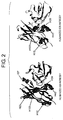
- Antibody Fv region models for humanized A69 and B26 antibodies were prepared by homology modeling using MOE software (Chemical Computing Group Inc.) to confirm amino acid residues exposed on the surface of variable regions of these antibodies. The models are shown in Fig. 2 . A detailed analysis of the models suggested that among surface-exposed amino acids in the FR sequences other than CDRs, those at H10, H12, H23, H39, H43, and H105 (according to the Kabat's numbering; Kabat EA et al. 1991. Sequences of Proteins of Immunological Interest. NIH) were candidate amino acids that could be modified to shift the isoelectric point without reduction of activity. The amino acid at H97 was selected as a surface-exposed amino acid in CDRs.
- Amino acids of the H chain variable regions of humanized A69 and B26 antibodies were modified to shift the isoelectric points of the antibodies. Specifically, mutations were introduced into the H chain variable regions of humanized A69 antibody (hA69a; nucleotide SEQ ID NO: 1) and humanized B26 antibody (hB26-F123e4; nucleotide SEQ ID NO: 3) prepared using a QuikChange Site-Directed Mutagenesis Kit (Stratagene) according to the method described in the attached instruction manual.
- H chain variable region fragment-inserted plasmids which had been confirmed to have the sequence of humanized antibody variable region gene of interest were digested with XhoI and SfiI, and then the reaction mixtures were subjected to electrophoresis using 1% agarose gel.
- DNA fragments having the size of interest (about 400 bp) were purified using a QIAquick Gel Extraction Kit (QIAGEN) according to the method described in the attached instruction manual, and then eluted using 30 ⁇ l of sterile water.
- the DNA fragments were inserted into an expression plasmid carrying the wild type constant region by the method described in Example 1-2 to construct H chain expression vectors. Modified amino acid residues in the respective antibodies and their SEQ IDs are shown in Table 1.
- a humanized A69 antibody (hA69a) and its modified forms (hA69-N97R, hA69-p18) were expressed using a combination of H chain expression vectors (variable region is hA69-N97R, hA69-p18) and an an L chain expression vector (variable region is hAL-F123j4; SEQ ID NO: 6) according to Example 1-3.
- a humanized B26 antibody (hB26-F123e4) and its modified form (hB26-p15) were expressed using a combination of H chain expression vectors (variable region is hB26-F123e4, hB26-p15) and an L chain expression vector (variable region is B26-VL; the amino acid sequence is described in WO2005/035756 (SEQ ID NO: 18)) according to Example 1-3.
- the antibodies were purified from culture supernatants by the method described in Example 1-4.
- an antibody-expressing cell line was established by the procedure described below.
- H-chain constant region was amplified by PCR using a wild-type human IgG4 H-chain constant region gene as a template and using a 5'-end primer designed so that the nucleotide sequence encoding two amino acids (Ala-Ser) in the N-terminal side of the H-chain constant region will be an NheI recognition sequence (GCTAGC) and a primer that anneals to the 3'-end and that carries a NotI recognizing site. Then, the amplified fragments were ligated to pBluescriptKS+ vector (TOYOBO) digested with NheI and Not I (both from Takara) to prepare pBCH4 (comprising an IgG4 constant region gene).
- pBluescriptKS+ vector TOYOBO
- PCR was performed using primers which are complementary to the 5'-end nucleotide sequence of the H-chain variable regions of the humanized A69-H chain antibody (hA69-PFL: SEQ ID NO: 11) and humanized B26-H chain antibody (hB26-PF: SEQ ID NO: 12) and which have a Kozak sequence (CCACC) and an EcoRI recognition sequence, and a primer on the 3'-end nucleotide sequence having an NheI recognition sequence.
- the obtained PCR products were digested with EcoRI and NheI (both from Takara) and inserted into pBCH4 also digested with EcoRI and NheI, and then the variable regions and the constant regions were linked.
- the prepared vector for humanized A69-H chain antibody was digested with EcoRI and NotI (both Takara), and then cloned into the animal cell expression vector pCXND3 digested with EcoRI and NotI.
- EcoRI and NotI both Takara
- the procedure for the construction of the vector pCXND3 is described below.
- DHFR- ⁇ E-rVH-PM1-f was cleaved at the EcoRI and SmaI restriction sites to separate the vector backbone form the antibody H chain gene. Only the vector backbone was recovered, and then an EcoRI-NotI-BamHI adaptor (Takara) was cloned into it. The resulting vector was named pCHOI.
- the DHFR gene expression region derived from pCHOI was cloned into pCXN ( Niwa et al., Gene 108: 193-200 (1991 )) at the HindIII restriction site.
- the resulting vector was named pCXND3.
- pCXZD1 vector is an expression vector obtained from pCXND3 by substituting the Zeocin resistance gene for the neomycin resistance gene.
- an L-chain expression vector was prepared by inserting the L chain variable region of the humanized BBA-L chain antibody (hAL-s8; SEQ ID NO: 8) into a plasmid (pCAG-g ⁇ DNA) having an inserted L chain constant region according to Example 1-2.
- the prepared three types of expression vectors were linearized with restriction enzymes and then introduced into CHO-DG44 cells to establish an antibody-expressing cell line.
- a stable expression cell line was prepared by the procedure described below. Genes were introduced by electroporation using GenePulserXcell (Bio-Rad). Each antibody expression vector was combined with 0.75 ml of CHO cells suspended in PBS (1 x 10 7 cells/ml). The mixtures were cooled on ice for ten minutes, transferred into cuvettes, and pulsed at 1.5 kV and 25 ⁇ FD. After a ten-minute restoration period at room temperature, the electroporated cells were suspended in 40 ml of CHO-S-SFMII medium (Invitrogen) containing 1x HT supplement (Invitrogen). The suspension was diluted 10 times with the same medium and aliquoted into 96-well culture plates at 100 ⁇ l/well.
- the bispecific antibody was purified from the culture supernatants obtained in Example 4.
- wash buffer 1 (20 mmol/l sodium phosphate buffer, 150 mol/l NaCl, pH 7.0
- wash buffer 2 50 mmol/l sodium acetate buffer, pH 6.0
- Solvent A 10 mmol/l sodium phosphate buffer, pH 6.3.
- bispecific antibody BiAb Two types of homodimers (hA69-PF and hB26-PF) and a single type of heterodimer, the bispecific antibody BiAb, were obtained by collecting eluted fractions of the detected three peaks separately.
- ATF is a previously obtained monoclonal antibody against human tissue factor, and is a humanized antibody comprising the constant region of human IgG4.
- the origin of ATF is described in detail in WO99/051743 .
- the amino acid sequences of its H chain and L chain variable regions are shown in SEQ ID Nos: 13 and 14, respectively.
- hA69-PF, BiAb, and hB26-PF prepared in Example 5;
- hA69-N97R, hA69-p18, hB26-e, and hB26-p15 prepared in Example 3; and
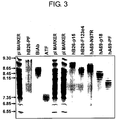
- ATF were analyzed by isoelectric focusing to assess changes in the surface charge due to the following: differences in the amino acid sequences of their variable regions and amino acid modifications.
- Phastsystem Cassette Amersham Bioscience
- Phast-Gel Dry IEF gel was allowed to swell for about 30 minutes in the swelling solution indicated below. Milli-Q water 1.5 ml Pharmalyte 5-8 for IEF (Amersham Bioscience) 50 ⁇ l Pharmalyte 8-10.5 for IEF (Amersham Bioscience) 50 ⁇ l
- Electrophoresis was carried out in PhastSystem (Amersham Bioscience) using the swollen gel according to the program indicated below. The samples were loaded onto the gel in Step 2.
- the pI marker used is a calibration kit for pI (Amersham Bioscience). Step 1: 2000 V 2.5 mA 3.5 W 15°C 75 Vh Step 2: 200 V 2.5 mA 3.5 W 15°C 15 Vh Step 3: 2000 V 2.5 mA 3.5 W 15°C 410 Vh
- the gel was fixed with 20% TCA, and then silver-stained using a silver staining kit protein (Amersham Bioscience) according to the protocol attached to the kit. After staining, the pIs of the samples were calculated from the known pIs of the pI marker.
- the analysis result of isoelectric focusing is shown in Fig. 3 .
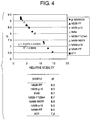
- the calibration curve of pI vs mobility prepared using the pI marker and pIs calculated from the curve are shown in Fig. 4 . The pIs were calculated based on the mobility of major bands since each sample exhibited antibody-derived charge heterogeneity.
- the result showed that the surface charges were changed due to differences in the amino acid sequences of the variable regions and that the pIs were shifted due to the change in surface charge through amino acid modifications.
- the pIs were as follows: about 9.2 for hB26-PF, about 8.7 for BiAb, about 8.0 for hA69-PF, about 7.2 for ATF, about 8.9 for hA69-N97R, about 8.5 for hA69-p18, about 8.7 for hB26-F123e4, and about 9.0 for hB26-p15.
- hA69-N97R, hA69-p18, and hA69-PF were obtained by modifying the same humanized antibody variable region.
- a pI shift of about 0.9 could be achieved in hA69-PF compared with hA69-N97R, and a pI shift of about 0.3 could be achieved in hB26-p15 compared with hB26-F123e4.
- the examination described above demonstrates that pI can be shifted depending on the amino acid sequence of a variable region as well as by modifying a surface amino acid at H10, H12, H23, H39, H43, H97, or H105 in a selected variable region to change its charge.
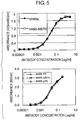
- Humanized A69 antibody and its modified form were assessed by assaying their binding activities to the antigen Factor IXa, as described below.
- Factor IXa ⁇ Enzyme Research Laboratories
- a coating buffer 100 mM sodium bicarbonate (pH 9.6), 0.02% sodium azide
- the plate was blocked with a diluent buffer (50 mM Tris-HCl (pH 8.1), 1% bovine serum albumin, 1 mM MgCl 2 , 0.15 M NaCl, 0.05% Tween (R) 20, 0.02% sodium azide) at room temperature for two hours. After removal of the buffer, the purified antibodies diluted with the diluent buffer were added to the plate at 100 ⁇ l/well. Then, the plate was incubated at room temperature for one hour.
- a diluent buffer 50 mM Tris-HCl (pH 8.1), 1% bovine serum albumin, 1 mM MgCl 2 , 0.15 M NaCl, 0.05% Tween (R) 20, 0.02% sodium azide
- alkaline phosphatase-labeled goat anti-mouse IgG (BIOSOURCE) diluted to 1/4000 with the diluent buffer was added at 100 ⁇ l/well. Then, the plate was incubated at room temperature for one hour. After washing the plate five times, a chromogenic substrate (Sigma) was added at 100 ⁇ l/well. The plate was then incubated at room temperature for 30 minutes. Absorbance at 405 nm (reference at 655 nm) was measured using the Model 3550 Microplate Reader (Bio-Rad Laboratories).
- the modified antibodies (hA69-N97R, hA69-p18, and hA69-PF) used in Example 8 were assessed by the following procedure. After Factor IXa (Enzyme Research Laboratories) diluted to 1 ⁇ g/ml with a coating buffer (0.05 M carbonate-bicarbonate buffer, pH 9.6) was aliquoted (100 ⁇ l/well) into a Nunc-Immuno plate (a Nunc-Immuno TM 96 MicroWell TM MaxiSorp TM plate (Nalge Nunc International)), the plate was incubated at 4°C overnight or for a longer period.
- a coating buffer 0.05 M carbonate-bicarbonate buffer, pH 9.6
- a diluent buffer Tris buffered saline containing Tween 20 (pH 8.0) (Sigma), 1% bovine serum albumin, 0.02% sodium azide
- PBS PBS containing 0.05% Tween (R) 20
- a diluent buffer Tris buffered saline containing Tween 20 (pH 8.0) (Sigma), 1% bovine serum albumin, 0.02% sodium azide
- the functions of the humanized B26 antibody hB26-F123e4 and its modified form, hB26-p15 were assessed by assaying their binding activities to the antigen Factor X.
- Factor X Enzyme Research Laboratories
- a coating buffer 100 mM sodium bicarbonate (pH 9.6), 0.02% sodium azide
- the plate was blocked with a diluent buffer (50 mM Tris-HCl (pH 8.1), 1% bovine serum albumin, 1 mM MgCl 2 , 0.15 M NaCl, 0.05% Tween (R) 20, 0.02% sodium azide) at room temperature for two hours. After removal of the buffer, the purified antibodies diluted with the diluent buffer were added at 100 ⁇ l/well to the plate. The plate was incubated at room temperature for one hour.
- a diluent buffer 50 mM Tris-HCl (pH 8.1), 1% bovine serum albumin, 1 mM MgCl 2 , 0.15 M NaCl, 0.05% Tween (R) 20, 0.02% sodium azide
- alkaline phosphatase-labeled goat anti-mouse IgG (BIOSOURCE) diluted to 1/4000 with the diluent buffer was added at 100 ⁇ l/well. The plate was then incubated at room temperature for one hour. After washing the plate five times, a chromogenic substrate (Sigma) was added at 100 ⁇ l/well. The plate was then incubated at room temperature for 30 minutes. Absorbance at 405 nm (reference at 655 nm) was measured using the Model 3550 Microplate Reader (Bio-Rad Laboratories). As shown in Fig. 6 , the results demonstrated that the antibody in which the variable region had been modified to change the surface charge showed binding activity comparable to that of the original antibody before modification.
- BIOSOURCE alkaline phosphatase-labeled goat anti-mouse IgG
- ATF was obtained as a monoclonal antibody against human tissue factor, and is a humanized antibody comprising the constant regions of human IgG4.
- the origin of ATF is described in detail in WO99/051743 .
- the amino acid sequences of its H chain and L chain variable regions are shown in SEQ ID NOs: 13 and 14, respectively.
- hA69-PF, BiAb, and hB26-PF prepared in Example 5, hA69-N97R, hA69-p18, hB26-e, and hB26-p15 prepared in Example 3, and ATF were assessed for the in vivo kinetics in mice (C57BL/6J; Charles River Japan, Inc.).
- ATF, hA69-PF, BiAb, and hB26-PF were intravenously administered once at 5 mg/kg to mice (C57BL/6J; Charles River Japan, Inc.).
- the blood was collected before administration and 15 minutes, two hours, eight hours, and one, two, four, seven, 11, 14, 21, and 28 days after administration.
- the collected blood was immediately centrifuged at 4°C and 15,000 rpm for 15 minutes to obtain plasma.
- the separated plasma was stored in a freezer at -20°C or below until use.
- hA69-N97R, hA69-p18, hB26-F123e4, and hB26-p15 were intravenously administered once at 1 mg/kg to mice (C57BL/6J; Charles River Japan, Inc.).
- the blood was collected before administration and 15 minutes, two hours, eight hours, and one, two, five, seven, nine, 14, 21, and 28 days after administration.
- the collected blood was immediately centrifuged at 4°C and 15,000 rpm for 15 minutes to obtain plasma.
- the separated plasma was stored in a freezer at -20°C or below until use.
- Plasma concentrations in mice were determined by ELISA. Calibration curve samples of 6.4, 3.2, 1.6, 0.8, 0.4, 0.2, and 0.1 ⁇ g/ml plasma concentrations were prepared. The standard curve samples and mouse plasma samples to be tested were aliquoted into immunoplates (Nunc-Immuno MaxiSorp plates (Nalge nunc International) immobilized with an anti-human IgG ( ⁇ -chain specific) F(ab')2 (Sigma). The samples were left to stand at room temperature for one hour, and then reacted with Goat Anti-Human IgG-BIOT (Southern Biotechnology Associates) and Streptavidin-alkaline phosphatase conjugate (Roche Diagnostics) in succession.
- the color development was carried out using BluePhos Microwell Phosphatase Substrates System (Kirkegaard & Perry Laboratories) as a substrate.
- the absorbance at 650 nm was measured using a microplate reader.
- the plasma concentrations in mice were calculated from the absorbance on the calibration curve using the analysis software SOFTmax PRO (Molecular Devices).
- the time courses of plasma concentrations of ATF, hA69-PF, BiAb, and hB26-PF are shown in Fig. 7 .
- Fig. 8 plots of antibody clearance (CL) and half-life (T1/2) relative to pI are shown in Fig. 8 . While the respective antibodies used share the same constant region sequences, each of clearance (CL) and half-life (T1/2) is strongly correlated with pI. This shows that, as pI is lower, clearance is lower and half-life in blood is more prolonged. Thus, half-life in blood can be controlled by pI values even when antibodies share the same constant region sequences. Accordingly, it is suggested that the half-life in blood can be prolonged by decreasing pI or can be reduced by increasing pI.
- Pyr(Q) represents an N-terminal glutamine residue which is assumed to be pyroglutamylated. Since the N-terminal amino group is protected, there is no significant charge difference between Pyr(Q) and E. Furthermore, sites of amino acid substitution which results in a pI shift are indicated by an asterisk.
- the present invention discovered that the half-life in blood of an IgG could be prolonged or reduced by decreasing or increasing the pI of IgG through substitution of surface amino acids in the variable regions, respectively.
- the half-life in blood (T1/2) could be prolonged by about 1.5 times by increasing the affinity for FcRn through modification of amino acids in the Fc in the constant region. Also, by decreasing pI through modification of surface amino acids in variable regions, the half-life in blood (T1/2) could be prolonged by about 1.5 times in the comparison between hA69-N97R and hA69-PF sharing the same constant region sequences.
- T1/2 of ATF with the lowest pI is longer by about 2.1 times than that of hA69-N97R.
- the half-life of hA69-N97R in blood can be further prolonged by decreasing its pI through additional modification of surface amino acids in the variable regions of hA69-N97R.
- the half-life in blood is different by about 2.4 times between hB26-PF with the highest pI and ATF with the lowest pI. Accordingly, the control of pharmacokinetics in blood through amino acid modifications in variable regions is expected to be more effective as compared to previous control techniques. Furthermore, the number of amino acid substitutions artificially introduced into constant regions is desired to be smaller from the viewpoint of immunogenicity.
- the present invention in which half-life in blood is controlled by modifying surface amino acids in variable regions, is expected to be useful in developing pharmaceuticals.
- amino acid substitutions are performed in variable regions, and thus the risk of immunogenicity is low as compared to conventional methods that modify constant regions.
- the methods of the present invention can be more effective in prolonging the half-life in blood as compared to the conventional methods that modify constant regions.
- the half-life in blood of polypeptides comprising an FcRn-binding domain such as IgG antibodies, can be controlled by controlling the surface charge in variable regions without changing structure or function (activity).
- Polypeptides comprising an FcRn-binding domain which retain the original activity and whose half-life in blood is controlled, can be obtained by using the methods disclosed herein.
Landscapes
- Health & Medical Sciences (AREA)
- Chemical & Material Sciences (AREA)
- Life Sciences & Earth Sciences (AREA)
- Organic Chemistry (AREA)
- Engineering & Computer Science (AREA)
- Genetics & Genomics (AREA)
- Bioinformatics & Cheminformatics (AREA)
- General Health & Medical Sciences (AREA)
- Medicinal Chemistry (AREA)
- Wood Science & Technology (AREA)
- Zoology (AREA)
- Biotechnology (AREA)
- Biochemistry (AREA)
- General Engineering & Computer Science (AREA)
- Biomedical Technology (AREA)
- Microbiology (AREA)
- Biophysics (AREA)
- Immunology (AREA)
- Molecular Biology (AREA)
- Proteomics, Peptides & Aminoacids (AREA)
- Tropical Medicine & Parasitology (AREA)
- Mycology (AREA)
- Virology (AREA)
- Epidemiology (AREA)
- Physics & Mathematics (AREA)
- Botany (AREA)
- Pharmacology & Pharmacy (AREA)
- Plant Pathology (AREA)
- Animal Behavior & Ethology (AREA)
- Public Health (AREA)
- Veterinary Medicine (AREA)
- Peptides Or Proteins (AREA)
- Preparation Of Compounds By Using Micro-Organisms (AREA)
- Medicines Containing Antibodies Or Antigens For Use As Internal Diagnostic Agents (AREA)
- Micro-Organisms Or Cultivation Processes Thereof (AREA)
Claims (6)
- Méthode de production d'un anticorps IgG modifié, dont la demi-vie dans le sang est prolongée ou réduite comparativement à avant la modification de l'anticorps, dans laquelle la méthode comprend :(a) la modification d'un acide nucléique codant pour l'anticorps pour modifier la charge d'au moins un résidu d'acide aminé qui peut être exposé sur la surface de l'anticorps, dans laquelle ledit au moins un résidu est un résidu d'acide aminé dans une région variable de chaîne lourde ou de chaîne légère de l'anticorps, et dans laquelle la modification de la charge est obtenue par substitution d'acide aminé ;(b) la culture d'une cellule hôte pour exprimer l'acide nucléique ; et(c) la collecte de l'anticorps à partir de la culture de la cellule hôte.
- Méthode selon la revendication 1, dans laquelle ledit au moins un résidu d'acide aminé est choisi dans le groupe constitué des résidus d'acides aminés au niveau des positions 10, 12, 23, 39, 43, et 105 selon le système de numérotation de Kabat dans la chaîne lourde de l'IgG.
- Méthode selon la revendication 1 ou 2, dans laquelle le au moins un résidu d'acide aminé modifié est choisi parmi les résidus d'acides aminés de l'un ou l'autre groupe (a) ou (b) ci-dessous :(a) l'acide glutamique (E) et l'acide aspartique (D) ; et(b) la lysine (K), l'arginine (R), et l'histidine (H).
- Méthode pour prolonger ou réduire la demi-vie d'un anticorps IgG, dans laquelle la méthode comprend la modification d'au moins un résidu d'acide aminé qui peut être exposé sur la surface de l'anticorps, dans laquelle ledit au moins un résidu est un résidu d'acide aminé dans une région variable de chaîne lourde ou de chaîne légère de l'anticorps, et dans laquelle ladite modification est réalisée par substitution pour modifier sa charge.
- Méthode selon la revendication 4, dans laquelle ledit au moins un résidu d'acide aminé est choisi dans le groupe constitué des résidus d'acides aminés au niveau des positions 10, 12, 23, 39, 43, et 105 selon le système de numérotation de Kabat dans la chaîne lourde de l'IgG.
- Méthode selon la revendication 4 ou 5, dans laquelle ledit au moins un résidu d'acide aminé est choisi parmi les résidus d'acides aminés de l'un ou l'autre groupe (a) ou (b) ci-dessous :(a) l'acide glutamique (E) et l'acide aspartique (D) ; et(b) la lysine (K), l'arginine (R), et l'histidine (H).
Priority Applications (4)
| Application Number | Priority Date | Filing Date | Title |
|---|---|---|---|
| DK15196240.4T DK3056568T3 (da) | 2006-03-31 | 2007-03-30 | Fremgangsmåder til kontrollering af antistoffers blodfarmakokinetik |
| EP23207448.4A EP4342995A3 (fr) | 2006-03-31 | 2007-03-30 | Procédés de régulation de la pharmacocinétique sanguine d'anticorps |
| EP21196629.6A EP4001409A1 (fr) | 2006-03-31 | 2007-03-30 | Procédés pour le contrôle de la pharmacocinétique sanguine d'anticorps |
| EP15196240.4A EP3056568B1 (fr) | 2006-03-31 | 2007-03-30 | Procédés pour le contrôle de la pharmacocinétique sanguine d'anticorps |
Applications Claiming Priority (2)
| Application Number | Priority Date | Filing Date | Title |
|---|---|---|---|
| JP2006097796 | 2006-03-31 | ||
| PCT/JP2007/057036 WO2007114319A1 (fr) | 2006-03-31 | 2007-03-30 | Procédé de régulation de la cinétique sanguine d'un anticorps |
Related Child Applications (4)
| Application Number | Title | Priority Date | Filing Date |
|---|---|---|---|
| EP23207448.4A Division EP4342995A3 (fr) | 2006-03-31 | 2007-03-30 | Procédés de régulation de la pharmacocinétique sanguine d'anticorps |
| EP21196629.6A Division EP4001409A1 (fr) | 2006-03-31 | 2007-03-30 | Procédés pour le contrôle de la pharmacocinétique sanguine d'anticorps |
| EP15196240.4A Division EP3056568B1 (fr) | 2006-03-31 | 2007-03-30 | Procédés pour le contrôle de la pharmacocinétique sanguine d'anticorps |
| EP15196240.4A Division-Into EP3056568B1 (fr) | 2006-03-31 | 2007-03-30 | Procédés pour le contrôle de la pharmacocinétique sanguine d'anticorps |
Publications (3)
| Publication Number | Publication Date |
|---|---|
| EP2006381A1 EP2006381A1 (fr) | 2008-12-24 |
| EP2006381A4 EP2006381A4 (fr) | 2009-04-29 |
| EP2006381B1 true EP2006381B1 (fr) | 2016-02-03 |
Family
ID=38563586
Family Applications (4)
| Application Number | Title | Priority Date | Filing Date |
|---|---|---|---|
| EP15196240.4A Active EP3056568B1 (fr) | 2006-03-31 | 2007-03-30 | Procédés pour le contrôle de la pharmacocinétique sanguine d'anticorps |
| EP21196629.6A Withdrawn EP4001409A1 (fr) | 2006-03-31 | 2007-03-30 | Procédés pour le contrôle de la pharmacocinétique sanguine d'anticorps |
| EP07740474.7A Revoked EP2006381B1 (fr) | 2006-03-31 | 2007-03-30 | Procédé de régulation de la pharmacocinétique sanguine des anticorps |
| EP23207448.4A Pending EP4342995A3 (fr) | 2006-03-31 | 2007-03-30 | Procédés de régulation de la pharmacocinétique sanguine d'anticorps |
Family Applications Before (2)
| Application Number | Title | Priority Date | Filing Date |
|---|---|---|---|
| EP15196240.4A Active EP3056568B1 (fr) | 2006-03-31 | 2007-03-30 | Procédés pour le contrôle de la pharmacocinétique sanguine d'anticorps |
| EP21196629.6A Withdrawn EP4001409A1 (fr) | 2006-03-31 | 2007-03-30 | Procédés pour le contrôle de la pharmacocinétique sanguine d'anticorps |
Family Applications After (1)
| Application Number | Title | Priority Date | Filing Date |
|---|---|---|---|
| EP23207448.4A Pending EP4342995A3 (fr) | 2006-03-31 | 2007-03-30 | Procédés de régulation de la pharmacocinétique sanguine d'anticorps |
Country Status (11)
| Country | Link |
|---|---|
| US (2) | US11046784B2 (fr) |
| EP (4) | EP3056568B1 (fr) |
| JP (4) | JP5624276B2 (fr) |
| KR (1) | KR101463631B1 (fr) |
| CN (2) | CN104761637B (fr) |
| AU (1) | AU2007232873B2 (fr) |
| CA (1) | CA2647846C (fr) |
| DK (2) | DK3056568T3 (fr) |
| ES (2) | ES2892925T3 (fr) |
| IN (1) | IN2014DN10515A (fr) |
| WO (1) | WO2007114319A1 (fr) |
Cited By (5)
| Publication number | Priority date | Publication date | Assignee | Title |
|---|---|---|---|---|
| US9334331B2 (en) | 2010-11-17 | 2016-05-10 | Chugai Seiyaku Kabushiki Kaisha | Bispecific antibodies |
| US9399680B2 (en) | 2007-12-05 | 2016-07-26 | Chugai Seiyaku Kabushiki Kaisha | Nucleic acids encoding anti-NR10 antibodies |
| US9493578B2 (en) | 2009-09-02 | 2016-11-15 | Xencor, Inc. | Compositions and methods for simultaneous bivalent and monovalent co-engagement of antigens |
| EP3816179A2 (fr) * | 2015-02-05 | 2021-05-05 | Chugai Seiyaku Kabushiki Kaisha | Variant de région fc comprenant un domaine de liaison fcrn modifié |
| EP3056568B1 (fr) | 2006-03-31 | 2021-09-15 | Chugai Seiyaku Kabushiki Kaisha | Procédés pour le contrôle de la pharmacocinétique sanguine d'anticorps |
Families Citing this family (149)
| Publication number | Priority date | Publication date | Assignee | Title |
|---|---|---|---|---|
| WO2005035754A1 (fr) * | 2003-10-14 | 2005-04-21 | Chugai Seiyaku Kabushiki Kaisha | Anticorps a double specificite de substitution de proteine fonctionnelle |
| AU2003271174A1 (en) * | 2003-10-10 | 2005-04-27 | Chugai Seiyaku Kabushiki Kaisha | Double specific antibodies substituting for functional protein |
| US20080206229A1 (en) * | 2003-12-12 | 2008-08-28 | Koichiro Ono | Modified Antibodies Recognizing Receptor Trimers or Higher Multimers |
| JP4418717B2 (ja) * | 2004-06-24 | 2010-02-24 | 住友化学株式会社 | (z)−1−フェニル−1−ジエチルアミノカルボニル−2−アミノメチルシクロプロパン塩酸塩の製造方法 |
| EP1870458B1 (fr) * | 2005-03-31 | 2018-05-09 | Chugai Seiyaku Kabushiki Kaisha | ISOMERES STRUCTURELS sc(Fv)2 |
| CN101198698B (zh) | 2005-03-31 | 2014-03-19 | 中外制药株式会社 | 通过调节多肽缔合制备多肽的方法 |
| CA2603264C (fr) * | 2005-04-08 | 2017-03-21 | Chugai Seiyaku Kabushiki Kaisha | Substitution des anticorps de la fonction du facteur viii de coagulation sanguine |
| EP2009101B1 (fr) * | 2006-03-31 | 2017-10-25 | Chugai Seiyaku Kabushiki Kaisha | Procede de modification d'anticorps pour purifier un anticorps bispecifique |
| EP3415529B1 (fr) * | 2007-09-26 | 2020-11-04 | Chugai Seiyaku Kabushiki Kaisha | Région constante d'anticorps modifié |
| CN101874042B9 (zh) | 2007-09-26 | 2019-01-01 | 中外制药株式会社 | 利用cdr的氨基酸取代来改变抗体等电点的方法 |
| EP2196541B1 (fr) * | 2007-09-28 | 2012-11-07 | Chugai Seiyaku Kabushiki Kaisha | Anticorps anti-glypican-3 dont la cinétique dans le plasma est améliorée |
| KR101568051B1 (ko) | 2007-11-15 | 2015-11-10 | 추가이 세이야쿠 가부시키가이샤 | Anexelekto에 결합하는 단일클론항체, 및 그의 이용 |
| BRPI0821417A2 (pt) | 2007-12-26 | 2015-06-16 | Biotest Ag | Método para diminuir a adesão de células de estroma a células tumorais que expressam cd138 em células tumorais de um indivíduo em necessidade do mesmo |
| HRP20140604T1 (hr) | 2007-12-26 | 2014-09-12 | Biotest Ag | Sredstva koja djeluju na cd138 i njihova upotreba |
| JP5817034B2 (ja) | 2007-12-26 | 2015-11-18 | バイオテスト・アクチエンゲゼルシヤフト | Cd138を標的とする免疫複合体及びその使用 |
| CL2009000647A1 (es) * | 2008-04-04 | 2010-06-04 | Chugai Pharmaceutical Co Ltd | Composicion farmaceutica para tratar o prevenir cancer hepatico que comprende una combinacion de un agente quimioterapeutico y un anticuerpo anti-glipicano 3; agente para atenuar un efecto secundario que comprende dicho anticuerpo; metodo para tratar o prevenir un cancer hepatico de un sujeto. |
| EP2275443B1 (fr) * | 2008-04-11 | 2015-12-02 | Chugai Seiyaku Kabushiki Kaisha | Molécule de liaison à l antigène capable de se lier à deux molécules d antigène ou plus de manière répétée |
| TWI440469B (zh) * | 2008-09-26 | 2014-06-11 | Chugai Pharmaceutical Co Ltd | Improved antibody molecules |
| WO2010106812A1 (fr) * | 2009-03-19 | 2010-09-23 | Chugai Seiyaku Kabushiki Kaisha | Formulation pharmaceutique contenant des molécules d'anticorps améliorées |
| TWI682995B (zh) | 2009-03-19 | 2020-01-21 | 日商中外製藥股份有限公司 | 抗體恆定區域改變體 |
| WO2010107110A1 (fr) | 2009-03-19 | 2010-09-23 | 中外製薬株式会社 | Variant d'une région constante d'anticorps |
| RU2011151069A (ru) * | 2009-05-15 | 2013-06-20 | Чугаи Сейяку Кабусики Кайся | Анти-axl антитело |
| JP5837821B2 (ja) | 2009-09-24 | 2015-12-24 | 中外製薬株式会社 | 抗体定常領域改変体 |
| AR080428A1 (es) | 2010-01-20 | 2012-04-11 | Chugai Pharmaceutical Co Ltd | Formulaciones liquidas estabilizadas contentivas de anticuerpos |
| WO2011092989A1 (fr) | 2010-01-29 | 2011-08-04 | 東レ株式会社 | Feuille de résine à base d'acide polylactique |
| US10435458B2 (en) | 2010-03-04 | 2019-10-08 | Chugai Seiyaku Kabushiki Kaisha | Antibody constant region variants with reduced Fcgammar binding |
| BR112012022917A2 (pt) * | 2010-03-11 | 2017-01-10 | Pfizer | anticorpos com ligação a antígeno dependente de ph |
| CA2806252C (fr) | 2010-07-29 | 2019-05-14 | Xencor, Inc. | Anticorps dont les points isoelectriques sont modifies |
| TWI654204B (zh) | 2010-11-30 | 2019-03-21 | Chugai Seiyaku Kabushiki Kaisha | 具有鈣依存性的抗原結合能力之抗體 |
| TWI638833B (zh) | 2010-11-30 | 2018-10-21 | 中外製藥股份有限公司 | 細胞傷害誘導治療劑 |
| EP2662385A4 (fr) * | 2011-01-07 | 2015-11-11 | Chugai Pharmaceutical Co Ltd | Procédé pour l'amélioration de propriétés physiques d'anticorps |
| CA2827923C (fr) | 2011-02-25 | 2021-11-23 | Chugai Seiyaku Kabushiki Kaisha | Anticorps fc specifique de fcgriib |
| WO2013012022A1 (fr) | 2011-07-19 | 2013-01-24 | 中外製薬株式会社 | Préparation à teneur en protéines stable renfermant de l'argininamide ou un composé analogue correspondant |
| WO2013022855A1 (fr) * | 2011-08-05 | 2013-02-14 | Xencor, Inc. | Anticorps avec points isoélectriques modifiés et immunofiltration |
| TW201817744A (zh) | 2011-09-30 | 2018-05-16 | 日商中外製藥股份有限公司 | 具有促進抗原清除之FcRn結合域的治療性抗原結合分子 |
| US20150050269A1 (en) | 2011-09-30 | 2015-02-19 | Chugai Seiyaku Kabushiki Kaisha | Antigen-binding molecule promoting disappearance of antigens having plurality of biological activities |
| US12466897B2 (en) | 2011-10-10 | 2025-11-11 | Xencor, Inc. | Heterodimeric human IgG1 polypeptides with isoelectric point modifications |
| ES2732712T3 (es) | 2011-10-31 | 2019-11-25 | Chugai Pharmaceutical Co Ltd | Molécula de unión a antígeno que tiene una conjugación regulada entre la cadena pesada y la cadena ligera |
| TWI593705B (zh) | 2011-12-28 | 2017-08-01 | Chugai Pharmaceutical Co Ltd | Humanized anti-epiregulin antibody and cancer therapeutic agent containing the antibody as an active ingredient |
| EP2813568B1 (fr) | 2012-02-09 | 2025-04-23 | Chugai Seiyaku Kabushiki Kaisha | Région fc modifiée d'un anticorps |
| WO2013125667A1 (fr) | 2012-02-24 | 2013-08-29 | 中外製薬株式会社 | MOLÉCULE DE LIAISON D'ANTIGÈNE DESTINÉE À FAVORISER LA DISPARITION D'ANTIGÈNE VIA LE RÉCEPTEUR FcγRIIB |
| KR20150004856A (ko) * | 2012-04-20 | 2015-01-13 | 이머전트 프로덕트 디벨롭먼트 시애틀, 엘엘씨 | Cd3 결합 폴리펩타이드 |
| EP3892638A1 (fr) * | 2012-05-30 | 2021-10-13 | Chugai Seiyaku Kabushiki Kaisha | Molécule de liaison d'antigène supprimant un antigène associé |
| SG11201500873XA (en) | 2012-08-24 | 2015-04-29 | Chugai Pharmaceutical Co Ltd | Fcgriib-specific fc region variant |
| WO2014030750A1 (fr) | 2012-08-24 | 2014-02-27 | 中外製薬株式会社 | ANTICORPS Fc SPÉCIFIQUE À FcyRII DE SOURIS |
| EP2921502A4 (fr) | 2012-10-19 | 2016-09-28 | Evec Inc | Anticorps humain spécifique d'une toxine produite à partir de clostridium difficile, ou fragment de liaison à un antigène correspondant |
| US10131710B2 (en) | 2013-01-14 | 2018-11-20 | Xencor, Inc. | Optimized antibody variable regions |
| US9605084B2 (en) | 2013-03-15 | 2017-03-28 | Xencor, Inc. | Heterodimeric proteins |
| US9701759B2 (en) | 2013-01-14 | 2017-07-11 | Xencor, Inc. | Heterodimeric proteins |
| US11053316B2 (en) | 2013-01-14 | 2021-07-06 | Xencor, Inc. | Optimized antibody variable regions |
| CA2898100C (fr) | 2013-01-14 | 2023-10-10 | Xencor, Inc. | Nouvelles proteines heterodimeres |
| US10968276B2 (en) | 2013-03-12 | 2021-04-06 | Xencor, Inc. | Optimized anti-CD3 variable regions |
| US10487155B2 (en) | 2013-01-14 | 2019-11-26 | Xencor, Inc. | Heterodimeric proteins |
| CA2897987A1 (fr) | 2013-01-15 | 2014-07-24 | Xencor, Inc. | Elimination rapide de complexes antigeniques a l'aide de nouveaux anticorps |
| US10519242B2 (en) | 2013-03-15 | 2019-12-31 | Xencor, Inc. | Targeting regulatory T cells with heterodimeric proteins |
| US10106624B2 (en) | 2013-03-15 | 2018-10-23 | Xencor, Inc. | Heterodimeric proteins |
| US10858417B2 (en) | 2013-03-15 | 2020-12-08 | Xencor, Inc. | Heterodimeric proteins |
| EP2970486B1 (fr) | 2013-03-15 | 2018-05-16 | Xencor, Inc. | Modulation de cellules t avec des anticorps bispecifiques et des fusions fc |
| TWI636062B (zh) | 2013-04-02 | 2018-09-21 | 中外製藥股份有限公司 | Fc region variant |
| WO2014200018A1 (fr) | 2013-06-11 | 2014-12-18 | 独立行政法人 国立精神・神経医療研究センター | Procédé permettant de prédire le pronostic post-thérapie d'un patient atteint de sclérose en plaques à périodes progressives et rémittentes (spppr) et procédé permettant de déterminer l'applicabilité d'une nouvelle thérapie |
| BR112015032414A2 (pt) | 2013-06-24 | 2017-11-07 | Chugai Pharmaceutical Co Ltd | agente terapêutico compreendendo anticorpo antiepirregulina humanizado como ingrediente ativo para carcinoma de pulmão de célula não pequena excluindo adenocarcinoma |
| CN105764922B (zh) | 2013-09-27 | 2020-07-17 | 中外制药株式会社 | 多肽异源多聚体的制备方法 |
| BR112016006502A2 (pt) | 2013-09-30 | 2017-09-19 | Chugai Pharmaceutical Co Ltd | Método para a produção de molécula de ligação de antígeno usando-se fago auxiliar modificado |
| CN111402950B (zh) * | 2013-11-29 | 2024-03-19 | 豪夫迈·罗氏有限公司 | 抗体选择装置和方法 |
| KR102344170B1 (ko) | 2013-12-27 | 2021-12-27 | 추가이 세이야쿠 가부시키가이샤 | 등전점이 낮은 항체의 정제방법 |
| NZ711451A (en) | 2014-03-07 | 2016-05-27 | Alexion Pharma Inc | Anti-c5 antibodies having improved pharmacokinetics |
| JP6775422B2 (ja) | 2014-03-28 | 2020-10-28 | ゼンコー・インコーポレイテッドXencor、 Inc. | Cd38及びcd3に結合する二重特異性抗体 |
| KR102568808B1 (ko) | 2014-04-07 | 2023-08-18 | 추가이 세이야쿠 가부시키가이샤 | 면역활성화 항원 결합 분자 |
| SG11201609370QA (en) | 2014-05-13 | 2016-12-29 | Chugai Pharmaceutical Co Ltd | T cell-redirected antigen-binding molecule for cells having immunosuppression function |
| KR101644078B1 (ko) | 2014-09-25 | 2016-07-29 | 린노알미늄 주식회사 | 케이블 트레이의 타격 결합형 조립방법 |
| TWI700300B (zh) | 2014-09-26 | 2020-08-01 | 日商中外製藥股份有限公司 | 中和具有第viii凝血因子(fviii)機能替代活性的物質之抗體 |
| MA40764A (fr) | 2014-09-26 | 2017-08-01 | Chugai Pharmaceutical Co Ltd | Agent thérapeutique induisant une cytotoxicité |
| TWI701435B (zh) | 2014-09-26 | 2020-08-11 | 日商中外製藥股份有限公司 | 測定fviii的反應性之方法 |
| JP2017536830A (ja) | 2014-11-26 | 2017-12-14 | ゼンコー・インコーポレイテッドXencor、 Inc. | Cd3及びcd38に結合するヘテロ二量体抗体 |
| US10259887B2 (en) | 2014-11-26 | 2019-04-16 | Xencor, Inc. | Heterodimeric antibodies that bind CD3 and tumor antigens |
| SG11201704283PA (en) | 2014-11-26 | 2017-06-29 | Xencor Inc | Heterodimeric antibodies that bind cd3 and tumor antigens |
| SG10201710322VA (en) | 2014-12-19 | 2018-02-27 | Chugai Pharmaceutical Co Ltd | Anti-c5 antibodies and methods of use |
| NZ730607A (en) | 2014-12-19 | 2022-07-01 | Chugai Pharmaceutical Co Ltd | Anti-myostatin antibodies, polypeptides containing variant fc regions, and methods of use |
| WO2016105450A2 (fr) | 2014-12-22 | 2016-06-30 | Xencor, Inc. | Anticorps trispécifiques |
| TWI873632B (zh) | 2015-02-27 | 2025-02-21 | 日商中外製藥股份有限公司 | Il-6受體抗體用於製備醫藥組成物的用途 |
| US10227411B2 (en) | 2015-03-05 | 2019-03-12 | Xencor, Inc. | Modulation of T cells with bispecific antibodies and FC fusions |
| US11142587B2 (en) | 2015-04-01 | 2021-10-12 | Chugai Seiyaku Kabushiki Kaisha | Method for producing polypeptide hetero-oligomer |
| PL3299810T3 (pl) | 2015-05-19 | 2021-12-13 | National Center Of Neurology And Psychiatry | Sposób określania zastosowania nowej terapii u pacjentów ze stwardnieniem rozsianym (sm) |
| CA2994043A1 (fr) | 2015-07-31 | 2017-02-09 | Glaxosmithkline Intellectual Property Development Limited | Variants d'anticorps |
| CN108271372B (zh) | 2015-09-18 | 2021-07-09 | 中外制药株式会社 | Il-8-结合抗体及其应用 |
| KR102784293B1 (ko) | 2015-09-21 | 2025-03-20 | 압테보 리서치 앤드 디벨롭먼트 엘엘씨 | Cd3 결합 폴리펩타이드 |
| EP3378488A4 (fr) | 2015-11-18 | 2019-10-30 | Chugai Seiyaku Kabushiki Kaisha | Procédé pour renforcer la réponse immunitaire humorale |
| WO2017086367A1 (fr) | 2015-11-18 | 2017-05-26 | 中外製薬株式会社 | Polythérapie utilisant une molécule de liaison à l'antigène à rôle de redirection des cellules t, ciblant des cellules immunosupressives |
| JP7058219B2 (ja) | 2015-12-07 | 2022-04-21 | ゼンコア インコーポレイテッド | Cd3及びpsmaに結合するヘテロ二量体抗体 |
| EP3390443A4 (fr) | 2015-12-18 | 2019-11-13 | Chugai Seiyaku Kabushiki Kaisha | Anticorps anti-myostatine, polypeptides contenant des variants de régions fc, et procédés d'utilisation |
| WO2017110981A1 (fr) | 2015-12-25 | 2017-06-29 | Chugai Seiyaku Kabushiki Kaisha | Anticorps anti-myostatine et procédés d'utilisation |
| WO2017110980A1 (fr) | 2015-12-25 | 2017-06-29 | 中外製薬株式会社 | Anticorps présentant une activité accrue et son procédé de modification |
| SG11201803989WA (en) | 2015-12-28 | 2018-06-28 | Chugai Pharmaceutical Co Ltd | Method for promoting efficiency of purification of fc region-containing polypeptide |
| CA3016424A1 (fr) | 2016-03-14 | 2017-09-21 | Chugai Seiyaku Kabushiki Kaisha | Medicament therapeutique induisant des lesions cellulaires a utiliser dans le traitement du cancer |
| ES3055961T3 (en) | 2016-04-28 | 2026-02-17 | Chugai Pharmaceutical Co Ltd | Antibody-containing preparation |
| AU2017269839A1 (en) | 2016-05-27 | 2018-11-22 | Alexion Pharmaceuticals, Inc. | Methods for treatment of refractory generalized myasthenia gravis |
| WO2017201731A1 (fr) * | 2016-05-27 | 2017-11-30 | Beijing Vdjbio Co., Ltd. | Anticorps, composition et kits les comprenant et leurs procédés d'utilisation |
| MA45255A (fr) | 2016-06-14 | 2019-04-17 | Xencor Inc | Anticorps inhibiteurs de points de contrôle bispécifiques |
| MX2018014375A (es) | 2016-06-17 | 2019-04-22 | Chugai Pharmaceutical Co Ltd | Anticuerpos antimiostatina y metodos de uso. |
| KR20190020341A (ko) | 2016-06-28 | 2019-02-28 | 젠코어 인코포레이티드 | 소마토스타틴 수용체 2에 결합하는 이종이량체 항체 |
| CN109415444B (zh) | 2016-07-29 | 2024-03-01 | 中外制药株式会社 | 显示增加的备选fviii辅因子功能活性的双特异性抗体 |
| BR112019001902A2 (pt) | 2016-08-05 | 2019-07-09 | Chugai Seiyaku Kabushiki Kaisha | composição para profilaxia ou tratamento de doenças relacionadas à il-8 |
| US10793632B2 (en) | 2016-08-30 | 2020-10-06 | Xencor, Inc. | Bispecific immunomodulatory antibodies that bind costimulatory and checkpoint receptors |
| EP3509637B1 (fr) | 2016-09-06 | 2024-11-27 | Chugai Seiyaku Kabushiki Kaisha | Procédés d'utilisation d'un anticorps bispécifique qui reconnaît le facteur de coagulation ix et/ou le facteur de coagulation ix activé et le facteur de coagulation x et/ou le facteur de coagulation x activé |
| SG10201607778XA (en) | 2016-09-16 | 2018-04-27 | Chugai Pharmaceutical Co Ltd | Anti-Dengue Virus Antibodies, Polypeptides Containing Variant Fc Regions, And Methods Of Use |
| BR112019007281A2 (pt) | 2016-10-14 | 2019-07-09 | Xencor Inc | proteína heterodimérica, composições de ácido nucleico e de vetor de expressão, vetor de expressão, célula hospedeira, e, métodos para produzir proteína heterodimérica e para tratar câncer em um paciente |
| JP7191833B2 (ja) | 2017-01-30 | 2022-12-19 | 中外製薬株式会社 | 抗スクレロスチン抗体およびその使用 |
| EP3603670A4 (fr) | 2017-03-31 | 2021-03-10 | Public University Corporation Nara Medical University | Composition médicinale utilisable pour prévenir et/ou traiter une anomalie du facteur ix de la coagulation sanguine, comprenant une molécule de liaison d'antigène multispécifique remplaçant la fonction du facteur viii de la coagulation sanguine |
| CA3059133A1 (fr) | 2017-04-21 | 2018-10-25 | Staten Biotechnology B.V. | Anticorps anti-apoc3 et leurs methodes d'utilisation |
| US11851486B2 (en) | 2017-05-02 | 2023-12-26 | National Center Of Neurology And Psychiatry | Method for predicting and evaluating therapeutic effect in diseases related to IL-6 and neutrophils |
| AU2018291497A1 (en) | 2017-06-30 | 2020-01-16 | Xencor, Inc. | Targeted heterodimeric Fc fusion proteins containing IL-15/IL-15Ra and antigen binding domains |
| CA3070342A1 (fr) | 2017-07-18 | 2019-01-24 | Kyowa Kirin Co., Ltd. | Anticorps monoclonal anti-ccr1 humain |
| BR112020001703B1 (pt) | 2017-07-27 | 2024-01-02 | Alexion Pharmaceuticals, Inc | Solução aquosa estável compreendendo um anticorpo anti-c5, método para produção desta solução, uso da mesma para tratar uma condição associada ao complemento e kit terapêutico compreendendo a mesma |
| JP6496095B1 (ja) | 2017-09-29 | 2019-04-03 | 中外製薬株式会社 | 血液凝固第viii因子(fviii)補因子機能代替活性を有する多重特異性抗原結合分子および当該分子を有効成分として含有する薬学的製剤 |
| US11692037B2 (en) | 2017-10-20 | 2023-07-04 | Hyogo College Of Medicine | Anti-IL-6 receptor antibody-containing medicinal composition for preventing post-surgical adhesion |
| EP3700928A1 (fr) | 2017-10-26 | 2020-09-02 | Alexion Pharmaceuticals, Inc. | Dosage et administration d'anticorps anti-c5 pour le traitement de l'hémoglobinurie paroxystique nocturne (pnh) et du syndrome hémolytique et urémique atypique (ahus) |
| CA3080103A1 (fr) | 2017-10-31 | 2019-05-09 | Staten Biotechnology B.V. | Anticorps anti-apoc3 et leurs procedes d'utilisation |
| TW202600611A (zh) | 2017-11-01 | 2026-01-01 | 日商中外製藥股份有限公司 | 生物活性降低之抗體變異體與同功型 |
| AU2018366199A1 (en) | 2017-11-08 | 2020-05-28 | Xencor, Inc. | Bispecific and monospecific antibodies using novel anti-PD-1 sequences |
| US10981992B2 (en) | 2017-11-08 | 2021-04-20 | Xencor, Inc. | Bispecific immunomodulatory antibodies that bind costimulatory and checkpoint receptors |
| AU2018390418B2 (en) | 2017-12-19 | 2023-12-21 | Xencor, Inc. | Engineered IL-2 Fc fusion proteins |
| WO2019151418A1 (fr) | 2018-01-31 | 2019-08-08 | 元一 加藤 | Agent thérapeutique pour l'asthme contenant un inhibiteur d'il-6 |
| CA3093729A1 (fr) | 2018-03-15 | 2019-09-19 | Chugai Seiyaku Kabushiki Kaisha | Anticorps diriges contre le virus de la dengue presentant une reactivite croisee au virus zika et procedes d'utilisation |
| AU2019247415A1 (en) | 2018-04-04 | 2020-10-22 | Xencor, Inc. | Heterodimeric antibodies that bind fibroblast activation protein |
| JP2021520829A (ja) | 2018-04-18 | 2021-08-26 | ゼンコア インコーポレイテッド | IL−15/IL−15RA Fc融合タンパク質およびTIM−3抗原結合ドメインを含む、TIM−3標的化ヘテロ二量体融合タンパク質 |
| CA3097593A1 (fr) | 2018-04-18 | 2019-10-24 | Xencor, Inc. | Proteines de fusion heterodimeres ciblant pd-1 contenant des proteines de fusion fc d'il-15/il-15ra, domaines de liaison a l'antigene pd-1 et utilisations associees |
| US12404320B2 (en) | 2018-05-31 | 2025-09-02 | Alexion Pharmaceuticals, Inc. | Dosage and administration of anti-C5 antibodies for treatment of paroxysmal nocturnal hemoglobinuria (PNH) in pediatric patients |
| JP7577542B2 (ja) | 2018-06-04 | 2024-11-05 | アレクシオン ファーマシューティカルズ, インコーポレイテッド | 小児患者における非典型溶血性尿毒症症候群(aHUS)の治療のための抗C5抗体の用量および投与 |
| JP7397444B2 (ja) | 2018-06-26 | 2023-12-13 | 協和キリン株式会社 | コンドロイチン硫酸プロテオグリカン-5に結合する抗体 |
| CN112424358B (zh) | 2018-06-26 | 2025-07-01 | 协和麒麟株式会社 | 与细胞粘附分子3结合的抗体 |
| EP3814373A1 (fr) | 2018-06-28 | 2021-05-05 | Alexion Pharmaceuticals, Inc. | Procédés de production d'anticorps anti-c5 |
| SG11202100961UA (en) * | 2018-08-21 | 2021-03-30 | Bioatla Inc | CONDITIONALLY ACTIVE PROTEINS WITH pH SELECTIVITY |
| SG11202103192RA (en) | 2018-10-03 | 2021-04-29 | Xencor Inc | Il-12 heterodimeric fc-fusion proteins |
| MX2021004994A (es) | 2018-10-30 | 2021-06-15 | Alexion Pharma Inc | Dosificacion subcutanea y administracion de anticuerpos anti-c5 para el tratamiento de la hemoglobinuria paroxistica nocturna (pnh). |
| WO2020180726A1 (fr) | 2019-03-01 | 2020-09-10 | Xencor, Inc. | Anticorps hétérodimères qui se lient à enpp3 et cd3 |
| AU2020273072B2 (en) | 2019-04-10 | 2026-01-22 | Chugai Seiyaku Kabushiki Kaisha | Method for purifying Fc region-modified antibody |
| WO2020213665A1 (fr) | 2019-04-17 | 2020-10-22 | 国立大学法人広島大学 | Agent thérapeutique pour cancer urologique caractérisé en ce qu'il est administré avec un inhibiteur de il-6 et un inhibiteur de ccr2 en combinaison |
| PH12021552960A1 (en) | 2019-07-10 | 2022-07-25 | Chugai Pharmaceutical Co Ltd | Claudin-6 binding molecules and uses thereof |
| WO2021231976A1 (fr) | 2020-05-14 | 2021-11-18 | Xencor, Inc. | Anticorps hétérodimères qui se lient à l'antigène membranaire spécifique de la prostate (psma) et cd3 |
| TWI872251B (zh) | 2020-05-29 | 2025-02-11 | 日商中外製藥股份有限公司 | 含有抗體製劑 |
| CN116194478A (zh) | 2020-06-24 | 2023-05-30 | 阿雷克森制药公司 | 皮下(sc)施用抗c5抗体治疗补体相关病症 |
| CA3192204A1 (fr) | 2020-08-19 | 2022-02-24 | Xencor, Inc. | Anticorps anti-cd28 et/ou compositions anti-b7h3 |
| EP4267622A1 (fr) * | 2020-12-23 | 2023-11-01 | Numab Therapeutics AG | Domaines variables d'anticorps et anticorps ayant une immunogénicité réduite |
| KR20230156079A (ko) | 2021-03-09 | 2023-11-13 | 젠코어 인코포레이티드 | Cd3과 cldn6에 결합하는 이종이량체 항체 |
| US11859012B2 (en) | 2021-03-10 | 2024-01-02 | Xencor, Inc. | Heterodimeric antibodies that bind CD3 and GPC3 |
| EP4412583A1 (fr) | 2021-10-04 | 2024-08-14 | Novartis AG | Stabilisants tensioactifs |
| MX2024004117A (es) | 2021-10-08 | 2024-04-19 | Chugai Pharmaceutical Co Ltd | Metodo para preparar formulacion de jeringa precargada. |
| CA3252263A1 (fr) | 2022-02-09 | 2025-07-07 | National Institutes Of Biomedical Innovation, Health And Nutrition | Anticorps ou fragment de celui-ci se liant à fcrl1 |
| WO2026039779A1 (fr) | 2024-08-15 | 2026-02-19 | Yale University | Anticorps 3e10 humanisés et fragments de liaison à l'antigène optimisés pour la liaison rad51 |
Citations (10)
| Publication number | Priority date | Publication date | Assignee | Title |
|---|---|---|---|---|
| WO1998003546A1 (fr) | 1996-07-19 | 1998-01-29 | Amgen Inc. | Analogues de proteines cationiques |
| US5990286A (en) | 1996-12-18 | 1999-11-23 | Techniclone, Inc. | Antibodies with reduced net positive charge |
| US20020137897A1 (en) | 1995-01-17 | 2002-09-26 | Fred J. Stevens | A method for altering antibody light chain interactions |
| US20020164339A1 (en) | 1995-09-14 | 2002-11-07 | Do Couto Fernando J.R. | Recombinant peptides derived from the Mc3 anti-BA46 antibody, methods of use thereof, and methods of humanizing antibody peptides |
| WO2003020949A2 (fr) | 2001-08-31 | 2003-03-13 | The General Hospital Corporation | Produits de recombinaison cibles d'acides nucleiques et utilisations en rapport avec lesdits produits |
| US20050095243A1 (en) | 2003-06-05 | 2005-05-05 | Genentech, Inc. | Combination therapy for B cell disorders |
| WO2005059106A2 (fr) | 2003-12-10 | 2005-06-30 | Medarex, Inc. | Anticorps contre l'interferon alpha et leur utilisations |
| US20050244403A1 (en) | 2004-03-24 | 2005-11-03 | Xencor, Inc. | Immunoglobulin variants outside the Fc region |
| US20060063228A1 (en) | 2004-06-09 | 2006-03-23 | Kasaian Marion T | Antibodies against human interleukin-13 and uses therefor |
| WO2006121852A2 (fr) | 2005-05-05 | 2006-11-16 | Duke University | Traitements des maladies auto-immunes par anticorps anti-cd19 |
Family Cites Families (612)
| Publication number | Priority date | Publication date | Assignee | Title |
|---|---|---|---|---|
| US1073811A (en) | 1913-04-24 | 1913-09-23 | Carl G Miller | Fly-trap. |
| SE370449B (fr) | 1970-08-29 | 1974-10-14 | Philips Nv | |
| JPS5334319B2 (fr) | 1971-12-28 | 1978-09-20 | ||
| JPS5717624B2 (fr) | 1974-04-17 | 1982-04-12 | ||
| US4208479A (en) | 1977-07-14 | 1980-06-17 | Syva Company | Label modified immunoassays |
| US4474893A (en) | 1981-07-01 | 1984-10-02 | The University of Texas System Cancer Center | Recombinant monoclonal antibodies |
| US4444878A (en) | 1981-12-21 | 1984-04-24 | Boston Biomedical Research Institute, Inc. | Bispecific antibody determinants |
| EP0091539B2 (fr) | 1982-03-31 | 1996-11-27 | Ajinomoto Co., Inc. | Gène codant pour interleukin-2 polypeptide, ADN recombinant portant ledit gène, lignées cellulaires possédant le recombinant ADN et procédé pour la préparation d'interleukin-2 utilisant lesdites cellules |
| JPS58201994A (ja) | 1982-05-21 | 1983-11-25 | Hideaki Hagiwara | 抗原特異的ヒト免疫グロブリンの生産方法 |
| US4816567A (en) | 1983-04-08 | 1989-03-28 | Genentech, Inc. | Recombinant immunoglobin preparations |
| GB8607679D0 (en) | 1986-03-27 | 1986-04-30 | Winter G P | Recombinant dna product |
| JPH0234615Y2 (fr) | 1986-08-08 | 1990-09-18 | ||
| JPH06104071B2 (ja) | 1986-08-24 | 1994-12-21 | 財団法人化学及血清療法研究所 | 第▲ix▼因子コンホメ−シヨン特異性モノクロ−ナル抗体 |
| US5260203A (en) | 1986-09-02 | 1993-11-09 | Enzon, Inc. | Single polypeptide chain binding molecules |
| JPS63149900A (ja) | 1986-12-15 | 1988-06-22 | Toshiba Corp | 半導体メモリ |
| US4851341A (en) | 1986-12-19 | 1989-07-25 | Immunex Corporation | Immunoaffinity purification system |
| US5004697A (en) | 1987-08-17 | 1991-04-02 | Univ. Of Ca | Cationized antibodies for delivery through the blood-brain barrier |
| JPH01144991A (ja) | 1987-12-02 | 1989-06-07 | Kagaku Oyobi Ketsusei Riyouhou Kenkyusho | 血液凝固第8因子の精製方法 |
| US5670373A (en) | 1988-01-22 | 1997-09-23 | Kishimoto; Tadamitsu | Antibody to human interleukin-6 receptor |
| US5322678A (en) | 1988-02-17 | 1994-06-21 | Neorx Corporation | Alteration of pharmacokinetics of proteins by charge modification |
| US6010902A (en) | 1988-04-04 | 2000-01-04 | Bristol-Meyers Squibb Company | Antibody heteroconjugates and bispecific antibodies for use in regulation of lymphocyte activity |
| JPH0250497A (ja) | 1988-08-12 | 1990-02-20 | Tokin Corp | 電波吸収体とその製造方法 |
| BG60017B2 (bg) | 1988-09-28 | 1993-06-30 | Eli Lilly And Company | Метод за намаляване хетерогенността на моноклонални антитела |
| US5126250A (en) | 1988-09-28 | 1992-06-30 | Eli Lilly And Company | Method for the reduction of heterogeneity of monoclonal antibodies |
| IL89491A0 (en) | 1988-11-17 | 1989-09-10 | Hybritech Inc | Bifunctional chimeric antibodies |
| DE3920358A1 (de) | 1989-06-22 | 1991-01-17 | Behringwerke Ag | Bispezifische und oligospezifische, mono- und oligovalente antikoerperkonstrukte, ihre herstellung und verwendung |
| GB8916400D0 (en) | 1989-07-18 | 1989-09-06 | Dynal As | Modified igg3 |
| JPH0636741B2 (ja) | 1989-11-08 | 1994-05-18 | 帝人株式会社 | ヒト・プロテインcの分離方法 |
| AU649952B2 (en) | 1989-12-11 | 1994-06-09 | Immunomedics Inc. | Method for antibody targeting of diagnostic or therapeutic agents |
| US5859205A (en) | 1989-12-21 | 1999-01-12 | Celltech Limited | Humanised antibodies |
| US5130129A (en) | 1990-03-06 | 1992-07-14 | The Regents Of The University Of California | Method for enhancing antibody transport through capillary barriers |
| TW212184B (fr) | 1990-04-02 | 1993-09-01 | Takeda Pharm Industry Co Ltd | |
| JPH05184383A (ja) | 1990-06-19 | 1993-07-27 | Dainabotsuto Kk | 二重特異性抗体 |
| CA2109602C (fr) | 1990-07-10 | 2002-10-01 | Gregory P. Winter | Methodes de production de membres de paires de liaison specifiques |
| GB9015198D0 (en) | 1990-07-10 | 1990-08-29 | Brien Caroline J O | Binding substance |
| JPH05199894A (ja) | 1990-08-20 | 1993-08-10 | Takeda Chem Ind Ltd | 二重特異性抗体および抗体含有薬剤 |
| AU8507191A (en) | 1990-08-29 | 1992-03-30 | Genpharm International, Inc. | Transgenic non-human animals capable of producing heterologous antibodies |
| GB9022547D0 (en) | 1990-10-17 | 1990-11-28 | Wellcome Found | Purified immunoglobulin |
| ES2134212T3 (es) | 1991-04-25 | 1999-10-01 | Chugai Pharmaceutical Co Ltd | Anticuerpo humano reconstituido contra el receptor de la interleuquina 6 humano. |
| JPH05304992A (ja) | 1991-06-20 | 1993-11-19 | Takeda Chem Ind Ltd | ハイブリッド・モノクローナル抗体および抗体含有薬剤 |
| US5468634A (en) | 1991-06-24 | 1995-11-21 | The University Of North Carolina At Chapel Hill | Axl oncogene |
| US6136310A (en) | 1991-07-25 | 2000-10-24 | Idec Pharmaceuticals Corporation | Recombinant anti-CD4 antibodies for human therapy |
| EP0605522B1 (fr) | 1991-09-23 | 1999-06-23 | Medical Research Council | Méthodes de production d'anticorps humanisés |
| DE69233528T2 (de) | 1991-11-25 | 2006-03-16 | Enzon, Inc. | Verfahren zur Herstellung von multivalenten antigenbindenden Proteinen |
| PT1696031E (pt) | 1991-12-02 | 2010-06-25 | Medical Res Council | Produção de auto-anticorpos a partir de reportórios de segmentos de anticorpo e exibidos em fagos |
| AU3328493A (en) | 1991-12-17 | 1993-07-19 | Genpharm International, Inc. | Transgenic non-human animals capable of producing heterologous antibodies |
| US5667988A (en) | 1992-01-27 | 1997-09-16 | The Scripps Research Institute | Methods for producing antibody libraries using universal or randomized immunoglobulin light chains |
| JPH05203652A (ja) | 1992-01-28 | 1993-08-10 | Fuji Photo Film Co Ltd | 抗体酵素免疫分析法 |
| JPH05213775A (ja) | 1992-02-05 | 1993-08-24 | Otsuka Pharmaceut Co Ltd | Bfa抗体 |
| US6749853B1 (en) | 1992-03-05 | 2004-06-15 | Board Of Regents, The University Of Texas System | Combined methods and compositions for coagulation and tumor treatment |
| JP3507073B2 (ja) | 1992-03-24 | 2004-03-15 | ケンブリッジ アンティボディー テクノロジー リミティド | 特異的結合対の成員の製造方法 |
| US6129914A (en) | 1992-03-27 | 2000-10-10 | Protein Design Labs, Inc. | Bispecific antibody effective to treat B-cell lymphoma and cell line |
| US5744446A (en) | 1992-04-07 | 1998-04-28 | Emory University | Hybrid human/animal factor VIII |
| CA2118508A1 (fr) | 1992-04-24 | 1993-11-11 | Elizabeth S. Ward | Production par recombinaison genetique de domaines semblables aux immunoglobulines dans les cellules procaryotes |
| ES2301158T3 (es) | 1992-07-24 | 2008-06-16 | Amgen Fremont Inc. | Produccion de anticuerpos xenogenicos. |
| ZA936260B (en) | 1992-09-09 | 1994-03-18 | Smithkline Beecham Corp | Novel antibodies for conferring passive immunity against infection by a pathogen in man |
| US5639641A (en) | 1992-09-09 | 1997-06-17 | Immunogen Inc. | Resurfacing of rodent antibodies |
| BR9204244A (pt) | 1992-10-26 | 1994-05-03 | Cofap | Ferro fundido cinzento |
| CA2149025A1 (fr) | 1992-12-01 | 1994-06-09 | Man Sung Co | Anticorps humanises reagissant en presence de l-selectine |
| JP3720353B2 (ja) | 1992-12-04 | 2005-11-24 | メディカル リサーチ カウンシル | 多価および多重特異性の結合タンパク質、それらの製造および使用 |
| US7393682B1 (en) | 1993-03-19 | 2008-07-01 | The Johns Hopkins University School Of Medicine | Polynucleotides encoding promyostatin polypeptides |
| ES2201076T3 (es) | 1993-03-19 | 2004-03-16 | The Johns Hopkins University School Of Medicine | Factor-8 de diferenciacion del crecimiento. |
| GB9313509D0 (en) | 1993-06-30 | 1993-08-11 | Medical Res Council | Chemisynthetic libraries |
| CA2143126A1 (fr) | 1993-07-01 | 1995-01-12 | Shamay Tang | Methode de preparation de plasma pauvre en facteur x |
| GB9314271D0 (en) | 1993-07-09 | 1993-08-18 | Inst Of Cancer The Research | Cell growth factor receptors |
| UA40577C2 (uk) | 1993-08-02 | 2001-08-15 | Мерк Патент Гмбх | Біспецифічна молекула, що використовується для лізису пухлинних клітин, спосіб її одержання, моноклональне антитіло (варіанти), фармацевтичний препарат, фармацевтичний набір (варіанти), спосіб видалення пухлинних клітин |
| AU7967294A (en) | 1993-10-06 | 1995-05-01 | Board Of Regents, The University Of Texas System | A monoclonal anti-human il-6 receptor antibody |
| IL107742A0 (en) | 1993-11-24 | 1994-02-27 | Yeda Res & Dev | Chemically-modified binding proteins |
| WO1995015388A1 (fr) | 1993-12-03 | 1995-06-08 | Medical Research Council | Proteines et peptides de liaison recombines |
| EP0732404A4 (fr) | 1993-12-03 | 1997-07-30 | Asahi Chemical Ind | Nouveau vecteur de detection d'expression |
| US6074642A (en) | 1994-05-02 | 2000-06-13 | Alexion Pharmaceuticals, Inc. | Use of antibodies specific to human complement component C5 for the treatment of glomerulonephritis |
| DE122009000068I2 (de) | 1994-06-03 | 2011-06-16 | Ascenion Gmbh | Verfahren zur Herstellung von heterologen bispezifischen Antikörpern |
| US5945311A (en) | 1994-06-03 | 1999-08-31 | GSF--Forschungszentrumfur Umweltund Gesundheit | Method for producing heterologous bi-specific antibodies |
| US8017121B2 (en) | 1994-06-30 | 2011-09-13 | Chugai Seiyaku Kabushika Kaisha | Chronic rheumatoid arthritis therapy containing IL-6 antagonist as effective component |
| EP0771216B9 (fr) | 1994-07-11 | 2003-01-02 | The Board Of Regents, The University Of Texas System | Procedes et compositions pour la coagulation specifique de vaisseaux tumoraux |
| CA2194907A1 (fr) | 1994-07-13 | 1996-02-01 | Kouji Matsushima | Anticorps humain reconstitue contre l'interleukine-8 humaine |
| TW416960B (en) | 1994-07-13 | 2001-01-01 | Chugai Pharmaceutical Co Ltd | Reshaped human antibody to human interleukin-8 |
| CN1156460A (zh) | 1994-07-13 | 1997-08-06 | 中外制药株式会社 | 抗人白细胞介素-8的重构人抗体 |
| JP3865418B2 (ja) | 1994-07-13 | 2007-01-10 | 中外製薬株式会社 | ヒトインターロイキン−8に対する再構成ヒト抗体 |
| US6048972A (en) | 1994-07-13 | 2000-04-11 | Chugai Pharmaceutical Co., Ltd. | Recombinant materials for producing humanized anti-IL-8 antibodies |
| ATE552012T1 (de) | 1994-10-07 | 2012-04-15 | Chugai Pharmaceutical Co Ltd | Hemmung des abnormalen wachstums von synovialzellen durch il-6-antagonisten als wirkstoff |
| PL182089B1 (en) | 1994-10-21 | 2001-11-30 | Chugai Pharmaceutical Co Ltd | Pharmaceutic compositions for treating diseases caused by production of il-6 |
| CA2207869A1 (fr) | 1994-12-02 | 1996-06-06 | Chiron Corporation | Methode permettant d'induire une reponse immunitaire avec un anticorps bispecifique |
| US5876950A (en) | 1995-01-26 | 1999-03-02 | Bristol-Myers Squibb Company | Monoclonal antibodies specific for different epitopes of human GP39 and methods for their use in diagnosis and therapy |
| MX9706538A (es) | 1995-02-28 | 1997-11-29 | Procter & Gamble | Preparacion de productos de bebida no carbonatada que tienen estabilidad microbiana superior. |
| US5731168A (en) | 1995-03-01 | 1998-03-24 | Genentech, Inc. | Method for making heteromultimeric polypeptides |
| US5641870A (en) | 1995-04-20 | 1997-06-24 | Genentech, Inc. | Low pH hydrophobic interaction chromatography for antibody purification |
| EP0822830B1 (fr) | 1995-04-27 | 2008-04-02 | Amgen Fremont Inc. | Anticorps anti-IL-8 dérivés de xenosouris immunisées |
| WO1996034096A1 (fr) | 1995-04-28 | 1996-10-31 | Abgenix, Inc. | Anticorps humains derives de xeno-souris immunisees |
| AU690474B2 (en) | 1995-09-11 | 1998-04-23 | Kyowa Hakko Kirin Co., Ltd. | Antibody againts alpha-chain of human interleukin 5 receptor |
| MA24512A1 (fr) | 1996-01-17 | 1998-12-31 | Univ Vermont And State Agrienl | Procede pour la preparation d'agents anticoagulants utiles dans le traitement de la thrombose |
| ATE279947T1 (de) | 1996-03-18 | 2004-11-15 | Univ Texas | Immunglobulinähnliche domäne mit erhöhten halbwertszeiten |
| JP3032287U (ja) | 1996-06-10 | 1996-12-17 | 幸喜 高橋 | 人 形 |
| US20020147326A1 (en) | 1996-06-14 | 2002-10-10 | Smithkline Beecham Corporation | Hexameric fusion proteins and uses therefor |
| WO1998005787A1 (fr) | 1996-08-02 | 1998-02-12 | Bristol-Myers Squibb Company | Procede servant a inhiber la toxicite provoquee par les immunoglobulines provenant de l'utilisation d'immunoglobulines en therapie et en diagnostic in vivo |
| US7247302B1 (en) | 1996-08-02 | 2007-07-24 | Bristol-Myers Squibb Company | Method for inhibiting immunoglobulin-induced toxicity resulting from the use of immunoglobulins in therapy and in vivo diagnosis |
| CZ106299A3 (cs) | 1996-09-26 | 1999-08-11 | Chugai Seiyaku Kabushiki Kaisha | Protilátky proti proteinu příbuznému s lidským parathyroidálním hormonem |
| JPH10165184A (ja) | 1996-12-16 | 1998-06-23 | Tosoh Corp | 抗体、遺伝子及びキメラ抗体の製法 |
| US6025158A (en) | 1997-02-21 | 2000-02-15 | Genentech, Inc. | Nucleic acids encoding humanized anti-IL-8 monoclonal antibodies |
| US6277375B1 (en) | 1997-03-03 | 2001-08-21 | Board Of Regents, The University Of Texas System | Immunoglobulin-like domains with increased half-lives |
| ES2312184T3 (es) | 1997-03-21 | 2009-02-16 | Chugai Seiyaku Kabushiki Kaisha | Agentes preventivos terapeuticos para el tratamiento de esclerosis multiple, que contienen anticuerpos anti-receptores de il-6 antagonistas. |
| US20070059302A1 (en) | 1997-04-07 | 2007-03-15 | Genentech, Inc. | Anti-vegf antibodies |
| US6884879B1 (en) | 1997-04-07 | 2005-04-26 | Genentech, Inc. | Anti-VEGF antibodies |
| FR2761994B1 (fr) | 1997-04-11 | 1999-06-18 | Centre Nat Rech Scient | Preparation de recepteurs membranaires a partir de baculovirus extracellulaires |
| US20020062010A1 (en) | 1997-05-02 | 2002-05-23 | Genentech, Inc. | Method for making multispecific antibodies having heteromultimeric and common components |
| US20030207346A1 (en) | 1997-05-02 | 2003-11-06 | William R. Arathoon | Method for making multispecific antibodies having heteromultimeric and common components |
| DK0979281T3 (da) | 1997-05-02 | 2005-11-21 | Genentech Inc | Fremgangsmåde til fremstilling af multispecifikke antistoffer med heteromultimere og fælles bestanddele |
| DE19725586C2 (de) | 1997-06-17 | 1999-06-24 | Gsf Forschungszentrum Umwelt | Verfahren zur Herstellung von Zellpräparaten zur Immunisierung mittels heterologer intakter bispezifischer und/oder trispezifischer Antikörper |
| CN1068524C (zh) | 1997-06-23 | 2001-07-18 | 叶庆炜 | 一种治疗顽症牛皮癣的药物 |
| US5980893A (en) | 1997-07-17 | 1999-11-09 | Beth Israel Deaconess Medical Center, Inc. | Agonist murine monoclonal antibody as a stimulant for megakaryocytopoiesis |
| US6207805B1 (en) | 1997-07-18 | 2001-03-27 | University Of Iowa Research Foundation | Prostate cell surface antigen-specific antibodies |
| US20020187150A1 (en) | 1997-08-15 | 2002-12-12 | Chugai Seiyaku Kabushiki Kaisha | Preventive and/or therapeutic agent for systemic lupus erythematosus comprising anti-IL-6 receptor antibody as an active ingredient |
| KR20100068498A (ko) | 1997-08-15 | 2010-06-23 | 츄가이 세이야꾸 가부시키가이샤 | 항 인터루킨-6 수용체 항체를 유효성분으로서 함유하는 전신성 홍반성 낭창의 예방 및/또는 치료제 |
| US6342220B1 (en) | 1997-08-25 | 2002-01-29 | Genentech, Inc. | Agonist antibodies |
| CA2305712A1 (fr) | 1997-10-03 | 1999-04-15 | Chugai Seiyaku Kabushiki Kaisha | Anticorps humain naturel |
| US6458355B1 (en) | 1998-01-22 | 2002-10-01 | Genentech, Inc. | Methods of treating inflammatory disease with anti-IL-8 antibody fragment-polymer conjugates |
| PT1074268E (pt) | 1998-03-17 | 2008-02-28 | Chugai Pharmaceutical Co Ltd | Agentes profilácticos ou terapêuticos para doenças intestinais inflamatórias contendo anticorpos antagonistas do receptor il-6 |
| IL138608A0 (en) | 1998-04-02 | 2001-10-31 | Genentech Inc | Antibody variants and fragments thereof |
| TR200002885T2 (tr) | 1998-04-03 | 2000-12-21 | Chugai Seiyaku Kabushiki Kaisha | İnsan doku faktörüne (TF) karşı insanlaştırılmış antikor |
| GB9809951D0 (en) | 1998-05-08 | 1998-07-08 | Univ Cambridge Tech | Binding molecules |
| EP1105427A2 (fr) * | 1998-08-17 | 2001-06-13 | Abgenix, Inc. | Production de molecules modifiees avec demi-vie serique prolongee |
| EP1135415B1 (fr) | 1998-12-01 | 2010-08-11 | Facet Biotech Corporation | Anticorps anti-interferon gamma humanises |
| EP1051432B1 (fr) | 1998-12-08 | 2007-01-24 | Biovation Limited | Modification de l'immunogenicite de proteines |
| US7183387B1 (en) | 1999-01-15 | 2007-02-27 | Genentech, Inc. | Polypeptide variants with altered effector function |
| KR100940380B1 (ko) | 1999-01-15 | 2010-02-02 | 제넨테크, 인크. | 효과기 기능이 변화된 폴리펩티드 변이체 |
| US6737056B1 (en) | 1999-01-15 | 2004-05-18 | Genentech, Inc. | Polypeptide variants with altered effector function |
| US6972125B2 (en) | 1999-02-12 | 2005-12-06 | Genetics Institute, Llc | Humanized immunoglobulin reactive with B7-2 and methods of treatment therewith |
| AU2006225302B2 (en) | 1999-03-25 | 2010-08-12 | AbbVie Deutschland GmbH & Co. KG | Human antibodies that bind human IL-12 and methods for producing |
| EP2135953B1 (fr) | 1999-06-02 | 2014-04-23 | Chugai Seiyaku Kabushiki Kaisha | Protéine réceptrice d'hémopoïétine, Nr. 10 |
| SK782002A3 (en) | 1999-07-21 | 2003-08-05 | Lexigen Pharm Corp | FC fusion proteins for enhancing the immunogenicity of protein and peptide antigens |
| AT411997B (de) | 1999-09-14 | 2004-08-26 | Baxter Ag | Faktor ix/faktor ixa aktivierende antikörper und antikörper-derivate |
| SE9903895D0 (sv) | 1999-10-28 | 1999-10-28 | Active Biotech Ab | Novel compounds |
| AU2001249835A1 (en) | 2000-04-03 | 2001-10-15 | Oxford Glycosciences (Uk) Ltd. | Diagnosis and treatment of alzheimer's disease |
| ATE353361T1 (de) | 2000-04-28 | 2007-02-15 | Sangamo Biosciences Inc | Gezielten modifikation der chromatinstruktur |
| AU6627201A (en) | 2000-05-03 | 2001-11-12 | Mbt Munich Biotechnology Gmbh | Cationic diagnostic, imaging and therapeutic agents associated with activated vascular sites |
| AU2001264946A1 (en) | 2000-05-24 | 2001-12-03 | Imclone Systems Incorporated | Bispecific immunoglobulin-like antigen binding proteins and method of production |
| EP1304573A4 (fr) | 2000-07-17 | 2006-06-07 | Chugai Pharmaceutical Co Ltd | Methode de criblage d'un ligand dote d'une activite biologique |
| AU2011244851A1 (en) | 2000-07-27 | 2011-11-24 | The John Hopkins University School Of Medicine | Promyostatin peptides and methods of using same |
| EP2113516B1 (fr) | 2000-10-10 | 2014-05-21 | Genentech, Inc. | Anticorps contre C5 inhibant l'activation de type II des cellules endothéliales |
| JP4340062B2 (ja) | 2000-10-12 | 2009-10-07 | ジェネンテック・インコーポレーテッド | 粘度の減少した濃縮タンパク質製剤 |
| AU1091802A (en) | 2000-10-20 | 2002-04-29 | Chugai Pharmaceutical Co Ltd | Degraded agonist antibody |
| WO2002034292A1 (fr) | 2000-10-25 | 2002-05-02 | Chugai Seiyaku Kabushiki Kaisha | Agents preventifs ou therapeutiques contre le psoriasis renfermant l'antagoniste de l'il-6 comme substance active |
| WO2002036165A1 (fr) | 2000-10-27 | 2002-05-10 | Chugai Seiyaku Kabushiki Kaisha | Agent à base d'antagoniste d'il-6, faisant baisser le niveau des mmp-3 dans le sang |
| JP4336498B2 (ja) | 2000-12-12 | 2009-09-30 | メディミューン,エルエルシー | 延長した半減期を有する分子ならびにその組成物および用途 |
| RU2179862C1 (ru) | 2000-12-26 | 2002-02-27 | Общество с ограниченной ответственностью Научно-производственный центр "МедБиоСпектр" | Лекарственное средство для предотвращения отторжения трансплантата, моноклональное антитело к cd3-антигену т-лимфоцитов человека, гибридома и способ лечения больных, имеющих реакцию острого отторжения трансплантата после пересадки почки |
| HUP0303428A2 (hu) | 2001-03-07 | 2004-01-28 | Merck Patent Gmbh. | Expressziós eljárás hibrid izotípusú antitestcsoportot tartalmazó fehérjékhez |
| UA80091C2 (en) | 2001-04-02 | 2007-08-27 | Chugai Pharmaceutical Co Ltd | Remedies for infant chronic arthritis-relating diseases and still's disease which contain an interleukin-6 (il-6) antagonist |
| UA83791C2 (ru) | 2001-04-13 | 2008-08-26 | Байоджен Айдек Ма Инк. | Антитело против vla-1, фармацевтическая композиция, которая его содержит, и из применение для лечения индивидуума с иммунологическим расстройством, опосредованным vla-1 |
| EP1411118B1 (fr) | 2001-06-22 | 2008-09-03 | Chugai Seiyaku Kabushiki Kaisha | Inhibiteurs de proliferation cellulaire renfermant un anticorps anti-glypicane 3 |
| US6833441B2 (en) | 2001-08-01 | 2004-12-21 | Abmaxis, Inc. | Compositions and methods for generating chimeric heteromultimers |
| CA2457461C (fr) | 2001-08-17 | 2013-12-24 | Tanox, Inc. | Inhibiteur de la voie du complement se fixant a c5 et a c5a sans empecher la formation de c5b |
| US7320789B2 (en) | 2001-09-26 | 2008-01-22 | Wyeth | Antibody inhibitors of GDF-8 and uses thereof |
| KR100988949B1 (ko) | 2001-10-25 | 2010-10-20 | 제넨테크, 인크. | 당단백질 조성물 |
| US20030190705A1 (en) | 2001-10-29 | 2003-10-09 | Sunol Molecular Corporation | Method of humanizing immune system molecules |
| DE10156482A1 (de) | 2001-11-12 | 2003-05-28 | Gundram Jung | Bispezifisches Antikörper-Molekül |
| RU2318829C2 (ru) | 2001-11-14 | 2008-03-10 | Сентокор, Инк. | Антитела против il-6, композиции, способы и применение |
| DE60226641D1 (de) | 2001-12-03 | 2008-06-26 | Amgen Fremont Inc | Antikörperkategorisierung auf der grundlage von bindungseigenschaften |
| WO2003057881A1 (fr) | 2001-12-28 | 2003-07-17 | Chugai Seiyaku Kabushiki Kaisha | Procede de stabilisation d'une proteine |
| ES2377188T3 (es) | 2002-01-18 | 2012-03-23 | Zymogenetics, Inc. | Nuevo ligando de citocina ZCYTOR17 |
| ES2382800T3 (es) | 2002-01-18 | 2012-06-13 | Zymogenetics, Inc. | Multímeros Zcytor17 receptores de citocinas |
| WO2003068801A2 (fr) | 2002-02-11 | 2003-08-21 | Genentech, Inc. | Variantes d'anticorps a vitesses d'association d'antigene accelerees |
| US8188231B2 (en) | 2002-09-27 | 2012-05-29 | Xencor, Inc. | Optimized FC variants |
| US20040132101A1 (en) | 2002-09-27 | 2004-07-08 | Xencor | Optimized Fc variants and methods for their generation |
| US7662925B2 (en) | 2002-03-01 | 2010-02-16 | Xencor, Inc. | Optimized Fc variants and methods for their generation |
| AU2003217912A1 (en) | 2002-03-01 | 2003-09-16 | Xencor | Antibody optimization |
| US20030216551A1 (en) | 2002-03-08 | 2003-11-20 | Diabetogen Biosciences Inc. | Fully human anti-CD3 monoclonal antibodies |
| US7736652B2 (en) | 2002-03-21 | 2010-06-15 | The Regents Of The University Of California | Antibody fusion proteins: effective adjuvants of protein vaccination |
| EP1500665B1 (fr) | 2002-04-15 | 2011-06-15 | Chugai Seiyaku Kabushiki Kaisha | PROCEDES D'ELABORATION DES BANQUES scDb |
| EP1495055B1 (fr) | 2002-04-18 | 2013-08-14 | Genencor International, Inc. | Production d'anticorps fonctionnels dans des champignons filamenteux |
| JP4518941B2 (ja) | 2002-04-26 | 2010-08-04 | 中外製薬株式会社 | アゴニスト抗体のスクリーニング方法 |
| EP1509770B1 (fr) | 2002-05-31 | 2014-07-09 | GE Healthcare Bio-Sciences AB | Technique de couplage d'agents de liaison a la surface d'un substrat |
| EP1510943A4 (fr) | 2002-05-31 | 2007-05-09 | Celestar Lexico Sciences Inc | Dispositif de prediction d'interactions |
| JP2004086862A (ja) | 2002-05-31 | 2004-03-18 | Celestar Lexico-Sciences Inc | タンパク質相互作用情報処理装置、タンパク質相互作用情報処理方法、プログラム、および、記録媒体 |
| US20060141456A1 (en) | 2002-06-12 | 2006-06-29 | Cynthia Edwards | Methods and compositions for milieu-dependent binding of a targeted agent to a target |
| DE60326839D1 (de) | 2002-06-12 | 2009-05-07 | Genencor Int | Verfahren zur verbesserung einer bindungseigenschaft eines moleküls |
| ITMI20021527A1 (it) | 2002-07-11 | 2004-01-12 | Consiglio Nazionale Ricerche | Anticorpi anti componente c5 del complemento e loro uso |
| EP1382969A1 (fr) | 2002-07-17 | 2004-01-21 | Max-Planck-Gesellschaft zur Förderung der Wissenschaften e.V. | Diagnostic et traitement de l'invasion des cellules cancéreuses |
| EP2314629B2 (fr) | 2002-07-18 | 2022-11-16 | Merus N.V. | Production recombinante de mélanges d'anticorps |
| TW200407335A (en) | 2002-07-22 | 2004-05-16 | Chugai Pharmaceutical Co Ltd | Non-neutralizing antibody to inhibit the inactivation of activated protein C |
| EP1539947A4 (fr) | 2002-08-15 | 2006-09-06 | Epitomics Inc | Anticorps humanises de lapin |
| AU2003261787B2 (en) | 2002-08-30 | 2008-11-06 | Juridical Foundation The Chemo-Sero-Therapeutic Research Institute | Human antihuman interleukin-6 antibody and fragment of the antibody |
| EP1578928B1 (fr) | 2002-09-16 | 2010-03-17 | The Johns Hopkins University | Activation de la myostatine dont la mediation est assuree par metalloprotease, et procedes relatifs a la modulation de l'activite de la myostatine |
| WO2004029207A2 (fr) | 2002-09-27 | 2004-04-08 | Xencor Inc. | Variants fc optimises et methodes destinees a leur generation |
| WO2004035752A2 (fr) | 2002-10-15 | 2004-04-29 | Protein Design Labs, Inc. | Modification d'affinites de liaison pour fcrn ou de demi-vies seriques d'anticorps par mutagenese |
| US7217797B2 (en) | 2002-10-15 | 2007-05-15 | Pdl Biopharma, Inc. | Alteration of FcRn binding affinities or serum half-lives of antibodies by mutagenesis |
| GB0224082D0 (en) | 2002-10-16 | 2002-11-27 | Celltech R&D Ltd | Biological products |
| US7261893B2 (en) | 2002-10-22 | 2007-08-28 | Wyeth | Neutralizing antibodies against GDF-8 and uses therefor |
| AU2003299641C1 (en) | 2002-12-16 | 2016-06-02 | Cormorant Pharmaceuticals Ab | Human monoclonal antibodies against interleukin 8 (IL-8) |
| EP2270048B1 (fr) | 2002-12-24 | 2015-11-11 | Rinat Neuroscience Corp. | Anticorps anti-NGF et leurs procédés d'utilisation |
| AU2003303543A1 (en) | 2002-12-26 | 2004-07-29 | Chugai Seiyaku Kabushiki Kaisha | Agonist antibody against heteroreceptor |
| DE602004021095D1 (de) | 2003-01-21 | 2009-06-25 | Chugai Pharmaceutical Co Ltd | Verfahren zum screening der leichten kette eines antikörpers |
| JP2006517109A (ja) | 2003-02-07 | 2006-07-20 | プロテイン デザイン ラブス インコーポレイテッド | アンフィレグリン抗体ならびに癌および乾癬を処置するためのその使用 |
| US20040223970A1 (en) | 2003-02-28 | 2004-11-11 | Daniel Afar | Antibodies against SLC15A2 and uses thereof |
| ATE553113T1 (de) | 2003-02-28 | 2012-04-15 | Agenus Inc | Verwendung von lektinen zur förderung der oligomerisierung von glycoproteinen und antigenen molekülen |
| CA2517310C (fr) | 2003-02-28 | 2015-11-24 | Chugai Seiyaku Kabushiki Kaisha | Formulations contenant des proteines stabilisees comprenant un poloxamere |
| US8388955B2 (en) | 2003-03-03 | 2013-03-05 | Xencor, Inc. | Fc variants |
| EP1605974B1 (fr) | 2003-03-04 | 2014-11-12 | Alexion Pharmaceuticals, Inc. | Procede de traitement de maladies auto-immunes en suscitant une presentation d'antigenes par des cellules presentant des antigenes inductrices de tolerance |
| GB0306098D0 (en) * | 2003-03-18 | 2003-04-23 | Platform Diagnostics Group Ltd | Sample testing device |
| EP1606317B1 (fr) | 2003-03-24 | 2010-07-28 | ZymoGenetics, Inc. | Anticorps anti-il-22ra et leurs partenaires de liaison, methodes d'utilisation de ces derniers dans les cas d'inflammation |
| GB2400851B (en) | 2003-04-25 | 2004-12-15 | Bioinvent Int Ab | Identifying binding of a polypeptide to a polypeptide target |
| JP2004321100A (ja) | 2003-04-25 | 2004-11-18 | Rikogaku Shinkokai | IgGのFc領域を含むタンパク質の変異体 |
| GB2401040A (en) | 2003-04-28 | 2004-11-03 | Chugai Pharmaceutical Co Ltd | Method for treating interleukin-6 related diseases |
| US9051373B2 (en) | 2003-05-02 | 2015-06-09 | Xencor, Inc. | Optimized Fc variants |
| WO2004106375A1 (fr) | 2003-05-30 | 2004-12-09 | Merus Biopharmaceuticals B.V. I.O. | Banque de fab pour la preparation de fab anti-vegf et antirabique |
| NZ621449A (en) | 2003-05-30 | 2015-07-31 | Genentech Inc | Treatment with anti-vegf antibodies |
| JP5110877B2 (ja) | 2003-06-02 | 2012-12-26 | ワイス・エルエルシー | 神経筋障害を処置するための、コルチコステロイドと組み合わせたミオスタチン(gdf8)インヒビターの使用 |
| WO2004111233A1 (fr) | 2003-06-11 | 2004-12-23 | Chugai Seiyaku Kabushiki Kaisha | Procede de production d'anticorps |
| EP1636264A2 (fr) | 2003-06-24 | 2006-03-22 | MERCK PATENT GmbH | Molecules de recepteur du facteur de necrose tumorale a immunogenicite reduite |
| US20050033029A1 (en) | 2003-06-30 | 2005-02-10 | Jin Lu | Engineered anti-target immunoglobulin derived proteins, compositions, methods and uses |
| WO2005023193A2 (fr) | 2003-09-04 | 2005-03-17 | Interleukin Genetics, Inc. | Methodes permettant de traiter l'endometriose |
| US7297336B2 (en) | 2003-09-12 | 2007-11-20 | Baxter International Inc. | Factor IXa specific antibodies displaying factor VIIIa like activity |
| JP2005101105A (ja) | 2003-09-22 | 2005-04-14 | Canon Inc | 位置決め装置、露光装置、デバイス製造方法 |
| US8101720B2 (en) | 2004-10-21 | 2012-01-24 | Xencor, Inc. | Immunoglobulin insertions, deletions and substitutions |
| US20060134105A1 (en) | 2004-10-21 | 2006-06-22 | Xencor, Inc. | IgG immunoglobulin variants with optimized effector function |
| US20070148170A1 (en) | 2005-10-03 | 2007-06-28 | Desjarlais John R | Fc Variants With Optimized Fc Receptor Binding Properties |
| JP2005112514A (ja) | 2003-10-06 | 2005-04-28 | Tadano Ltd | 伸縮ブーム |
| AU2003271174A1 (en) | 2003-10-10 | 2005-04-27 | Chugai Seiyaku Kabushiki Kaisha | Double specific antibodies substituting for functional protein |
| WO2005035754A1 (fr) | 2003-10-14 | 2005-04-21 | Chugai Seiyaku Kabushiki Kaisha | Anticorps a double specificite de substitution de proteine fonctionnelle |
| EP1673395A1 (fr) | 2003-10-15 | 2006-06-28 | PDL BioPharma, Inc. | Modification de demi-vies seriques de proteines de fusion fc par mutagenese de positions 250, 314 et/ou 428 de la region constante de la chaine lourde des immunoglobulines |
| RU2554942C2 (ru) | 2003-10-17 | 2015-07-10 | Тугаи Сейяку Кабусики Кайся | Терапевтический агент для мезотелиомы |
| US20050100965A1 (en) | 2003-11-12 | 2005-05-12 | Tariq Ghayur | IL-18 binding proteins |
| EP2385069A3 (fr) | 2003-11-12 | 2012-05-30 | Biogen Idec MA Inc. | Variantes de polypeptides Fc se liant au récepteur (FcRn) néonatal, protéines Fc dimèriques et procédés correspondants |
| EP1701979A2 (fr) | 2003-12-03 | 2006-09-20 | Xencor, Inc. | Proteines optimisees qui ciblent le recepteur du facteur de croissance epidermique |
| JP2007512846A (ja) | 2003-12-04 | 2007-05-24 | ゼンコー・インコーポレイテッド | 増加した宿主ストリング含有量を有する変異体タンパク質の生成方法およびその組成物 |
| KR101374514B1 (ko) | 2003-12-10 | 2014-03-13 | 메다렉스, 인코포레이티드 | Ip―10 항체 및 그의 용도 |
| AR048210A1 (es) | 2003-12-19 | 2006-04-12 | Chugai Pharmaceutical Co Ltd | Un agente preventivo para la vasculitis. |
| WO2005077981A2 (fr) | 2003-12-22 | 2005-08-25 | Xencor, Inc. | Polypeptides fc a nouveaux sites de liaison de ligands fc |
| US20050136051A1 (en) | 2003-12-22 | 2005-06-23 | Bernard Scallon | Methods for generating multimeric molecules |
| KR101223373B1 (ko) | 2003-12-25 | 2013-01-16 | 교와 핫꼬 기린 가부시키가이샤 | 항 cd40 항체의 변이체 |
| PT1699822E (pt) | 2003-12-30 | 2008-07-30 | Merck Patent Gmbh | Proteínas de fusão de il-7 |
| US20050266425A1 (en) | 2003-12-31 | 2005-12-01 | Vaccinex, Inc. | Methods for producing and identifying multispecific antibodies |
| CN1902221A (zh) | 2003-12-31 | 2007-01-24 | 先灵-普劳有限公司 | 基于中和表位的生长增强疫苗 |
| ITMI20040003A1 (it) | 2004-01-07 | 2004-04-07 | Zambon Spa | Processo per la preparazione di 6-fluoro-2-metil-1-indanone |
| MX370489B (es) | 2004-01-09 | 2019-12-16 | Pfizer | Anticuerpos contra madcam. |
| EP1706424B1 (fr) | 2004-01-12 | 2009-07-22 | Applied Molecular Evolution, Inc. | Variants de la region fc |
| US20070116710A1 (en) | 2004-02-03 | 2007-05-24 | Leonard Bell | Methods of treating hemolytic anemia |
| US20050169921A1 (en) | 2004-02-03 | 2005-08-04 | Leonard Bell | Method of treating hemolytic disease |
| DE602005020743D1 (de) | 2004-02-11 | 2010-06-02 | Warner Lambert Co | Verfahren zur behandlung von osteoarthritis mit anti-il-6 antikörpern |
| US20070178095A1 (en) | 2004-03-23 | 2007-08-02 | Eli Lilly And Company | Anti-myostatin antibodies |
| AR048335A1 (es) | 2004-03-24 | 2006-04-19 | Chugai Pharmaceutical Co Ltd | Agentes terapeuticos para trastornos del oido interno que contienen un antagonista de il- 6 como un ingrediente activo |
| WO2005090405A1 (fr) | 2004-03-24 | 2005-09-29 | Chugai Seiyaku Kabushiki Kaisha | Sous-type d'anticorps humanisé contre un récepteur de l'interleukine-6 |
| KR20070035482A (ko) | 2004-03-24 | 2007-03-30 | 추가이 세이야쿠 가부시키가이샤 | 인터로킨-6 안타고니스트를 활성성분으로 함유하는내이장해 치료제 |
| WO2005123780A2 (fr) | 2004-04-09 | 2005-12-29 | Protein Design Labs, Inc. | Modification des affinites de liaison pour le fcrn ou de la demi-vie serique d'anticorps par mutagenese |
| WO2005112564A2 (fr) | 2004-04-15 | 2005-12-01 | The Government Of The United States Of America As Represented By The Secretary Of The Department Of Health And Human Services | Régions variables d'anticorps humanisés et lignée germinale et méthodes de fabrication et d'utilisation |
| SG173322A1 (en) | 2004-04-16 | 2011-08-29 | Macrogenics Inc Dw Us | Fc gammad riib - specific antibodies and methods of use thereof |
| KR100620554B1 (ko) * | 2004-06-05 | 2006-09-06 | 한국생명공학연구원 | Tag-72에 대한 인간화 항체 |
| US20060019342A1 (en) | 2004-06-25 | 2006-01-26 | Medimmune, Inc. | Increasing the production of recombinant antibodies in mammalian cells by site-directed mutagenesis |
| MX2007000105A (es) | 2004-07-06 | 2007-07-18 | Bioren Inc | Mutagenesis look-through para crear polipeptidos alterados con propiedades mejoradas. |
| WO2006085967A2 (fr) | 2004-07-09 | 2006-08-17 | Xencor, Inc. | Anticorps monoclonaux optimises anti-cd20 a variants fc |
| CA2544692C (fr) | 2004-07-09 | 2014-04-01 | Chugai Seiyaku Kabushiki Kaisha | Anticorps anti-glypican 3 |
| EP3342782B1 (fr) | 2004-07-15 | 2022-08-17 | Xencor, Inc. | Variantes optimisées de fc |
| EA012464B1 (ru) | 2004-08-04 | 2009-10-30 | Эпплайд Молекьюлар Эволюшн, Инк. | Антитело против cd20 и его применение |
| AU2005277641A1 (en) | 2004-08-16 | 2006-03-02 | Medimmune, Llc | Eph receptor Fc variants with enhanced antibody dependent cell-mediated cytotoxicity activity |
| WO2006031370A2 (fr) | 2004-08-19 | 2006-03-23 | Genentech, Inc. | Variants de polypeptides dotes d'une fonction effectrice modifiee |
| CA2577082A1 (fr) | 2004-09-02 | 2006-03-16 | Genentech, Inc. | Molecules heteromultimeriques |
| CA2579142A1 (fr) | 2004-09-13 | 2006-03-23 | Macrogenics, Inc. | Anticorps humanises contre le virus du nil occidental ainsi qu'utilisations therapeutiques et prophylactiques associees |
| US20060074225A1 (en) | 2004-09-14 | 2006-04-06 | Xencor, Inc. | Monomeric immunoglobulin Fc domains |
| US20080233131A1 (en) | 2004-09-14 | 2008-09-25 | Richard John Stebbings | Vaccine |
| TWI309240B (en) | 2004-09-17 | 2009-05-01 | Hoffmann La Roche | Anti-ox40l antibodies |
| US7563443B2 (en) | 2004-09-17 | 2009-07-21 | Domantis Limited | Monovalent anti-CD40L antibody polypeptides and compositions thereof |
| CA2580981C (fr) | 2004-09-22 | 2013-10-22 | Kirin Beer Kabushiki Kaisha | Anticorps igg4 humains stabilises |
| WO2006047350A2 (fr) | 2004-10-21 | 2006-05-04 | Xencor, Inc. | Variants d'immunoglobuline igg a fonction effectrice optimisee |
| SG156672A1 (en) | 2004-10-22 | 2009-11-26 | Amgen Inc | Methods for refolding of recombinant antibodies |
| CN101132811B (zh) | 2004-10-22 | 2012-05-30 | 米迪缪尼有限公司 | 抗hmgb1的高亲和力抗体及其用法 |
| US20060115485A1 (en) | 2004-10-29 | 2006-06-01 | Medimmune, Inc. | Methods of preventing and treating RSV infections and related conditions |
| US7462697B2 (en) | 2004-11-08 | 2008-12-09 | Epitomics, Inc. | Methods for antibody engineering |
| WO2007024249A2 (fr) | 2004-11-10 | 2007-03-01 | Macrogenics, Inc. | Fonction effectrice obtenue par creation par genie biologique de regions d'anticorps fc |
| CN101098890B (zh) | 2004-11-12 | 2012-07-18 | 赞科股份有限公司 | 对FcRn的结合被改变的Fc变体 |
| US8367805B2 (en) | 2004-11-12 | 2013-02-05 | Xencor, Inc. | Fc variants with altered binding to FcRn |
| US8802820B2 (en) | 2004-11-12 | 2014-08-12 | Xencor, Inc. | Fc variants with altered binding to FcRn |
| BRPI0517837A (pt) | 2004-11-12 | 2008-10-21 | Xencor Inc | variantes fc com ligação alterada a fcrn |
| WO2006065208A1 (fr) | 2004-12-14 | 2006-06-22 | Ge Healthcare Bio-Sciences Ab | Purification d'immunoglobulines |
| US8329186B2 (en) | 2004-12-20 | 2012-12-11 | Isu Abxis Co., Ltd | Treatment of inflammation using BST2 inhibitor |
| US8728828B2 (en) | 2004-12-22 | 2014-05-20 | Ge Healthcare Bio-Sciences Ab | Purification of immunoglobulins |
| JPWO2006067847A1 (ja) | 2004-12-22 | 2008-06-12 | 中外製薬株式会社 | フコーストランスポーターの機能が阻害された細胞を用いた抗体の作製方法 |
| EP1833510A4 (fr) | 2004-12-27 | 2010-02-10 | Progenics Pharmaceuticals Neva | Anticorps antitoxines d'administration orale et leurs procedes de fabrication et d'utilisation |
| EP1831258B2 (fr) | 2004-12-28 | 2023-06-07 | Innate Pharma S.A. | Anticorps monoclonaux contre le nkg2a |
| US8716451B2 (en) | 2005-01-12 | 2014-05-06 | Kyowa Hakko Kirin Co., Ltd | Stabilized human IgG2 and IgG3 antibodies |
| CA2595169A1 (fr) | 2005-01-12 | 2006-07-20 | Xencor, Inc. | Anticorps et proteines de fusion fc a immunogenicite modifiee |
| NZ538097A (en) | 2005-02-07 | 2006-07-28 | Ovita Ltd | Method and compositions for improving wound healing |
| US7700099B2 (en) | 2005-02-14 | 2010-04-20 | Merck & Co., Inc. | Non-immunostimulatory antibody and compositions containing the same |
| WO2006088855A1 (fr) | 2005-02-14 | 2006-08-24 | Zymogenetics, Inc. | Méthodes de traitement d’affections de la peau en employant un antagoniste de il-31ra |
| EP1869192B1 (fr) | 2005-03-18 | 2016-01-20 | MedImmune, LLC | Rearrangement de l'infrastructure d'anticorps |
| WO2006105338A2 (fr) | 2005-03-31 | 2006-10-05 | Xencor, Inc. | Variants fc presentant des proprietes optimisees |
| EP1870458B1 (fr) | 2005-03-31 | 2018-05-09 | Chugai Seiyaku Kabushiki Kaisha | ISOMERES STRUCTURELS sc(Fv)2 |
| CN101198698B (zh) | 2005-03-31 | 2014-03-19 | 中外制药株式会社 | 通过调节多肽缔合制备多肽的方法 |
| CA2603264C (fr) | 2005-04-08 | 2017-03-21 | Chugai Seiyaku Kabushiki Kaisha | Substitution des anticorps de la fonction du facteur viii de coagulation sanguine |
| ZA200710599B (en) | 2005-04-15 | 2009-08-26 | Genentech Inc | HGF Beta chain variants |
| EP1874820A4 (fr) | 2005-04-20 | 2010-09-22 | Amgen Fremont Inc | Anticorps monoclonaux entièrement humains à affinité élevée d'interleukine-8 et épitopes destinés à ces anticorps |
| EP1877075A4 (fr) | 2005-04-25 | 2008-07-30 | Pfizer | Anticorps diriges contre la myostatine |
| US8008443B2 (en) | 2005-04-26 | 2011-08-30 | Medimmune, Llc | Modulation of antibody effector function by hinge domain engineering |
| PA8672101A1 (es) | 2005-04-29 | 2006-12-07 | Centocor Inc | Anticuerpos anti-il-6, composiciones, métodos y usos |
| PE20061323A1 (es) | 2005-04-29 | 2007-02-09 | Rinat Neuroscience Corp | Anticuerpos dirigidos contra el peptido amiloide beta y metodos que utilizan los mismos |
| US8003108B2 (en) | 2005-05-03 | 2011-08-23 | Amgen Inc. | Sclerostin epitopes |
| US8163881B2 (en) | 2005-05-31 | 2012-04-24 | The Board Of Regents Of The University Of Texas System | Immunoglobulin molecules with improved characteristics |
| CN101237890A (zh) | 2005-06-10 | 2008-08-06 | 中外制药株式会社 | 含有葡甲胺的蛋白质制剂的稳定剂及其利用 |
| TW200718780A (en) | 2005-06-10 | 2007-05-16 | Chugai Pharmaceutical Co Ltd | Sc(Fv)2 site-directed mutant |
| KR20080025174A (ko) | 2005-06-23 | 2008-03-19 | 메디뮨 인코포레이티드 | 응집 및 단편화 프로파일이 최적화된 항체 제제 |
| EP2004695A2 (fr) | 2005-07-08 | 2008-12-24 | Xencor, Inc. | Proteines optimisees qui ciblent la molecule ep-cam |
| US20070036786A1 (en) | 2005-07-11 | 2007-02-15 | Nadine Tuaillon | Method of treating autoimmune disease using humanized anti-CD16A antibodies |
| HUE029465T2 (en) | 2005-08-10 | 2017-02-28 | Macrogenics Inc | Identification and engineering of antibodies with variant Fc regions and methods of using same |
| PL2407486T3 (pl) | 2005-08-19 | 2018-05-30 | Wyeth Llc | Przeciwciała antagonistyczne względem GDF-8 i zastosowania w leczeniu ALS i innych zaburzeń związanych z GDF-8 |
| EP1789435B1 (fr) | 2005-09-12 | 2010-02-24 | Industry Foundation of Chonnam National University | Methode de production de cellule tueuse naturelle mature |
| AU2006297173A1 (en) | 2005-09-29 | 2007-04-12 | Viral Logic Systems Technology Corp. | Immunomodulatory compositions and uses therefor |
| ES2533464T3 (es) | 2005-10-06 | 2015-04-10 | Eli Lilly And Company | Anticuerpos anti-miostatina |
| JP4860703B2 (ja) | 2005-10-06 | 2012-01-25 | ゼンコー・インコーポレイテッド | 最適化された抗cd30抗体 |
| UA92504C2 (en) | 2005-10-12 | 2010-11-10 | Эли Лилли Энд Компани | Anti-myostatin monoclonal antibody |
| AU2006300234B2 (en) | 2005-10-14 | 2013-01-10 | Chugai Seiyaku Kabushiki Kaisha | Agents for suppressing damage to transplanted islets after islet transplantation |
| US8945558B2 (en) | 2005-10-21 | 2015-02-03 | Chugai Seiyaku Kabushiki Kaisha | Methods for treating myocardial infarction comprising administering an IL-6 inhibitor |
| AR057582A1 (es) | 2005-11-15 | 2007-12-05 | Nat Hospital Organization | Agentes para suprimir la induccion de linfocitos t citotoxicos |
| WO2007060411A1 (fr) | 2005-11-24 | 2007-05-31 | Ucb Pharma S.A. | Anticorps anti-tnf alpha qui inhibent sélectivement le signal tnf alpha par le p55r |
| WO2007061029A1 (fr) | 2005-11-25 | 2007-05-31 | Keio University | Agent thérapeutique pour le cancer de la prostate |
| CA2631212A1 (fr) | 2005-11-28 | 2007-07-05 | Medimmune, Llc | Antagonistes de hmgb1 et/ou rage et leurs procedes d'utilisation |
| SG172617A1 (en) | 2005-12-12 | 2011-07-28 | Ac Immune Sa | Therapeutic vaccine |
| JP5231810B2 (ja) | 2005-12-28 | 2013-07-10 | 中外製薬株式会社 | 抗体含有安定化製剤 |
| AU2007249713A1 (en) | 2006-01-10 | 2007-11-22 | Zymogenetics, Inc. | Methods of treating pain and inflammation in neuronal tissue using IL-31Ra and OSMRb antagonists |
| US8075884B2 (en) | 2006-01-12 | 2011-12-13 | Alexion Pharmaceuticals, Inc. | Antibodies to OX-2/CD200 and uses thereof |
| EP3135298B1 (fr) | 2006-01-27 | 2018-06-06 | Keio University | Agents thérapeutiques pour maladie associée à la neovascularisation choroïdienne |
| JP2009525986A (ja) | 2006-02-03 | 2009-07-16 | メディミューン,エルエルシー | タンパク質製剤 |
| US20070190056A1 (en) | 2006-02-07 | 2007-08-16 | Ravi Kambadur | Muscle regeneration compositions and uses therefor |
| JP4179517B2 (ja) | 2006-02-21 | 2008-11-12 | プロテノバ株式会社 | イムノグロブリン親和性リガンド |
| WO2007097361A1 (fr) | 2006-02-21 | 2007-08-30 | Protenova Co., Ltd. | Ligand presentant une affinite pour les immunoglobulines |
| AU2007224250B2 (en) | 2006-03-02 | 2012-05-03 | Alexion Pharmaceuticals, Inc. | Prolongation of survival of an allograft by inhibiting complement activity |
| EP2596807B1 (fr) | 2006-03-08 | 2015-12-16 | Archemix LLC | Aptamères de liaison complémentaires et agents anti-C5 utiles dans le traitement des troubles oculaires |
| ES2965283T3 (es) | 2006-03-15 | 2024-05-28 | Alexion Pharma Inc | Tratamiento de pacientes con hemoglobinuria paroxística nocturna mediante un inhibidor del complemento |
| CN103073639A (zh) | 2006-03-17 | 2013-05-01 | 比奥根艾迪克Ma公司 | 稳定的多肽组合物 |
| TW200808347A (en) | 2006-03-23 | 2008-02-16 | Kirin Brewery | Agonistic antibody directed against human thrombopoietin receptor |
| BRPI0709050B1 (pt) | 2006-03-23 | 2018-12-26 | Bioarctic Neuroscience Ab | anticorpo ou fragmento do mesmo, composição, métodos para detectar protofibrilas ab in vitro, e, uso do anticorpo |
| US7612178B2 (en) | 2006-03-28 | 2009-11-03 | Biogen Idec Ma Inc | Anti-IGF-1R antibodies and uses thereof |
| CN104761637B (zh) | 2006-03-31 | 2021-10-15 | 中外制药株式会社 | 调控抗体血液动力学的方法 |
| EP2009101B1 (fr) | 2006-03-31 | 2017-10-25 | Chugai Seiyaku Kabushiki Kaisha | Procede de modification d'anticorps pour purifier un anticorps bispecifique |
| EP2025346B1 (fr) | 2006-04-07 | 2016-08-10 | Osaka University | Promoteur de régénération musculaire |
| TWI395754B (zh) | 2006-04-24 | 2013-05-11 | Amgen Inc | 人類化之c-kit抗體 |
| AU2007267213B2 (en) | 2006-05-25 | 2012-03-29 | Glaxo Group Limited | Modified humanised anti-interleukin-18 antibodies |
| NZ587107A (en) | 2006-06-02 | 2012-05-25 | Regeneron Pharma | High affinity antibodies to human il-6 receptor |
| US8080248B2 (en) | 2006-06-02 | 2011-12-20 | Regeneron Pharmaceuticals, Inc. | Method of treating rheumatoid arthritis with an IL-6R antibody |
| DK2047863T3 (da) | 2006-06-08 | 2013-09-16 | Chugai Pharmaceutical Co Ltd | Middel til forebyggelse eller behandling af inflammatoriske sygdomme |
| WO2007147122A2 (fr) | 2006-06-15 | 2007-12-21 | The Board Of Trustees Of The University Of Arkansas | Anticorps monoclonaux qui reconnaissent sélectivement des composés de méthamphétamine et de type méthamphétamine |
| WO2007147901A1 (fr) | 2006-06-22 | 2007-12-27 | Novo Nordisk A/S | Production d'anticorps bispécifiques |
| CL2007001829A1 (es) | 2006-06-23 | 2008-01-25 | Smithkline Beecham Corp | P-toluensulfonato de n-[4-cloro-2-hidroxi-3-(piperazina-1-sulfonil)fenil]-n-(2-cloro-3-fluorofenil)urea;procedimiento de preparacion;composicion farmaceutica;combinacion farmaceutica;y uso en el tratamiento de una enfermedad mediada por la quiimioquina il-8, tales como asma y epoc. |
| AR062223A1 (es) | 2006-08-09 | 2008-10-22 | Glycart Biotechnology Ag | Moleculas de adhesion al antigeno que se adhieren a egfr, vectores que los codifican, y sus usos de estas |
| PL2383297T3 (pl) | 2006-08-14 | 2013-06-28 | Xencor Inc | Zoptymalizowane przeciwciała ukierunkowane na CD19 |
| PL2066695T3 (pl) | 2006-09-05 | 2013-08-30 | Lilly Co Eli | Przeciwciała przeciwko miostatynie |
| JP5401314B2 (ja) | 2006-09-08 | 2014-01-29 | メディミューン,エルエルシー | ヒト化抗cd19抗体ならびに癌、移植および自己免疫疾患の治療におけるその使用 |
| CA2660795C (fr) | 2006-09-18 | 2014-11-18 | Xencor, Inc. | Anticorps optimises ciblant l'antigene hm1.24 |
| US20100034194A1 (en) | 2006-10-11 | 2010-02-11 | Siemens Communications Inc. | Eliminating unreachable subscribers in voice-over-ip networks |
| WO2008121160A2 (fr) | 2006-11-21 | 2008-10-09 | Xencor, Inc. | Anticorps optimisés qui ciblent cd5 |
| CN100455598C (zh) | 2006-11-29 | 2009-01-28 | 中国抗体制药有限公司 | 功能人源化抗人cd20抗体及其应用 |
| WO2008091798A2 (fr) | 2007-01-22 | 2008-07-31 | Xencor, Inc. | Anticorps de ca9 optimises et methodes d'utilisation associees |
| KR101508019B1 (ko) | 2007-01-23 | 2015-04-06 | 고쿠리츠 다이가쿠 호우징 신슈 다이가쿠 | 만성 거부반응 억제제 |
| JP5357778B2 (ja) | 2007-01-23 | 2013-12-04 | ゼンコー・インコーポレイテッド | 最適化cd40抗体および前記を使用する方法 |
| EP2107115A1 (fr) | 2007-01-24 | 2009-10-07 | Kyowa Hakko Kirin Co., Ltd. | Composition d'anticorps génétiquement recombinés capables de se lier spécifiquement au ganglioside gm2 |
| WO2008092117A2 (fr) | 2007-01-25 | 2008-07-31 | Xencor, Inc. | Nouvelles insertions, délétions et substitutions d'immunoglobulines |
| WO2008098115A2 (fr) | 2007-02-07 | 2008-08-14 | Xencor, Inc. | Anti-corps igf-1r optimisés et procédés utilisant ceux-ci |
| DE602008004296D1 (de) | 2007-02-14 | 2011-02-17 | Vaccinex Inc | Humanisierte anti-cd100-antikörper |
| DK2426144T3 (en) | 2007-02-23 | 2019-01-07 | Merck Sharp & Dohme | Manipulated Anti-IL-23P19 Antibodies |
| JPWO2008114733A1 (ja) | 2007-03-16 | 2010-07-01 | 協和発酵キリン株式会社 | 抗Claudin−4抗体 |
| MX2009010181A (es) | 2007-03-22 | 2009-12-04 | Novartis Ag | Antigenos c5 y usos de los mismos. |
| BRPI0809435A2 (pt) | 2007-03-27 | 2014-09-09 | Sea Lane Biotechnologies, Llc | Constructos e bibliotecas que compreendem sequências de cadeia leve substituida de anticorpos |
| CN104497143B (zh) | 2007-03-29 | 2020-08-25 | 健玛保 | 双特异性抗体及其制造方法 |
| CL2008001071A1 (es) | 2007-04-17 | 2009-05-22 | Smithkline Beecham Corp | Metodo para obtener anticuerpo penta-especifico contra il-8/cxcl8, gro-alfa/cxcl1, gro-beta/cxcl2), gro-gama/cxcl3 y ena-78/cxcl5 humanas; anticuerpo penta-especifico; proceso de produccion del mismo; vector, hbridoma o celela que lo comprende; composicion farmceutica; uso para tratar copd, otras enfermedades. |
| GB0708002D0 (en) | 2007-04-25 | 2007-06-06 | Univ Sheffield | Antibodies |
| EP2158318A2 (fr) | 2007-05-14 | 2010-03-03 | Biogen Idec MA, Inc. | Régions fc simple chaîne, polypeptides de liaison comportant de telles régions, et procédés correspondants |
| AU2008260498B2 (en) | 2007-05-30 | 2012-11-29 | Xencor, Inc. | Methods and compositions for inhibiting CD32b expressing cells |
| EP2155790A1 (fr) | 2007-05-31 | 2010-02-24 | Genmab A/S | Procédé d'extension de la demi-vie de molécules exogènes ou endogènes solubles |
| JP6071165B2 (ja) | 2007-05-31 | 2017-02-01 | ゲンマブ エー/エス | 安定なIgG4抗体 |
| KR101530723B1 (ko) | 2007-06-25 | 2015-06-22 | 에스바테크 - 어 노바티스 컴파니 엘엘씨 | 단일 쇄 항체의 서열에 기초한 공학처리 및 최적화 |
| DK2158315T3 (en) | 2007-06-25 | 2016-06-06 | Esbatech Alcon Biomed Res Unit | Methods of modifying antibodies and modified antibodies with improved functional properties |
| DK2178921T3 (en) | 2007-07-17 | 2016-04-04 | Squibb & Sons Llc | Monoclonal antibodies to glypican 3 |
| EP3246045B1 (fr) | 2007-07-26 | 2025-09-03 | Osaka University | Agents thérapeutiques pour une maladie inflammatoire oculaire comprenant un inhibiteur du récepteur de l'interleukine 6 en tant qu'ingrédient actif |
| WO2009026117A2 (fr) | 2007-08-16 | 2009-02-26 | Glaxo Group Limited | Nouveaux composés |
| JP2010538012A (ja) | 2007-08-28 | 2010-12-09 | バイオジェン アイデック マサチューセッツ インコーポレイテッド | Igf−1rの複数のエピトープに結合する組成物 |
| AU2008295506A1 (en) | 2007-08-28 | 2009-03-12 | Biogen Idec Ma Inc. | Anti-IGF-1R antibodies and uses thereof |
| EP2031064A1 (fr) | 2007-08-29 | 2009-03-04 | Boehringer Ingelheim Pharma GmbH & Co. KG | Procédé d'augmentation de titres de protéines |
| MX2010002683A (es) | 2007-09-14 | 2010-03-26 | Amgen Inc | Poblaciones de anticuerpos homogeneos. |
| WO2009041734A1 (fr) | 2007-09-26 | 2009-04-02 | Kyowa Hakko Kirin Co., Ltd. | Anticorps agoniste anti-récepteur de la thrombopoïétine humaine |
| EP3415529B1 (fr) | 2007-09-26 | 2020-11-04 | Chugai Seiyaku Kabushiki Kaisha | Région constante d'anticorps modifié |
| CN101874042B9 (zh) | 2007-09-26 | 2019-01-01 | 中外制药株式会社 | 利用cdr的氨基酸取代来改变抗体等电点的方法 |
| CN101939425B (zh) | 2007-09-26 | 2014-05-14 | 中外制药株式会社 | 抗il-6受体抗体 |
| EP2196541B1 (fr) | 2007-09-28 | 2012-11-07 | Chugai Seiyaku Kabushiki Kaisha | Anticorps anti-glypican-3 dont la cinétique dans le plasma est améliorée |
| KR100888133B1 (ko) | 2007-10-02 | 2009-03-13 | 에스케이에너지 주식회사 | 4종의 금속성분으로 구성된 다성분계 비스무스몰리브데이트 촉매 제조방법 및 상기촉매를 이용하여1,3-부타디엔을 제조하는 방법 |
| AU2008308163B2 (en) | 2007-10-02 | 2013-03-21 | Chugai Seiyaku Kabushiki Kaisha | Therapeutic agents for graft-versus-host disease comprising interleukin 6 receptor inhibitor as active ingredient |
| JO3076B1 (ar) | 2007-10-17 | 2017-03-15 | Janssen Alzheimer Immunotherap | نظم العلاج المناعي المعتمد على حالة apoe |
| AU2008314687A1 (en) | 2007-10-22 | 2009-04-30 | Merck Serono S.A. | Method for purifying Fc-fusion proteins |
| AU2008314697B2 (en) | 2007-10-22 | 2013-08-29 | Merck Serono S.A. | Single IFN-beta fused to a mutated lgG Fc fragment |
| AU2008345242B2 (en) | 2007-10-31 | 2014-02-27 | Xencor, Inc. | Fc variants with altered binding to FcRn |
| PE20091163A1 (es) | 2007-11-01 | 2009-08-09 | Wyeth Corp | Anticuerpos para gdf8 |
| KR101568051B1 (ko) | 2007-11-15 | 2015-11-10 | 추가이 세이야쿠 가부시키가이샤 | Anexelekto에 결합하는 단일클론항체, 및 그의 이용 |
| WO2009072598A1 (fr) | 2007-12-05 | 2009-06-11 | Chugai Seiyaku Kabushiki Kaisha | Agent thérapeutique contre le prurit |
| BRPI0821110B8 (pt) | 2007-12-05 | 2021-05-25 | Chugai Pharmaceutical Co Ltd | anticorpo de neutralização de anti-nr10/il31ra, composição farmacêutica compreendendo o referido anticorpo e uso do mesmo |
| CN105732813A (zh) | 2007-12-18 | 2016-07-06 | 生物联合公司 | 识别癌细胞上表达的cd-43和cea的含糖表位的抗体及其使用方法 |
| PE20091174A1 (es) | 2007-12-27 | 2009-08-03 | Chugai Pharmaceutical Co Ltd | Formulacion liquida con contenido de alta concentracion de anticuerpo |
| EP3663318A1 (fr) | 2008-01-07 | 2020-06-10 | Amgen Inc. | Procédé de fabrication de molécules hétérodimères fc d'anticorps utilisant les effets de conduite électrostatique |
| DK2229409T3 (da) | 2008-01-18 | 2013-01-14 | Sanquin Bloedvoorziening | Fremgangsmåde til at forøge den terapeutiske effektivitet af immunoglobulin-G-klasse-3-(IgG3)-antistoffer |
| CA2712432C (fr) | 2008-01-29 | 2018-09-25 | Ablynx N.V. | Procedes de stabilisation de proteines et de polypeptides |
| CN101952454B (zh) | 2008-02-08 | 2014-06-04 | 米迪缪尼有限公司 | 具有减弱的Fc配体亲和性的抗IFNAR1抗体 |
| EP2275443B1 (fr) | 2008-04-11 | 2015-12-02 | Chugai Seiyaku Kabushiki Kaisha | Molécule de liaison à l antigène capable de se lier à deux molécules d antigène ou plus de manière répétée |
| AU2015227424A1 (en) | 2008-04-11 | 2015-10-01 | Chugai Seiyaku Kabushiki Kaisha | Antigen-binding molecule capable of binding to two or more antigen molecules repeatedly |
| JP2011519279A (ja) | 2008-05-01 | 2011-07-07 | アムジエン・インコーポレーテツド | 抗ヘプシジン抗体及び使用の方法 |
| RU2519645C2 (ru) | 2008-05-14 | 2014-06-20 | Эгрикалчер Виктория Сервисиз Пти Лтд | Применение ангиогенина или агонистов ангиогенина для лечения заболеваний и нарушений |
| TWI528973B (zh) | 2008-06-05 | 2016-04-11 | Chugai Pharmaceutical Co Ltd | Nerve infiltration inhibitor |
| PY09026846A (es) | 2008-08-05 | 2015-09-01 | Novartis Ag | Composiciones y métodos para anticuerpos que se dirigen a la proteína de complemento c5 |
| JP5785493B2 (ja) | 2008-09-17 | 2015-09-30 | ゼンコア インコーポレイテッド | IgE媒介性疾患を治療するための新規組成物および方法 |
| TWI440469B (zh) | 2008-09-26 | 2014-06-11 | Chugai Pharmaceutical Co Ltd | Improved antibody molecules |
| JP5028372B2 (ja) | 2008-09-26 | 2012-09-19 | 京セラドキュメントソリューションズ株式会社 | 画像処理装置、画像処理方法及び画像処理プログラム |
| JP5229888B2 (ja) | 2008-09-30 | 2013-07-03 | 独立行政法人産業技術総合研究所 | 弱酸性域での易解離性を向上したプロテインa変異型タンパク質及び抗体捕捉剤 |
| WO2010042904A2 (fr) | 2008-10-10 | 2010-04-15 | Trubion Pharmaceuticals, Inc. | Immunothérapie impliquant le complexe tcr |
| KR101834999B1 (ko) | 2008-10-14 | 2018-03-06 | 제넨테크, 인크. | 이뮤노글로불린 변이체 및 그의 용도 |
| US9447176B2 (en) | 2008-11-10 | 2016-09-20 | Alexion Pharmaceuticals, Inc. | Methods and compositions for treating complement-associated disorders |
| JP5807300B2 (ja) | 2008-11-18 | 2015-11-10 | 株式会社シノテスト | 試料中のc反応性蛋白質の測定方法及び測定試薬 |
| MX2011005411A (es) | 2008-11-25 | 2011-06-16 | Alder Biopharmaceuticals Inc | Anticuerpos de il-6 y uso de los mismos. |
| AR074438A1 (es) | 2008-12-02 | 2011-01-19 | Pf Medicament | Proceso para la modulacion de la actividad antagonista de un anticuerpo monoclonal |
| WO2010064090A1 (fr) | 2008-12-02 | 2010-06-10 | Pierre Fabre Medicament | Procédé de modulation de l'activité antagoniste d'un anticorps monoclonal |
| KR20160062207A (ko) | 2008-12-05 | 2016-06-01 | 추가이 세이야쿠 가부시키가이샤 | 항nr10 항체 및 그의 이용 |
| AR074777A1 (es) | 2008-12-19 | 2011-02-09 | Glaxo Group Ltd | Proteinas de union a antigeno |
| US20120149875A1 (en) | 2009-01-12 | 2012-06-14 | Ge Healthcare Bio-Sciences Ab | Affinity chromatography matrix |
| WO2010081173A2 (fr) | 2009-01-12 | 2010-07-15 | Cytomx Therapeutics, Llc | Compositions d’anticorps modifiées et leurs procédés de production et d’utilisation |
| BRPI1006998A2 (pt) | 2009-01-23 | 2015-08-25 | Biogen Idec Inc | Polipeptídeos fc estabilizados com função efetora reduzida e métodos de uso |
| JP2010210772A (ja) | 2009-03-13 | 2010-09-24 | Dainippon Screen Mfg Co Ltd | 液晶表示装置の製造方法 |
| WO2010107110A1 (fr) | 2009-03-19 | 2010-09-23 | 中外製薬株式会社 | Variant d'une région constante d'anticorps |
| WO2010106812A1 (fr) | 2009-03-19 | 2010-09-23 | Chugai Seiyaku Kabushiki Kaisha | Formulation pharmaceutique contenant des molécules d'anticorps améliorées |
| TWI682995B (zh) | 2009-03-19 | 2020-01-21 | 日商中外製藥股份有限公司 | 抗體恆定區域改變體 |
| JP4809930B2 (ja) | 2009-03-19 | 2011-11-09 | 中外製薬株式会社 | 関節リウマチ治療剤 |
| EP2233500A1 (fr) | 2009-03-20 | 2010-09-29 | LFB Biotechnologies | Variantes Fc optimisées |
| PT2417156E (pt) | 2009-04-07 | 2015-04-29 | Roche Glycart Ag | Anticorpos trivalentes, biespecíficos |
| AU2010201495B2 (en) | 2009-04-16 | 2012-04-12 | Accenture Global Services Limited | Touchpoint customization system |
| AU2010245011B2 (en) | 2009-04-27 | 2015-09-03 | Oncomed Pharmaceuticals, Inc. | Method for making heteromultimeric molecules |
| RU2011151069A (ru) | 2009-05-15 | 2013-06-20 | Чугаи Сейяку Кабусики Кайся | Анти-axl антитело |
| US8609097B2 (en) | 2009-06-10 | 2013-12-17 | Hoffmann-La Roche Inc. | Use of an anti-Tau pS422 antibody for the treatment of brain diseases |
| KR20120105405A (ko) | 2009-06-23 | 2012-09-25 | 알렉시온 파마슈티칼스, 인코포레이티드 | 보체 단백질에 결합하는 이중특이적 항체 |
| US8945511B2 (en) | 2009-06-25 | 2015-02-03 | Paul Weinberger | Sensitive methods for detecting the presence of cancer associated with the over-expression of galectin-3 using biomarkers derived from galectin-3 |
| LT2975051T (lt) | 2009-06-26 | 2021-07-12 | Regeneron Pharmaceuticals, Inc. | Lengvai išskiriami bispecifiniai antikūnai su natyvios formos imunoglobulinu |
| GB0914691D0 (en) | 2009-08-21 | 2009-09-30 | Lonza Biologics Plc | Immunoglobulin variants |
| US8623358B2 (en) | 2009-08-29 | 2014-01-07 | Abbvie Inc. | Therapeutic DLL4 binding proteins |
| PT3023438T (pt) | 2009-09-03 | 2020-05-08 | Merck Sharp & Dohme | Anticorpos anti-gitr |
| JP5837821B2 (ja) | 2009-09-24 | 2015-12-24 | 中外製薬株式会社 | 抗体定常領域改変体 |
| US8568726B2 (en) | 2009-10-06 | 2013-10-29 | Medimmune Limited | RSV specific binding molecule |
| AU2009353693B2 (en) | 2009-10-06 | 2016-07-21 | Medimmune Ltd | RSV-specific binding molecule |
| AU2010303415B2 (en) | 2009-10-07 | 2015-02-19 | Macrogenics, Inc. | Fc region-containing polypeptides that exhibit improved effector function due to alterations of the extent of fucosylation, and methods for their use |
| CA2778673A1 (fr) | 2009-10-27 | 2011-05-05 | Karen Margrete Miller | Modification fonctionnelle des anticorps anti-nav 1.7 |
| CN101875696B (zh) | 2009-11-11 | 2012-02-08 | 中国人民解放军军事医学科学院生物工程研究所 | 一种抗体及其制备方法与应用 |
| EP2327725A1 (fr) | 2009-11-26 | 2011-06-01 | InflaRx GmbH | Groupes caractéristiques à liaison anti-C5a avec une activité à blocage élevé |
| EP2522724B1 (fr) | 2009-12-25 | 2020-02-05 | Chugai Seiyaku Kabushiki Kaisha | Procédé de modification de polypeptide pour purifier un multimère de polypeptide |
| SI2519543T1 (sl) | 2009-12-29 | 2016-08-31 | Emergent Product Development Seattle, Llc | Beljakovine, ki se vežejo s heterodimeri in njihova uporaba |
| EP2525822B1 (fr) | 2010-01-20 | 2017-05-10 | Merck Sharp & Dohme Corp. | Immunorégulation par des anticorps anti-ilt5 et fragments d'anticorps se liant à ilt5 |
| AR080428A1 (es) | 2010-01-20 | 2012-04-11 | Chugai Pharmaceutical Co Ltd | Formulaciones liquidas estabilizadas contentivas de anticuerpos |
| WO2011091177A1 (fr) | 2010-01-20 | 2011-07-28 | Tolerx, Inc. | Anticorps anti-ilt5 et fragments d'anticorps se liant à ilt5 |
| WO2011094593A2 (fr) | 2010-01-28 | 2011-08-04 | Ab Biosciences, Inc. | Nouveaux anticorps d'affinité moindre et procédés de fabrication associés |
| US20120021409A1 (en) | 2010-02-08 | 2012-01-26 | Regeneron Pharmaceuticals, Inc. | Common Light Chain Mouse |
| JP2013518606A (ja) | 2010-02-09 | 2013-05-23 | グラクソスミスクライン・リミテッド・ライアビリティ・カンパニー | 新規使用 |
| PL3053932T3 (pl) | 2010-02-19 | 2021-03-08 | Xencor, Inc. | Nowe immunoadhezyny CTLA4-IG |
| CA2791962A1 (fr) | 2010-03-01 | 2011-09-09 | Alexion Pharmaceuticals, Inc. | Methodes et compositions pour le traitement de la maladie de degos |
| EP2543727B1 (fr) | 2010-03-02 | 2016-08-31 | Kyowa Hakko Kirin Co., Ltd. | Composition d'anticorps modifié |
| US10435458B2 (en) | 2010-03-04 | 2019-10-08 | Chugai Seiyaku Kabushiki Kaisha | Antibody constant region variants with reduced Fcgammar binding |
| TW201206466A (en) | 2010-03-11 | 2012-02-16 | Rinat Neuroscience Corp | Antibodies with pH dependent antigen binding |
| BR112012022917A2 (pt) | 2010-03-11 | 2017-01-10 | Pfizer | anticorpos com ligação a antígeno dependente de ph |
| JP2011184418A (ja) | 2010-03-11 | 2011-09-22 | Tokyo Institute Of Technology | 親和性可変抗体 |
| TWI667257B (zh) | 2010-03-30 | 2019-08-01 | 中外製藥股份有限公司 | 促進抗原消失之具有經修飾的FcRn親和力之抗體 |
| US9162161B2 (en) | 2010-03-31 | 2015-10-20 | Jsr Corporation | Filler for affinity chromatography |
| JP6040148B2 (ja) | 2010-04-20 | 2016-12-07 | ゲンマブ エー/エス | ヘテロ二量体抗体Fc含有タンパク質およびその産生方法 |
| CA2796633C (fr) | 2010-04-23 | 2020-10-27 | Genentech, Inc. | Production de proteines heteromultimeres |
| EP2563812A4 (fr) | 2010-04-30 | 2016-01-13 | Alexion Pharma Inc | Anticorps dont l'antigénicité pour l'humain est réduite |
| EP2569337A1 (fr) | 2010-05-14 | 2013-03-20 | Rinat Neuroscience Corp. | Protéines hétérodimériques et leurs procédés de production et de purification |
| JO3340B1 (ar) | 2010-05-26 | 2019-03-13 | Regeneron Pharma | مضادات حيوية لـعامل تمايز النمو 8 البشري |
| EP2578233B1 (fr) | 2010-05-28 | 2017-04-26 | National Cancer Center | Agent thérapeutique contre le cancer du pancréas |
| AR081556A1 (es) | 2010-06-03 | 2012-10-03 | Glaxo Group Ltd | Proteinas de union al antigeno humanizadas |
| CA2806252C (fr) | 2010-07-29 | 2019-05-14 | Xencor, Inc. | Anticorps dont les points isoelectriques sont modifies |
| EP2603526A1 (fr) | 2010-08-13 | 2013-06-19 | Medimmune Limited | Polypeptides monomères comprenant des régions du variant fc et procédés d'utilisation de ceux-ci |
| CA2808382A1 (fr) | 2010-08-16 | 2012-02-23 | Amgen Inc. | Anticorps se liant a la myostatine, compositions et procedes |
| MX349622B (es) | 2010-09-08 | 2017-08-07 | Halozyme Inc | Metodos para evaluar e identificar o evolucionar proteinas terapeuticas condicionalmente activas. |
| WO2012032181A2 (fr) | 2010-09-10 | 2012-03-15 | Allozyne, Inc | Nouveaux dérivés d'anticorps |
| PL2635607T3 (pl) | 2010-11-05 | 2020-05-18 | Zymeworks Inc. | Projekt stabilnego przeciwciała heterodimerowego z mutacjami w domenie FC |
| EP2787007A3 (fr) | 2010-11-08 | 2015-03-11 | F. Hoffmann-La Roche AG | Anticorps du récepteur ANTI-IL-6 administré par voie sous-cutanée |
| KR101962483B1 (ko) | 2010-11-17 | 2019-03-29 | 추가이 세이야쿠 가부시키가이샤 | 혈액응고 제viii 인자의 기능을 대체하는 기능을 갖는 다중특이성 항원 결합 분자 |
| TWI638833B (zh) | 2010-11-30 | 2018-10-21 | 中外製藥股份有限公司 | 細胞傷害誘導治療劑 |
| TWI654204B (zh) | 2010-11-30 | 2019-03-21 | Chugai Seiyaku Kabushiki Kaisha | 具有鈣依存性的抗原結合能力之抗體 |
| CA2822288A1 (fr) | 2010-12-22 | 2012-06-28 | Medimmune, Llc | Fragments et anticorps anti-c5/c5a/c5adesr |
| EP2662385A4 (fr) | 2011-01-07 | 2015-11-11 | Chugai Pharmaceutical Co Ltd | Procédé pour l'amélioration de propriétés physiques d'anticorps |
| CA2827923C (fr) | 2011-02-25 | 2021-11-23 | Chugai Seiyaku Kabushiki Kaisha | Anticorps fc specifique de fcgriib |
| WO2012132067A1 (fr) | 2011-03-30 | 2012-10-04 | 中外製薬株式会社 | Rétention de molécules de liaison d'antigène dans le plasma sanguin et procédé pour modifier l'immunogénicité |
| KR102168731B1 (ko) | 2011-03-30 | 2020-10-23 | 추가이 세이야쿠 가부시키가이샤 | 항원 결합 분자의 혈장 체류성과 면역원성을 개변하는 방법 |
| EP2698431B1 (fr) | 2011-03-30 | 2020-09-09 | Chugai Seiyaku Kabushiki Kaisha | Rétention de molécules de liaison à l'antigène dans le plasma sanguin et procédé de modification du caractère immunogène |
| US20140112883A1 (en) | 2011-04-20 | 2014-04-24 | Liquidating Trust | Methods for reducing an adverse immune response to a foreign antigen in a human subject with anti-cd4 antibodies or cd4-binding fragments thereof or cd4-binding molecules |
| ES2709654T3 (es) | 2011-04-29 | 2019-04-17 | Apexigen Inc | Anticuerpos anti-CD40 y métodos de uso |
| MX361175B (es) | 2011-05-04 | 2018-11-29 | Omeros Corp | Composiciones para inhibir la activación del complemento dependiente de la masp-2. |
| US9587021B2 (en) | 2011-05-21 | 2017-03-07 | Macrogenics, Inc. | CD3-binding molecules capable of binding to human and non-human CD3 |
| US8961981B2 (en) | 2011-06-20 | 2015-02-24 | Saint Louis University | Targeting the neuromuscular junction for treatment |
| UA117901C2 (uk) | 2011-07-06 | 2018-10-25 | Ґенмаб Б.В. | Спосіб посилення ефекторної функції вихідного поліпептиду, його варіанти та їх застосування |
| US9738707B2 (en) | 2011-07-15 | 2017-08-22 | Biogen Ma Inc. | Heterodimeric Fc regions, binding molecules comprising same, and methods relating thereto |
| US20150050269A1 (en) | 2011-09-30 | 2015-02-19 | Chugai Seiyaku Kabushiki Kaisha | Antigen-binding molecule promoting disappearance of antigens having plurality of biological activities |
| WO2013047752A1 (fr) | 2011-09-30 | 2013-04-04 | 中外製薬株式会社 | Molécule de liaison aux antigènes pour favoriser la perte d'antigènes |
| BR112014007484A2 (pt) | 2011-09-30 | 2017-04-04 | Chugai Pharmaceutical Co Ltd | molécula de ligação a antígeno de indução de resposta imune a antígeno alvo |
| TW201817744A (zh) | 2011-09-30 | 2018-05-16 | 日商中外製藥股份有限公司 | 具有促進抗原清除之FcRn結合域的治療性抗原結合分子 |
| SG11201401102VA (en) | 2011-09-30 | 2014-09-26 | Chugai Pharmaceutical Co Ltd | Ion concentration-dependent binding molecule library |
| DK2771364T3 (da) | 2011-10-27 | 2019-08-19 | Genmab As | Fremstilling af heterodimere proteiner |
| ES2732712T3 (es) | 2011-10-31 | 2019-11-25 | Chugai Pharmaceutical Co Ltd | Molécula de unión a antígeno que tiene una conjugación regulada entre la cadena pesada y la cadena ligera |
| WO2014067011A1 (fr) | 2012-11-02 | 2014-05-08 | Zymeworks Inc. | Structures cristallines de domaines fc hétérodimères |
| PL2773671T3 (pl) | 2011-11-04 | 2022-01-24 | Zymeworks Inc. | Projekt stabilnego przeciwciała heterodimerycznego z mutacjami w domenie fc |
| CA3233142A1 (fr) | 2011-11-30 | 2013-06-06 | Chugai Seiyaku Kabushiki Kaisha | Support contenant des medicaments dans une cellule pour former un complexe immunitaire |
| GB201203051D0 (en) | 2012-02-22 | 2012-04-04 | Ucb Pharma Sa | Biological products |
| WO2013125667A1 (fr) | 2012-02-24 | 2013-08-29 | 中外製薬株式会社 | MOLÉCULE DE LIAISON D'ANTIGÈNE DESTINÉE À FAVORISER LA DISPARITION D'ANTIGÈNE VIA LE RÉCEPTEUR FcγRIIB |
| AU2013229613B2 (en) | 2012-03-08 | 2015-07-30 | F. Hoffmann-La Roche Ag | Abeta antibody formulation |
| WO2013136186A2 (fr) | 2012-03-13 | 2013-09-19 | Novimmune S.A. | Anticorps bispécifiques aisément isolés avec un format d'immunoglobuline native |
| DK2825036T3 (en) | 2012-03-16 | 2018-07-16 | Regeneron Pharma | Histidine engineered light chain antibodies and genetically modified rodents to generate them |
| KR102213535B1 (ko) | 2012-03-16 | 2021-02-08 | 리제너론 파마슈티칼스 인코포레이티드 | pH-민감성 면역글로불린 서열을 발현하는 비-사람 동물 |
| JP6280031B2 (ja) | 2012-03-29 | 2018-02-14 | 中外製薬株式会社 | 抗lamp5抗体およびその利用 |
| CA2869048C (fr) | 2012-03-29 | 2023-10-17 | Novimmune S.A. | Anticorps anti-tlr4 et utilisations de ceux-ci |
| TWI619729B (zh) | 2012-04-02 | 2018-04-01 | 再生元醫藥公司 | 抗-hla-b*27抗體及其用途 |
| DK2838918T3 (da) | 2012-04-20 | 2019-08-12 | Merus Nv | Fremgangsmåder og midler til fremstilling af heterodimere ig-lignende molekyler |
| KR20150004856A (ko) | 2012-04-20 | 2015-01-13 | 이머전트 프로덕트 디벨롭먼트 시애틀, 엘엘씨 | Cd3 결합 폴리펩타이드 |
| EP2844290A4 (fr) | 2012-05-01 | 2015-12-16 | Glaxosmithkline Llc | Nouveaux anticorps |
| US9255154B2 (en) | 2012-05-08 | 2016-02-09 | Alderbio Holdings, Llc | Anti-PCSK9 antibodies and use thereof |
| US20140154270A1 (en) | 2012-05-21 | 2014-06-05 | Chen Wang | Purification of non-human antibodies using kosmotropic salt enhanced protein a affinity chromatography |
| SG10202006507XA (en) | 2012-05-30 | 2020-08-28 | Chugai Pharmaceutical Co Ltd | Target-tissue-specific antigen-binding molecule |
| EP3892638A1 (fr) | 2012-05-30 | 2021-10-13 | Chugai Seiyaku Kabushiki Kaisha | Molécule de liaison d'antigène supprimant un antigène associé |
| US9409994B2 (en) | 2012-06-01 | 2016-08-09 | The United States Of America, As Represented By The Secretary, Department Of Health And Human Services | High-affinity monoclonal antibodies to glypican-3 and use thereof |
| MY177331A (en) | 2012-06-15 | 2020-09-12 | Pfizer | Improved antagonist antibodies against gdf-8 and uses therefor |
| US11180572B2 (en) | 2012-07-06 | 2021-11-23 | Genmab B.V. | Dimeric protein with triple mutations |
| EP2882778B1 (fr) | 2012-08-13 | 2018-04-11 | Regeneron Pharmaceuticals, Inc. | Anticorps anti-pcsk9 ayant des caractéristiques de liaison dépendantes du ph |
| SG11201500873XA (en) | 2012-08-24 | 2015-04-29 | Chugai Pharmaceutical Co Ltd | Fcgriib-specific fc region variant |
| US9133269B2 (en) | 2012-08-24 | 2015-09-15 | Anaptysbio, Inc. | Humanized antibodies directed against complement protein C5 |
| WO2014038686A1 (fr) | 2012-09-10 | 2014-03-13 | 株式会社カネカ | Absorbant |
| TWI595007B (zh) | 2012-09-10 | 2017-08-11 | Neotope Biosciences Ltd | 抗mcam抗體及相關使用方法 |
| HUE043482T2 (hu) | 2012-09-13 | 2019-08-28 | Bristol Myers Squibb Co | Miosztatint megkötõ fibronektin alapú váz domén proteinek |
| JOP20200236A1 (ar) | 2012-09-21 | 2017-06-16 | Regeneron Pharma | الأجسام المضادة لمضاد cd3 وجزيئات ربط الأنتيجين ثنائية التحديد التي تربط cd3 وcd20 واستخداماتها |
| TW201418707A (zh) | 2012-09-21 | 2014-05-16 | Alexion Pharma Inc | 補體組分c5拮抗劑之篩選分析 |
| PL2900694T3 (pl) | 2012-09-27 | 2018-12-31 | Merus N.V. | Dwuswoiste przeciwciała igg jako aktywatory komórek t |
| EP2905290B1 (fr) | 2012-10-05 | 2019-12-04 | Kyowa Kirin Co., Ltd. | Composition de protéine hétérodimère |
| US20150284455A1 (en) | 2012-11-06 | 2015-10-08 | Scholar Rock, Inc. | Compositions and methods for modulating cell signaling |
| CN103833852A (zh) | 2012-11-23 | 2014-06-04 | 上海市肿瘤研究所 | 针对磷脂酰肌醇蛋白多糖-3和t细胞抗原的双特异性抗体 |
| CA2896076C (fr) | 2012-12-21 | 2022-12-06 | Aveo Pharmaceuticals, Inc. | Anticorps anti-gdf15 |
| US9701759B2 (en) | 2013-01-14 | 2017-07-11 | Xencor, Inc. | Heterodimeric proteins |
| CN105051064A (zh) | 2013-01-24 | 2015-11-11 | 葛兰素史克知识产权开发有限公司 | 抗TNF-α抗原结合蛋白 |
| BR112015018438A2 (pt) | 2013-01-31 | 2017-07-18 | Seoul Nat Univ R&Db Foundation | anticorpo contra c5 e método para prevenir e tratar doenças relacionadas a complemento |
| US9481725B2 (en) | 2013-03-14 | 2016-11-01 | Alderbio Holdings, Llc | Antibodies to HGF and compositions containing |
| BR112015022119A2 (pt) | 2013-03-15 | 2017-08-29 | Abbvie Biotherapeutics Inc | Polipeptídeo, composto conjugado, composição farmacêutica, ácido nucleico, vetor, células hospedeiras procariótica e eucariótica, método de produção de um polipeptídeo, e, método de tratamento |
| US20160038588A1 (en) | 2013-03-15 | 2016-02-11 | Amgen Inc. | Myostatin Antagonism in Human Subjects |
| US10858417B2 (en) | 2013-03-15 | 2020-12-08 | Xencor, Inc. | Heterodimeric proteins |
| EP2970508A4 (fr) | 2013-03-15 | 2016-12-14 | Permeon Biologics Inc | Anticorps à charge génétiquement modifiée ou compositions de protéines de ciblage à pénétration améliorée et méthodes d'utilisation |
| EP3936521B1 (fr) | 2013-03-15 | 2026-02-11 | Xencor, Inc. | Protéines hétérodimériques |
| EP3473272A1 (fr) | 2013-03-29 | 2019-04-24 | Alexion Pharmaceuticals, Inc. | Compositions et procédés pour augmenter la demi-vie sérique d'un agent thérapeutique ciblant c5 complémentaire |
| TWI636062B (zh) | 2013-04-02 | 2018-09-21 | 中外製藥股份有限公司 | Fc region variant |
| HUE052232T2 (hu) | 2013-05-06 | 2021-04-28 | Scholar Rock Inc | Készítmények és eljárások növekedési faktor modulálására |
| US10047156B2 (en) | 2013-05-17 | 2018-08-14 | Centre National De La Recherche Scientifique (Cnrs) | Anti-CXCL1, CXCL7 and CXCL8 antibodies and their applications |
| RU2655439C2 (ru) | 2013-05-31 | 2018-05-28 | Займворкс Инк. | Гетеромультимеры с уменьшенной или подавленной эффекторной функцией |
| JP6693872B2 (ja) | 2013-07-25 | 2020-05-13 | シトムクス セラピューティクス,インコーポレイティド | 多重特異性抗体、多重特異性活性化可能抗体、及びそれらの使用方法 |
| CA2918300A1 (fr) | 2013-08-14 | 2015-02-19 | Novartis Ag | Procede de traitement de la myosite a corps d'inclusion sporadique |
| US20160184391A1 (en) | 2013-08-16 | 2016-06-30 | Alexion Pharmaceuticals, Inc. | Treatment of graft rejection by administering a complement inhibitor to an organ prior to transplant |
| EP3042912B1 (fr) | 2013-09-04 | 2026-02-25 | Protenova Co., Ltd. | Multimère du domaine de liaison de l'immunoglobuline |
| CN105764922B (zh) | 2013-09-27 | 2020-07-17 | 中外制药株式会社 | 多肽异源多聚体的制备方法 |
| EP2853898B1 (fr) | 2013-09-27 | 2017-01-04 | Medizinische Hochschule Hannover | Analyse de la myostatine dans le sérum |
| BR112016006502A2 (pt) | 2013-09-30 | 2017-09-19 | Chugai Pharmaceutical Co Ltd | Método para a produção de molécula de ligação de antígeno usando-se fago auxiliar modificado |
| WO2015063339A1 (fr) | 2013-11-04 | 2015-05-07 | Glenmark Pharmaceuticals S.A. | Production de cellules t reciblant des immunoglobulines héréro-dimériques |
| JP2017510622A (ja) | 2014-01-27 | 2017-04-13 | ノバルティス アーゲー | 筋萎縮を予測するバイオマーカー、方法および使用 |
| AU2015218903B2 (en) | 2014-02-20 | 2020-10-15 | Allergan, Inc. | Complement component C5 antibodies |
| NZ711451A (en) | 2014-03-07 | 2016-05-27 | Alexion Pharma Inc | Anti-c5 antibodies having improved pharmacokinetics |
| KR102568808B1 (ko) | 2014-04-07 | 2023-08-18 | 추가이 세이야쿠 가부시키가이샤 | 면역활성화 항원 결합 분자 |
| TW201622746A (zh) | 2014-04-24 | 2016-07-01 | 諾華公司 | 改善或加速髖部骨折術後身體復原之方法 |
| SG11201609370QA (en) | 2014-05-13 | 2016-12-29 | Chugai Pharmaceutical Co Ltd | T cell-redirected antigen-binding molecule for cells having immunosuppression function |
| TW201625299A (zh) | 2014-06-20 | 2016-07-16 | Chugai Pharmaceutical Co Ltd | 用於因第viii凝血因子及/或活化的第viii凝血因子的活性降低或欠缺而發病及/或進展的疾病之預防及/或治療之醫藥組成物 |
| ES2926376T3 (es) | 2014-06-30 | 2022-10-25 | Merck Patent Gmbh | Anticuerpos anti-TNFa con unión al antígeno dependiente del pH |
| AR101262A1 (es) | 2014-07-26 | 2016-12-07 | Regeneron Pharma | Plataforma de purificación para anticuerpos biespecíficos |
| MA40764A (fr) | 2014-09-26 | 2017-08-01 | Chugai Pharmaceutical Co Ltd | Agent thérapeutique induisant une cytotoxicité |
| JP6630036B2 (ja) | 2014-09-30 | 2020-01-15 | Jsr株式会社 | 標的物の精製方法、及び、ミックスモード用担体 |
| US10307480B2 (en) | 2014-11-06 | 2019-06-04 | Scholar Rock, Inc. | Anti-pro/latent-myostatin antibodies and uses thereof |
| WO2016073879A2 (fr) | 2014-11-06 | 2016-05-12 | Scholar Rock, Inc. | Anticorps liés à des facteurs de croissance transformants et utilisations de ceux-ci |
| CA2969800A1 (fr) | 2014-12-08 | 2016-06-16 | Novartis Ag | Antagonistes de la myostatine ou de l'activine utilisables en vue du traitement de la sarcopenie |
| NZ730607A (en) | 2014-12-19 | 2022-07-01 | Chugai Pharmaceutical Co Ltd | Anti-myostatin antibodies, polypeptides containing variant fc regions, and methods of use |
| SG10201710322VA (en) | 2014-12-19 | 2018-02-27 | Chugai Pharmaceutical Co Ltd | Anti-c5 antibodies and methods of use |
| CN107428823B (zh) | 2015-01-22 | 2021-10-26 | 中外制药株式会社 | 两种以上抗-c5抗体的组合与使用方法 |
| WO2016125495A1 (fr) | 2015-02-05 | 2016-08-11 | Chugai Seiyaku Kabushiki Kaisha | Anticorps comprenant un domaine se liant à l'antigène dépendant de la concentration d'ions, variants de la région fc, anticorps se liant à l'il-8, et leurs utilisations |
| TWI873632B (zh) | 2015-02-27 | 2025-02-21 | 日商中外製藥股份有限公司 | Il-6受體抗體用於製備醫藥組成物的用途 |
| WO2016160756A2 (fr) | 2015-03-31 | 2016-10-06 | Alexion Pharmaceuticlas, Inc. | Identification et traitement de sous-populations de patients souffrant d'hémoglobinurie paroxystique nocturne |
| US11142587B2 (en) | 2015-04-01 | 2021-10-12 | Chugai Seiyaku Kabushiki Kaisha | Method for producing polypeptide hetero-oligomer |
| CN108472360B (zh) | 2015-04-10 | 2023-01-17 | 阿迪马布有限责任公司 | 从亲代同源二聚抗体种类中纯化异源二聚多特异性抗体的方法 |
| WO2016168613A1 (fr) | 2015-04-15 | 2016-10-20 | Regeneron Pharmaceuticals, Inc. | Méthode pour augmenter la résistance et la fonctionnalité avec des inhibiteurs de gdf-8 |
| AU2016248817A1 (en) | 2015-04-17 | 2017-08-17 | F. Hoffmann-La Roche Ag | Combination therapy with coagulation factors and multispecific antibodies |
| JP2018123055A (ja) | 2015-04-24 | 2018-08-09 | 公立大学法人奈良県立医科大学 | 血液凝固第viii因子(fviii)の機能を代替する多重特異性抗原結合分子を含有する、血液凝固第xi因子(fxi)異常症の予防および/または治療に用いられる医薬組成物 |
| EP3288586A1 (fr) | 2015-05-01 | 2018-03-07 | Alexion Pharmaceuticals, Inc. | Efficacité d'un anticorps anti-c5 dans la prévention du rejet à médiation par les anticorps chez des receveurs sensibilisés d'une greffe de rein |
| WO2016209956A1 (fr) | 2015-06-26 | 2016-12-29 | Alexion Pharmaceuticals, Inc. | Procédé de traitement d'un patient soumis à une vaccination avec l'éculizumab ou un variant de l'éculizumab |
| US10940126B2 (en) | 2015-07-03 | 2021-03-09 | Camilla Svensson | Inhibition of IL-8 in the treatment of pain and/or bone loss |
| PT3922645T (pt) | 2015-09-15 | 2025-05-29 | Scholar Rock Inc | ¿anticorpos anti-pró-miostatina/miostatina latente e suas utilizações |
| CN108271372B (zh) | 2015-09-18 | 2021-07-09 | 中外制药株式会社 | Il-8-结合抗体及其应用 |
| TW201718014A (zh) | 2015-10-12 | 2017-06-01 | 諾華公司 | C5抑制劑於移植相關微血管病之用途 |
| EP3390443A4 (fr) | 2015-12-18 | 2019-11-13 | Chugai Seiyaku Kabushiki Kaisha | Anticorps anti-myostatine, polypeptides contenant des variants de régions fc, et procédés d'utilisation |
| PL3390442T3 (pl) | 2015-12-18 | 2024-03-18 | Chugai Seiyaku Kabushiki Kaisha | Przeciwciała anty-c5 i sposoby ich stosowania |
| WO2017110981A1 (fr) | 2015-12-25 | 2017-06-29 | Chugai Seiyaku Kabushiki Kaisha | Anticorps anti-myostatine et procédés d'utilisation |
| SG11201803989WA (en) | 2015-12-28 | 2018-06-28 | Chugai Pharmaceutical Co Ltd | Method for promoting efficiency of purification of fc region-containing polypeptide |
| CN115814077A (zh) | 2016-01-08 | 2023-03-21 | 供石公司 | 抗-原肌生长抑制素/潜伏肌生长抑制素抗体及其使用方法 |
| US20190023775A1 (en) | 2016-01-11 | 2019-01-24 | Alexion Pharmaceuticals, Inc. | Dosage and administration of anti-c5 antibodies for treatment |
| WO2017132259A1 (fr) | 2016-01-25 | 2017-08-03 | Shire Human Genetic Therapies, Inc. | Anticorps anti-c5 à commutation ph améliorée |
| JOP20170017B1 (ar) | 2016-01-25 | 2021-08-17 | Amgen Res Munich Gmbh | تركيب صيدلي يتضمن تركيبات جسم مضاد ثنائي الاختصاص |
| CA3016424A1 (fr) | 2016-03-14 | 2017-09-21 | Chugai Seiyaku Kabushiki Kaisha | Medicament therapeutique induisant des lesions cellulaires a utiliser dans le traitement du cancer |
| ES3055961T3 (en) | 2016-04-28 | 2026-02-17 | Chugai Pharmaceutical Co Ltd | Antibody-containing preparation |
| KR20210082548A (ko) | 2016-06-13 | 2021-07-05 | 스칼러 락, 인크. | 미오스타틴 억제제의 용도 및 조합 요법 |
| WO2017218515A1 (fr) | 2016-06-14 | 2017-12-21 | Regeneron Pharmaceuticals, Inc. | Anticorps anti-c5 et leurs utilisations |
| UA126561C2 (uk) | 2016-06-17 | 2022-11-02 | Чугаі Сейяку Кабусікі Кайся | Застосування антитіла проти с5 |
| MX2018014375A (es) | 2016-06-17 | 2019-04-22 | Chugai Pharmaceutical Co Ltd | Anticuerpos antimiostatina y metodos de uso. |
| BR112019001902A2 (pt) | 2016-08-05 | 2019-07-09 | Chugai Seiyaku Kabushiki Kaisha | composição para profilaxia ou tratamento de doenças relacionadas à il-8 |
| CR20190403A (es) | 2017-01-31 | 2019-10-10 | Hoffmann La Roche | Una composición farmacéutica que comprende un anticuerpo anti-c5 contra una enfermedad relacionada con c5 y un producto de la misma |
| EP3595720A4 (fr) | 2017-03-14 | 2021-05-26 | Five Prime Therapeutics, Inc. | Anticorps se liant à vista à un ph acide |
| EP3603670A4 (fr) | 2017-03-31 | 2021-03-10 | Public University Corporation Nara Medical University | Composition médicinale utilisable pour prévenir et/ou traiter une anomalie du facteur ix de la coagulation sanguine, comprenant une molécule de liaison d'antigène multispécifique remplaçant la fonction du facteur viii de la coagulation sanguine |
| EP3978523A1 (fr) | 2017-04-03 | 2022-04-06 | InflaRx GmbH | Traitement de maladies inflammatoires au moyen d'inhibiteurs de l'activité c5a |
| JP6496095B1 (ja) | 2017-09-29 | 2019-04-03 | 中外製薬株式会社 | 血液凝固第viii因子(fviii)補因子機能代替活性を有する多重特異性抗原結合分子および当該分子を有効成分として含有する薬学的製剤 |
| EP3700928A1 (fr) | 2017-10-26 | 2020-09-02 | Alexion Pharmaceuticals, Inc. | Dosage et administration d'anticorps anti-c5 pour le traitement de l'hémoglobinurie paroxystique nocturne (pnh) et du syndrome hémolytique et urémique atypique (ahus) |
| TW202600611A (zh) | 2017-11-01 | 2026-01-01 | 日商中外製藥股份有限公司 | 生物活性降低之抗體變異體與同功型 |
| KR20200095485A (ko) | 2017-12-04 | 2020-08-10 | 라 파마슈티컬스 인코포레이티드 | 보체 활성의 조절인자 |
| IL280475B2 (en) | 2018-08-01 | 2026-04-01 | Chugai Pharmaceutical Co Ltd | Pharmaceutical preparation for use in the treatment or prevention of a C5-related disease and a method for treating or preventing a C5-related disease |
| AU2020273072B2 (en) | 2019-04-10 | 2026-01-22 | Chugai Seiyaku Kabushiki Kaisha | Method for purifying Fc region-modified antibody |
| CA3211328A1 (fr) | 2021-03-12 | 2022-09-15 | Takatoshi Ozawa | Composition pharmaceutique pour le traitement ou la prevention de la myasthenie grave |
| WO2023095305A1 (fr) | 2021-11-26 | 2023-06-01 | Chugai Seiyaku Kabushiki Kaisha | Traitement d'une maladie démyélinisante du système nerveux central (snc) à l'aide de satralizumab |
| JP2025502891A (ja) | 2022-01-19 | 2025-01-28 | 中外製薬株式会社 | 自己免疫性脳炎のサトラリズマブによる治療 |
-
2007
- 2007-03-30 CN CN201510175644.9A patent/CN104761637B/zh active Active
- 2007-03-30 IN IN10515DEN2014 patent/IN2014DN10515A/en unknown
- 2007-03-30 DK DK15196240.4T patent/DK3056568T3/da active
- 2007-03-30 CA CA2647846A patent/CA2647846C/fr active Active
- 2007-03-30 WO PCT/JP2007/057036 patent/WO2007114319A1/fr not_active Ceased
- 2007-03-30 AU AU2007232873A patent/AU2007232873B2/en active Active
- 2007-03-30 KR KR1020087026579A patent/KR101463631B1/ko active Active
- 2007-03-30 EP EP15196240.4A patent/EP3056568B1/fr active Active
- 2007-03-30 JP JP2008508646A patent/JP5624276B2/ja active Active
- 2007-03-30 EP EP21196629.6A patent/EP4001409A1/fr not_active Withdrawn
- 2007-03-30 EP EP07740474.7A patent/EP2006381B1/fr not_active Revoked
- 2007-03-30 EP EP23207448.4A patent/EP4342995A3/fr active Pending
- 2007-03-30 ES ES15196240T patent/ES2892925T3/es active Active
- 2007-03-30 US US12/295,039 patent/US11046784B2/en active Active
- 2007-03-30 CN CN200780019984.6A patent/CN101479381B/zh active Active
- 2007-03-30 ES ES07740474.7T patent/ES2568436T3/es active Active
- 2007-03-30 DK DK07740474.7T patent/DK2006381T3/en active
-
2013
- 2013-03-12 JP JP2013048910A patent/JP5882247B2/ja active Active
-
2015
- 2015-04-13 JP JP2015081671A patent/JP6158852B2/ja active Active
-
2017
- 2017-02-27 JP JP2017034246A patent/JP6585106B2/ja active Active
-
2021
- 2021-06-28 US US17/359,867 patent/US12473375B2/en active Active
Patent Citations (10)
| Publication number | Priority date | Publication date | Assignee | Title |
|---|---|---|---|---|
| US20020137897A1 (en) | 1995-01-17 | 2002-09-26 | Fred J. Stevens | A method for altering antibody light chain interactions |
| US20020164339A1 (en) | 1995-09-14 | 2002-11-07 | Do Couto Fernando J.R. | Recombinant peptides derived from the Mc3 anti-BA46 antibody, methods of use thereof, and methods of humanizing antibody peptides |
| WO1998003546A1 (fr) | 1996-07-19 | 1998-01-29 | Amgen Inc. | Analogues de proteines cationiques |
| US5990286A (en) | 1996-12-18 | 1999-11-23 | Techniclone, Inc. | Antibodies with reduced net positive charge |
| WO2003020949A2 (fr) | 2001-08-31 | 2003-03-13 | The General Hospital Corporation | Produits de recombinaison cibles d'acides nucleiques et utilisations en rapport avec lesdits produits |
| US20050095243A1 (en) | 2003-06-05 | 2005-05-05 | Genentech, Inc. | Combination therapy for B cell disorders |
| WO2005059106A2 (fr) | 2003-12-10 | 2005-06-30 | Medarex, Inc. | Anticorps contre l'interferon alpha et leur utilisations |
| US20050244403A1 (en) | 2004-03-24 | 2005-11-03 | Xencor, Inc. | Immunoglobulin variants outside the Fc region |
| US20060063228A1 (en) | 2004-06-09 | 2006-03-23 | Kasaian Marion T | Antibodies against human interleukin-13 and uses therefor |
| WO2006121852A2 (fr) | 2005-05-05 | 2006-11-16 | Duke University | Traitements des maladies auto-immunes par anticorps anti-cd19 |
Non-Patent Citations (28)
Cited By (5)
| Publication number | Priority date | Publication date | Assignee | Title |
|---|---|---|---|---|
| EP3056568B1 (fr) | 2006-03-31 | 2021-09-15 | Chugai Seiyaku Kabushiki Kaisha | Procédés pour le contrôle de la pharmacocinétique sanguine d'anticorps |
| US9399680B2 (en) | 2007-12-05 | 2016-07-26 | Chugai Seiyaku Kabushiki Kaisha | Nucleic acids encoding anti-NR10 antibodies |
| US9493578B2 (en) | 2009-09-02 | 2016-11-15 | Xencor, Inc. | Compositions and methods for simultaneous bivalent and monovalent co-engagement of antigens |
| US9334331B2 (en) | 2010-11-17 | 2016-05-10 | Chugai Seiyaku Kabushiki Kaisha | Bispecific antibodies |
| EP3816179A2 (fr) * | 2015-02-05 | 2021-05-05 | Chugai Seiyaku Kabushiki Kaisha | Variant de région fc comprenant un domaine de liaison fcrn modifié |
Also Published As
Similar Documents
| Publication | Publication Date | Title |
|---|---|---|
| US12473375B2 (en) | Methods for controlling blood pharmacokinetics of antibodies | |
| US10934344B2 (en) | Methods of modifying antibodies for purification of bispecific antibodies | |
| HK1208229B (zh) | 调控抗体血液动力学的方法 | |
| HK1130833B (en) | Method for control of blood kinetics of antibody |
Legal Events
| Date | Code | Title | Description |
|---|---|---|---|
| PUAI | Public reference made under article 153(3) epc to a published international application that has entered the european phase |
Free format text: ORIGINAL CODE: 0009012 |
|
| 17P | Request for examination filed |
Effective date: 20081027 |
|
| AK | Designated contracting states |
Kind code of ref document: A1 Designated state(s): AT BE BG CH CY CZ DE DK EE ES FI FR GB GR HU IE IS IT LI LT LU LV MC MT NL PL PT RO SE SI SK TR |
|
| A4 | Supplementary search report drawn up and despatched |
Effective date: 20090327 |
|
| 17Q | First examination report despatched |
Effective date: 20090603 |
|
| DAX | Request for extension of the european patent (deleted) | ||
| GRAJ | Information related to disapproval of communication of intention to grant by the applicant or resumption of examination proceedings by the epo deleted |
Free format text: ORIGINAL CODE: EPIDOSDIGR1 |
|
| GRAP | Despatch of communication of intention to grant a patent |
Free format text: ORIGINAL CODE: EPIDOSNIGR1 |
|
| GRAP | Despatch of communication of intention to grant a patent |
Free format text: ORIGINAL CODE: EPIDOSNIGR1 |
|
| INTG | Intention to grant announced |
Effective date: 20150326 |
|
| GRAS | Grant fee paid |
Free format text: ORIGINAL CODE: EPIDOSNIGR3 |
|
| GRAP | Despatch of communication of intention to grant a patent |
Free format text: ORIGINAL CODE: EPIDOSNIGR1 |
|
| RIN1 | Information on inventor provided before grant (corrected) |
Inventor name: IGAWA, TOMOYUKI Inventor name: TACHIBANA, TATSUHIKO Inventor name: TSUNODA, HIROYUKI |
|
| INTG | Intention to grant announced |
Effective date: 20150824 |
|
| GRAA | (expected) grant |
Free format text: ORIGINAL CODE: 0009210 |
|
| INTG | Intention to grant announced |
Effective date: 20151203 |
|
| AK | Designated contracting states |
Kind code of ref document: B1 Designated state(s): AT BE BG CH CY CZ DE DK EE ES FI FR GB GR HU IE IS IT LI LT LU LV MC MT NL PL PT RO SE SI SK TR |
|
| REG | Reference to a national code |
Ref country code: GB Ref legal event code: FG4D |
|
| REG | Reference to a national code |
Ref country code: AT Ref legal event code: REF Ref document number: 773725 Country of ref document: AT Kind code of ref document: T Effective date: 20160215 Ref country code: CH Ref legal event code: EP |
|
| REG | Reference to a national code |
Ref country code: DK Ref legal event code: T3 Effective date: 20160216 |
|
| REG | Reference to a national code |
Ref country code: IE Ref legal event code: FG4D |
|
| REG | Reference to a national code |
Ref country code: CH Ref legal event code: NV Representative=s name: VOSSIUS AND PARTNER, CH |
|
| REG | Reference to a national code |
Ref country code: DE Ref legal event code: R096 Ref document number: 602007044777 Country of ref document: DE |
|
| REG | Reference to a national code |
Ref country code: FR Ref legal event code: PLFP Year of fee payment: 10 |
|
| REG | Reference to a national code |
Ref country code: NL Ref legal event code: FP |
|
| REG | Reference to a national code |
Ref country code: ES Ref legal event code: FG2A Ref document number: 2568436 Country of ref document: ES Kind code of ref document: T3 Effective date: 20160429 |
|
| REG | Reference to a national code |
Ref country code: SE Ref legal event code: TRGR |
|
| REG | Reference to a national code |
Ref country code: LT Ref legal event code: MG4D |
|
| REG | Reference to a national code |
Ref country code: AT Ref legal event code: MK05 Ref document number: 773725 Country of ref document: AT Kind code of ref document: T Effective date: 20160203 |
|
| REG | Reference to a national code |
Ref country code: CH Ref legal event code: PFA Owner name: CHUGAI SEIYAKU KABUSHIKI KAISHA, JP Free format text: FORMER OWNER: CHUGAI SEIYAKU KABUSHIKI KAISHA, JP |
|
| PG25 | Lapsed in a contracting state [announced via postgrant information from national office to epo] |
Ref country code: FI Free format text: LAPSE BECAUSE OF FAILURE TO SUBMIT A TRANSLATION OF THE DESCRIPTION OR TO PAY THE FEE WITHIN THE PRESCRIBED TIME-LIMIT Effective date: 20160203 Ref country code: GR Free format text: LAPSE BECAUSE OF FAILURE TO SUBMIT A TRANSLATION OF THE DESCRIPTION OR TO PAY THE FEE WITHIN THE PRESCRIBED TIME-LIMIT Effective date: 20160504 |
|
| PG25 | Lapsed in a contracting state [announced via postgrant information from national office to epo] |
Ref country code: PL Free format text: LAPSE BECAUSE OF FAILURE TO SUBMIT A TRANSLATION OF THE DESCRIPTION OR TO PAY THE FEE WITHIN THE PRESCRIBED TIME-LIMIT Effective date: 20160203 Ref country code: AT Free format text: LAPSE BECAUSE OF FAILURE TO SUBMIT A TRANSLATION OF THE DESCRIPTION OR TO PAY THE FEE WITHIN THE PRESCRIBED TIME-LIMIT Effective date: 20160203 Ref country code: LT Free format text: LAPSE BECAUSE OF FAILURE TO SUBMIT A TRANSLATION OF THE DESCRIPTION OR TO PAY THE FEE WITHIN THE PRESCRIBED TIME-LIMIT Effective date: 20160203 Ref country code: LV Free format text: LAPSE BECAUSE OF FAILURE TO SUBMIT A TRANSLATION OF THE DESCRIPTION OR TO PAY THE FEE WITHIN THE PRESCRIBED TIME-LIMIT Effective date: 20160203 Ref country code: IS Free format text: LAPSE BECAUSE OF FAILURE TO SUBMIT A TRANSLATION OF THE DESCRIPTION OR TO PAY THE FEE WITHIN THE PRESCRIBED TIME-LIMIT Effective date: 20160603 Ref country code: BE Free format text: LAPSE BECAUSE OF NON-PAYMENT OF DUE FEES Effective date: 20160331 Ref country code: PT Free format text: LAPSE BECAUSE OF FAILURE TO SUBMIT A TRANSLATION OF THE DESCRIPTION OR TO PAY THE FEE WITHIN THE PRESCRIBED TIME-LIMIT Effective date: 20160603 |
|
| PG25 | Lapsed in a contracting state [announced via postgrant information from national office to epo] |
Ref country code: EE Free format text: LAPSE BECAUSE OF FAILURE TO SUBMIT A TRANSLATION OF THE DESCRIPTION OR TO PAY THE FEE WITHIN THE PRESCRIBED TIME-LIMIT Effective date: 20160203 |
|
| REG | Reference to a national code |
Ref country code: DE Ref legal event code: R026 Ref document number: 602007044777 Country of ref document: DE |
|
| PLBI | Opposition filed |
Free format text: ORIGINAL CODE: 0009260 |
|
| PLBI | Opposition filed |
Free format text: ORIGINAL CODE: 0009260 |
|
| PG25 | Lapsed in a contracting state [announced via postgrant information from national office to epo] |
Ref country code: SK Free format text: LAPSE BECAUSE OF FAILURE TO SUBMIT A TRANSLATION OF THE DESCRIPTION OR TO PAY THE FEE WITHIN THE PRESCRIBED TIME-LIMIT Effective date: 20160203 Ref country code: RO Free format text: LAPSE BECAUSE OF FAILURE TO SUBMIT A TRANSLATION OF THE DESCRIPTION OR TO PAY THE FEE WITHIN THE PRESCRIBED TIME-LIMIT Effective date: 20160203 Ref country code: CZ Free format text: LAPSE BECAUSE OF FAILURE TO SUBMIT A TRANSLATION OF THE DESCRIPTION OR TO PAY THE FEE WITHIN THE PRESCRIBED TIME-LIMIT Effective date: 20160203 |
|
| 26 | Opposition filed |
Opponent name: ALEXION PHARMACEUTICALS, INC. Effective date: 20161101 |
|
| PLAX | Notice of opposition and request to file observation + time limit sent |
Free format text: ORIGINAL CODE: EPIDOSNOBS2 |
|
| 26 | Opposition filed |
Opponent name: NOVO NORDISK A/S Effective date: 20161103 Opponent name: OLSWANG LLP Effective date: 20161103 |
|
| PLAF | Information modified related to communication of a notice of opposition and request to file observations + time limit |
Free format text: ORIGINAL CODE: EPIDOSCOBS2 |
|
| PG25 | Lapsed in a contracting state [announced via postgrant information from national office to epo] |
Ref country code: BE Free format text: LAPSE BECAUSE OF FAILURE TO SUBMIT A TRANSLATION OF THE DESCRIPTION OR TO PAY THE FEE WITHIN THE PRESCRIBED TIME-LIMIT Effective date: 20160203 |
|
| PG25 | Lapsed in a contracting state [announced via postgrant information from national office to epo] |
Ref country code: BG Free format text: LAPSE BECAUSE OF FAILURE TO SUBMIT A TRANSLATION OF THE DESCRIPTION OR TO PAY THE FEE WITHIN THE PRESCRIBED TIME-LIMIT Effective date: 20160503 Ref country code: SI Free format text: LAPSE BECAUSE OF FAILURE TO SUBMIT A TRANSLATION OF THE DESCRIPTION OR TO PAY THE FEE WITHIN THE PRESCRIBED TIME-LIMIT Effective date: 20160203 |
|
| REG | Reference to a national code |
Ref country code: FR Ref legal event code: PLFP Year of fee payment: 11 |
|
| PLBB | Reply of patent proprietor to notice(s) of opposition received |
Free format text: ORIGINAL CODE: EPIDOSNOBS3 |
|
| PG25 | Lapsed in a contracting state [announced via postgrant information from national office to epo] |
Ref country code: MT Free format text: LAPSE BECAUSE OF FAILURE TO SUBMIT A TRANSLATION OF THE DESCRIPTION OR TO PAY THE FEE WITHIN THE PRESCRIBED TIME-LIMIT Effective date: 20160203 |
|
| PLAB | Opposition data, opponent's data or that of the opponent's representative modified |
Free format text: ORIGINAL CODE: 0009299OPPO |
|
| REG | Reference to a national code |
Ref country code: FR Ref legal event code: PLFP Year of fee payment: 12 |
|
| R26 | Opposition filed (corrected) |
Opponent name: NOVO NORDISK A/S Effective date: 20161103 |
|
| PG25 | Lapsed in a contracting state [announced via postgrant information from national office to epo] |
Ref country code: HU Free format text: LAPSE BECAUSE OF FAILURE TO SUBMIT A TRANSLATION OF THE DESCRIPTION OR TO PAY THE FEE WITHIN THE PRESCRIBED TIME-LIMIT; INVALID AB INITIO Effective date: 20070330 Ref country code: CY Free format text: LAPSE BECAUSE OF FAILURE TO SUBMIT A TRANSLATION OF THE DESCRIPTION OR TO PAY THE FEE WITHIN THE PRESCRIBED TIME-LIMIT Effective date: 20160203 |
|
| PG25 | Lapsed in a contracting state [announced via postgrant information from national office to epo] |
Ref country code: MC Free format text: LAPSE BECAUSE OF FAILURE TO SUBMIT A TRANSLATION OF THE DESCRIPTION OR TO PAY THE FEE WITHIN THE PRESCRIBED TIME-LIMIT Effective date: 20160203 Ref country code: LU Free format text: LAPSE BECAUSE OF NON-PAYMENT OF DUE FEES Effective date: 20160330 Ref country code: MT Free format text: LAPSE BECAUSE OF FAILURE TO SUBMIT A TRANSLATION OF THE DESCRIPTION OR TO PAY THE FEE WITHIN THE PRESCRIBED TIME-LIMIT Effective date: 20160331 |
|
| RDAF | Communication despatched that patent is revoked |
Free format text: ORIGINAL CODE: EPIDOSNREV1 |
|
| STAA | Information on the status of an ep patent application or granted ep patent |
Free format text: STATUS: THE PATENT HAS BEEN GRANTED |
|
| APBM | Appeal reference recorded |
Free format text: ORIGINAL CODE: EPIDOSNREFNO |
|
| APBP | Date of receipt of notice of appeal recorded |
Free format text: ORIGINAL CODE: EPIDOSNNOA2O |
|
| APAH | Appeal reference modified |
Free format text: ORIGINAL CODE: EPIDOSCREFNO |
|
| APBQ | Date of receipt of statement of grounds of appeal recorded |
Free format text: ORIGINAL CODE: EPIDOSNNOA3O |
|
| PLAB | Opposition data, opponent's data or that of the opponent's representative modified |
Free format text: ORIGINAL CODE: 0009299OPPO |
|
| R26 | Opposition filed (corrected) |
Opponent name: ALEXION PHARMACEUTICALS, INC. Effective date: 20161101 |
|
| PLAB | Opposition data, opponent's data or that of the opponent's representative modified |
Free format text: ORIGINAL CODE: 0009299OPPO |
|
| R26 | Opposition filed (corrected) |
Opponent name: OLSWANG LLP Effective date: 20161103 |
|
| PLBP | Opposition withdrawn |
Free format text: ORIGINAL CODE: 0009264 |
|
| PGFP | Annual fee paid to national office [announced via postgrant information from national office to epo] |
Ref country code: NL Payment date: 20230215 Year of fee payment: 17 |
|
| PGFP | Annual fee paid to national office [announced via postgrant information from national office to epo] |
Ref country code: IE Payment date: 20230209 Year of fee payment: 17 Ref country code: FR Payment date: 20230208 Year of fee payment: 17 Ref country code: DK Payment date: 20230314 Year of fee payment: 17 |
|
| PGFP | Annual fee paid to national office [announced via postgrant information from national office to epo] |
Ref country code: TR Payment date: 20230329 Year of fee payment: 17 Ref country code: SE Payment date: 20230210 Year of fee payment: 17 Ref country code: IT Payment date: 20230213 Year of fee payment: 17 Ref country code: GB Payment date: 20230209 Year of fee payment: 17 Ref country code: DE Payment date: 20230131 Year of fee payment: 17 |
|
| P01 | Opt-out of the competence of the unified patent court (upc) registered |
Effective date: 20230421 |
|
| PGFP | Annual fee paid to national office [announced via postgrant information from national office to epo] |
Ref country code: ES Payment date: 20230404 Year of fee payment: 17 Ref country code: CH Payment date: 20230401 Year of fee payment: 17 |
|
| APBU | Appeal procedure closed |
Free format text: ORIGINAL CODE: EPIDOSNNOA9O |
|
| REG | Reference to a national code |
Ref country code: DE Ref legal event code: R103 Ref document number: 602007044777 Country of ref document: DE Ref country code: DE Ref legal event code: R064 Ref document number: 602007044777 Country of ref document: DE |
|
| RDAG | Patent revoked |
Free format text: ORIGINAL CODE: 0009271 |
|
| STAA | Information on the status of an ep patent application or granted ep patent |
Free format text: STATUS: PATENT REVOKED |
|
| REG | Reference to a national code |
Ref country code: CH Ref legal event code: PL |
|
| 27W | Patent revoked |
Effective date: 20230814 |
|
| GBPR | Gb: patent revoked under art. 102 of the ep convention designating the uk as contracting state |
Effective date: 20230814 |
|
| REG | Reference to a national code |
Ref country code: SE Ref legal event code: ECNC |