EP3176236A1 - Matériau de revêtement de surface, film revêtu et matériau oléophobe/hydrophile - Google Patents
Matériau de revêtement de surface, film revêtu et matériau oléophobe/hydrophile Download PDFInfo
- Publication number
- EP3176236A1 EP3176236A1 EP15827185.8A EP15827185A EP3176236A1 EP 3176236 A1 EP3176236 A1 EP 3176236A1 EP 15827185 A EP15827185 A EP 15827185A EP 3176236 A1 EP3176236 A1 EP 3176236A1
- Authority
- EP
- European Patent Office
- Prior art keywords
- oil
- hydrophilic
- substrate
- repellent
- group
- Prior art date
- Legal status (The legal status is an assumption and is not a legal conclusion. Google has not performed a legal analysis and makes no representation as to the accuracy of the status listed.)
- Withdrawn
Links
- 239000000463 material Substances 0.000 title claims abstract description 233
- 239000005871 repellent Substances 0.000 title claims abstract description 192
- 239000011248 coating agent Substances 0.000 title claims abstract description 154
- 238000000576 coating method Methods 0.000 title claims abstract description 154
- 239000000758 substrate Substances 0.000 claims abstract description 226
- 150000001875 compounds Chemical class 0.000 claims abstract description 155
- YCKRFDGAMUMZLT-UHFFFAOYSA-N Fluorine atom Chemical compound [F] YCKRFDGAMUMZLT-UHFFFAOYSA-N 0.000 claims abstract description 150
- 239000011737 fluorine Substances 0.000 claims abstract description 150
- 229910052731 fluorine Inorganic materials 0.000 claims abstract description 150
- 239000002904 solvent Substances 0.000 claims abstract description 88
- 239000011230 binding agent Substances 0.000 claims abstract description 86
- 239000003921 oil Substances 0.000 claims description 182
- XLYOFNOQVPJJNP-UHFFFAOYSA-N water Substances O XLYOFNOQVPJJNP-UHFFFAOYSA-N 0.000 claims description 174
- DCAYPVUWAIABOU-UHFFFAOYSA-N hexadecane Chemical compound CCCCCCCCCCCCCCCC DCAYPVUWAIABOU-UHFFFAOYSA-N 0.000 claims description 52
- 230000003068 static effect Effects 0.000 claims description 47
- 239000011521 glass Substances 0.000 claims description 46
- 125000004432 carbon atom Chemical group C* 0.000 claims description 44
- 238000011109 contamination Methods 0.000 claims description 40
- 229920005989 resin Polymers 0.000 claims description 38
- 239000011347 resin Substances 0.000 claims description 38
- 239000000203 mixture Substances 0.000 claims description 34
- 238000002834 transmittance Methods 0.000 claims description 29
- 229920002799 BoPET Polymers 0.000 claims description 27
- 125000005010 perfluoroalkyl group Chemical group 0.000 claims description 26
- 150000001768 cations Chemical class 0.000 claims description 17
- 150000001450 anions Chemical class 0.000 claims description 16
- 125000006551 perfluoro alkylene group Chemical group 0.000 claims description 15
- 125000005647 linker group Chemical group 0.000 claims description 14
- NTHWMYGWWRZVTN-UHFFFAOYSA-N sodium silicate Chemical compound [Na+].[Na+].[O-][Si]([O-])=O NTHWMYGWWRZVTN-UHFFFAOYSA-N 0.000 claims description 10
- 235000019353 potassium silicate Nutrition 0.000 claims description 8
- 229910052757 nitrogen Inorganic materials 0.000 claims description 7
- 125000004433 nitrogen atom Chemical group N* 0.000 claims description 7
- 239000003960 organic solvent Substances 0.000 claims description 7
- 125000004430 oxygen atom Chemical group O* 0.000 claims description 7
- 239000004744 fabric Substances 0.000 claims description 6
- 229910052751 metal Inorganic materials 0.000 claims description 5
- 239000002184 metal Substances 0.000 claims description 5
- 125000000962 organic group Chemical group 0.000 claims description 5
- 229920003023 plastic Polymers 0.000 claims description 5
- 239000004033 plastic Substances 0.000 claims description 5
- 229910052782 aluminium Inorganic materials 0.000 claims description 4
- 239000000919 ceramic Substances 0.000 claims description 4
- 239000000835 fiber Substances 0.000 claims description 4
- 239000010985 leather Substances 0.000 claims description 4
- XAGFODPZIPBFFR-UHFFFAOYSA-N aluminium Chemical compound [Al] XAGFODPZIPBFFR-UHFFFAOYSA-N 0.000 claims description 3
- 239000004568 cement Substances 0.000 claims description 3
- 239000004567 concrete Substances 0.000 claims description 3
- 239000000123 paper Substances 0.000 claims description 3
- 239000010935 stainless steel Substances 0.000 claims description 3
- 229910001220 stainless steel Inorganic materials 0.000 claims description 3
- 239000004575 stone Substances 0.000 claims description 3
- 239000002023 wood Substances 0.000 claims description 3
- 235000019198 oils Nutrition 0.000 description 180
- 239000010408 film Substances 0.000 description 172
- LFQSCWFLJHTTHZ-UHFFFAOYSA-N Ethanol Chemical compound CCO LFQSCWFLJHTTHZ-UHFFFAOYSA-N 0.000 description 116
- QJGQUHMNIGDVPM-UHFFFAOYSA-N nitrogen group Chemical group [N] QJGQUHMNIGDVPM-UHFFFAOYSA-N 0.000 description 107
- 238000011156 evaluation Methods 0.000 description 90
- 230000015572 biosynthetic process Effects 0.000 description 86
- 238000003786 synthesis reaction Methods 0.000 description 86
- -1 silane compound Chemical class 0.000 description 76
- OKKJLVBELUTLKV-UHFFFAOYSA-N Methanol Chemical compound OC OKKJLVBELUTLKV-UHFFFAOYSA-N 0.000 description 65
- 239000010410 layer Substances 0.000 description 56
- 239000000047 product Substances 0.000 description 54
- 230000000052 comparative effect Effects 0.000 description 42
- 238000000034 method Methods 0.000 description 38
- 238000005406 washing Methods 0.000 description 38
- 238000004519 manufacturing process Methods 0.000 description 37
- LRHPLDYGYMQRHN-UHFFFAOYSA-N N-Butanol Chemical compound CCCCO LRHPLDYGYMQRHN-UHFFFAOYSA-N 0.000 description 36
- 238000004140 cleaning Methods 0.000 description 31
- 238000001035 drying Methods 0.000 description 31
- 239000007864 aqueous solution Substances 0.000 description 26
- 229920002037 poly(vinyl butyral) polymer Polymers 0.000 description 26
- UIIMBOGNXHQVGW-UHFFFAOYSA-M Sodium bicarbonate Chemical compound [Na+].OC([O-])=O UIIMBOGNXHQVGW-UHFFFAOYSA-M 0.000 description 24
- FAPWRFPIFSIZLT-UHFFFAOYSA-M Sodium chloride Chemical compound [Na+].[Cl-] FAPWRFPIFSIZLT-UHFFFAOYSA-M 0.000 description 24
- 230000003373 anti-fouling effect Effects 0.000 description 23
- IUVCFHHAEHNCFT-INIZCTEOSA-N 2-[(1s)-1-[4-amino-3-(3-fluoro-4-propan-2-yloxyphenyl)pyrazolo[3,4-d]pyrimidin-1-yl]ethyl]-6-fluoro-3-(3-fluorophenyl)chromen-4-one Chemical compound C1=C(F)C(OC(C)C)=CC=C1C(C1=C(N)N=CN=C11)=NN1[C@@H](C)C1=C(C=2C=C(F)C=CC=2)C(=O)C2=CC(F)=CC=C2O1 IUVCFHHAEHNCFT-INIZCTEOSA-N 0.000 description 22
- 239000000243 solution Substances 0.000 description 22
- YXFVVABEGXRONW-UHFFFAOYSA-N Toluene Chemical compound CC1=CC=CC=C1 YXFVVABEGXRONW-UHFFFAOYSA-N 0.000 description 21
- 239000000126 substance Substances 0.000 description 21
- 230000000694 effects Effects 0.000 description 20
- 238000005259 measurement Methods 0.000 description 20
- 239000012043 crude product Substances 0.000 description 18
- 239000002345 surface coating layer Substances 0.000 description 16
- XXZOEDQFGXTEAD-UHFFFAOYSA-N 1,2-bis(trifluoromethyl)benzene Chemical group FC(F)(F)C1=CC=CC=C1C(F)(F)F XXZOEDQFGXTEAD-UHFFFAOYSA-N 0.000 description 15
- XEKOWRVHYACXOJ-UHFFFAOYSA-N Ethyl acetate Chemical compound CCOC(C)=O XEKOWRVHYACXOJ-UHFFFAOYSA-N 0.000 description 15
- 238000000926 separation method Methods 0.000 description 15
- 238000001914 filtration Methods 0.000 description 14
- 229920000728 polyester Polymers 0.000 description 14
- 238000003682 fluorination reaction Methods 0.000 description 13
- 239000000706 filtrate Substances 0.000 description 12
- 239000007788 liquid Substances 0.000 description 12
- 239000011259 mixed solution Substances 0.000 description 12
- 229910000030 sodium bicarbonate Inorganic materials 0.000 description 12
- 239000011780 sodium chloride Substances 0.000 description 12
- 239000004698 Polyethylene Substances 0.000 description 11
- VYPSYNLAJGMNEJ-UHFFFAOYSA-N Silicium dioxide Chemical compound O=[Si]=O VYPSYNLAJGMNEJ-UHFFFAOYSA-N 0.000 description 11
- IUNMPGNGSSIWFP-UHFFFAOYSA-N dimethylaminopropylamine Chemical compound CN(C)CCCN IUNMPGNGSSIWFP-UHFFFAOYSA-N 0.000 description 11
- 239000002994 raw material Substances 0.000 description 11
- 150000002430 hydrocarbons Chemical group 0.000 description 10
- 229920001477 hydrophilic polymer Polymers 0.000 description 10
- 125000002924 primary amino group Chemical group [H]N([H])* 0.000 description 10
- 238000003756 stirring Methods 0.000 description 10
- 238000012360 testing method Methods 0.000 description 10
- KWIUHFFTVRNATP-UHFFFAOYSA-N Betaine Natural products C[N+](C)(C)CC([O-])=O KWIUHFFTVRNATP-UHFFFAOYSA-N 0.000 description 8
- 229920000742 Cotton Polymers 0.000 description 8
- KRHYYFGTRYWZRS-UHFFFAOYSA-M Fluoride anion Chemical compound [F-] KRHYYFGTRYWZRS-UHFFFAOYSA-M 0.000 description 8
- 125000000217 alkyl group Chemical group 0.000 description 8
- 229960003237 betaine Drugs 0.000 description 8
- 239000003795 chemical substances by application Substances 0.000 description 8
- 238000004821 distillation Methods 0.000 description 8
- FDRCDNZGSXJAFP-UHFFFAOYSA-M sodium chloroacetate Chemical compound [Na+].[O-]C(=O)CCl FDRCDNZGSXJAFP-UHFFFAOYSA-M 0.000 description 8
- QTBSBXVTEAMEQO-UHFFFAOYSA-M Acetate Chemical compound CC([O-])=O QTBSBXVTEAMEQO-UHFFFAOYSA-M 0.000 description 7
- CSCPPACGZOOCGX-UHFFFAOYSA-N Acetone Chemical compound CC(C)=O CSCPPACGZOOCGX-UHFFFAOYSA-N 0.000 description 7
- 239000011575 calcium Substances 0.000 description 7
- 229910052749 magnesium Inorganic materials 0.000 description 7
- 229920000573 polyethylene Polymers 0.000 description 7
- 229920002635 polyurethane Polymers 0.000 description 7
- 239000004814 polyurethane Substances 0.000 description 7
- PSBDWGZCVUAZQS-UHFFFAOYSA-N (dimethylsulfonio)acetate Chemical compound C[S+](C)CC([O-])=O PSBDWGZCVUAZQS-UHFFFAOYSA-N 0.000 description 6
- WEVYAHXRMPXWCK-UHFFFAOYSA-N Acetonitrile Chemical compound CC#N WEVYAHXRMPXWCK-UHFFFAOYSA-N 0.000 description 6
- GZUXJHMPEANEGY-UHFFFAOYSA-N bromomethane Chemical compound BrC GZUXJHMPEANEGY-UHFFFAOYSA-N 0.000 description 6
- 229910052791 calcium Inorganic materials 0.000 description 6
- 150000001732 carboxylic acid derivatives Chemical class 0.000 description 6
- 125000004435 hydrogen atom Chemical group [H]* 0.000 description 6
- 239000012046 mixed solvent Substances 0.000 description 6
- 238000002156 mixing Methods 0.000 description 6
- VLKZOEOYAKHREP-UHFFFAOYSA-N n-Hexane Chemical compound CCCCCC VLKZOEOYAKHREP-UHFFFAOYSA-N 0.000 description 6
- 239000004800 polyvinyl chloride Substances 0.000 description 6
- 239000011734 sodium Substances 0.000 description 6
- 229940117986 sulfobetaine Drugs 0.000 description 6
- 239000004372 Polyvinyl alcohol Substances 0.000 description 5
- CDBYLPFSWZWCQE-UHFFFAOYSA-L Sodium Carbonate Chemical compound [Na+].[Na+].[O-]C([O-])=O CDBYLPFSWZWCQE-UHFFFAOYSA-L 0.000 description 5
- 229910052783 alkali metal Inorganic materials 0.000 description 5
- 239000003599 detergent Substances 0.000 description 5
- 239000005038 ethylene vinyl acetate Substances 0.000 description 5
- 239000003925 fat Substances 0.000 description 5
- INQOMBQAUSQDDS-UHFFFAOYSA-N iodomethane Chemical compound IC INQOMBQAUSQDDS-UHFFFAOYSA-N 0.000 description 5
- 229910052744 lithium Inorganic materials 0.000 description 5
- 125000002496 methyl group Chemical group [H]C([H])([H])* 0.000 description 5
- 229920002451 polyvinyl alcohol Polymers 0.000 description 5
- 229910000077 silane Inorganic materials 0.000 description 5
- 229910052708 sodium Inorganic materials 0.000 description 5
- 238000005507 spraying Methods 0.000 description 5
- OBTWBSRJZRCYQV-UHFFFAOYSA-N sulfuryl difluoride Chemical compound FS(F)(=O)=O OBTWBSRJZRCYQV-UHFFFAOYSA-N 0.000 description 5
- 150000003512 tertiary amines Chemical group 0.000 description 5
- XQPQGUNCJIIYCL-UHFFFAOYSA-N 2-[[bis(1,1,2,2,3,3,4,4,4-nonafluorobutyl)amino]-difluoromethyl]-2,3,3,3-tetrafluoropropanoyl fluoride Chemical compound FC(C(=O)F)(C(N(C(C(C(C(F)(F)F)(F)F)(F)F)(F)F)C(C(C(C(F)(F)F)(F)F)(F)F)(F)F)(F)F)C(F)(F)F XQPQGUNCJIIYCL-UHFFFAOYSA-N 0.000 description 4
- 239000004925 Acrylic resin Substances 0.000 description 4
- LSNNMFCWUKXFEE-UHFFFAOYSA-M Bisulfite Chemical compound OS([O-])=O LSNNMFCWUKXFEE-UHFFFAOYSA-M 0.000 description 4
- HEDRZPFGACZZDS-UHFFFAOYSA-N Chloroform Chemical compound ClC(Cl)Cl HEDRZPFGACZZDS-UHFFFAOYSA-N 0.000 description 4
- YNQLUTRBYVCPMQ-UHFFFAOYSA-N Ethylbenzene Chemical compound CCC1=CC=CC=C1 YNQLUTRBYVCPMQ-UHFFFAOYSA-N 0.000 description 4
- QAOWNCQODCNURD-UHFFFAOYSA-N Sulfuric acid Chemical compound OS(O)(=O)=O QAOWNCQODCNURD-UHFFFAOYSA-N 0.000 description 4
- BOTDANWDWHJENH-UHFFFAOYSA-N Tetraethyl orthosilicate Chemical compound CCO[Si](OCC)(OCC)OCC BOTDANWDWHJENH-UHFFFAOYSA-N 0.000 description 4
- WYURNTSHIVDZCO-UHFFFAOYSA-N Tetrahydrofuran Chemical compound C1CCOC1 WYURNTSHIVDZCO-UHFFFAOYSA-N 0.000 description 4
- 230000009471 action Effects 0.000 description 4
- 238000006243 chemical reaction Methods 0.000 description 4
- 125000004122 cyclic group Chemical group 0.000 description 4
- VAYGXNSJCAHWJZ-UHFFFAOYSA-N dimethyl sulfate Chemical compound COS(=O)(=O)OC VAYGXNSJCAHWJZ-UHFFFAOYSA-N 0.000 description 4
- 230000007613 environmental effect Effects 0.000 description 4
- RTZKZFJDLAIYFH-UHFFFAOYSA-N ether Substances CCOCC RTZKZFJDLAIYFH-UHFFFAOYSA-N 0.000 description 4
- 210000003127 knee Anatomy 0.000 description 4
- JWMZBTCOXOGERJ-UHFFFAOYSA-N methyl 3-(dibutylamino)-2-methylpropanoate Chemical compound CCCCN(CCCC)CC(C)C(=O)OC JWMZBTCOXOGERJ-UHFFFAOYSA-N 0.000 description 4
- 229920000915 polyvinyl chloride Polymers 0.000 description 4
- 229910052700 potassium Inorganic materials 0.000 description 4
- 238000001226 reprecipitation Methods 0.000 description 4
- 239000007787 solid Substances 0.000 description 4
- 239000007921 spray Substances 0.000 description 4
- GETQZCLCWQTVFV-UHFFFAOYSA-N trimethylamine Chemical compound CN(C)C GETQZCLCWQTVFV-UHFFFAOYSA-N 0.000 description 4
- FSSPGSAQUIYDCN-UHFFFAOYSA-N 1,3-Propane sultone Chemical compound O=S1(=O)CCCO1 FSSPGSAQUIYDCN-UHFFFAOYSA-N 0.000 description 3
- SJBBXFLOLUTGCW-UHFFFAOYSA-N 1,3-bis(trifluoromethyl)benzene Chemical group FC(F)(F)C1=CC=CC(C(F)(F)F)=C1 SJBBXFLOLUTGCW-UHFFFAOYSA-N 0.000 description 3
- ZWEHNKRNPOVVGH-UHFFFAOYSA-N 2-Butanone Chemical compound CCC(C)=O ZWEHNKRNPOVVGH-UHFFFAOYSA-N 0.000 description 3
- ZCXSGCQBUDWHSM-UHFFFAOYSA-N 3-[bis(1,1,2,2,3,3,4,4,4-nonafluorobutyl)amino]-2,2,3,3-tetrafluoropropanoyl fluoride Chemical compound FC(F)(F)C(F)(F)C(F)(F)C(F)(F)N(C(F)(F)C(F)(F)C(=O)F)C(F)(F)C(F)(F)C(F)(F)C(F)(F)F ZCXSGCQBUDWHSM-UHFFFAOYSA-N 0.000 description 3
- 229920000178 Acrylic resin Polymers 0.000 description 3
- 102100033806 Alpha-protein kinase 3 Human genes 0.000 description 3
- 101710082399 Alpha-protein kinase 3 Proteins 0.000 description 3
- YMWUJEATGCHHMB-UHFFFAOYSA-N Dichloromethane Chemical compound ClCCl YMWUJEATGCHHMB-UHFFFAOYSA-N 0.000 description 3
- IAZDPXIOMUYVGZ-UHFFFAOYSA-N Dimethylsulphoxide Chemical compound CS(C)=O IAZDPXIOMUYVGZ-UHFFFAOYSA-N 0.000 description 3
- KFZMGEQAYNKOFK-UHFFFAOYSA-N Isopropanol Chemical compound CC(C)O KFZMGEQAYNKOFK-UHFFFAOYSA-N 0.000 description 3
- NTIZESTWPVYFNL-UHFFFAOYSA-N Methyl isobutyl ketone Chemical compound CC(C)CC(C)=O NTIZESTWPVYFNL-UHFFFAOYSA-N 0.000 description 3
- UIHCLUNTQKBZGK-UHFFFAOYSA-N Methyl isobutyl ketone Natural products CCC(C)C(C)=O UIHCLUNTQKBZGK-UHFFFAOYSA-N 0.000 description 3
- 239000004743 Polypropylene Substances 0.000 description 3
- KWYUFKZDYYNOTN-UHFFFAOYSA-M Potassium hydroxide Chemical compound [OH-].[K+] KWYUFKZDYYNOTN-UHFFFAOYSA-M 0.000 description 3
- HEMHJVSKTPXQMS-UHFFFAOYSA-M Sodium hydroxide Chemical compound [OH-].[Na+] HEMHJVSKTPXQMS-UHFFFAOYSA-M 0.000 description 3
- 239000002253 acid Substances 0.000 description 3
- 229920000122 acrylonitrile butadiene styrene Polymers 0.000 description 3
- 239000005456 alcohol based solvent Substances 0.000 description 3
- 229910052784 alkaline earth metal Inorganic materials 0.000 description 3
- DQXBYHZEEUGOBF-UHFFFAOYSA-N but-3-enoic acid;ethene Chemical compound C=C.OC(=O)CC=C DQXBYHZEEUGOBF-UHFFFAOYSA-N 0.000 description 3
- 229920002678 cellulose Polymers 0.000 description 3
- 239000001913 cellulose Substances 0.000 description 3
- 238000004132 cross linking Methods 0.000 description 3
- 239000003431 cross linking reagent Substances 0.000 description 3
- 239000006185 dispersion Substances 0.000 description 3
- 235000013305 food Nutrition 0.000 description 3
- 125000005843 halogen group Chemical group 0.000 description 3
- 125000002887 hydroxy group Chemical group [H]O* 0.000 description 3
- 238000007654 immersion Methods 0.000 description 3
- 230000001771 impaired effect Effects 0.000 description 3
- 229910010272 inorganic material Inorganic materials 0.000 description 3
- 150000002500 ions Chemical class 0.000 description 3
- OTMLJGIEQPAZPI-UHFFFAOYSA-N methyl 3-(dibutylamino)propanoate Chemical compound CCCCN(CCCC)CCC(=O)OC OTMLJGIEQPAZPI-UHFFFAOYSA-N 0.000 description 3
- 229920001200 poly(ethylene-vinyl acetate) Polymers 0.000 description 3
- 239000004417 polycarbonate Substances 0.000 description 3
- 229920000515 polycarbonate Polymers 0.000 description 3
- 229920001155 polypropylene Polymers 0.000 description 3
- BDERNNFJNOPAEC-UHFFFAOYSA-N propan-1-ol Chemical compound CCCO BDERNNFJNOPAEC-UHFFFAOYSA-N 0.000 description 3
- 239000012779 reinforcing material Substances 0.000 description 3
- 150000003839 salts Chemical class 0.000 description 3
- 238000003892 spreading Methods 0.000 description 3
- 230000007480 spreading Effects 0.000 description 3
- 239000004094 surface-active agent Substances 0.000 description 3
- 229920003051 synthetic elastomer Polymers 0.000 description 3
- 239000005061 synthetic rubber Substances 0.000 description 3
- 229920001187 thermosetting polymer Polymers 0.000 description 3
- 229920002554 vinyl polymer Polymers 0.000 description 3
- GMULCLDVNPEEKN-UHFFFAOYSA-N 2,2,3,4,4,4-hexafluoro-3-(2,2,3,3,5,5,6,6-octafluoromorpholin-4-yl)butanoyl fluoride Chemical compound FC(=O)C(F)(F)C(F)(C(F)(F)F)N1C(F)(F)C(F)(F)OC(F)(F)C1(F)F GMULCLDVNPEEKN-UHFFFAOYSA-N 0.000 description 2
- PYLPZRSXAWUNGT-UHFFFAOYSA-N 3-[bis(1,1,2,2,3,3,4,4,4-nonafluorobutyl)amino]-2,2,3,3-tetrafluoropropanoic acid Chemical compound FC(F)(F)C(F)(F)C(F)(F)C(F)(F)N(C(F)(F)C(F)(F)C(=O)O)C(F)(F)C(F)(F)C(F)(F)C(F)(F)F PYLPZRSXAWUNGT-UHFFFAOYSA-N 0.000 description 2
- ZCYVEMRRCGMTRW-UHFFFAOYSA-N 7553-56-2 Chemical compound [I] ZCYVEMRRCGMTRW-UHFFFAOYSA-N 0.000 description 2
- WKBOTKDWSSQWDR-UHFFFAOYSA-N Bromine atom Chemical compound [Br] WKBOTKDWSSQWDR-UHFFFAOYSA-N 0.000 description 2
- ZAMOUSCENKQFHK-UHFFFAOYSA-N Chlorine atom Chemical compound [Cl] ZAMOUSCENKQFHK-UHFFFAOYSA-N 0.000 description 2
- MHAJPDPJQMAIIY-UHFFFAOYSA-N Hydrogen peroxide Chemical compound OO MHAJPDPJQMAIIY-UHFFFAOYSA-N 0.000 description 2
- ZMXDDKWLCZADIW-UHFFFAOYSA-N N,N-Dimethylformamide Chemical compound CN(C)C=O ZMXDDKWLCZADIW-UHFFFAOYSA-N 0.000 description 2
- 239000004677 Nylon Substances 0.000 description 2
- 239000004734 Polyphenylene sulfide Substances 0.000 description 2
- ZLMJMSJWJFRBEC-UHFFFAOYSA-N Potassium Chemical compound [K] ZLMJMSJWJFRBEC-UHFFFAOYSA-N 0.000 description 2
- 229920000297 Rayon Polymers 0.000 description 2
- 239000004115 Sodium Silicate Substances 0.000 description 2
- DKGAVHZHDRPRBM-UHFFFAOYSA-N Tert-Butanol Chemical compound CC(C)(C)O DKGAVHZHDRPRBM-UHFFFAOYSA-N 0.000 description 2
- QIZUKNLBGXGYQF-UHFFFAOYSA-N [Ca].OC(=O)C(F)(F)C(F)(F)N(C(F)(F)C(F)(F)C(F)(F)C(F)(F)F)C(F)(F)C(F)(F)C(F)(F)C(F)(F)F Chemical compound [Ca].OC(=O)C(F)(F)C(F)(F)N(C(F)(F)C(F)(F)C(F)(F)C(F)(F)F)C(F)(F)C(F)(F)C(F)(F)C(F)(F)F QIZUKNLBGXGYQF-UHFFFAOYSA-N 0.000 description 2
- 239000000654 additive Substances 0.000 description 2
- 230000000996 additive effect Effects 0.000 description 2
- 229910001854 alkali hydroxide Inorganic materials 0.000 description 2
- 150000008044 alkali metal hydroxides Chemical class 0.000 description 2
- 150000001340 alkali metals Chemical class 0.000 description 2
- 239000002168 alkylating agent Substances 0.000 description 2
- 229940100198 alkylating agent Drugs 0.000 description 2
- 125000002947 alkylene group Chemical group 0.000 description 2
- 150000001412 amines Chemical class 0.000 description 2
- 229910052788 barium Inorganic materials 0.000 description 2
- 231100000693 bioaccumulation Toxicity 0.000 description 2
- GDTBXPJZTBHREO-UHFFFAOYSA-N bromine Substances BrBr GDTBXPJZTBHREO-UHFFFAOYSA-N 0.000 description 2
- 229910052794 bromium Inorganic materials 0.000 description 2
- BTANRVKWQNVYAZ-UHFFFAOYSA-N butan-2-ol Chemical compound CCC(C)O BTANRVKWQNVYAZ-UHFFFAOYSA-N 0.000 description 2
- 239000003153 chemical reaction reagent Substances 0.000 description 2
- 239000000460 chlorine Substances 0.000 description 2
- 229910052801 chlorine Inorganic materials 0.000 description 2
- 238000010411 cooking Methods 0.000 description 2
- 238000007598 dipping method Methods 0.000 description 2
- 239000008157 edible vegetable oil Substances 0.000 description 2
- 229920001971 elastomer Polymers 0.000 description 2
- UHESRSKEBRADOO-UHFFFAOYSA-N ethyl carbamate;prop-2-enoic acid Chemical compound OC(=O)C=C.CCOC(N)=O UHESRSKEBRADOO-UHFFFAOYSA-N 0.000 description 2
- 230000001747 exhibiting effect Effects 0.000 description 2
- 238000000605 extraction Methods 0.000 description 2
- 239000012847 fine chemical Substances 0.000 description 2
- 125000001153 fluoro group Chemical group F* 0.000 description 2
- 125000000524 functional group Chemical group 0.000 description 2
- 239000007789 gas Substances 0.000 description 2
- 150000004676 glycans Chemical class 0.000 description 2
- 125000001841 imino group Chemical group [H]N=* 0.000 description 2
- 150000002484 inorganic compounds Chemical class 0.000 description 2
- 239000011630 iodine Substances 0.000 description 2
- 229910052740 iodine Inorganic materials 0.000 description 2
- 239000012280 lithium aluminium hydride Substances 0.000 description 2
- 239000010721 machine oil Substances 0.000 description 2
- 230000000873 masking effect Effects 0.000 description 2
- KGDDIHUWJWGQDG-UHFFFAOYSA-N methyl 2-methyl-3-morpholin-4-ylpropanoate Chemical compound COC(=O)C(C)CN1CCOCC1 KGDDIHUWJWGQDG-UHFFFAOYSA-N 0.000 description 2
- 229940102396 methyl bromide Drugs 0.000 description 2
- 238000012986 modification Methods 0.000 description 2
- 230000004048 modification Effects 0.000 description 2
- 239000000178 monomer Substances 0.000 description 2
- 229920001778 nylon Polymers 0.000 description 2
- 239000003973 paint Substances 0.000 description 2
- YFSUTJLHUFNCNZ-UHFFFAOYSA-N perfluorooctane-1-sulfonic acid Chemical compound OS(=O)(=O)C(F)(F)C(F)(F)C(F)(F)C(F)(F)C(F)(F)C(F)(F)C(F)(F)C(F)(F)F YFSUTJLHUFNCNZ-UHFFFAOYSA-N 0.000 description 2
- SNGREZUHAYWORS-UHFFFAOYSA-N perfluorooctanoic acid Chemical compound OC(=O)C(F)(F)C(F)(F)C(F)(F)C(F)(F)C(F)(F)C(F)(F)C(F)(F)F SNGREZUHAYWORS-UHFFFAOYSA-N 0.000 description 2
- XHXFXVLFKHQFAL-UHFFFAOYSA-N phosphoryl trichloride Chemical compound ClP(Cl)(Cl)=O XHXFXVLFKHQFAL-UHFFFAOYSA-N 0.000 description 2
- 229920000069 polyphenylene sulfide Polymers 0.000 description 2
- 229920001282 polysaccharide Polymers 0.000 description 2
- 239000005017 polysaccharide Substances 0.000 description 2
- 239000011591 potassium Substances 0.000 description 2
- 150000003242 quaternary ammonium salts Chemical class 0.000 description 2
- 239000005060 rubber Substances 0.000 description 2
- 239000012279 sodium borohydride Substances 0.000 description 2
- 229910000033 sodium borohydride Inorganic materials 0.000 description 2
- 229910052911 sodium silicate Inorganic materials 0.000 description 2
- 238000007711 solidification Methods 0.000 description 2
- 230000008023 solidification Effects 0.000 description 2
- 125000000472 sulfonyl group Chemical group *S(*)(=O)=O 0.000 description 2
- 238000004381 surface treatment Methods 0.000 description 2
- YLQBMQCUIZJEEH-UHFFFAOYSA-N tetrahydrofuran Natural products C=1C=COC=1 YLQBMQCUIZJEEH-UHFFFAOYSA-N 0.000 description 2
- 229920005992 thermoplastic resin Polymers 0.000 description 2
- 125000000391 vinyl group Chemical group [H]C([*])=C([H])[H] 0.000 description 2
- 239000008096 xylene Substances 0.000 description 2
- MJYQFWSXKFLTAY-OVEQLNGDSA-N (2r,3r)-2,3-bis[(4-hydroxy-3-methoxyphenyl)methyl]butane-1,4-diol;(2r,3r,4s,5s,6r)-6-(hydroxymethyl)oxane-2,3,4,5-tetrol Chemical compound OC[C@H]1O[C@@H](O)[C@H](O)[C@@H](O)[C@@H]1O.C1=C(O)C(OC)=CC(C[C@@H](CO)[C@H](CO)CC=2C=C(OC)C(O)=CC=2)=C1 MJYQFWSXKFLTAY-OVEQLNGDSA-N 0.000 description 1
- ZXSQEZNORDWBGZ-UHFFFAOYSA-N 1,3-dihydropyrrolo[2,3-b]pyridin-2-one Chemical compound C1=CN=C2NC(=O)CC2=C1 ZXSQEZNORDWBGZ-UHFFFAOYSA-N 0.000 description 1
- RNFJDJUURJAICM-UHFFFAOYSA-N 2,2,4,4,6,6-hexaphenoxy-1,3,5-triaza-2$l^{5},4$l^{5},6$l^{5}-triphosphacyclohexa-1,3,5-triene Chemical compound N=1P(OC=2C=CC=CC=2)(OC=2C=CC=CC=2)=NP(OC=2C=CC=CC=2)(OC=2C=CC=CC=2)=NP=1(OC=1C=CC=CC=1)OC1=CC=CC=C1 RNFJDJUURJAICM-UHFFFAOYSA-N 0.000 description 1
- OIXSOQOJISAETD-UHFFFAOYSA-N 2-(diethylamino)ethanesulfonic acid Chemical compound CCN(CC)CCS(O)(=O)=O OIXSOQOJISAETD-UHFFFAOYSA-N 0.000 description 1
- PTTPXKJBFFKCEK-UHFFFAOYSA-N 2-Methyl-4-heptanone Chemical compound CC(C)CC(=O)CC(C)C PTTPXKJBFFKCEK-UHFFFAOYSA-N 0.000 description 1
- UCZVOMZHFHZSHX-UHFFFAOYSA-N 2-[(2,2,3,3,4,4,5,5,6,6-decafluoropiperidin-1-yl)-difluoromethyl]-2,3,3,3-tetrafluoropropanoyl fluoride Chemical compound FC(=O)C(F)(C(F)(F)F)C(F)(F)N1C(F)(F)C(F)(F)C(F)(F)C(F)(F)C1(F)F UCZVOMZHFHZSHX-UHFFFAOYSA-N 0.000 description 1
- KZMQMEGYZCDXSS-UHFFFAOYSA-N 2-[[bis(1,1,2,2,3,3,4,4,5,5,6,6,6-tridecafluorohexyl)amino]-difluoromethyl]-2,3,3,3-tetrafluoropropanoyl fluoride Chemical compound FC(C(=O)F)(C(N(C(C(C(C(C(C(F)(F)F)(F)F)(F)F)(F)F)(F)F)(F)F)C(C(C(C(C(C(F)(F)F)(F)F)(F)F)(F)F)(F)F)(F)F)(F)F)C(F)(F)F KZMQMEGYZCDXSS-UHFFFAOYSA-N 0.000 description 1
- MFVLOQJGHMLGIF-UHFFFAOYSA-N 2-[difluoro-[2,2,3,3,5,5,6,6-octafluoro-4-(trifluoromethyl)piperazin-1-yl]methyl]-2,3,3,3-tetrafluoropropanoyl fluoride Chemical compound FC(C(C(=O)F)(C(F)(F)F)F)(N1C(C(N(C(C1(F)F)(F)F)C(F)(F)F)(F)F)(F)F)F MFVLOQJGHMLGIF-UHFFFAOYSA-N 0.000 description 1
- ZMCHBSMFKQYNKA-UHFFFAOYSA-N 2-aminobenzenesulfonic acid Chemical compound NC1=CC=CC=C1S(O)(=O)=O ZMCHBSMFKQYNKA-UHFFFAOYSA-N 0.000 description 1
- LDLCZOVUSADOIV-UHFFFAOYSA-N 2-bromoethanol Chemical compound OCCBr LDLCZOVUSADOIV-UHFFFAOYSA-N 0.000 description 1
- HSXUNHYXJWDLDK-UHFFFAOYSA-M 2-hydroxypropane-1-sulfonate Chemical compound CC(O)CS([O-])(=O)=O HSXUNHYXJWDLDK-UHFFFAOYSA-M 0.000 description 1
- PYSGFFTXMUWEOT-UHFFFAOYSA-N 3-(dimethylamino)propan-1-ol Chemical compound CN(C)CCCO PYSGFFTXMUWEOT-UHFFFAOYSA-N 0.000 description 1
- BGVCBJWTMMUFNT-UHFFFAOYSA-N 3-[[3-[bis(1,1,2,2,3,3,4,4,4-nonafluorobutyl)amino]-2,2,3,3-tetrafluoropropanoyl]amino]propyl-trimethylazanium iodide Chemical compound [I-].FC(C(=O)NCCC[N+](C)(C)C)(C(N(C(C(C(C(F)(F)F)(F)F)(F)F)(F)F)C(C(C(C(F)(F)F)(F)F)(F)F)(F)F)(F)F)F BGVCBJWTMMUFNT-UHFFFAOYSA-N 0.000 description 1
- OYPRJOBELJOOCE-UHFFFAOYSA-N Calcium Chemical compound [Ca] OYPRJOBELJOOCE-UHFFFAOYSA-N 0.000 description 1
- GSNUFIFRDBKVIE-UHFFFAOYSA-N DMF Natural products CC1=CC=C(C)O1 GSNUFIFRDBKVIE-UHFFFAOYSA-N 0.000 description 1
- 239000004593 Epoxy Substances 0.000 description 1
- JOYRKODLDBILNP-UHFFFAOYSA-N Ethyl urethane Chemical compound CCOC(N)=O JOYRKODLDBILNP-UHFFFAOYSA-N 0.000 description 1
- DGAQECJNVWCQMB-PUAWFVPOSA-M Ilexoside XXIX Chemical compound C[C@@H]1CC[C@@]2(CC[C@@]3(C(=CC[C@H]4[C@]3(CC[C@@H]5[C@@]4(CC[C@@H](C5(C)C)OS(=O)(=O)[O-])C)C)[C@@H]2[C@]1(C)O)C)C(=O)O[C@H]6[C@@H]([C@H]([C@@H]([C@H](O6)CO)O)O)O.[Na+] DGAQECJNVWCQMB-PUAWFVPOSA-M 0.000 description 1
- 241000665629 Linum flavum Species 0.000 description 1
- WHXSMMKQMYFTQS-UHFFFAOYSA-N Lithium Chemical compound [Li] WHXSMMKQMYFTQS-UHFFFAOYSA-N 0.000 description 1
- CTQNGGLPUBDAKN-UHFFFAOYSA-N O-Xylene Chemical compound CC1=CC=CC=C1C CTQNGGLPUBDAKN-UHFFFAOYSA-N 0.000 description 1
- 239000004695 Polyether sulfone Substances 0.000 description 1
- 239000004642 Polyimide Substances 0.000 description 1
- 239000004793 Polystyrene Substances 0.000 description 1
- XBDQKXXYIPTUBI-UHFFFAOYSA-M Propionate Chemical compound CCC([O-])=O XBDQKXXYIPTUBI-UHFFFAOYSA-M 0.000 description 1
- 229910006146 SO3M1 Inorganic materials 0.000 description 1
- 244000000231 Sesamum indicum Species 0.000 description 1
- 235000003434 Sesamum indicum Nutrition 0.000 description 1
- BLRPTPMANUNPDV-UHFFFAOYSA-N Silane Chemical compound [SiH4] BLRPTPMANUNPDV-UHFFFAOYSA-N 0.000 description 1
- 238000003848 UV Light-Curing Methods 0.000 description 1
- 235000010724 Wisteria floribunda Nutrition 0.000 description 1
- 238000005299 abrasion Methods 0.000 description 1
- DHKHKXVYLBGOIT-UHFFFAOYSA-N acetaldehyde Diethyl Acetal Natural products CCOC(C)OCC DHKHKXVYLBGOIT-UHFFFAOYSA-N 0.000 description 1
- 125000002777 acetyl group Chemical class [H]C([H])([H])C(*)=O 0.000 description 1
- 125000003158 alcohol group Chemical group 0.000 description 1
- 150000001298 alcohols Chemical class 0.000 description 1
- 150000001338 aliphatic hydrocarbons Chemical class 0.000 description 1
- 239000003513 alkali Substances 0.000 description 1
- 125000004450 alkenylene group Chemical group 0.000 description 1
- 150000001414 amino alcohols Chemical class 0.000 description 1
- 229940107816 ammonium iodide Drugs 0.000 description 1
- 125000000129 anionic group Chemical group 0.000 description 1
- 150000004945 aromatic hydrocarbons Chemical class 0.000 description 1
- 125000000732 arylene group Chemical group 0.000 description 1
- 239000012298 atmosphere Substances 0.000 description 1
- QVGXLLKOCUKJST-UHFFFAOYSA-N atomic oxygen Chemical compound [O] QVGXLLKOCUKJST-UHFFFAOYSA-N 0.000 description 1
- DSAJWYNOEDNPEQ-UHFFFAOYSA-N barium atom Chemical compound [Ba] DSAJWYNOEDNPEQ-UHFFFAOYSA-N 0.000 description 1
- 239000006227 byproduct Substances 0.000 description 1
- 229910052792 caesium Inorganic materials 0.000 description 1
- TVFDJXOCXUVLDH-UHFFFAOYSA-N caesium atom Chemical compound [Cs] TVFDJXOCXUVLDH-UHFFFAOYSA-N 0.000 description 1
- AXCZMVOFGPJBDE-UHFFFAOYSA-L calcium dihydroxide Chemical compound [OH-].[OH-].[Ca+2] AXCZMVOFGPJBDE-UHFFFAOYSA-L 0.000 description 1
- 239000000920 calcium hydroxide Substances 0.000 description 1
- 229910001861 calcium hydroxide Inorganic materials 0.000 description 1
- 239000000828 canola oil Substances 0.000 description 1
- 235000019519 canola oil Nutrition 0.000 description 1
- 239000004202 carbamide Substances 0.000 description 1
- IYRWEQXVUNLMAY-UHFFFAOYSA-N carbonyl fluoride Chemical compound FC(F)=O IYRWEQXVUNLMAY-UHFFFAOYSA-N 0.000 description 1
- 125000002915 carbonyl group Chemical group [*:2]C([*:1])=O 0.000 description 1
- 239000003054 catalyst Substances 0.000 description 1
- 125000002091 cationic group Chemical group 0.000 description 1
- 229910052681 coesite Inorganic materials 0.000 description 1
- 239000008119 colloidal silica Substances 0.000 description 1
- 239000002131 composite material Substances 0.000 description 1
- 239000000470 constituent Substances 0.000 description 1
- 229920001577 copolymer Polymers 0.000 description 1
- 239000002537 cosmetic Substances 0.000 description 1
- 239000013039 cover film Substances 0.000 description 1
- 229910052906 cristobalite Inorganic materials 0.000 description 1
- 239000013078 crystal Substances 0.000 description 1
- 238000001723 curing Methods 0.000 description 1
- 125000000753 cycloalkyl group Chemical group 0.000 description 1
- 238000013461 design Methods 0.000 description 1
- 238000004090 dissolution Methods 0.000 description 1
- 125000003700 epoxy group Chemical group 0.000 description 1
- 239000003822 epoxy resin Substances 0.000 description 1
- 239000003759 ester based solvent Substances 0.000 description 1
- 239000004210 ether based solvent Substances 0.000 description 1
- 239000002657 fibrous material Substances 0.000 description 1
- 239000003063 flame retardant Substances 0.000 description 1
- 239000005357 flat glass Substances 0.000 description 1
- 235000004426 flaxseed Nutrition 0.000 description 1
- 235000013312 flour Nutrition 0.000 description 1
- 125000003709 fluoroalkyl group Chemical group 0.000 description 1
- 229910021485 fumed silica Inorganic materials 0.000 description 1
- 230000000855 fungicidal effect Effects 0.000 description 1
- 239000000417 fungicide Substances 0.000 description 1
- 150000008282 halocarbons Chemical class 0.000 description 1
- 238000010438 heat treatment Methods 0.000 description 1
- 239000001257 hydrogen Substances 0.000 description 1
- 229910052739 hydrogen Inorganic materials 0.000 description 1
- 230000007062 hydrolysis Effects 0.000 description 1
- 238000006460 hydrolysis reaction Methods 0.000 description 1
- 239000011147 inorganic material Substances 0.000 description 1
- 239000010954 inorganic particle Substances 0.000 description 1
- 230000003993 interaction Effects 0.000 description 1
- 230000009878 intermolecular interaction Effects 0.000 description 1
- 239000012948 isocyanate Substances 0.000 description 1
- 239000005453 ketone based solvent Substances 0.000 description 1
- 210000002414 leg Anatomy 0.000 description 1
- 239000000944 linseed oil Substances 0.000 description 1
- 235000021388 linseed oil Nutrition 0.000 description 1
- UBJHJGYIZOTJCT-UHFFFAOYSA-N methyl 2-methyl-3-piperidin-1-ylpropanoate Chemical compound COC(=O)C(C)CN1CCCCC1 UBJHJGYIZOTJCT-UHFFFAOYSA-N 0.000 description 1
- MGOYBMFCELTAHS-UHFFFAOYSA-N methyl 3-(diethylamino)propanoate Chemical compound CCN(CC)CCC(=O)OC MGOYBMFCELTAHS-UHFFFAOYSA-N 0.000 description 1
- LYVLQGVMIMLXAR-UHFFFAOYSA-N methyl 3-(dihexylamino)-2-methylpropanoate Chemical compound CC(C(=O)OC)CN(CCCCCC)CCCCCC LYVLQGVMIMLXAR-UHFFFAOYSA-N 0.000 description 1
- 238000006386 neutralization reaction Methods 0.000 description 1
- 239000004745 nonwoven fabric Substances 0.000 description 1
- 239000004006 olive oil Substances 0.000 description 1
- 235000008390 olive oil Nutrition 0.000 description 1
- 150000007524 organic acids Chemical class 0.000 description 1
- 239000011368 organic material Substances 0.000 description 1
- MHYFEEDKONKGEB-UHFFFAOYSA-N oxathiane 2,2-dioxide Chemical compound O=S1(=O)CCCCO1 MHYFEEDKONKGEB-UHFFFAOYSA-N 0.000 description 1
- 239000001301 oxygen Substances 0.000 description 1
- 229910052760 oxygen Inorganic materials 0.000 description 1
- 230000002688 persistence Effects 0.000 description 1
- 239000005011 phenolic resin Substances 0.000 description 1
- 239000000049 pigment Substances 0.000 description 1
- 238000009832 plasma treatment Methods 0.000 description 1
- 229920002492 poly(sulfone) Polymers 0.000 description 1
- 229920002239 polyacrylonitrile Polymers 0.000 description 1
- 229920000647 polyepoxide Polymers 0.000 description 1
- 229920005906 polyester polyol Polymers 0.000 description 1
- 229920006393 polyether sulfone Polymers 0.000 description 1
- 229920001721 polyimide Polymers 0.000 description 1
- 229920000642 polymer Polymers 0.000 description 1
- 229920005862 polyol Polymers 0.000 description 1
- 229920002223 polystyrene Polymers 0.000 description 1
- 239000004810 polytetrafluoroethylene Substances 0.000 description 1
- 229920001343 polytetrafluoroethylene Polymers 0.000 description 1
- LPNYRYFBWFDTMA-UHFFFAOYSA-N potassium tert-butoxide Chemical compound [K+].CC(C)(C)[O-] LPNYRYFBWFDTMA-UHFFFAOYSA-N 0.000 description 1
- 230000002265 prevention Effects 0.000 description 1
- 238000012545 processing Methods 0.000 description 1
- KCXFHTAICRTXLI-UHFFFAOYSA-N propane-1-sulfonic acid Chemical compound CCCS(O)(=O)=O KCXFHTAICRTXLI-UHFFFAOYSA-N 0.000 description 1
- WMFABESKCHGSRC-UHFFFAOYSA-N propanoyl fluoride Chemical compound CCC(F)=O WMFABESKCHGSRC-UHFFFAOYSA-N 0.000 description 1
- 125000001453 quaternary ammonium group Chemical group 0.000 description 1
- 238000005956 quaternization reaction Methods 0.000 description 1
- 239000002964 rayon Substances 0.000 description 1
- 230000001846 repelling effect Effects 0.000 description 1
- 239000004576 sand Substances 0.000 description 1
- 229930195734 saturated hydrocarbon Natural products 0.000 description 1
- 239000008159 sesame oil Substances 0.000 description 1
- 235000011803 sesame oil Nutrition 0.000 description 1
- 150000004756 silanes Chemical class 0.000 description 1
- RMAQACBXLXPBSY-UHFFFAOYSA-N silicic acid Chemical compound O[Si](O)(O)O RMAQACBXLXPBSY-UHFFFAOYSA-N 0.000 description 1
- 239000000377 silicon dioxide Substances 0.000 description 1
- 229920002050 silicone resin Polymers 0.000 description 1
- LKZMBDSASOBTPN-UHFFFAOYSA-L silver carbonate Substances [Ag].[O-]C([O-])=O LKZMBDSASOBTPN-UHFFFAOYSA-L 0.000 description 1
- 229910001958 silver carbonate Inorganic materials 0.000 description 1
- 229910000029 sodium carbonate Inorganic materials 0.000 description 1
- 159000000000 sodium salts Chemical class 0.000 description 1
- TZLNJNUWVOGZJU-UHFFFAOYSA-M sodium;3-chloro-2-hydroxypropane-1-sulfonate Chemical compound [Na+].ClCC(O)CS([O-])(=O)=O TZLNJNUWVOGZJU-UHFFFAOYSA-M 0.000 description 1
- 229910052682 stishovite Inorganic materials 0.000 description 1
- 229910052712 strontium Inorganic materials 0.000 description 1
- CIOAGBVUUVVLOB-UHFFFAOYSA-N strontium atom Chemical compound [Sr] CIOAGBVUUVVLOB-UHFFFAOYSA-N 0.000 description 1
- 125000001424 substituent group Chemical group 0.000 description 1
- 229940124530 sulfonamide Drugs 0.000 description 1
- 239000012756 surface treatment agent Substances 0.000 description 1
- 229920003002 synthetic resin Polymers 0.000 description 1
- 239000000057 synthetic resin Substances 0.000 description 1
- 239000008399 tap water Substances 0.000 description 1
- 235000020679 tap water Nutrition 0.000 description 1
- TXEYQDLBPFQVAA-UHFFFAOYSA-N tetrafluoromethane Chemical compound FC(F)(F)F TXEYQDLBPFQVAA-UHFFFAOYSA-N 0.000 description 1
- 229920001169 thermoplastic Polymers 0.000 description 1
- 229920002725 thermoplastic elastomer Polymers 0.000 description 1
- 229920002803 thermoplastic polyurethane Polymers 0.000 description 1
- 239000004416 thermosoftening plastic Substances 0.000 description 1
- 229910052905 tridymite Inorganic materials 0.000 description 1
- 229930195735 unsaturated hydrocarbon Natural products 0.000 description 1
- 238000012795 verification Methods 0.000 description 1
- 230000000007 visual effect Effects 0.000 description 1
- 238000009736 wetting Methods 0.000 description 1
- 239000002759 woven fabric Substances 0.000 description 1
Images

Classifications
-
- C—CHEMISTRY; METALLURGY
- C09—DYES; PAINTS; POLISHES; NATURAL RESINS; ADHESIVES; COMPOSITIONS NOT OTHERWISE PROVIDED FOR; APPLICATIONS OF MATERIALS NOT OTHERWISE PROVIDED FOR
- C09D—COATING COMPOSITIONS, e.g. PAINTS, VARNISHES OR LACQUERS; FILLING PASTES; CHEMICAL PAINT OR INK REMOVERS; INKS; CORRECTING FLUIDS; WOODSTAINS; PASTES OR SOLIDS FOR COLOURING OR PRINTING; USE OF MATERIALS THEREFOR
- C09D7/00—Features of coating compositions, not provided for in group C09D5/00; Processes for incorporating ingredients in coating compositions
- C09D7/40—Additives
- C09D7/60—Additives non-macromolecular
- C09D7/63—Additives non-macromolecular organic
-
- A—HUMAN NECESSITIES
- A41—WEARING APPAREL
- A41D—OUTERWEAR; PROTECTIVE GARMENTS; ACCESSORIES
- A41D13/00—Professional, industrial or sporting protective garments, e.g. surgeons' gowns or garments protecting against blows or punches
- A41D13/04—Aprons; Fastening devices for aprons
-
- A—HUMAN NECESSITIES
- A41—WEARING APPAREL
- A41D—OUTERWEAR; PROTECTIVE GARMENTS; ACCESSORIES
- A41D19/00—Gloves
- A41D19/015—Protective gloves
- A41D19/01547—Protective gloves with grip improving means
- A41D19/01558—Protective gloves with grip improving means using a layer of grip improving material
-
- A—HUMAN NECESSITIES
- A43—FOOTWEAR
- A43B—CHARACTERISTIC FEATURES OF FOOTWEAR; PARTS OF FOOTWEAR
- A43B13/00—Soles; Sole-and-heel integral units
- A43B13/02—Soles; Sole-and-heel integral units characterised by the material
- A43B13/04—Plastics, rubber or vulcanised fibre
-
- A—HUMAN NECESSITIES
- A43—FOOTWEAR
- A43B—CHARACTERISTIC FEATURES OF FOOTWEAR; PARTS OF FOOTWEAR
- A43B13/00—Soles; Sole-and-heel integral units
- A43B13/14—Soles; Sole-and-heel integral units characterised by the constructive form
- A43B13/22—Soles made slip-preventing or wear-resisting, e.g. by impregnation or spreading a wear-resisting layer
- A43B13/223—Profiled soles
-
- A—HUMAN NECESSITIES
- A43—FOOTWEAR
- A43B—CHARACTERISTIC FEATURES OF FOOTWEAR; PARTS OF FOOTWEAR
- A43B7/00—Footwear with health or hygienic arrangements
- A43B7/12—Special watertight footwear
-
- B—PERFORMING OPERATIONS; TRANSPORTING
- B05—SPRAYING OR ATOMISING IN GENERAL; APPLYING FLUENT MATERIALS TO SURFACES, IN GENERAL
- B05D—PROCESSES FOR APPLYING FLUENT MATERIALS TO SURFACES, IN GENERAL
- B05D5/00—Processes for applying liquids or other fluent materials to surfaces to obtain special surface effects, finishes or structures
-
- B—PERFORMING OPERATIONS; TRANSPORTING
- B05—SPRAYING OR ATOMISING IN GENERAL; APPLYING FLUENT MATERIALS TO SURFACES, IN GENERAL
- B05D—PROCESSES FOR APPLYING FLUENT MATERIALS TO SURFACES, IN GENERAL
- B05D7/00—Processes, other than flocking, specially adapted for applying liquids or other fluent materials to particular surfaces or for applying particular liquids or other fluent materials
- B05D7/24—Processes, other than flocking, specially adapted for applying liquids or other fluent materials to particular surfaces or for applying particular liquids or other fluent materials for applying particular liquids or other fluent materials
-
- B—PERFORMING OPERATIONS; TRANSPORTING
- B32—LAYERED PRODUCTS
- B32B—LAYERED PRODUCTS, i.e. PRODUCTS BUILT-UP OF STRATA OF FLAT OR NON-FLAT, e.g. CELLULAR OR HONEYCOMB, FORM
- B32B27/00—Layered products comprising a layer of synthetic resin
- B32B27/18—Layered products comprising a layer of synthetic resin characterised by the use of special additives
-
- C—CHEMISTRY; METALLURGY
- C09—DYES; PAINTS; POLISHES; NATURAL RESINS; ADHESIVES; COMPOSITIONS NOT OTHERWISE PROVIDED FOR; APPLICATIONS OF MATERIALS NOT OTHERWISE PROVIDED FOR
- C09D—COATING COMPOSITIONS, e.g. PAINTS, VARNISHES OR LACQUERS; FILLING PASTES; CHEMICAL PAINT OR INK REMOVERS; INKS; CORRECTING FLUIDS; WOODSTAINS; PASTES OR SOLIDS FOR COLOURING OR PRINTING; USE OF MATERIALS THEREFOR
- C09D201/00—Coating compositions based on unspecified macromolecular compounds
-
- C—CHEMISTRY; METALLURGY
- C09—DYES; PAINTS; POLISHES; NATURAL RESINS; ADHESIVES; COMPOSITIONS NOT OTHERWISE PROVIDED FOR; APPLICATIONS OF MATERIALS NOT OTHERWISE PROVIDED FOR
- C09D—COATING COMPOSITIONS, e.g. PAINTS, VARNISHES OR LACQUERS; FILLING PASTES; CHEMICAL PAINT OR INK REMOVERS; INKS; CORRECTING FLUIDS; WOODSTAINS; PASTES OR SOLIDS FOR COLOURING OR PRINTING; USE OF MATERIALS THEREFOR
- C09D201/00—Coating compositions based on unspecified macromolecular compounds
- C09D201/02—Coating compositions based on unspecified macromolecular compounds characterised by the presence of specified groups, e.g. terminal or pendant functional groups
-
- C—CHEMISTRY; METALLURGY
- C09—DYES; PAINTS; POLISHES; NATURAL RESINS; ADHESIVES; COMPOSITIONS NOT OTHERWISE PROVIDED FOR; APPLICATIONS OF MATERIALS NOT OTHERWISE PROVIDED FOR
- C09D—COATING COMPOSITIONS, e.g. PAINTS, VARNISHES OR LACQUERS; FILLING PASTES; CHEMICAL PAINT OR INK REMOVERS; INKS; CORRECTING FLUIDS; WOODSTAINS; PASTES OR SOLIDS FOR COLOURING OR PRINTING; USE OF MATERIALS THEREFOR
- C09D201/00—Coating compositions based on unspecified macromolecular compounds
- C09D201/02—Coating compositions based on unspecified macromolecular compounds characterised by the presence of specified groups, e.g. terminal or pendant functional groups
- C09D201/025—Coating compositions based on unspecified macromolecular compounds characterised by the presence of specified groups, e.g. terminal or pendant functional groups containing nitrogen atoms
-
- C—CHEMISTRY; METALLURGY
- C09—DYES; PAINTS; POLISHES; NATURAL RESINS; ADHESIVES; COMPOSITIONS NOT OTHERWISE PROVIDED FOR; APPLICATIONS OF MATERIALS NOT OTHERWISE PROVIDED FOR
- C09D—COATING COMPOSITIONS, e.g. PAINTS, VARNISHES OR LACQUERS; FILLING PASTES; CHEMICAL PAINT OR INK REMOVERS; INKS; CORRECTING FLUIDS; WOODSTAINS; PASTES OR SOLIDS FOR COLOURING OR PRINTING; USE OF MATERIALS THEREFOR
- C09D201/00—Coating compositions based on unspecified macromolecular compounds
- C09D201/02—Coating compositions based on unspecified macromolecular compounds characterised by the presence of specified groups, e.g. terminal or pendant functional groups
- C09D201/04—Coating compositions based on unspecified macromolecular compounds characterised by the presence of specified groups, e.g. terminal or pendant functional groups containing halogen atoms
-
- C—CHEMISTRY; METALLURGY
- C09—DYES; PAINTS; POLISHES; NATURAL RESINS; ADHESIVES; COMPOSITIONS NOT OTHERWISE PROVIDED FOR; APPLICATIONS OF MATERIALS NOT OTHERWISE PROVIDED FOR
- C09D—COATING COMPOSITIONS, e.g. PAINTS, VARNISHES OR LACQUERS; FILLING PASTES; CHEMICAL PAINT OR INK REMOVERS; INKS; CORRECTING FLUIDS; WOODSTAINS; PASTES OR SOLIDS FOR COLOURING OR PRINTING; USE OF MATERIALS THEREFOR
- C09D201/00—Coating compositions based on unspecified macromolecular compounds
- C09D201/02—Coating compositions based on unspecified macromolecular compounds characterised by the presence of specified groups, e.g. terminal or pendant functional groups
- C09D201/06—Coating compositions based on unspecified macromolecular compounds characterised by the presence of specified groups, e.g. terminal or pendant functional groups containing oxygen atoms
-
- C—CHEMISTRY; METALLURGY
- C09—DYES; PAINTS; POLISHES; NATURAL RESINS; ADHESIVES; COMPOSITIONS NOT OTHERWISE PROVIDED FOR; APPLICATIONS OF MATERIALS NOT OTHERWISE PROVIDED FOR
- C09D—COATING COMPOSITIONS, e.g. PAINTS, VARNISHES OR LACQUERS; FILLING PASTES; CHEMICAL PAINT OR INK REMOVERS; INKS; CORRECTING FLUIDS; WOODSTAINS; PASTES OR SOLIDS FOR COLOURING OR PRINTING; USE OF MATERIALS THEREFOR
- C09D201/00—Coating compositions based on unspecified macromolecular compounds
- C09D201/02—Coating compositions based on unspecified macromolecular compounds characterised by the presence of specified groups, e.g. terminal or pendant functional groups
- C09D201/06—Coating compositions based on unspecified macromolecular compounds characterised by the presence of specified groups, e.g. terminal or pendant functional groups containing oxygen atoms
- C09D201/08—Carboxyl groups
-
- C—CHEMISTRY; METALLURGY
- C09—DYES; PAINTS; POLISHES; NATURAL RESINS; ADHESIVES; COMPOSITIONS NOT OTHERWISE PROVIDED FOR; APPLICATIONS OF MATERIALS NOT OTHERWISE PROVIDED FOR
- C09D—COATING COMPOSITIONS, e.g. PAINTS, VARNISHES OR LACQUERS; FILLING PASTES; CHEMICAL PAINT OR INK REMOVERS; INKS; CORRECTING FLUIDS; WOODSTAINS; PASTES OR SOLIDS FOR COLOURING OR PRINTING; USE OF MATERIALS THEREFOR
- C09D5/00—Coating compositions, e.g. paints, varnishes or lacquers, characterised by their physical nature or the effects produced; Filling pastes
-
- C—CHEMISTRY; METALLURGY
- C09—DYES; PAINTS; POLISHES; NATURAL RESINS; ADHESIVES; COMPOSITIONS NOT OTHERWISE PROVIDED FOR; APPLICATIONS OF MATERIALS NOT OTHERWISE PROVIDED FOR
- C09D—COATING COMPOSITIONS, e.g. PAINTS, VARNISHES OR LACQUERS; FILLING PASTES; CHEMICAL PAINT OR INK REMOVERS; INKS; CORRECTING FLUIDS; WOODSTAINS; PASTES OR SOLIDS FOR COLOURING OR PRINTING; USE OF MATERIALS THEREFOR
- C09D5/00—Coating compositions, e.g. paints, varnishes or lacquers, characterised by their physical nature or the effects produced; Filling pastes
- C09D5/16—Antifouling paints; Underwater paints
-
- C—CHEMISTRY; METALLURGY
- C09—DYES; PAINTS; POLISHES; NATURAL RESINS; ADHESIVES; COMPOSITIONS NOT OTHERWISE PROVIDED FOR; APPLICATIONS OF MATERIALS NOT OTHERWISE PROVIDED FOR
- C09D—COATING COMPOSITIONS, e.g. PAINTS, VARNISHES OR LACQUERS; FILLING PASTES; CHEMICAL PAINT OR INK REMOVERS; INKS; CORRECTING FLUIDS; WOODSTAINS; PASTES OR SOLIDS FOR COLOURING OR PRINTING; USE OF MATERIALS THEREFOR
- C09D7/00—Features of coating compositions, not provided for in group C09D5/00; Processes for incorporating ingredients in coating compositions
- C09D7/40—Additives
-
- C—CHEMISTRY; METALLURGY
- C09—DYES; PAINTS; POLISHES; NATURAL RESINS; ADHESIVES; COMPOSITIONS NOT OTHERWISE PROVIDED FOR; APPLICATIONS OF MATERIALS NOT OTHERWISE PROVIDED FOR
- C09K—MATERIALS FOR MISCELLANEOUS APPLICATIONS, NOT PROVIDED FOR ELSEWHERE
- C09K3/00—Materials not provided for elsewhere
-
- A—HUMAN NECESSITIES
- A41—WEARING APPAREL
- A41D—OUTERWEAR; PROTECTIVE GARMENTS; ACCESSORIES
- A41D2500/00—Materials for garments
- A41D2500/50—Synthetic resins or rubbers
- A41D2500/54—Synthetic resins or rubbers in coated form
-
- A—HUMAN NECESSITIES
- A41—WEARING APPAREL
- A41D—OUTERWEAR; PROTECTIVE GARMENTS; ACCESSORIES
- A41D2600/00—Uses of garments specially adapted for specific purposes
- A41D2600/20—Uses of garments specially adapted for specific purposes for working activities
Definitions
- the present invention relates to a surface-coating material, a coated film, and a hydrophilic/oil-repellent material.
- a surface modifying agent formed of a copolymer of a fluorine-based vinyl monomer having a fluoroalkyl group, a cationic, anionic, or nonionic vinyl monomer, and the like is disclosed.
- a method of imparting antifouling properties and antifogging properties by applying the surface modifying agent to a slide glass and forming a hydrophilic/oil-repellent layer on the surface of the slide glass which is a substrate is disclosed.
- a method of forming a film on a glass surface and imparting durability, easy cleaning properties, and antifogging properties by performing a plasma treatment in an atmosphere in which an oxygen-containing compound having a perfluorocarbon and an oxygen atom and having neither a C-H bond nor a halogen atom is present is disclosed.
- the present invention has been made in consideration of the above-described circumstances, and provides a surface-coating material capable of imparting sufficient hydrophilicity/oil-repellency to various substrates and capable of forming a hydrophilic/oil-repellent layer (coated film) having excellent sustainability of a hydrophilic/oil-repellent effect.
- the present invention provides a hydrophilic/oil-repellent material provided with a hydrophilic/oil-repellent layer (coated film) which exhibits hydrophilicity/oil-repellency on a part or all of the surface of the substrate.
- the treated surface typically shows water and oil-repellency, and as the number of carbon atoms of the fluorine structure increases, the water-repellency generally increases.
- a compound obtained by adding a hydrophilicity imparting group to a specific nitrogen-containing fluorine-based compound has unusual characteristics which could not be realized with the fluorine-based compounds in the related art, that is, hydrophilicity/oil-repellency, and in particular, even a compound in which the number of carbon atoms of the fluorine structure is large exhibits excellent hydrophilicity and excellent oil-repellency at the same time, and found a method of fixing the nitrogen-containing fluorine-based compound on the surface of the substrate, and completed the present invention.
- the present invention relates to a surface-coating material, a coated film, and a hydrophilic/oil-repellent material in which the above-described problems have been solved by the following configuration.
- Rf 1 and Rf 2 each represent a linear or branched perfluoroalkyl group having 1 to 6 carbon atoms, which are the same as or different from each other.
- Rf 3 represents a linear or branched perfluoroalkylene group having 1 to 6 carbon atoms.
- Rf 4 , Rf 5 , and Rf 6 each represent a linear or branched perfluoroalkylene group having 1 to 6 carbon atoms, which are the same as or different from each other.
- Z includes any one of an oxygen atom, a nitrogen atom, a CF 2 group, and a CF group.
- R represents a linking group which is a divalent organic group.
- X is any one hydrophilicity imparting group selected from the group consisting of anion type hydrophilicity imparting groups, cation type hydrophilicity imparting groups, and amphoteric type hydrophilicity imparting groups.
- Rf 1 and Rf 2 each represent a linear or branched perfluoroalkyl group having 1 to 6 carbon atoms, which are the same as or different from each other.
- Rf 3 represents a linear or branched perfluoroalkylene group having 1 to 6 carbon atoms.
- Rf 4 , Rf 5 , and Rf 6 each represent a linear or branched perfluoroalkylene group having 1 to 6 carbon atoms, which are the same as or different from each other.
- Z includes any one of an oxygen atom, a nitrogen atom, a CF 2 group, and a CF group.
- Y is CO or SO 2 .
- A is any one halogen atom selected from the group consisting of fluorine, chlorine, bromine, and iodine.
- the stain adhesion preventing film corresponds to the surface-coating layer of the hydrophilic/oil-repellent material.
- the coated film corresponds to the surface-coating layer including the binder or the stain adhesion preventing film.
- the stain adhesion preventing film including a fluorine-based compound which is a hydrophilic/oil-repellent is provided on at least a part of the surface of the member main body, the member with a stain adhesion preventing film having such a configuration has excellent antifouling properties and easy cleaning properties.
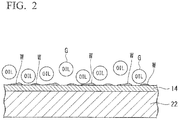
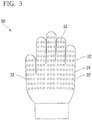
- the oil contamination protection tool having such a configuration, it is possible to suppress adhesion of fats and oils to the oil contamination protection tool, and even if oil adheres to the oil contamination protection tool, it is possible to easily wash out the adhered oil by washing with water. That is, by the oil/water separator formed on the substrate, hydrophilicity/oil-repellency is imparted to the substrate. If oil comes into contact with the substrate on which the oil/water separator has been formed, due to the oil-repellency of the oil/water separator, the oil agglomerates as oil droplets having a large static contact angle. Only by shooting out water, due to the hydrophilicity of the oil/water separator, moisture becomes an aqueous layer having a small static contact angle and spreads along the surface of the substrate, and oil droplets are easily peeled off and washed off.
- the surface-coating material of the present invention includes a fluorine-based compound which is a hydrophilic/oil-repellent, a binder, and a solvent, it is possible to form a hydrophilic/oil-repellent layer (coated film) having excellent coatability, capable of imparting sufficient hydrophilicity/oil-repellency to various substrates, and having excellent sustainability of a hydrophilic/oil-repellent effect.
- the coated film of the present invention includes a fluorine-based compound which is a hydrophilic/oil-repellent and a binder, the coated film has excellent adhesion to various substrates, and when the coated film is provided on at least a part of the surface of a substrate, it is possible to impart sufficient hydrophilicity/oil-repellency.
- hydrophilic/oil-repellent layer is provided on at least a part of the surface of a substrate by the surface-coating material described above, the hydrophilic/oil-repellent material of the present invention shows hydrophilicity/oil-repellency.
- the surface-coating material which is one embodiment to which the present invention has been applied will be described together with a coated film and a hydrophilic/oil-repellent material formed by using the surface-coating material.
- the surface-coating material of the present embodiment is obtained by forming a hydrophilic/oil-repellent layer (or, "coated film") which exhibits hydrophilicity/oil-repellency on a part or all of the surface of a substrate, by applying to various substrates.
- the surface-coating material of the present embodiment includes a nitrogen-containing fluorine-based compound (fluorine-based compound) represented by the following formulas (1) to (4), a binder, and a solvent.
- a nitrogen-containing fluorine-based compound represented by the following formulas (1) to (4)
- a binder represented by the following formulas (1) to (4)
- a solvent represented by the following formulas (1) to (4)
- Rf 1 and Rf 2 each represent a linear or branched perfluoroalkyl group having 1 to 6 carbon atoms, which are the same as or different from each other.
- Rf 2 represents a linear or branched perfluoroalkylene group having 1 to 6 carbon atoms.
- Rf 2 and Rf 2 each preferably represent a linear or branched perfluoroalkyl group having 1 to 4 carbon atoms, which are the same as or different from each other.
- Rf 3 preferably represents a linear or branched perfluoroalkylene group having 1 to 4 carbon atoms.
- Rf 4 , Rf 5 , and Rf 6 each represent a linear or branched perfluoroalkylene group having 1 to 6 carbon atoms, which are the same as or different from each other.
- Z includes any one of an oxygen atom, a nitrogen atom, a CF 2 group, and a CF group.
- a perfluoroalkyl group branched from Z may be bonded to Z.
- Rf 4 , Rf 5 , and Rf 6 each preferably represent a linear or branched perfluoroalkylene group having 1 to 4 carbon atoms, which are the same as or different from each other.
- R represents a linking group which is a divalent organic group.
- R may be a linear or branched organic group.
- R may include one or more types of bonds selected from an ether bond, an ester bond, an amide bond, and a urethane bond in the molecular chain, or may not include.
- X is any one hydrophilicity imparting group selected from the group consisting of anion type hydrophilicity imparting groups, cation type hydrophilicity imparting groups, and amphoteric type hydrophilicity imparting groups.
- the nitrogen-containing fluorine-based compound represented by the formulas (1) to (4) is a hydrophilic/oil-repellent including an oil-repellency imparting group and a hydrophilicity imparting group in the molecule.
- the surface-coating material of the present embodiment may be obtained by using a mixture including two or more fluorine-based compounds selected from the group consisting of nitrogen-containing fluorine-based compounds represented by the formulas (1) to (4) as a hydrophilic/oil-repellent.
- nitrogen-containing fluorine-based compounds as the hydrophilic/oil-repellent will be described in detail.
- a nitrogen-containing perfluoroalkyl group formed of Rf 1 and Rf 2 and a nitrogen-containing perfluoroalkylene group formed of Rf 3 configure an oil-repellency imparting group.
- the total number of carbon atoms to which fluorine is bonded, in Rf 1 to Rf 2 which are the oil-repellency imparting groups is preferably within a range of 4 to 18. If the number of carbon atoms to which fluorine is bonded is less than 4, since an oil-repellent effect is not sufficient, this is not preferable.
- Rf 5 , and Rf 6 , and Z configure an oil-repellency imparting group.
- the total number of carbon atoms to which fluorine is bonded, in Rf 4 to Rf 6 and Z which are the oil-repellency imparting groups is preferably within a range of 4 to 18, and more preferably within a range of 5 to 12. If the number of carbon atoms to which fluorine is bonded is less than 4, since an oil-repellent effect is not sufficient, this is not preferable.
- R is a linking group connecting an oil-repellency imparting group and a hydrophilicity imparting group in the molecular chain.
- the structure of the linking group R is not particularly limited as long as it is a divalent organic group.
- the linking group R may include one or more selected from polyoxyalkylene groups and epoxy groups.
- the hydrocarbon group may be a saturated hydrocarbon group or an unsaturated hydrocarbon group.
- the hydrocarbon group may be a chainlike hydrocarbon group or a cyclic hydrocarbon group.
- the chainlike hydrocarbon group may be linear or branched. Examples of the hydrocarbon group include an alkylene group, an alkenylene group, and an arylene group.
- the imino group and the hydrocarbon group may have a substituent.
- the linking group R may include one or more types of bonds selected from an ether bond, an ester bond, an amide bond, and a urethane bond in the molecular chain, or may not include.
- the amide bond includes a carboxylic acid amide bond and a sulfonamide bond.
- the ester bond includes a carboxylic acid ester bond, a sulfonic acid ester bond, and a phosphoric acid ester bond.
- the linking group R is preferably suitably selected and introduced, according to the characteristics desired to be imparted to the nitrogen-containing fluorine-based compound. Specific examples thereof include a case where it is desired to adjust the solubility in a solvent, a case where it is desired to improve durability by improving adhesion to a substrate, and a case where it is desired to improve compatibility with a resin component or the like.
- the method there are a method of adjusting the presence or absence and the type of polar group affecting intermolecular interaction, a method of adjusting the chain length of a hydrocarbon group having a linear or branched structure, and a method of introducing a structure similar to a part of the chemical structure included in the substrate or the resin component.
- X is any one hydrophilicity imparting group selected from the group consisting of anion type hydrophilicity imparting groups, cation type hydrophilicity imparting groups, and amphoteric type hydrophilicity imparting groups.
- hydrophilic/oil-repellent nitrogen-containing fluorine-based compound
- X is an anion type hydrophilicity imparting group having "-CO 2 M 1 ", “-SO 3 M 1 ", “-OSO 3 M 1 ", “-OP(OH)O 2 M 1 ", “-OPO 3 M 1 2 “, “-O 2 PO 2 M 1 ", or “-PO(OH) y (OM 1 ) 2-y "
- M 1 represents an alkali metal, an alkali earth metal, Mg, Al, or R 1 R 2 R 3 R 4 N + ;
- R 1 to R 4 are hydrogen atoms or each independently a linear or branched alkyl group having 1 to 20 carbon atoms, and preferably having 1 to 10 carbon atoms, and y represents an integer of 0 to 2) at the terminal.
- the above-described structure example of the terminal shows a case where M 1 is monovalent.
- M 1 is divalent
- two identical anions may be bonded to M 1
- two different types of anions may be bonded to M 1 .
- alkali metal examples include lithium (Li), sodium (Na), potassium (K), and cesium (Cs).
- alkali earth metal examples include calcium (Ca), strontium (Sr), and barium (Ba).
- the quaternary ammonium salt (R 1 R 2 R 3 R 4 N + ) is not particularly limited as long as R 1 to R 4 are hydrogen atoms or each independently a linear or branched alkyl group having 1 to 20 carbon atoms, and preferably having 1 to 10 carbon atoms.
- R 1 to R 4 are hydrogen atoms or each independently a linear or branched alkyl group having 1 to 20 carbon atoms, and preferably having 1 to 10 carbon atoms.
- the number of carbon atoms of the alkyl group is 20 or less, since the hydrophilicity/oil-repellency is not impaired, this is preferable.
- R 1 , R 2 , R 3 , and R 4 are the same include (CH 3 ) 4 N + , (C 2 H 5 ) 4 N + , (C 3 H 7 ) 4 N + , (C 4 H 9 ) 4 N + , (C 5 H 11 ) 4 N + , (C 6 H 13 ) 4 N + , (C 7 H 15 ) 4 N + , (C 8 H 17 ) 4 N + , (C 9 H 19 ) 4 N + , and (C 10 H 21 ) 4 N + .
- R 4 is (C 2 H 5 ), (C 6 H 13 ), (CsH 17 ), (C 9 H 19 ), (C 10 H 21 ), (C 12 H 25 ), (C 14 H 29 ), (C 16 H 33 ), or (C 18 H 37 ) is exemplified.
- R 3 and R 4 are (C 8 H 17 ), (C 10 H 21 ), (C 12 H 25 ), (C 14 H 29 ), (C 16 H 33 ), or (C 18 H 37 ) is exemplified.
- R 1 is a methyl group
- R 4 are (C 4 H 9 ) or (C 8 H 17 ) is exemplified.
- a nitrogen-containing fluorine-based compound (A) is desired to be a sparingly soluble compound having low solubility in water.
- M 1 which is an counter ion is preferably an alkali earth metal, Mg, or Al, and, in particular, Ca, Ba, and Mg are preferable since they have excellent hydrophilicity/oil-repellency and low solubility in water.
- hydrophilicity imparting group X is an anion type
- specific examples here, the structure of M 1 which is a counter ion is excluded
- the structure of the hydrophilic/oil-repellent represented by the formula (1) or (2) that is, a linear nitrogen-containing fluorine-based compound
- structures of the following formulas (50) to (117) include structures of the following formulas (50) to (117).
- hydrophilicity imparting group X is a cation type
- specific examples of the structure of the hydrophilic/oil-repellent represented by the formula (1) or (2) include structures of the following formulas (190) to (223).
- X has a carboxy betaine type "-N + R 8 R 9 (CH 2 ) n CO 2 - ", a sulfobetaine type "-N + R 8 R 9 (CH 2 ) n SO 3 - ", an amine oxide type "-N + R 8 R 9 O - ", or Phosphobetaine type "-OPO 3 - (CH 2 ) n N + R 8 R 9 R 10 " (n is an integer of 1 to 5, R 8 and R 9 are hydrogen atoms or alkyl groups having 1 to 10 carbon atoms, and R 10 is a hydrogen atom or an alkyl group having 1 to 10 carbon atoms or an alkylene group having 1 to 10 carbon atoms) at the terminal.
- R 8 and R 9 are hydrogen atoms or alkyl groups having 1 to 10 carbon atoms
- R 10 is a hydrogen atom or an alkyl group having 1 to 10 carbon atoms or an alkylene group having 1 to 10 carbon atoms
- hydrophilicity imparting group X is an amphoteric type
- specific examples of the structure of the hydrophilic/oil-repellent represented by the formula (1) or (2) that is, a linear nitrogen-containing fluorine-based compound
- structures of the following formulas (259) to (309) include structures of the following formulas (259) to (309).
- hydrophilic/oil-repellent represented by the formula (3) or (4) that is, a cyclic nitrogen-containing fluorine-based compound
- structures of the following formulas (310) to (375) include structures of the following formulas (310) to (375).
- the hydrophilic/oil-repellent used in the surface-coating material of the present embodiment described above are simply examples, and the technical scope of the present invention is not limited to the above specific examples. That is, the hydrophilic/oil-repellent used in the surface-coating material of the present embodiment may have at least one or more oil-repellency imparting groups formed of a nitrogen-containing perfluoroalkyl group and at least one or more hydrophilicity imparting groups of any types of an anion type, a cation type, and an amphoteric type, in the molecule, respectively.
- hydrophilic/oil-repellent used in the surface-coating material of the present embodiment described above sufficiently exhibits hydrophilicity/oil-repellency by itself, but, since in the practical environment, acid, alkali, oil, and the like are included, there are many differences, and thus, in the case of considering practical durability, it is desirable to increase the durability against the practical environment by suitably combining hydrophilic/oil-repellents.
- hydrophilic/oil-repellent used in the surface-coating material of the present invention various modifications can be added in a range not departing from the scope of the present invention.
- an oil-repellency imparting group formed of a nitrogen-containing perfluoroalkyl group a case where R f1 and R f2 shown in the formulas (1) and (2) are symmetric has been described, but the present invention is not limited thereto, and R f1 and R f2 may be asymmetric.
- the hydrophilic/oil-repellent used in the surface-coating material of the present embodiment may have two or more same or different oil-repellency imparting groups in the molecule.
- the oil-repellency imparting groups may be provided at both terminals of the molecule or may be provided in the molecular chain.
- hydrophilic/oil-repellent used in the surface-coating material of the present embodiment may have two or more same or different hydrophilicity imparting groups in the molecule.
- the hydrophilic/oil-repellent used in the surface-coating material of the present embodiment may have two or more same or different bonds in the linking group.
- the linking group is a polymer type
- the repeat number and the bonding order of unit are not particularly limited.
- hydrophilicity/oil-repellency specifically, can be performed by a contact angle measurement (droplet method).
- the nitrogen-containing fluorine-based compound represented by each of the above formulas (1) to (4) is dissolved in methanol to obtain a methanol solution.
- the soda glass plate is washed with pure water and washed with acetone, and dried.
- the soda glass plate is immersed (dip coated) in the methanol solution, then, the methanol is removed by drying at room temperature, whereby a coating film is formed on the glass plate.
- the dropping method of water and n-hexadecane is performed using the following conditions.
- the nitrogen-containing fluorine-based compound represented by each of the above formulas (1) to (4) is produced using a carboxylic acid halide or a sulfonic acid halide having a nitrogen-containing perfluoroalkyl group represented by the following formula (5) or (6) as a raw material.
- the nitrogen-containing fluorine-based compound represented by the formula (1) or (2) is produced using a carboxylic acid halide or a sulfonic acid halide having a nitrogen-containing perfluoroalkyl group represented by the following formula (5) as a raw material.
- the nitrogen-containing fluorine-based compound represented by the formula (3) or (4) is produced using a carboxylic acid halide or a sulfonic acid halide having a nitrogen-containing perfluoroalkyl group represented by the following formula (6) as a raw material.
- Rf 1 and Rf 2 each represent a linear or branched perfluoroalkyl group having 1 to 6 carbon atoms, which are the same as or different from each other.
- Rf 3 represents a linear or branched perfluoroalkylene group having 1 to 6 carbon atoms.
- Rf 1 and Rf 2 each preferably represent a linear or branched perfluoroalkyl group having 1 to 4 carbon atoms, which are the same as or different from each other.
- Rf 3 preferably represents a linear or branched perfluoroalkyl group having 1 to 4 carbon atoms.
- Rf 4 , Rf 5 , and Rf 6 each represent a linear or branched perfluoroalkylene group having 1 to 6 carbon atoms, which are the same as or different from each other.
- Rf 4 , Rf 5 , and Rf 6 each preferably represent a linear or branched perfluoroalkylene group having 1 to 4 carbon atoms, which are the same as or different from each other.
- Z includes any one of an oxygen atom, a nitrogen atom, a CF 2 group, and a CF group.
- a perfluoroalkyl group branched from Z may be bonded to Z.
- Y is CO or SO 2 .
- A is any one halogen atom selected from the group consisting of fluorine, chlorine, bromine, and iodine.
- the production method of a hydrophilic/oil-repellent used in the surface-coating material of the present embodiment is a production method different depending on the type of X shown in the above formulas (1) to (4). The cases will be explained separately below.
- the raw material in a case where Y is CO (in the case of being carboxylic acid-based), the raw material is added dropwise to the aqueously solubilized M(OH) m (M is Li, Na, K, Ca, Mg, or Al, m is 1 in the case of a monovalent cation such as Li, Na, or K, m is 2 in the case of a divalent cation such as Ca or Mg, and m is 3 in case of a trivalent cation such as Al) and in a case where Y is SO 2 (in the case of being sulfonic acid-based), the raw material is added dropwise to the aqueously solubilized M(OH) m (M is Li, Na, K, R 1 R 2 R 3 R 4 N + , Ca, Mg, or Al, m is 1 in case of a monovalent cation such as Li, Na, or K, m is 2 in the case of a di
- the objective substance is extracted from the obtained solid by performing dry solidification using a solvent in which the objective substance is soluble and M(A), M(A) 2 , or M(A) 3 which is a by-product is insoluble, then, by further performing dry solidification on this extraction solvent, the objective substance can be obtained.
- this salt can be converted to carboxylic acid or sulfonic acid using an acid such as sulfuric acid, and by making a desired salt using M(OH) m again after distillation, it is also possible to make highly pure.
- a linking group R having an amide bond between an oil-repellency imparting group (nitrogen-containing perfluoroalkyl group) and an anion type hydrophilicity imparting group first, by reacting a nitrogen-containing perfluoroalkylcarbonyl fluoride or a sulfonyl fluoride with an aminoalkylcarboxylic acid or aminophenylsulfonic acid and then reacting with alkali hydroxide, an alkali metal salt of a carboxylic acid or sulfonic acid having an amide bond is obtained.
- a linking group R having an ester bond between an oil-repellency imparting group (nitrogen-containing perfluoroalkyl group) and an anion type hydrophilicity imparting group first, by reacting a nitrogen-containing perfluoroalkylcarbonyl fluoride or a sulfonyl fluoride with a hydroxyphenyl organic acid and then reacting with alkali hydroxide, an alkali metal salt of a carboxylic acid or sulfonic acid having an ester bond is obtained.
- nitrogen-containing perfluoroalkylcarbonyl fluoride is reduced with lithium aluminum hydride (LiAlH 4 ) or sodium borohydride (NaBH 4 ) to produce an alcohol having a nitrogen-containing perfluoroalkyl group.
- the alcohol is converted to potassium alcoholate with t-butoxypotassium or the like, and then by reacting with a metal salt of a halogenated organic acid, an alkali metal salt of a carboxylic acid having an ether bond is obtained.
- nitrogen-containing perfluoroalkylcarbonyl fluoride or sulfonyl fluoride is amide-bonded with N,N-dialkylaminoalkyleneamine to give a terminal tertiary amine, and by performing quaternization with an alkylating agent such as methyl iodide (CH 3 I), methyl bromide (CH 3 Br), or dimethyl sulfate ((CH 3 ) 2 SO 4 ), a nitrogen-containing fluorine-based compound having a cation type hydrophilicity imparting group is obtained.
- an alkylating agent such as methyl iodide (CH 3 I), methyl bromide (CH 3 Br), or dimethyl sulfate ((CH 3 ) 2 SO 4 .
- nitrogen-containing perfluoroalkylcarbonyl fluoride or sulfonyl fluoride is ether-bonded with N,N-dialkylaminoalkylene alcohol to give a terminal tertiary amine, and by performing guaternization with an alkylating agent such as methyl iodide (CH 3 I), methyl bromide (CH 3 Br), or dimethyl sulfate ((CH 3 ) 2 SO 4 ), a nitrogen-containing fluorine-based compound having a cation type hydrophilicity imparting group is obtained.
- an alkylating agent such as methyl iodide (CH 3 I), methyl bromide (CH 3 Br), or dimethyl sulfate ((CH 3 ) 2 SO 4 .
- nitrogen-containing perfluoroalkylcarbonyl fluoride or sulfonyl fluoride is amide-bonded with N,N-dialkylaminoalkyleneamine or ether-bonded with N,N-dialkylaminoalkylene alcohol to give a terminal tertiary amine, and by reacting with sodium monochloroacetate, a nitrogen-containing fluorine-based compound having an amphoteric type hydrophilicity imparting group is obtained.
- a nitrogen-containing fluorine-based compound having an amphoteric type hydrophilicity imparting group is obtained.
- a phosphobetaine type by reacting an alcohol form obtained by reducing nitrogen-containing perfluorocarbonyl fluoride or one obtained by introducing a hydroxyl group at the terminal by sulfonamidating nitrogen-containing perfluoroalkylsulfonyl fluoride with an amino alcohol, with, for example, phosphorus oxychloride in the presence of abase such as trimethylamine, a dichlorophosphoric acid ester having a nitrogen-containing perfluoroalkyl group is obtained.
- the surface-coating material of the present embodiment may include a binder. Since the surface-coating material includes a binder, when a surface-coating layer (coated film) is formed on at least a part of the surface of the substrate by applying the surface-coating material to the surface of the substrate to be treated, it is possible to enhance adhesion between the surface of the substrate and the surface-coating layer (coated film).
- the binder included in the surface-coating material has a function of reducing the area in contact with the environment of the hydrophilic/oil-repellent itself by enclosing the hydrophilic/oil-repellent (nitrogen-containing fluorine-based compound), and thus, it is possible to improve sustainability of the hydrophilic/oil-repellent effect.
- the binder include a resin or an inorganic glass.
- the resin include a thermoplastic resin, a thermoplastic elastomer, a thermosetting resin, a UV curable resin, and specific examples thereof include thermoplastic resins such as polyvinyl chloride, polyethylene, polypropylene, polycarbonate, polyester, polystyrene, a silicone resin, polyvinyl acetal, polyvinyl alcohol, an acrylic polyol-based resin, a polyester polyol-based resin, a urethane resin, a fluororesin, and a thermoplastic acrylic resin, and thermosetting resins such as an epoxy resin, a phenol resin, and a thermosetting acrylic resin.
- hydrophilic polymers are preferably used as a binder.
- a hydrophilic polymer containing a hydroxyl group which bring about adhesion to the substrate or interaction such as a hydrogen bond with a hydrophilic/oil-repellent composite is preferable.
- hydrophilic polymer examples include polysaccharides such as polyvinyl alcohol, polyvinyl butyral and cellulose, and derivatives thereof. These may be used alone or in combination of two or more types thereof.
- the hydrophilic polymer may be crosslinked with a crosslinking agent. By such crosslinking, the durability of paint is improved.
- the crosslinking agent is not particularly limited, and can be suitably selected depending on the purpose. Specific examples thereof include an epoxy compound, an isocyanate compound, an aldehyde compound, an aldehyde compound, an ultraviolet crosslinking type compound, a leaving group-containing compound, a carboxylic acid compound, and a urea compound.
- the inorganic glass include silane compounds such as a trialkoxysilane represented by the chemical formula [R 14 Si(OR 15 ) 3 ] and a tetraalkoxysilane represented by the chemical formula [Si(OR 16 ) 4 ] (R 14 to R 16 are each independently an alkyl group having 1 to 6 carbon atoms), and water glass.
- silane compounds such as a trialkoxysilane represented by the chemical formula [R 14 Si(OR 15 ) 3 ] and a tetraalkoxysilane represented by the chemical formula [Si(OR 16 ) 4 ]
- R 14 to R 16 are each independently an alkyl group having 1 to 6 carbon atoms
- water glass since water glass has a high durability improving effect, this is preferable.
- the mass composition ratio between a fluorine-based compound (hydrophilic/oil-repellent) described above and a binder is preferably within a range of 0.2 to 99.9:99.8 to 0.1, more preferably within a range of 2 to 98:98 to 2, and still more preferably within a range of 10 to 90:90 to 10. If the mass composition ratio of the hydrophilic/oil-repellent is 0.2 or greater, since the hydrophilicity/oil-repellency is sufficiently obtained, this is preferable.
- examples of the solvent which can be used in the surface-coating material of the present embodiment include water, an organic solvent, and a mixture of water and an organic solvent.
- examples of the organic solvent include methanol, ethanol, IPA, tetrahydrofuran, hexane, chloroform, toluene, ethyl acetate, DMSO, DMF, acetone, and a fluorine-based solvent.
- water or alcohols such as methanol, ethanol, and IPA, or a mixture of water and alcohol is preferable.
- solvents include ether-based solvents such as tetrahydrofuran, aliphatic hydrocarbon-based solvents such as hexane, halogenated hydrocarbon-based solvents such as chloroform, aromatic hydrocarbon-based solvents such as toluene, ester-based solvents such as ethyl acetate, ketone-based solvents such as acetone, and fluorine-based solvents such as hexafluoroxylene.
- ether-based solvents such as tetrahydrofuran
- aliphatic hydrocarbon-based solvents such as hexane
- halogenated hydrocarbon-based solvents such as chloroform
- aromatic hydrocarbon-based solvents such as toluene
- ester-based solvents such as ethyl acetate
- ketone-based solvents such as acetone
- fluorine-based solvents such as hexafluoroxylene.
- the mass composition ratio between a fluorine-based compound (hydrophilic/oil-repellent) and a solvent is preferably within a range of 0.05 to 50:99.95 to 50, more preferably within a range of 1 to 20:99 to 80, and still more preferably within a range of 2 to 10:98 to 90. If the mass composition ratio of the fluorine-based compound (hydrophilic/oil-repellent) in the surface-coating material is 0.05 or greater, when treated, since it is possible to sufficiently render hydrophilicity/oil-repellency to the entirety of the substrate, this is preferable.
- the mass composition ratio of the fluorine-based compound in the surface-coating material is 50 or less, since the solution dispersion stability of the surface-coating material is excellent, this is preferable.
- the mass composition ratio between the fluorine-based compound in the surface-coating material and the solvent is preferably within a range of 2 to 10:98 to 90.
- a silane compound is used when hydrophilicity/oil-repellency is imparted to a substrate. Therefore, there is a problem that the substrate to be treated is limited to glass.
- the binder can be suitably selected depending on the type or the shape of the substrate to be treated, or the application, and thus, it is possible to impart sufficient hydrophilicity/oil-repellency to various substrates, and it is possible to improve sustainability of a hydrophilic/oil-repellent effect.
- the surface-coating material may further include an additive such as a pigment, a conductivity imparting agent, or a leveling agent, as an optional component.
- the production method of the surface-coating material of the present embodiment is not particularly limited as long as it is a mixing method in which the fluorine-based compound (hydrophilic/oil-repellent) can be dispersed or dissolved in a solvent.
- a mixing method include a ball mill, a roll mill, a sand mill, a paint shaker, a homogenizer, an impeller stirrer, an ultrasonic disperser, and a magnetic stirrer.
- the mass composition ratio between the fluorine-based compound (hydrophilic/oil-repellent) and the binder is preferably within a range of 0.2 to 99.9:99.8 to 0.1.
- the mass composition ratio of the fluorine-based compound is 0.2 or greater, since sufficient hydrophilicity/oil-repellency is obtained, this is preferable.
- the mass composition ratio is more preferably within a range of 2 to 98:98 to 2, and particularly preferably within a range of 10 to 90:90 to 10.
- a forming method that is, a usage method of a surface-coating material of a coated film (surface-coating layer) of a coated film (surface-coating layer)
- the surface-coating material described above is applied onto at least a part of the surface of a substrate, and then, a drying treatment is performed for removing the solvent.
- a drying treatment is performed for removing the solvent.
- the substrate is not particularly limited, and glass, plastic, metal, ceramics, stainless steel, aluminum, wood, stone, cement, concrete, fiber, cloth, paper, leather, a combination thereof, a structure thereof, or a laminate thereof can be used.
- the method of applying the surface-coating material to the surface of a substrate is not particularly limited. Specific example thereof include a dipping method of dipping a substrate in a surface-coating material, a bar coater method, and a method using application means such as a spray, a brush, or a roller, or using a printing technique. Thereby, it is possible to form the coated film (surface-coating layer) on a part or all of the surface of the substrate.
- the conditions of the drying treatment of the coated film (surface-coating layer) formed vary depending on the type and content of the solvent included in the surface-coating material, for example, drying at room temperature for 1 to 24 hours, or drying by heating to an extent that the substrate is not influenced can be exemplified.
- a coated film (hydrophilic/oil-repellent layer) including the nitrogen-containing fluorine-based compound (hydrophilic/oil-repellent) described above on a part or all of the surface of the substrate.
- hydrophilic/oil-repellent material in which a coated film (hydrophilic/oil-repellent layer) has been provided on a part or all of the surface of the substrate.
- the hydrophilic/oil-repellent material of the present embodiment is a hydrophilic/oil-repellent material in which a hydrophilic/oil-repellent layer (coated film) has been provided on a part or all of the surface of a substrate by the surface-coating material described above.
- the substrates materials to be treated
- the substrates exemplified as the treatment target of the surface-coating material described above can be used.
- a transparent resin substrate such as a PET film or a transparent inorganic material substrate such as plate glass (that is, glass plate) is preferably used.
- a transparent resin substrate such as a PET film
- a transparent inorganic material substrate such as plate glass (that is, glass plate) is preferably used.
- the hydrophilic/oil-repellent layer is a coated film formed on a part or all of the surface of a substrate using the surface-coating material described above. Therefore, the hydrophilic/oil-repellent layer includes one or more nitrogen-containing fluorine-based compounds represented by the formulas (1) to (4) and a binder.
- the mass composition ratio between the nitrogen-containing fluorine-based compound (hydrophilic/oil-repellent) and the binder in the hydrophilic/oil-repellent layer is preferably within a range of 0.2 to 99.9:99.8 to 0.1, as the mass composition ratio in the surface-coating material.
- the mass composition ratio of the fluorine-based compound is 0.2 or greater, since sufficient hydrophilicity/oil-repellency is obtained, this is preferable.
- the mass composition ratio is more preferably within a range of 2 to 98:98 to 2, and particularly preferably within a range of 10 to 90:90 to 10.
- hydrophilic/oil-repellent material of the present embodiment the evaluation of hydrophilicity and oil-repellency can be performed by contact angle measurement, as in the surface-coating material described above.
- the substrate is defined to have hydrophilicity/oil-repellency (that is, a hydrophilic/oil-repellent material).
- hydrophilicity/oil-repellency that is, a hydrophilic/oil-repellent material
- the static contact angle for water in the hydrophilic/oil-repellent layer provided on the surface of a substrate is 15° or less, and the static contact angle for n-hexadecane is 65° or greater. If the static contact angle is within the above range, the action of the oil-repellency imparting group and the hydrophilicity imparting group is excellent, and thus, it is possible to realize a hydrophilic/oil-repellent material having excellent low adhesiveness of oil stains (that is, antifouling properties) and easy cleaning properties by water.
- the evaluation of the sustainability of a hydrophilic/oil-repellent effect (that is, the durability of a hydrophilic/oil-repellent effect) can be performed by immersing the hydrophilic/oil-repellent material in water at room temperature for 1 hour, by drying, and by measuring the static contact angle for water and oil of the hydrophilic/oil-repellent layer (coated film) provided on the surface of the hydrophilic/oil-repellent material.
- the hydrophilic/oil-repellent layer provided on the surface of a substrate has a configuration including a binder suitable for improving adhesion to the substrate and durability to water. Therefore, the hydrophilic/oil-repellent layer has excellent adhesion to the substrate and durability to water, and thus, even in a case where washing with water is performed after once being contaminated, hydrophilicity/oil-repellency does not disappear. That is, it is possible to provide a hydrophilic/oil-repellent material having excellent sustainability of the hydrophilic/oil-repellent effect.
- the evaluation of transparency can be performed by the total light transmittance (%).
- the total light transmittance (%) can be measured using a haze meter ("NDH-300A" manufactured by Nippon Denshoku Industries Co., Ltd. or the like).
- NDH-300A manufactured by Nippon Denshoku Industries Co., Ltd. or the like.
- the total light transmittance (%) of the entire hydrophilic/oil-repellent material including the hydrophilic/oil-repellent layer was measured, and in a case where the total light transmittance is 90% or greater, it can be determined to be a hydrophilic/oil-repellent material having excellent transparency.
- a member in the related art requiring transparency can also be replaced with the transparent hydrophilic/oil-repellent material.
- a member in the related art requiring transparency for example, in a case where it is necessary to ensure visibility and the like, it is possible to easily maintain transparency over a long period of time.
- the hydrophilic/oil-repellent material having excellent flexibility and using a transparent PET film
- by providing the PET film on the surface of another member as a protection film it is possible to simply impart antifouling properties and easy cleaning properties to another member.
- a specific nitrogen-containing fluorine-based compound is included as a hydrophilic/oil-repellent, and thus, it is possible to impart excellent hydrophilicity/oil-repellency (hydrophilicity/oil-repellency) to the substrate to be treated.
- the surface-coating material of the present embodiment includes a binder suitably selected depending on the type of the substrate to be treated at a required mass composition ratio with respect to the nitrogen-containing fluorine-based compound, and since it is possible to improve the adhesion between the hydrophilic/oil-repellent layer (coated film) exhibiting hydrophilic/oil-repellency and the substrate, improve the durability of the hydrophilic/oil-repellent layer itself, or improve the durability to water, it is possible to improve sustainability of the hydrophilic/oil-repellent effect.
- the surface-coating material of the present embodiment by suitably selecting the types of the nitrogen-containing fluorine-based compound which becomes a hydrophilic/oil-repellent and the binder, it is possible to form a hydrophilic/oil-repellent layer (coated film) which exhibits hydrophilicity/oil-repellency to the substrate without impairing the transparency of the substrate.
- the surface-coating material of the present embodiment includes only the nitrogen-containing fluorine-based compound represented by the formulas (1) to (4) as a hydrophilic/oil-repellent and does not contain a perfluoroalkyl group having 8 or more carbon atoms which are continuously bonded, while the surface-coating material has a chemical structure without concern of generating PFOS or PFOA which becomes a problem in terms of bioaccumulation and environmental adaptability, and can impart excellent hydrophilicity/oil-repellency to the substrate.
- the hydrophilic/oil-repellent material of the present embodiment has excellent antifouling properties and easy cleaning properties. Furthermore, since the adhesion between the hydrophilic/oil-repellent layer (coated film) and the substrate, the durability of the hydrophilic/oil-repellent layer itself, and the durability to water are excellent, the sustainability of effect is also excellent.
- a member for example, a glass plate or the like in the related art requiring transparency can also be easily replaced with the transparent hydrophilic/oil-repellent material, and it is possible to simply impart antifouling properties and easy cleaning properties to the member.
- the member with a stain adhesion preventing film which is one aspect of the hydrophilic/oil-repellent material described above is roughly configured to have a member main body (substrate) and a stain adhesion preventing film (coated film or surface-coating layer) formed on at least a part of the surface of the member main body.
- the member main body to which a stain adhesion preventing film is imparted is not particularly limited as long as it is a member in which stains is less likely to adhere on the surface of the member and in which stains is desired to be easily removed by washing with water.
- Examples of such a member include a kitchen member and a sanitary member.
- a kitchen member examples include a kitchen panel, a range hood, a gas table, and a cooking utensil.
- the sanitary member is a member used in a sanitary facility such as a toilet, a bathroom, or a toilet, and examples thereof include a toilet, a bathroom and toilet ceiling, a wall, a door, a mirror, a washstand, a bathtub, and a toilet bowl.
- a resin film such as a PET film having a total light transmittance of 90% or greater may be used as the member main body.
- a resin film such as a PET film having excellent transparency as the member main body, it is possible to provide a hydrophilic/oil-repellent film having good familiarity with water (static contact angle for water, at most 15°) while showing stain low adhesion performance in which oil (here, hexadecane) is repelled and oil droplets are scattered if air is sprayed.
- the evaluation of transparency of the resin film can be performed by the total light transmittance (%).
- the total light transmittance (%) can be measured using a haze meter ("NDH-300A" manufactured by Nippon Denshoku Industries Co., Ltd. or the like). Specifically, the total light transmittance (%) of the entire member main body is measured, and in a case where the total light transmittance is 90% or greater, this can be used as the member main body of the present aspect.
- the stain adhesion preventing film of the present aspect is a film (corresponds to the coated film and the surface-coating layer described above) which exhibits hydrophilicity/oil-repellency, provided on a part or all of the surface of the substrate of the member main body.
- the surface of the member main body is not particularly limited, at least, it is possible to select an arbitrary place such as a place where stains easily adhere or a place where it is desired to prevent adhesion of stains.
- the stain prevention film may be a continuous film or a discontinuous film.
- the evaluation of hydrophilicity and oil-repellency can be performed by contact angle measurement, as in the hydrophilic/oil-repellent material described above.
- the member is defined to have hydrophilicity/oil-repellency (that is, a member with a stain adhesion preventing film).
- hydrophilicity/oil-repellency that is, a member with a stain adhesion preventing film.
- the static contact angle for water in the stain adhesion preventing film provided on the surface of the member main body is 15° or less, and the static contact angle for n-hexadecane is 65° or greater. If the static contact angle is within the above range, the action of the oil-repellency imparting group and the hydrophilicity imparting group is excellent, and thus, it is possible to realize a member with a stain adhesion preventing film having excellent low adhesiveness of oil stains (that is, antifouling properties) and easy cleaning properties by water.
- the evaluation of transparency can be performed by the total light transmittance (%).
- the total light transmittance (%) can be measured using a haze meter ("NDH-300A" manufactured by Nippon Denshoku Industries Co., Ltd. or the like).
- NDH-300A manufactured by Nippon Denshoku Industries Co., Ltd. or the like.
- the total light transmittance (%) of the entire member with a stain adhesion preventing film including the stain adhesion preventing film (coated film, surface-coating layer) is measured, and in a case where the total light transmittance is 90% or greater, it is possible to determine to be a member with a stain adhesion preventing film having excellent transparency.
- the member with a stain adhesion preventing film (film with a stain adhesion preventing film) having excellent antifouling properties and easy cleaning properties and using a transparent PET film, by providing the PET film on the surface of another member as a protection film, it is possible to simply impart antifouling properties and easy cleaning properties to another member.
- the production method that is, a method of forming a stain adhesion preventing film of producing the member with a stain adhesion preventing film of the present aspect
- the surface-coating material described above is applied to the surface of the member main body, and then, a drying treatment is performed to remove the solvent component included in the surface-coating material.
- a coated film stain adhesion preventing film
- the member with a stain adhesion preventing film of the present aspect it is possible to easily provide a stain adhesion preventing film (coated film, surface-coating layer) that exhibits hydrophilicity/oil-repellency on the surface of the member main body by the surface-coating material described above.
- the stain adhesion preventing film including the specific nitrogen-containing fluorine-based compound described above as a hydrophilic/oil-repellent is provided in the member with a stain adhesion preventing film of the present aspect, the member has excellent antifouling properties and easy cleaning properties.
- the adhesion between the stain adhesion preventing film and the surface of the member main body and the durability of the stain adhesion preventing film itself are excellent, the sustainability of effect is also excellent.
- the member with a stain adhesion preventing film having excellent flexibility and using a transparent PET film by providing the PET film on the surface of another member as a protection film, it is possible to simply impart antifouling properties and easy cleaning properties to another member.
- the member with a stain adhesion preventing film of the present aspect includes only the nitrogen-containing fluorine-based compound represented by the formulas (1) to (4) as a hydrophilic/oil-repellent and does not contain a perfluoroalkyl group having 8 or more carbon atoms which are continuously bonded, while the surface-coating material has a chemical structure without concern of generating PFOS or PFOA which becomes a problem in terms of bioaccumulation and environmental adaptability, and can exhibit excellent hydrophilicity/oil-repellency.
- the oil contamination protection tool which is another aspect of the hydrophilic/oil-repellent material described above is an oil contamination protection tool for preventing sticking of oils, having a substrate covering a part of the body and an oil/water separator having hydrophilicity/oil-repellency formed on at least a part of the substrate, and the oil/water separator has a configuration in which a fluorine-based compound having an oil-repellency imparting group and a hydrophilicity imparting group is included.
- oil contamination protection tool which is another aspect of the hydrophilic/oil-repellent material described above, work shoes used in a workshop where fats and oils are present on the floor surface are exemplified.
- FIG. 1 (a) is a side plan view showing a work shoe (oil contamination protection tool) in the first example
- FIG 1 (b) is a plan view showing a ground surface of the shoe sole of the work shoe.
- the work shoe (oil contamination protection tool) 20 in the first example is formed of an upper portion 21 and a shoe sole (substrate) 22 bonded to the upper part 21.
- the upper portion 21 is formed of, for example, soft cloth or leather in which the surface has been subjected to waterproof finish.
- the shoe sole 22 is entirely formed of a resilient synthetic resin, for example, ethylene vinyl acetate (EVA) or polyvinyl chloride (PVC).
- EVA ethylene vinyl acetate
- PVC polyvinyl chloride
- a plurality of island-shape tread patterns 23 for preventing slip at the time of walking are formed.
- the respective tread patterns 23 are partitioned by the groove portion 24.
- an oil/water separator 14 is applied in a layer shape to the groove portion 24 (refer to FIG. 1 ) of the shoe sole (substrate) 22.
- the oil/water separator 14 is configured of a material including a fluorine-based compound having an oil-repellency imparting group and a hydrophilicity imparting group.
- the oil-repellency imparting group is a functional group that forms oil droplets with a static contact angle of, for example, 65° or greater on the surface of the oil/water separator 14.
- the hydrophilicity imparting group is a functional group that imparts the wettability to moisture with a static contact angle of, for example, 15° or less on the surface of the oil/water separator 14. Such a contact angle can be measured by, for example, an automatic contact angle meter ("Drop Master 701" manufactured by Kyowa Interface Science Co., Ltd.).
- the oil/water separator 14 imparts hydrophilicity/oil-repellency to the groove portion 24 of the shoe sole (substrate) 22. If oil (fat and oil) such as lard comes into contact with the groove portion 24 to which the oil/water separator 14 has been applied, due to the oil-repellency of the oil/water separator 14, the oil agglomerates as oil droplets (oil clot) G having a large static contact angle.
- the oil/water separator 14 repels oil so as not to be sticked to the shoe sole (substrate) 22, and it is possible to easily wash off oil by washing with water due to hydrophilicity.
- the fluorine-based compound configuring the oil/water separator 14 includes, for example, at least one or more of fluorine-based compounds represented by the formulas (1) to (4).
- the fluorine-based compound represented by the formulas (1) to (4) is a hydrophilic/oil-repellent including an oil-repellency imparting group and a hydrophilicity imparting group in the molecule.
- a mixture including one or more fluorine-based compounds selected from among the group consisting of fluorine-based compounds represented by the formulas (1) to (4) may be used as the oil/water separator 14.
- the oil/water separator 14 in the first example is a separator in which the nitrogen-containing fluorine-based compound (hydrophilic/oil-repellent) represented by the formulas (1) to (4) is applied alone to a substrate such as a shoe sole, or applied to a substrate such as a shoe sole together with a binder.
- the fluorine-based compound (hydrophilic/oil-repellent) configuring the oil/water separator 14 exists on the substrate.
- the fluorine-based compound is not lost by moisture or the like, the fluorine-based compound is preferably sticked to the substrate as the oil/water separator 14.
- a part or all of the surface of the substrate 22 may be coated with a coated film including the nitrogen-containing fluorine-based compound (hydrophilic/oil-repellent) represented by the formulas (1) to (4) or a coated film including the nitrogen-containing fluorine-based compound represented by the formulas (1) to (4) and a binder.
- a coated film including the nitrogen-containing fluorine-based compound (hydrophilic/oil-repellent) represented by the formulas (1) to (4) or a coated film including the nitrogen-containing fluorine-based compound represented by the formulas (1) to (4) and a binder may be coated with a coated film including the nitrogen-containing fluorine-based compound (hydrophilic/oil-repellent) represented by the formulas (1) to (4) or a coated film including the nitrogen-containing fluorine-based compound represented by the formulas (1) to (4) and a binder.
- the coated film is formed of only the fluorine-based compound (hydrophilic/oil-repellent), and there is a case where the coated film includes a binder.
- the mass composition ratio between a hydrophilic/oil-repellent and a binder is preferably within a range of 0.2 to 99.9:99.8 to 0.1, more preferably within a range of 2 to 98:98 to 2, and still more preferably within a range of 10 to 90:90 to 10. If the mass composition ratio of the hydrophilic/oil-repellent is 0.2 or greater, since the hydrophilicity/oil-repellency is sufficiently obtained, this is preferable.
- binder examples include an organic binder (resin) or an inorganic binder (inorganic glass) described above.
- a binder it is preferable to use a hydrophilic polymer.
- a hydrophilic polymer containing a hydroxyl group is preferable.
- hydrophilic polymer examples include polysaccharides such as polyvinyl alcohol, polyvinyl butyral and cellulose, and derivatives thereof. These may be used alone or in combination of two or more types thereof.
- the hydrophilic polymer may be crosslinked with the crosslinking agent described above. By such crosslinking, the durability of a coated film is improved.
- the inorganic binder include a silane compound and water glass, as described above.
- water glass since water glass has a high durability improving effect, this is preferable.
- inorganic particles such as fumed silica or colloidal silica can also be used as an inorganic reinforcing material, and by adding an inorganic reinforcing material, it is possible to reduce the dissolution properties of the nitrogen-containing fluorine-based compound into water and to improve the strength of the coated film.
- oil/water separator 14 When the oil/water separator 14 is actually formed on the substrate such as the shoe sole 22, for example, it is preferable to form an oil/water separation layer by applying a coating material including a solvent and a binder to the substrate.
- a coating material including a solvent and a binder
- the organic material capable of being used as the substrate 22 of the work shoe in the first example is not particularly limited, and specific examples thereof include ethylene vinyl acetate (EVA), polyvinyl chloride (PVC), cellulose cloth (polyester, polyethylene, polypropylene, polytetrafluoroethylene, nylon, polyimide, polyacrylonitrile, polysulfone, polyether sulfone, and polyphenylene sulfide), nonwoven fabric (polyester, polyethylene, polypropylene, rayon, nylon, and polyphenylene sulfide), and fiber (a resin, glass, ceramics, and metal).
- EVA ethylene vinyl acetate
- PVC polyvinyl chloride
- cellulose cloth polyyester, polyethylene, polypropylene, polytetrafluoroethylene, nylon, polyimide, polyacrylonitrile, polysulfone, polyether sulfone, and polyphenylene sulfide
- nonwoven fabric polyyester, polyethylene, polypropylene
- the fluorine-based compound (hydrophilic/oil-repellent) represented by the formulas (1) to (4) is supported on the substrate.
- a method of supporting the fluorine-based compound on a substrate a method in which a substrate to be supported is immersed in a solution or a dispersion of the fluorine-based compound (hydrophilic/oil-repellent) or a substrate to be supported is spray-coated with the solution or the dispersion, and the solvent is removed by drying can be applied.
- the oil/water separator 14 may further include an additive to impart functions other than the hydrophilicity/oil-repellency, such as a fluidity improver, a surfactant, a flame retardant, a conductivity imparting agent, and a fungicide, as optional components.
- an additive to impart functions other than the hydrophilicity/oil-repellency such as a fluidity improver, a surfactant, a flame retardant, a conductivity imparting agent, and a fungicide, as optional components.
- the work shoe (oil contamination protection tool) 20 in the first example is used in a kitchen or a food processing factory, even if oil (fat and oil) adheres to the groove portion 24 of the shoe sole (substrate) 22, it is possible to easily wash out the adhered oil by washing with water. That is, by the oil/water separator 14 formed in the groove portion 24 of the shoe sole 22, hydrophilicity/oil-repellency is imparted to the groove portion 24 of the shoe sole 22.
- oil (fat and oil) such as lard comes into contact with the groove portion 24 to which the oil/water separator 14 has been applied, due to the oil-repellency of the oil/water separator 14, the oil agglomerates as oil droplets (oil clot) G having a large static contact angle. Only by spraying water, due to the hydrophilicity of the oil/water separator 14, moisture becomes an aqueous layer having a small static contact angle and spreads along the shoe sole (substrate) 22, and oil droplets (oil clot) G are easily peeled off and washed off. As work shoes in the related art, it is prevented that water is repelled by water-repellency of the resin, and due to this, removal of oil by washing with water becomes difficult. In addition, increase in environmental burden due to use of a surfactant (detergent) or abrasion of the shoe sole due to use of brush or the like can be prevented.
- FIG. 3 is a plan view showing a glove (oil contamination protection tool) in the second example.
- the glove (oil contamination protection tool) 30 in the second example has a bag shape substrate 31 representing a palm and a large number of protrusions 32 formed of the resin formed on the holding surface of the substrate 31.
- the protrusion 32 prevents slip and is configured of an elastic resin.
- the substrate 31 of the glove (oil contamination protection tool) 30 is formed of a fibrous material, for example, a woven fabric.
- the oil/water separator 14 as shown in FIG. 2 is formed on the substrate 31.
- the glove (oil contamination protection tool) 30 of the second example even if oil adheres to the substrate 31, it is possible to easily wash out the adhered oil by washing with water. That is, since hydrophilicity/oil-repellency is imparted by the oil/water separator 14 formed on the substrate 31, even if machine oil or the like adheres to the fibrous substrate 31, the oil agglomerates as oil droplets having a large static contact angle. Only by washing the glove 30 with water, due to the hydrophilicity of the oil/water separator 14, moisture becomes an aqueous layer having a small static contact angle and is soaked into the substrate 31, and due to this, oil droplets float up. Thus, even without using a surfactant (detergent) or the like, it is possible to easily remove the oil adhered to the glove 30 only by washing with water.
- a surfactant detergent
- the oil contamination protection tool which is another aspect of the hydrophilic/oil-repellent material described above can be applied to various protection tools for preventing adhesion of oil in the environment where oil is present.
- an apron 41 covering the chest or the waist of the body can also be applied to a knee pad 42 covering the leg including the knee portion or boots 43.
- an oil/water separator By forming an oil/water separator on the substrate configuring the apron 41, the knee pad 42, or the boots 43, hydrophilicity/oil-repellency is imparted, and it is possible to easily remove the oil adhered only by washing with water.
- an oil/water separator on the substrate (cloth) configuring working clothes 46 such as an upper garment 44 and trousers 45 worn by the operator.
- 352 g of a 12.5% (mass percent concentration, and hereinafter, the same is applied) sodium hydroxide aqueous solution was put into a 2 L glass flask, and by adding 837 g of perfluoro(3-dibutylaminopropionic acid) fluoride obtained by electrolytic fluorination of methyl 3-dibutylaminopropionate dropwise thereto, a reaction was performed. After adding dropwise, 500 mL of ethyl acetate was added thereto, and by extraction, perfluoro(3-dibutylaminopropionic acid) sodium was obtained.
- Perfluoro(3-diethylamino)propionyl fluoride obtained by electrolytic fluorination of methyl 3-diethylaminopropionate was derived to perfluoro[2-(diethylamino)ethanesulfonic acid fluoride by the method described in Japanese Patent No. 4406700 , and 50 g thereof was added dropwise to a solution obtained by dissolving 24.1 g of dimethylaminopropylamine in 250 ml of an IPE solvent, in an ice bath.
- the mass composition ratio of the nitrogen-containing fluorine-based compound and the binder in the surface-coating material is adjusted to be 0.2% by mass and 0.2% by mass, respectively.
- Example A1 provided with a coated film on the surface was produced.
- the production conditions are shown in Table 1 below.
- a surface-coating material of Example A2 was produced in the same manner as in Example A1 except that the mass composition ratio of the nitrogen-containing fluorine-based compound and the binder in the surface-coating material was 16.7% by mass and 16.7% by mass, respectively.
- Example A2 an evaluation substrate of Example A2 was produced in the same manner as in Example A1 except that the surface-coating material of Example A2 was used.
- the production conditions are shown in the following Table 1.
- a surface-coating material of Example A3 was produced in the same manner as in Example A1 except that the nitrogen-containing fluorine-based compound of Synthesis Example 2 was used instead of the nitrogen-containing fluorine-based compound of Synthesis Example 1, and the mass composition ratio of the nitrogen-containing fluorine-based compound and the binder in the surface-coating material was 0.2% by mass and 1.8% by mass, respectively.
- Example A3 an evaluation substrate of Example A3 was produced in the same manner as in Example A1 except that the surface-coating material of Example A3 was used.
- the production conditions are shown in the following Table 1.
- a surface-coating material of Example A4 was produced in the same manner as in Example A3 except that the mass composition ratio of the nitrogen-containing fluorine-based compound and the binder in the surface-coating material was 33.3% by mass and 0.3% by mass, respectively.
- Example A4 provided with a coated film on the surface was produced.
- the production conditions are shown in the following Table 1.
- Example A5 0.5% by mass of the nitrogen-containing fluorine-based compound synthesized in Synthesis Example 3, 4.5% by mass of water glass (No. 3 manufactured by Fuji Kagaku CORP.) as a binder, and 95.0% by mass of methanol as a solvent were mixed at this ratio, whereby a surface-coating material of Example A5 was produced.
- Example A5 provided with a coated film on the glass plate was produced.
- the production conditions are shown in the following Table 1.
- Example A6 1.0% by mass of the nitrogen-containing fluorine-based compound synthesized in Synthesis Example 4, 5.0% by mass of polyvinyl butyral (S-LEC BL-1 manufactured by Sekisui Chemical Co., Ltd.) as a binder, and 94.0% by mass of ethanol as a solvent were mixed at this ratio, whereby a surface-coating material of Example A6 was produced.
- S-LEC BL-1 polyvinyl butyral
- Example A7 2.0% by mass of the nitrogen-containing fluorine-based compound synthesized in Synthesis Example 5, 2.0% by mass of a polyvinyl butyral resin (S-LEC BL-1 manufactured by Sekisui Chemical Co., Ltd.) as a binder, and 96.0% by mass of methanol as a solvent were mixed at this ratio, whereby a surface-coating material of Example A7 was produced.
- S-LEC BL-1 polyvinyl butyral resin manufactured by Sekisui Chemical Co., Ltd.
- the adjusted surface-coating material was applied to the surface of an ABS resin (AS ONE Corporation, product name: test piece, ABS/Black) by a dip method, and the solvent was removed by natural drying at room temperature, whereby an evaluation substrate of Example A7 provided with a coated film on the surface was produced.
- the production conditions are shown in the following Table 1.
- Example A8 a coated film of a surface-coating material was produced on an SUS substrate (AS ONE Corporation, product name: test piece, material: SUS304), whereby an evaluation substrate of Example A8 was produced.
- SUS substrate AS ONE Corporation, product name: test piece, material: SUS304
- Example A9 The production conditions are shown in the following Table 1.
- Example A10 0.9% by mass of the nitrogen-containing fluorine-based compound synthesized in Synthesis Example 6, 0.9% by mass of a polyvinyl butyral resin (S-LEC BL-1 manufactured by Sekisui Chemical Co., Ltd.) and 8.2% by mass of tetraethoxysilane (reagent manufactured by Wako Pure Chemical Industries, Ltd.) as a binder, and 90.0% by mass of methanol as a solvent were mixed at this ratio, whereby a surface-coating material of Example A10 was produced.
- S-LEC BL-1 polyvinyl butyral resin
- tetraethoxysilane reagent manufactured by Wako Pure Chemical Industries, Ltd.
- Example A10 provided with a coated film on the glass plate was produced.
- the production conditions are shown in the following Table 1.
- Example 1 a coated film of a surface-coating material was produced on an SUS substrate (AS ONE Corporation, product name: test piece, material: SUS304), whereby an evaluation substrate of Example A11 was produced.
- SUS substrate AS ONE Corporation, product name: test piece, material: SUS304
- Example A 12 0.2% by mass of the nitrogen-containing fluorine-based compound synthesized in Synthesis Example 7, 10.0% by mass of polyvinyl alcohol (Kanto Chemical Co., Inc.) as a binder, and 89.8% by mass of a mixed solution of water and ethanol having a mass ratio of 90:10 as a solvent were mixed at this ratio, and the resulting product was sufficiently dispersed, whereby a surface-coating material of Example A 12 was produced.
- Example A12 provided with a coated film on the surface was produced.
- the production conditions are shown in the following Table 1.
- Example 2 a coated film of a surface-coating material was produced on an SUS substrate (AS ONE Corporation, product name: test piece, material: SUS304), whereby an evaluation substrate of Example A13 was produced.
- SUS substrate AS ONE Corporation, product name: test piece, material: SUS304
- Example A14 a coated film of a surface-coating material was produced on an SUS substrate (AS ONE Corporation, product name: test piece, material: SUS304), whereby an evaluation substrate of Example A14 was produced.
- SUS substrate AS ONE Corporation, product name: test piece, material: SUS304
- Example A15 a surface-coating material was applied to an SUS substrate (AS ONE Corporation, product name: test piece, material: SUS304), and the resulting product was dried at 110°C for 1 hour to produce a coated film, whereby an evaluation substrate of Example A15 was produced.
- SUS substrate AS ONE Corporation, product name: test piece, material: SUS304
- the production conditions are shown in the following Table 2.
- Example A16 0.2% by mass of the nitrogen-containing fluorine-based compound synthesized in Synthesis Example 9, 10.0% by mass of sodium silicate (Kanto Chemical Co., Inc.) as a binder, and 89.8% by mass of a mixed solution of water and ethanol having a mass ratio of 97:3 as a solvent were mixed at this ratio, and the resulting product was sufficiently dispersed, whereby a surface-coating material of Example A16 was produced.
- Example A16 provided with a coated film on the surface was produced.
- the production conditions are shown in the following Table 2.
- Example A17 1.3% by mass of the nitrogen-containing fluorine-based compound synthesized in Synthesis Example 10, 0.6% by mass of a polyvinyl butyral resin (S-LEC KX-5 manufactured by Sekisui Chemical Co., Ltd.) as a binder, and 98.1 % by mass of methanol as a solvent were mixed at this ratio, whereby a surface-coating material of Example A17 was produced.
- a polyvinyl butyral resin S-LEC KX-5 manufactured by Sekisui Chemical Co., Ltd.
- Example A17 provided with a coated film on the glass plate was produced.
- the production conditions are shown in the following Table 2.
- Example A18 provided with a coated film on the surface was produced.
- the production conditions are shown in the following Table 2.
- Example A19 provided with a coated film on the surface was produced.
- the production conditions are shown in the following Table 2.
- Example A20 0.9% by mass of the nitrogen-containing fluorine-based compound synthesized in Synthesis Example 13, 0.9% by mass of a polyvinyl butyral resin (S-LEC BL-1 manufactured by Sekisui Chemical Co., Ltd.) and 8.2% by mass of tetraethoxysilane (reagent manufactured by Wako Pure Chemical Industries, Ltd.) as a binder, and 90.0% by mass of methanol as a solvent were mixed at this ratio, whereby a surface-coating material of Example A20 was produced.
- S-LEC BL-1 polyvinyl butyral resin
- tetraethoxysilane reagent manufactured by Wako Pure Chemical Industries, Ltd.
- Example A20 provided with a coated film on the glass plate was produced.
- the production conditions are shown in the following Table 2.
- Example A1 a coated film of a surface-coating material was produced on an SUS substrate (AS ONE Corporation, product name: test piece, material: SUS304), whereby an evaluation substrate of Example A21 was produced.
- SUS substrate AS ONE Corporation, product name: test piece, material: SUS304
- a surface-coating material of Comparative Example A1 was produced using the nitrogen-containing fluorine-based compound synthesized in Synthesis Example 1 and the same binder as in Example 1, by making the mass composition ratio of the nitrogen-containing fluorine-based compound and the binder in the surface-coating material be 34.0% by mass and 33.0% by mass, respectively, and using a solvent having the same composition as in Example A1.
- an evaluation substrate of Comparative Example A1 was produced in the same manner as in Example A1 except that the surface-coating material of Comparative Example A1 was used.
- the production conditions are shown in the following Table 2.
- a surface-coating material of Comparative Example A2 was produced in the same manner as in Comparative Example A1 except that the nitrogen-containing fluorine-based compound synthesized in Synthesis Example 2 was used, and the mass composition ratio of the nitrogen-containing fluorine-based compound and the binder in the surface-coating material was 25.0% by mass and 0.02% by mass, respectively.
- an evaluation substrate of Comparative Example A2 was produced in the same manner as in Comparative Example A1 except that the surface-coating material of Comparative Example A2 was used.
- the production conditions are shown in the following Table 2.
- the contact angle measurement (droplet method) was performed on the evaluation substrates of Examples A1 to A21 and Comparative Examples A1 to A3, and evaluation of hydrophilicity/oil-repellency was performed.
- the evaluation substrates of Examples A1 to A21 and Comparative Examples A1 and A2 were immersed in water at room temperature for 1 hour, and then dried.
- the static contact angle for water and oil on the evaluation substrate after immersion and drying was measured, and if the difference between the measured values of the static contact angle before and after immersion and drying was within 5°, it was determined that the durability of the coated film to water (that is, sustainability of a hydrophilic/oil-repellent effect) was good (described as "A” in Table 1), and in a case where the difference was greater than 5°, it was determined that the coated film did not to have durability (described as "B” in Table 1).
- the results are shown in the following Tables 1 and 2.
- the total light transmittance (%) of the coated films provided on the evaluation substrates of Examples A1 to A21 and Comparative Examples A1 and A2 was measured using a haze meter (model number: NDH-300A) manufactured by Nippon Denshoku Industries Co., Ltd.). In a case where the total light transmittance was 90% or greater, it was determined to be a hydrophilic/oil-repellent substrate having excellent transparency. The results are shown in the following Tables 1 and 2.
- the evaluation substrates of Examples A1 to A21 had a static contact angle for water of 15° or less, and a static contact angle for n-hexadecane of 65° or greater, for all the coated films. Therefore, it was confirmed that the coated films obtained by the surface-coating materials of Examples A1 to A21 were hydrophilic/oil-repellent layers, and the evaluation substrates were hydrophilic/oil-repellent materials.
- the evaluation substrates of Examples A1 to A6, A9, A10, A12, andA16 to A20 had a total light transmittance of 90% or greater, and were hydrophilic/oil-repellent materials having excellent transparency, for all the evaluation substrates.
- a nitrogen-containing fluorine-based compound and a binder were added to a solvent such that the nitrogen-containing fluorine-based compound synthesized in Synthesis Example 1, a polyvinyl butyral resin (S-LEC BL-1 manufactured by Sekisui Chemical Co., Ltd.) as a binder, and ethanol as a solvent became 2.0% by mass, 4.0% by mass, and 94.0% by mass, respectively, and dissolved, whereby a surface-coating material B1 was produced.
- a polyvinyl butyral resin S-LEC BL-1 manufactured by Sekisui Chemical Co., Ltd.
- the adjusted surface-coating material was applied to the surface of a SUS substrate (AS ONE Corporation, product name: test piece, material: SUS304) by a dip method, and the solvent was removed by natural drying at room temperature, whereby an evaluation substrate of Example B1 provided with a coated film on the surface was produced.
- a SUS substrate AS ONE Corporation, product name: test piece, material: SUS304
- Example B2 An evaluation substrate of Example B2 was produced in the same manner as in Example B1 except that a PE substrate (AS ONE Corporation, product name: polyethylene plate, material: PE) was used instead of the SUS substrate.
- a PE substrate AS ONE Corporation, product name: polyethylene plate, material: PE
- Example B3 An evaluation substrate of Example B3 was produced in the same manner as in Example B1 except that an acryl substrate (AS ONE Corporation, product name: acryl plate, material: acryl) was used instead of the SUS substrate.
- an acryl substrate AS ONE Corporation, product name: acryl plate, material: acryl
- a nitrogen-containing fluorine-based compound and a binder were added to a solvent such that the nitrogen-containing fluorine-based compound synthesized in Synthesis Example 1, DIANAL BR-80 (manufactured by Mitsubishi Rayon Co., Ltd.) as a binder, and a solution obtained by mixing 5% by mass of ethanol and 95% by mass of toluene as a solvent in this ratio became 0.3% by mass, 0.5% by mass, and 99.2% by mass, respectively, and dissolved, whereby a surface-coating material B4 was produced.
- the adjusted surface-coating material B4 was applied to the surface of a SUS substrate by a dip method, and the solvent was removed by natural drying at room temperature, whereby an evaluation substrate of Example B4 provided with a coated film on the surface was produced.
- Example B5 An evaluation substrate of Example B5 was produced in the same manner as in Example B4 except that a PE substrate was used instead of the SUS substrate.
- Example B6 An evaluation substrate of Example B6 was produced in the same manner as in Example B4 except that an acryl substrate was used instead of the SUS substrate.
- Example B7 An evaluation substrate of Example B7 was produced in the same manner as in Example B4 except that a PET film (Panak Corporation, product name: Lumirror, product number: 100T60) was used instead of the SUS substrate.
- a PET film Panak Corporation, product name: Lumirror, product number: 100T60
- An untreated SUS substrate, an untreated PE substrate, and an untreated acryl substrate, on which a treatment with the surface-coating material had not been performed were used as the evaluation substrates of Comparative Examples B1 to B3, respectively.
- the contact angle measurement (droplet method) was performed on the evaluation substrates of Examples B1 to B7 and Comparative Examples B1 to B3, and evaluation of antifouling properties was performed.
- Hexadecane was dropped onto the surface of the coated film (stain adhesion preventing film) obtained in Examples B1 to B7 and Comparative Examples B1 to B3, and the degree of spreading of oil droplets when an aero duster (spray can ZC-32 manufactured by Engineer INC.) was sprayed on this oil droplets was observed.
- the evaluation of transparency can be performed by the total light transmittance (%).
- the total light transmittance (%) was measured using a haze meter "NDH-300A" manufactured by Nippon Denshoku Industries Co., Ltd.
- the total light transmittance (%) of the entire member with a stain adhesion preventing film including the stain adhesion preventing film (that is, hydrophilic/oil-repellent layer) was measured, and in a case where the total light transmittance is 90% or greater, it can be said to be a member with a stain adhesion preventing film having excellent transparency.
- the evaluation substrates of Examples B1 to B7 had a static contact angle for n-hexadecane of 65° or greater, for all the coated films. Therefore, it was confirmed that the coated films provided on the evaluation substrates of Examples B1 to B7 were stain adhesion preventing films since these had oil-repellency (that is, antifouling property).
- the evaluation substrates of Examples B1 to B7 had a static contact angle for water of 15° or less, for all the coated films. Therefore, it was confirmed that the coated films provided on the evaluation substrates of Examples B1 to B7 had hydrophilicity.
- the evaluation substrate of Example B7 had a total light transmittance of 90%, and was members with a stain adhesion preventing film having excellent transparency.
- a commercially available glove (100% cotton) was immersed in the same surface-coating material as in Example C1 and natural-dried.
- Example C1 to Example C5 were not treated with the surface-coating material, and were used as protection tools of Comparative Examples C1 to C5.
- evaluation criteria are as follows.
- the evaluation criteria were as follows.
- the surface-coating material and the hydrophilic/oil-repellent material of the present invention can impart hydrophilicity/oil-repellency at the same time to a substrate by the surface-coating layer (coated film), the surface-coating material and the hydrophilic/oil-repellent material can be applied in a wide range of applications where hydrophilicity/oil-repellency, such as kitchen equipment (range hood), a bathroom and toilet, a bathroom mirror, a sewer piping, a house wallpaper, a side mirror for automobile, railroad, an exterior wall, a tunnel, an outdoor advertisement, a road material, an electric wire, an FPD cover film, a solar cell (surface protecting material), clothing, and cosmetics, is desired.
- the member with a stain adhesion preventing film which is one embodiment of the hydrophilic/oil-repellent material of the present invention is industrially applicable in a wide range of applications where antifouling and easy cleaning properties are desired, such as kitchen members including a kitchen panel, a range hood, a gas table, and a cooking utensil for kitchens, a washstand, a wall and a ceiling in a bathroom, and toiletry members including a toilet bowl.
- the oil contamination protection tool which is one aspect the hydrophilic/oil-repellent material of the present invention can impart oil-repellency and hydrophilicity at the same time by an oil/water separator, the oil contamination protection tool can be widely applied to various protection tool that may be contaminated with oil.
Landscapes
- Chemical & Material Sciences (AREA)
- Engineering & Computer Science (AREA)
- Materials Engineering (AREA)
- Life Sciences & Earth Sciences (AREA)
- Wood Science & Technology (AREA)
- Organic Chemistry (AREA)
- Health & Medical Sciences (AREA)
- Textile Engineering (AREA)
- General Health & Medical Sciences (AREA)
- Physical Education & Sports Medicine (AREA)
- Epidemiology (AREA)
- Public Health (AREA)
- Paints Or Removers (AREA)
- Materials Applied To Surfaces To Minimize Adherence Of Mist Or Water (AREA)
- Laminated Bodies (AREA)
- Application Of Or Painting With Fluid Materials (AREA)
Applications Claiming Priority (7)
| Application Number | Priority Date | Filing Date | Title |
|---|---|---|---|
| JP2014155554 | 2014-07-30 | ||
| JP2014155553 | 2014-07-30 | ||
| JP2014206793 | 2014-10-07 | ||
| JP2014206782 | 2014-10-07 | ||
| JP2014206795 | 2014-10-07 | ||
| JP2015078567 | 2015-04-07 | ||
| PCT/JP2015/071661 WO2016017761A1 (fr) | 2014-07-30 | 2015-07-30 | Matériau de revêtement de surface, film revêtu et matériau oléophobe/hydrophile |
Publications (2)
| Publication Number | Publication Date |
|---|---|
| EP3176236A1 true EP3176236A1 (fr) | 2017-06-07 |
| EP3176236A4 EP3176236A4 (fr) | 2018-05-16 |
Family
ID=55217658
Family Applications (1)
| Application Number | Title | Priority Date | Filing Date |
|---|---|---|---|
| EP15827185.8A Withdrawn EP3176236A4 (fr) | 2014-07-30 | 2015-07-30 | Matériau de revêtement de surface, film revêtu et matériau oléophobe/hydrophile |
Country Status (5)
| Country | Link |
|---|---|
| US (1) | US10364360B2 (fr) |
| EP (1) | EP3176236A4 (fr) |
| JP (1) | JP5909604B1 (fr) |
| CN (1) | CN106574166B (fr) |
| WO (1) | WO2016017761A1 (fr) |
Families Citing this family (14)
| Publication number | Priority date | Publication date | Assignee | Title |
|---|---|---|---|---|
| USD791452S1 (en) * | 2015-02-02 | 2017-07-11 | Under Armour, Inc. | Sole structure for an article of footwear |
| JP6584124B2 (ja) * | 2015-04-28 | 2019-10-02 | 三菱マテリアル株式会社 | 被膜形成用組成物及びその製造方法、並びに被膜 |
| US11229248B2 (en) * | 2015-12-02 | 2022-01-25 | Showa Glove Co. | Supporting glove and method for manufacturing the supporting glove |
| JP6694718B2 (ja) * | 2016-01-28 | 2020-05-20 | 三菱マテリアル株式会社 | 親水撥油性回復剤及び親水撥油性被膜の親水撥油性の回復方法、並びに親水撥油性被膜 |
| JP6619505B2 (ja) * | 2016-04-05 | 2019-12-11 | 日本電信電話株式会社 | センサ中継装置およびセンサ中継システム |
| CN110582529B (zh) * | 2017-03-03 | 2022-05-31 | 汉阳大学校产学协力团埃丽卡校区 | 用于使聚合物基底的表面改性的方法以及具有由此改性的表面的聚合物基底 |
| JP7123301B2 (ja) * | 2017-11-22 | 2022-08-23 | Toto株式会社 | 浴室 |
| JP7123299B2 (ja) * | 2017-11-22 | 2022-08-23 | Toto株式会社 | 浴室 |
| CN110028662B (zh) * | 2019-04-22 | 2021-07-16 | 深圳市玉瓶科技有限公司 | 一种全氟代液态聚合物及其制备方法、用途 |
| CN111057804B (zh) * | 2020-01-02 | 2022-05-06 | 兴业皮革科技股份有限公司 | 花纹皮革制作方法、皮革及皮革制品 |
| JP7749344B2 (ja) * | 2021-05-24 | 2025-10-06 | 三菱マテリアル電子化成株式会社 | 親水撥油性膜形成用液組成物及びその製造方法、親水撥油性膜及び親水撥油性不織布 |
| CN113521882B (zh) * | 2021-07-06 | 2022-04-01 | 哈尔滨工业大学 | 一种基于无尘纸的柔性水处理材料及其制备方法 |
| US20230048522A1 (en) * | 2021-08-11 | 2023-02-16 | Emem Stephen | Aprons That Protect |
| USD1018002S1 (en) * | 2023-04-17 | 2024-03-19 | Skechers U.S.A., Inc. Ii | Shoe outsole bottom |
Family Cites Families (105)
| Publication number | Priority date | Publication date | Assignee | Title |
|---|---|---|---|---|
| US2266350A (en) | 1940-04-13 | 1941-12-16 | Womack Isabelle Jones | Absorber |
| US3471484A (en) | 1965-05-03 | 1969-10-07 | Minnesota Mining & Mfg | Perfluorinated beta amino propionic acid fluorides |
| JPS4631802Y1 (fr) | 1968-04-25 | 1971-11-04 | ||
| US3645398A (en) | 1969-07-24 | 1972-02-29 | Exxon Research Engineering Co | Coalescer cartridge and coalescer for oily water |
| JPS5112463A (ja) | 1974-07-21 | 1976-01-31 | Somar Mfg | Yusuibunrirokatai |
| JPS5112462A (ja) | 1974-07-21 | 1976-01-31 | Somar Mfg | Yusuibunrirokatai |
| JPS5159133U (fr) | 1974-11-05 | 1976-05-10 | ||
| FR2317955A1 (fr) | 1975-07-18 | 1977-02-11 | Anvar | Procede de separation d'une phase organique en emulsion dans une phase aqueuse et materiaux de coalescence pour sa mise en oeuvre |
| JPS5221130U (fr) | 1975-07-31 | 1977-02-15 | ||
| JPS5274960A (en) | 1975-12-18 | 1977-06-23 | Nikku Ind Co | Oil and water separating device |
| JPS5290861A (en) | 1976-01-26 | 1977-07-30 | Mitsubishi Rayon Co Ltd | Method and apparatus for separating oil from oil c containing water |
| JPS53109266A (en) | 1977-03-07 | 1978-09-22 | Dainippon Ink & Chemicals | Deeoiler |
| JPS5934404B2 (ja) | 1977-03-10 | 1984-08-22 | 大日本インキ化学工業株式会社 | 水と油を分離する方法 |
| JPS5461362A (en) | 1977-10-21 | 1979-05-17 | Shizuoka Prefecture | Filter for separation of oil and water |
| JPS59231118A (ja) * | 1983-06-13 | 1984-12-25 | Honda Motor Co Ltd | 内燃機関の動弁装置 |
| JPS6018186U (ja) | 1983-07-13 | 1985-02-07 | タキロン株式会社 | 埋込式油分離除去槽 |
| JPS60139306A (ja) | 1983-12-28 | 1985-07-24 | Toyota Motor Corp | 排水処理用濾過器の運転制御方法 |
| JPS61257211A (ja) | 1985-05-09 | 1986-11-14 | Asahi Chem Ind Co Ltd | 微小油滴の粗粒化分離方法 |
| JPS6337187U (fr) | 1986-08-29 | 1988-03-10 | ||
| JP2508760B2 (ja) | 1987-10-20 | 1996-06-19 | 旭硝子株式会社 | 汚れ離脱性を有する撥水撥油剤 |
| JPH0360791A (ja) | 1989-07-28 | 1991-03-15 | Hesco | 油水分離槽 |
| JPH03144006A (ja) | 1989-10-28 | 1991-06-19 | Ebiox System Ag | 水に対する保安装置 |
| JPH0720917B2 (ja) | 1991-08-27 | 1995-03-08 | 工業技術院長 | 含窒素ペルフルオロカルボン酸の光学活性体及びその製造方法 |
| JP3004432B2 (ja) | 1991-11-22 | 2000-01-31 | ダイセル化学工業株式会社 | 排水処理方法およびその装置 |
| JPH05177766A (ja) | 1991-12-27 | 1993-07-20 | Sumitomo Metal Ind Ltd | 耐候性、耐汚れ性に優れた樹脂被覆金属材 |
| JPH05272027A (ja) | 1992-03-25 | 1993-10-19 | Taiyo Kogyo Kk | 収縮性織物、固定具及び水中張設構造物 |
| JPH05285305A (ja) | 1992-04-14 | 1993-11-02 | Nippon Health Kogyo Kk | エマルジョン性含油廃水の油水分離による廃水処理方法 |
| JP2859777B2 (ja) | 1992-05-28 | 1999-02-24 | 建設省関東地方建設局長 | 流出油の回収装置および回収方法 |
| JP2877616B2 (ja) | 1992-05-29 | 1999-03-31 | 信越化学工業株式会社 | 親水撥油処理剤 |
| JPH0724212A (ja) | 1992-06-19 | 1995-01-27 | Zeotetsuku L R C Kk | 油水分離装置 |
| JPH06134300A (ja) | 1992-10-26 | 1994-05-17 | Sankei:Kk | 油分含有液の吸収体 |
| US5443724A (en) | 1992-12-23 | 1995-08-22 | Pall Corporation | Apparatus for separating the components of a liquid/liquid mixture |
| DE4308369C2 (de) | 1993-03-16 | 2001-02-01 | Gore & Ass | Oleophob modifizierte mikroporöse Polymere |
| JP2607781Y2 (ja) | 1993-06-28 | 2002-07-08 | シバタ工業株式会社 | 汚濁防止膜 |
| JPH07204505A (ja) | 1994-01-20 | 1995-08-08 | Daiichi Eizai Kk | 流出油回収マット |
| JPH07265605A (ja) | 1994-02-10 | 1995-10-17 | Nippon Shokubai Co Ltd | 油中水分脱水方法 |
| JPH07284606A (ja) | 1994-04-18 | 1995-10-31 | Yasukawa Setsubi Giken Kk | 油水分離装置 |
| JP2573798B2 (ja) | 1994-04-25 | 1997-01-22 | 株式会社エフエスケー | 油水分離方法および装置 |
| JPH08243558A (ja) | 1995-03-01 | 1996-09-24 | Elf Antar Fr | 浮上油回収用ベルト |
| JPH0994401A (ja) | 1995-10-02 | 1997-04-08 | Kako Kogyosho:Kk | 油用濾過材 |
| JP3003593B2 (ja) | 1995-12-22 | 2000-01-31 | 東陶機器株式会社 | 光触媒性親水性部材 |
| AU1698297A (en) | 1996-04-02 | 1997-10-22 | W.L. Gore & Associates, Inc. | Water and oil repellent polyurethane film |
| JPH107742A (ja) * | 1996-06-20 | 1998-01-13 | Showa Denko Kk | フルオロシリコーン系機能性付与剤 |
| JPH106973A (ja) | 1996-06-21 | 1998-01-13 | Nissan Diesel Motor Co Ltd | 液圧ブレーキ用オイルリザーバ |
| JPH10103816A (ja) | 1996-09-27 | 1998-04-24 | Sanyo Electric Co Ltd | 冷凍装置および密閉型圧縮機 |
| JPH10204860A (ja) | 1997-01-22 | 1998-08-04 | Hiroshi Fujita | 浮遊物回収器具 |
| JPH1121866A (ja) | 1997-06-30 | 1999-01-26 | Mitsubishi Heavy Ind Ltd | オイルフェンス |
| JPH11279527A (ja) | 1997-06-30 | 1999-10-12 | Asahi Glass Co Ltd | 防汚加工剤組成物、その製造方法およびそれを用いた被処理物 |
| JP4125810B2 (ja) | 1997-10-09 | 2008-07-30 | オリオン機械株式会社 | 油水分離装置及び油水分離方法 |
| JPH11156104A (ja) | 1997-11-21 | 1999-06-15 | Seiren Co Ltd | 油水分離フィルターとその製造方法 |
| JPH11244671A (ja) | 1998-02-27 | 1999-09-14 | Mitsubishi Rayon Co Ltd | 原油処理用中空糸膜モジュールならびにこれを用いた原油処理方法および原油処理装置 |
| US6196708B1 (en) | 1998-05-14 | 2001-03-06 | Donaldson Company, Inc. | Oleophobic laminated articles, assemblies of use, and methods |
| JP3058326B2 (ja) | 1998-05-18 | 2000-07-04 | 飛島道路株式会社 | 舗装補強兼防水シート及びそれを用いた舗装方法 |
| JP2000024656A (ja) | 1998-07-14 | 2000-01-25 | World Chemical:Kk | 浮上油回収装置 |
| JP2000096082A (ja) * | 1998-09-18 | 2000-04-04 | Isao Kosan Kk | 油分凝集分離型洗剤 |
| JP2000126505A (ja) | 1998-10-29 | 2000-05-09 | Nippon Rokaki Kk | フィルタ装置及び油分離装置 |
| JP3010291B1 (ja) | 1998-12-28 | 2000-02-21 | ホーコス株式会社 | グリ―ストラップ装置 |
| JP2000288303A (ja) | 1999-04-06 | 2000-10-17 | Asahi Chem Ind Co Ltd | 油水分離フィルターおよび油水混合液の粗粒化分離方法 |
| JP2000342359A (ja) | 1999-06-04 | 2000-12-12 | Hitachi Chem Co Ltd | 厨房家具 |
| JP2001000960A (ja) | 1999-06-23 | 2001-01-09 | Hitachi Cable Ltd | 排水処理の制御方法 |
| GB2354458A (en) | 1999-09-22 | 2001-03-28 | Mantis Oil Separation Ltd | Controlling level using adjustable height weir; Separating oil and water |
| JP3134930B1 (ja) | 1999-12-09 | 2001-02-13 | 東亜紡織株式会社 | 油吸着マット |
| JP2001004125A (ja) | 2000-01-01 | 2001-01-12 | Toyotomi Co Ltd | 油水分離瀘過フィルタの製法 |
| JP3459892B2 (ja) | 2000-02-08 | 2003-10-27 | 独立行政法人産業技術総合研究所 | フッ素系界面活性化合物及びその製造方法 |
| JP2002105433A (ja) | 2000-10-02 | 2002-04-10 | Lion Corp | フッ素含有表面処理剤 |
| JP2002113301A (ja) | 2000-10-11 | 2002-04-16 | Suehiro Tadashi | 油水分離装置 |
| JP2002266329A (ja) | 2001-03-12 | 2002-09-18 | Toa Shoji Kk | 遮断体 |
| JP2003166173A (ja) | 2001-09-20 | 2003-06-13 | Mitsui Chemicals Inc | 繊維シート及び作業用保護衣類 |
| JP2003227117A (ja) | 2002-02-01 | 2003-08-15 | Sumitomo Rubber Ind Ltd | 防水用具および該防水用具を使用する防水方法 |
| JP4500987B2 (ja) | 2002-03-13 | 2010-07-14 | 独立行政法人産業技術総合研究所 | フッ素系カルボン酸及びその塩の使用方法 |
| JP2004098047A (ja) | 2002-07-19 | 2004-04-02 | Heisei Takara Shokai:Kk | 含油処理廃液の浄化・再生装置 |
| JP3973570B2 (ja) | 2003-01-30 | 2007-09-12 | 新日本ウエックス株式会社 | 含油排水の処理方法 |
| JP4505625B2 (ja) * | 2003-03-31 | 2010-07-21 | 独立行政法人産業技術総合研究所 | 二酸化炭素溶媒中で用いるフッ素系界面活性剤 |
| JP2005074316A (ja) | 2003-08-29 | 2005-03-24 | Toshiba Plant Systems & Services Corp | コンプレッサードレンの処理装置 |
| JP2005144436A (ja) | 2003-10-22 | 2005-06-09 | Kao Corp | 油処理材 |
| CN100415337C (zh) | 2004-03-10 | 2008-09-03 | 笹仓机械工程有限公司 | 油水分离装置 |
| JP4630955B2 (ja) * | 2004-05-19 | 2011-02-09 | 大原パラヂウム化学株式会社 | 親水・撥油加工剤で処理する繊維布帛の加工方法 |
| JP4406700B2 (ja) | 2004-06-15 | 2010-02-03 | 独立行政法人産業技術総合研究所 | 新規な含窒素ペルフルオロアルカンスルホン酸塩 |
| JP2006110452A (ja) | 2004-10-14 | 2006-04-27 | Katsumi Otsuka | 油分回収システム及びこのシステムを用いた油分回収方法 |
| JP2006130743A (ja) | 2004-11-04 | 2006-05-25 | Sumitomo Electric Fine Polymer Inc | フッ素樹脂被覆材、調理器具、電磁誘導加熱容器および該電磁誘導加熱容器の形成方法 |
| JP4568611B2 (ja) | 2005-01-18 | 2010-10-27 | 株式会社ササクラ | 油水分離装置 |
| JP2006200269A (ja) | 2005-01-21 | 2006-08-03 | Chugoku Electric Power Co Inc:The | オイルフェンスの展張方法、オイルフェンスの展張方法の決定を支援する情報処理装置及びプログラム |
| JP4270160B2 (ja) | 2005-04-14 | 2009-05-27 | パナソニック株式会社 | レンジフード |
| JP2007144239A (ja) | 2005-11-24 | 2007-06-14 | Fujiyama Kesao | 油水分離装置および排水処理装置 |
| JP5072001B2 (ja) | 2006-02-20 | 2012-11-14 | Jx日鉱日石エネルギー株式会社 | 油吸着材およびその製造方法 |
| JP5017631B2 (ja) * | 2006-06-09 | 2012-09-05 | 独立行政法人産業技術総合研究所 | 新規なフッ素化合物およびこのものを含有してなる難燃化剤 |
| JP4822269B2 (ja) | 2006-06-09 | 2011-11-24 | 独立行政法人産業技術総合研究所 | 新規なオニウム塩 |
| JP2008031511A (ja) | 2006-07-27 | 2008-02-14 | Asahi Glass Co Ltd | 親水撥油性物品の製造方法 |
| JP5082347B2 (ja) | 2006-09-05 | 2012-11-28 | 旭硝子株式会社 | 分離膜の製造方法および水処理用分離膜 |
| US20090317621A1 (en) | 2006-11-30 | 2009-12-24 | Youngblood Jeffrey P | Stimuli-Responsive Polymeric Surface Materials |
| JP4780503B2 (ja) | 2007-09-05 | 2011-09-28 | 独立行政法人港湾空港技術研究所 | 流出油回収処理装置 |
| JP2009133173A (ja) | 2007-09-19 | 2009-06-18 | Kankyo System Kaihatsu:Kk | グリーストラップ装置 |
| JP2009127015A (ja) | 2007-11-27 | 2009-06-11 | Panasonic Electric Works Co Ltd | キッチン部材 |
| JP2010159563A (ja) | 2009-01-07 | 2010-07-22 | Maeda Kosen Co Ltd | オイルフェンス |
| JP2010201321A (ja) | 2009-03-02 | 2010-09-16 | Yasuo Umehara | グリーストラップ内の汚水中の油脂分の回収方法および油脂分固化装置 |
| JP2011011172A (ja) | 2009-07-03 | 2011-01-20 | Seiwa Kogyo Kk | 油分捕捉具 |
| JP5389196B2 (ja) | 2012-01-23 | 2014-01-15 | 株式会社東芝 | 水処理方法及び水処理装置 |
| JP5826683B2 (ja) | 2012-03-13 | 2015-12-02 | 株式会社東芝 | 水処理用磁性粉 |
| JP5583162B2 (ja) | 2012-03-29 | 2014-09-03 | 株式会社東芝 | 水処理用ろ過助剤及び水処理方法 |
| JP2014036931A (ja) | 2012-08-17 | 2014-02-27 | Kansai Electric Power Co Inc:The | 油水分離装置 |
| JP2014057920A (ja) | 2012-09-18 | 2014-04-03 | Toshiba Corp | 水処理方法 |
| JP2014148670A (ja) | 2013-01-11 | 2014-08-21 | Mitsubishi Materials Corp | 乳化重合用乳化剤及びそれを用いたフルオロポリマーの製造方法 |
| JP6395246B2 (ja) * | 2013-01-11 | 2018-09-26 | 三菱マテリアル電子化成株式会社 | フッ素系界面活性剤及びその製造方法 |
| JP5710664B2 (ja) | 2013-02-19 | 2015-04-30 | 株式会社東芝 | ろ過助材濃度管理装置を利用した水処理方法、水処理装置及びろ過助材濃度管理装置 |
| KR101554865B1 (ko) | 2013-06-26 | 2015-09-22 | 한국과학기술원 | 초친유성 표면, 이의 제조 방법 및 이를 이용한 수용액내 포함된 기름의 분리 방법 |
-
2015
- 2015-07-30 EP EP15827185.8A patent/EP3176236A4/fr not_active Withdrawn
- 2015-07-30 CN CN201580041417.5A patent/CN106574166B/zh not_active Expired - Fee Related
- 2015-07-30 JP JP2015556295A patent/JP5909604B1/ja not_active Expired - Fee Related
- 2015-07-30 US US15/329,426 patent/US10364360B2/en active Active
- 2015-07-30 WO PCT/JP2015/071661 patent/WO2016017761A1/fr not_active Ceased
Also Published As
| Publication number | Publication date |
|---|---|
| WO2016017761A1 (fr) | 2016-02-04 |
| JPWO2016017761A1 (ja) | 2017-04-27 |
| CN106574166A (zh) | 2017-04-19 |
| EP3176236A4 (fr) | 2018-05-16 |
| JP5909604B1 (ja) | 2016-04-26 |
| CN106574166B (zh) | 2018-10-02 |
| US10364360B2 (en) | 2019-07-30 |
| US20170210916A1 (en) | 2017-07-27 |
Similar Documents
| Publication | Publication Date | Title |
|---|---|---|
| EP3176236A1 (fr) | Matériau de revêtement de surface, film revêtu et matériau oléophobe/hydrophile | |
| TWI723964B (zh) | 撥水撥油塗覆組成物及透明皮膜 | |
| CN101638512B (zh) | 一种有机硅氟改性树脂及涂层制备方法 | |
| EP3176237A1 (fr) | Agent oléofuge hydrophile et procédé de fabrication associé, et matériau de recouvrement de surface, film de revêtement, composition de résine, milieu de filtre de séparation huile-eau et corps poreux | |
| JP6914711B2 (ja) | 組成物 | |
| JP5909605B1 (ja) | 表面被覆材、塗布膜、親水撥油複合体、親水撥油複合体の製造方法及び油水分離濾材 | |
| JPWO2019208503A1 (ja) | 含フッ素エーテル化合物、それを含む組成物、コーティング液及び物品 | |
| JP6887297B2 (ja) | 噴霧塗布用組成物 | |
| JP6993894B2 (ja) | 組成物 | |
| WO2019234566A1 (fr) | Composition de revêtement protecteur à base de polysiloxane pour surfaces dures | |
| KR20170083058A (ko) | 투명 피막 | |
| JP2020158779A (ja) | 含フッ素エーテル化合物の製造方法、物品の製造方法 | |
| JP5879012B1 (ja) | 親水撥油複合体及びその製造方法、並びに表面被覆材、塗布膜、樹脂組成物、油水分離濾材 | |
| JP6563041B2 (ja) | 親水撥油剤及びその製造方法、並びに表面被覆材、塗布膜、樹脂組成物、油水分離濾材、多孔質体 | |
| WO2020109920A1 (fr) | Compositions de revêtement durcissables, procédés et articles | |
| TW201718609A (zh) | 氟化合物 | |
| CN113045970B (zh) | 涂覆组合物及具备涂层的物品 | |
| JP2022036343A (ja) | 含フッ素エーテル化合物および物品 | |
| JP4211313B2 (ja) | フッ素系界面活性剤組成物 | |
| JP2016074828A (ja) | 親水撥油剤、表面被覆材、塗布膜、樹脂組成物、油水分離濾材及び多孔質体 | |
| KR20200074224A (ko) | 조성물 | |
| CN106752841A (zh) | 一种水性聚氨酯组合物及其制备方法 | |
| WO2020128860A1 (fr) | Composition comprenant un phosphate ou un phosphonate de polysiloxane et procédé de fabrication d'un article traité | |
| JP2009280697A (ja) | 上塗り塗料組成物及び上塗り塗膜 |
Legal Events
| Date | Code | Title | Description |
|---|---|---|---|
| 17P | Request for examination filed |
Effective date: 20170220 |
|
| AK | Designated contracting states |
Kind code of ref document: A1 Designated state(s): AL AT BE BG CH CY CZ DE DK EE ES FI FR GB GR HR HU IE IS IT LI LT LU LV MC MK MT NL NO PL PT RO RS SE SI SK SM TR |
|
| AX | Request for extension of the european patent |
Extension state: BA ME |
|
| PUAI | Public reference made under article 153(3) epc to a published international application that has entered the european phase |
Free format text: ORIGINAL CODE: 0009012 |
|
| DAV | Request for validation of the european patent (deleted) | ||
| DAX | Request for extension of the european patent (deleted) | ||
| A4 | Supplementary search report drawn up and despatched |
Effective date: 20180416 |
|
| RAP1 | Party data changed (applicant data changed or rights of an application transferred) |
Owner name: MITSUBISHI MATERIALS CORPORATION Owner name: MITSUBISHI MATERIALS ELECTRONIC CHEMICALS CO., LTD |
|
| STAA | Information on the status of an ep patent application or granted ep patent |
Free format text: STATUS: THE APPLICATION HAS BEEN WITHDRAWN |
|
| 18W | Application withdrawn |
Effective date: 20200429 |