EP0447840A2 - Verfahren zur Herstellung eines Verbindungshalbleiterbauelements und damit hergestelltes Verbindungshalbleiterbauelement - Google Patents
Verfahren zur Herstellung eines Verbindungshalbleiterbauelements und damit hergestelltes Verbindungshalbleiterbauelement Download PDFInfo
- Publication number
- EP0447840A2 EP0447840A2 EP91102769A EP91102769A EP0447840A2 EP 0447840 A2 EP0447840 A2 EP 0447840A2 EP 91102769 A EP91102769 A EP 91102769A EP 91102769 A EP91102769 A EP 91102769A EP 0447840 A2 EP0447840 A2 EP 0447840A2
- Authority
- EP
- European Patent Office
- Prior art keywords
- layer
- structural
- opening
- structural layer
- resist pattern
- Prior art date
- Legal status (The legal status is an assumption and is not a legal conclusion. Google has not performed a legal analysis and makes no representation as to the accuracy of the status listed.)
- Granted
Links
Images


Classifications
-
- H—ELECTRICITY
- H10—SEMICONDUCTOR DEVICES; ELECTRIC SOLID-STATE DEVICES NOT OTHERWISE PROVIDED FOR
- H10D—INORGANIC ELECTRIC SEMICONDUCTOR DEVICES
- H10D30/00—Field-effect transistors [FET]
- H10D30/01—Manufacture or treatment
- H10D30/015—Manufacture or treatment of FETs having heterojunction interface channels or heterojunction gate electrodes, e.g. HEMT
-
- H—ELECTRICITY
- H10—SEMICONDUCTOR DEVICES; ELECTRIC SOLID-STATE DEVICES NOT OTHERWISE PROVIDED FOR
- H10D—INORGANIC ELECTRIC SEMICONDUCTOR DEVICES
- H10D30/00—Field-effect transistors [FET]
- H10D30/40—FETs having zero-dimensional [0D], one-dimensional [1D] or two-dimensional [2D] charge carrier gas channels
- H10D30/47—FETs having zero-dimensional [0D], one-dimensional [1D] or two-dimensional [2D] charge carrier gas channels having two-dimensional [2D] charge carrier gas channels, e.g. nanoribbon FETs or high electron mobility transistors [HEMT]
- H10D30/471—High electron mobility transistors [HEMT] or high hole mobility transistors [HHMT]
- H10D30/475—High electron mobility transistors [HEMT] or high hole mobility transistors [HHMT] having wider bandgap layer formed on top of lower bandgap active layer, e.g. undoped barrier HEMTs such as i-AlGaN/GaN HEMTs
- H10D30/4755—High electron mobility transistors [HEMT] or high hole mobility transistors [HHMT] having wider bandgap layer formed on top of lower bandgap active layer, e.g. undoped barrier HEMTs such as i-AlGaN/GaN HEMTs having wide bandgap charge-carrier supplying layers, e.g. modulation doped HEMTs such as n-AlGaAs/GaAs HEMTs
-
- H—ELECTRICITY
- H10—SEMICONDUCTOR DEVICES; ELECTRIC SOLID-STATE DEVICES NOT OTHERWISE PROVIDED FOR
- H10D—INORGANIC ELECTRIC SEMICONDUCTOR DEVICES
- H10D30/00—Field-effect transistors [FET]
- H10D30/60—Insulated-gate field-effect transistors [IGFET]
- H10D30/67—Thin-film transistors [TFT]
- H10D30/6729—Thin-film transistors [TFT] characterised by the electrodes
- H10D30/6737—Thin-film transistors [TFT] characterised by the electrodes characterised by the electrode materials
- H10D30/6738—Schottky barrier electrodes
-
- H—ELECTRICITY
- H10—SEMICONDUCTOR DEVICES; ELECTRIC SOLID-STATE DEVICES NOT OTHERWISE PROVIDED FOR
- H10D—INORGANIC ELECTRIC SEMICONDUCTOR DEVICES
- H10D30/00—Field-effect transistors [FET]
- H10D30/60—Insulated-gate field-effect transistors [IGFET]
- H10D30/67—Thin-film transistors [TFT]
- H10D30/674—Thin-film transistors [TFT] characterised by the active materials
- H10D30/675—Group III-V materials, Group II-VI materials, Group IV-VI materials, selenium or tellurium
-
- H—ELECTRICITY
- H10—SEMICONDUCTOR DEVICES; ELECTRIC SOLID-STATE DEVICES NOT OTHERWISE PROVIDED FOR
- H10D—INORGANIC ELECTRIC SEMICONDUCTOR DEVICES
- H10D64/00—Electrodes of devices having potential barriers
- H10D64/01—Manufacture or treatment
- H10D64/012—Manufacture or treatment of electrodes comprising a Schottky barrier to a semiconductor
- H10D64/0124—Manufacture or treatment of electrodes comprising a Schottky barrier to a semiconductor to Group III-V semiconductors
- H10D64/0125—Manufacture or treatment of electrodes comprising a Schottky barrier to a semiconductor to Group III-V semiconductors characterised by the sectional shape, e.g. T or inverted T
-
- H—ELECTRICITY
- H10—SEMICONDUCTOR DEVICES; ELECTRIC SOLID-STATE DEVICES NOT OTHERWISE PROVIDED FOR
- H10D—INORGANIC ELECTRIC SEMICONDUCTOR DEVICES
- H10D64/00—Electrodes of devices having potential barriers
- H10D64/60—Electrodes characterised by their materials
- H10D64/64—Electrodes comprising a Schottky barrier to a semiconductor
-
- H—ELECTRICITY
- H10—SEMICONDUCTOR DEVICES; ELECTRIC SOLID-STATE DEVICES NOT OTHERWISE PROVIDED FOR
- H10D—INORGANIC ELECTRIC SEMICONDUCTOR DEVICES
- H10D62/00—Semiconductor bodies, or regions thereof, of devices having potential barriers
- H10D62/80—Semiconductor bodies, or regions thereof, of devices having potential barriers characterised by the materials
- H10D62/85—Semiconductor bodies, or regions thereof, of devices having potential barriers characterised by the materials being Group III-V materials, e.g. GaAs
-
- Y—GENERAL TAGGING OF NEW TECHNOLOGICAL DEVELOPMENTS; GENERAL TAGGING OF CROSS-SECTIONAL TECHNOLOGIES SPANNING OVER SEVERAL SECTIONS OF THE IPC; TECHNICAL SUBJECTS COVERED BY FORMER USPC CROSS-REFERENCE ART COLLECTIONS [XRACs] AND DIGESTS
- Y10—TECHNICAL SUBJECTS COVERED BY FORMER USPC
- Y10S—TECHNICAL SUBJECTS COVERED BY FORMER USPC CROSS-REFERENCE ART COLLECTIONS [XRACs] AND DIGESTS
- Y10S148/00—Metal treatment
- Y10S148/056—Gallium arsenide
-
- Y—GENERAL TAGGING OF NEW TECHNOLOGICAL DEVELOPMENTS; GENERAL TAGGING OF CROSS-SECTIONAL TECHNOLOGIES SPANNING OVER SEVERAL SECTIONS OF THE IPC; TECHNICAL SUBJECTS COVERED BY FORMER USPC CROSS-REFERENCE ART COLLECTIONS [XRACs] AND DIGESTS
- Y10—TECHNICAL SUBJECTS COVERED BY FORMER USPC
- Y10S—TECHNICAL SUBJECTS COVERED BY FORMER USPC CROSS-REFERENCE ART COLLECTIONS [XRACs] AND DIGESTS
- Y10S438/00—Semiconductor device manufacturing: process
- Y10S438/942—Masking
- Y10S438/948—Radiation resist
- Y10S438/951—Lift-off
Definitions
- This invention relates to a process for fabricating compound semiconductor devices. More particularly, this invention relates to a process for fabricating compound semiconductor devices such as high electron mobility transistors (hereinafter referred to simply as "HEMT”) that are suitable for use as low-noise amplifying devices operating in the microwave band.
- HEMT high electron mobility transistors
- a known process for fabricating a HEMT typically comprises the following steps.
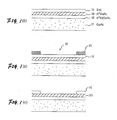
- a GaAs buffer (non-doped GaAs) 1 is overlaid successively with an n+-AlGaAs layer 2 and an n+-GaAs layer 3.
- a drain electrode 8 and a source electrode 9 made of a metal establishing an ohmic contact are formed on the n+-GaAs layer 3 by conventional methods.
- the drain electrode 8 and source electrode 9 may be formed by depositing metal by vacuum vapor deposition with a resist pattern having openings being used as a mask.
- the n+-GaAs layer 3 is recessed at later stages to form a drain region 3a and a source region 3b of the HEMT as shown in Fig. 2(f).
- a resist pattern 5 having a reversely tapered opening 4 is formed over the n+-GaAs layer 3 and the electrodes 8 and 9.
- the opening 4 is reversely tapered in order to facilitate the liftoff process in the sixth step to be described later.
- the part of the n+-GaAs layer 3 that is exposed through the opening 4 is subjected to recess-etching, with the resist pattern 5 being used as a mask, whereby the n+-AlGaAs layer 2 is made exposed as shown in Fig. 2(d).
- the recess etching is accomplished by wet etching with a commonly used etchant (e.g. a liquid mixture of H2O2 and H2SO4).
- a gate metal 6 such as Al and W is deposited vertically by vacuum vapor deposition on the area of n+-AlGaAs layer 2 that is exposed through the opening 4, whereby a gate electrode 7 is formed on the n+-AlGaAs layer 2 (see Fig. 2(e)).
- the resist pattern 5 is removed so as to lift off the unwanted gate metal 6, whereby the n-GaAs layer 3 as well as the drain electrode 8 and source electrode 9 formed on that layer are made exposed, thus completing the process of HEMT fabrication (see Fig. 2(f)).
- the distance between the gate electrode 7 and the drain region 3a of the device fabricated by the above process is equal to the distance between the gate electrode 7 and the source region 3b.
- Unexamined Published Japanese Patent Application No. 21877/1988 proposed that the distance between the gate electrode and the drain region be reduced by oblique vacuum vapor deposition of a mask material.
- the position of an opening in the mask is determined by the amount of the oblique deposition, so that it is very difficult to form the gate electrode at a desired position with high precision.
- the most effective way to improve the low noise characteristic of a HEMT is to shorten the gate length, thereby reducing the gate capacitance (C gs ) while increasing the transconductance (g m ). In fact, however, a shorter gate length leads to a greater gate resistance, which may result in a deteriorated low noise characteristic.
- the present invention has been made under these circumstances and has an object of providing a process that is capable of fabricating a compound semiconductor device with the distance between a gate electrode and a source region and that between the gate electrode and a drain region being controlled with high precision.
- Another object of the present invention is to provide a process for fabricating a compound semiconductor device that has a smaller gate resistance and a shorter gate length.
- a process that comprises: the first step of forming successively a first semiconductor layer, a second semiconductor layer for a source and a drain, and a first structural layer on a semiconductor substrate; the second step of forming a first resist pattern with a predetermined opening on the first structural layer; the third step of etching an area of the first structural layer that is exposed through the opening, with the first resist pattern being used as a mask, to thereby make the second semiconductor layer exposed, and thereafter removing the first resist pattern; the fourth step of forming successively a second structural layer and a third structural layer over the exposed area of the second semiconductor layer and the entire first structural layer, the second structural layer being dissoluble by a particular etchant and the third structural layer being less dissoluble than the second structural layer by the etchant; the fifth step of forming on the third structural layer a second resist pattern having an opening that is located over the etched area of the first structural layer and that is distant from an area where a drain is to be formed and close to an area
- a step in which a third resist pattern having an opening larger than the opening formed in the third structural layer by the etching in the sixth step is formed in such a way that the latter opening is positioned within the former opening, is provided between the sixth and seventh steps, and the gate metal to be formed on the first semiconductor layer in the ninth step is vapor-deposited until it is deposited to a height exceeding the third structural layer.
- a gate electrode is to be formed in a position that is closed to a source region and distant from a drain region
- the process of the present invention having the features described above insures that the position of the source region is determined by the source-side edge of the first structural layer formed by the etching in the third step, that the position of the drain region is determined by the drain-side edge of the second structural layer formed by the side etching in the seventh layer, and that the position of the gate electrode is determined by the opening formed in the third structural layer by the etching in the sixth step.
- Figs. 1(a) - 1(k) show the sequence of steps of fabricating a compound semiconductor device according to the embodiment of the present invention.
- the figures depict in cross section the structures that are produced in the individual steps of the process.
- the following description assumes that the semiconductor device to be fabricated is a HEMT, but it should be understood that the process of the present invention is also applicable to other compound semiconductor devices such as low-noise GaAs FETs.
- step (a) a GaAs buffer 11 used as a semiconductor substrate is overlaid in superposition with an n+-AlGaAs layer 12, an n+-GaAs layer 13 for forming a source and a drain, and an insulating SiN layer 14 (see Fig. 1(a)).
- a resist pattern 15 having a predetermined opening 16 is formed over the SiN layer 14 (see Fig. 1(b)).
- the resist pattern 15 is formed by conventional photolithography.
- step (c) the area of SiN layer 14 that is exposed through the opening 16 is etched, with the resist pattern 15 being used as a mask, whereby the corresponding area of the n+-GaAs layer 13 is made exposed. Thereafter, the resist pattern 15 is removed (see Fig. 1(c)).
- the etching may be performed by common wet etching or dry etching technique.
- step (d) a SiON layer 17 and a SiN layer 18 are successively formed over the exposed area of the n+-GaAs layer 13 and the entire SiN layer 14 (see Fig. 1(d)).
- the left side of Fig. 1(e) is the area where a drain is to be formed and the right side is where a source is to be formed.
- the size of the opening 20 corresponds to the "gate length" which is to be discussed later. In other words, the gate length is determined by the opening 20.
- step (f ) the SiON layer 17 and SiN layer 18 are etched, with the resist pattern 19 being used as a mask, whereby the corresponding area of the n+-GaAs layer 13 is made exposed. Thereafter, the resist pattern 19 is removed (see Fig. 1(f)).
- the etching in step (f) is performed by a dry etching technique such as reactive ion etching (RIE) and, therefore, a hole 21 substantially equal in size to the opening 20 can be formed in the SiON layer 17 and the SiN layer 18 by anisotropic etching.
- RIE reactive ion etching
- step (g) a resist pattern 19 having the opening 22 larger than the hole 21 formed in the SiN layer 18 by the etching in step (f) is formed in such a way that the hole 21 is located within the opening 22 (see Fig. 1(g)).
- the size of the opening 22 corresponds to the top size of a gate electrode 27 which is to be discussed later (see Fig. 1(k)).
- the opening 22 is reverse by tapered in order to insure that the resist pattern 19 can be readily lifted off in step (k) to be discussed later.
- step (h) the SiON layer 17 is side-etched with a particular etchant through the hole 21 formed in the SiN layer 18 (see Fig. 1(h)).
- Hydrofluoric acid may be used as this etchant for the side etching. Hydrofluoric acid etches faster a compound that contains many oxygen atoms. Hence, the SiON layer 17 is dissolved by hydrofluoric acid, but the SiN layer 18 is less dissoluble than the SiON layer 17.
- both the SiON layer 17 and SiN layer 18 are made of an insulating material, but this is not necessarily the case of the present invention.
- the structural layers to be combined with the particular etchant may be composed of suitable materials having different solubilities in that etchant.
- a SiO n layer may be used instead of the SiON layer 17.
- the SiN layer 14 is side-etched until the source-side SiN layer 14 becomes exposed, so that the position of the area of the n+-GaAs layer 13 where a source region is to be created is determined with respect to the gate electrode 27 (see Fig. 1(k)).
- step (i) the area of the n+-GaAs layer 13 that is exposed through a hole 21a formed in the SiON layer 17 by the side etching in step (h) is etched to make the n+-AlGaAs layer 12 exposed (see Fig. 1(i)).
- the etching performed in step (i) is recess etching of the same type as performed in the third step of the prior art process shown in Fig. 2(c), and can be accomplished by a known wet etching process.
- a gate metal 26 such as Al and W is vapor-deposited vertically on the n+-AlGaAs layer 12 that is exposed through the hole 21 (see Fig. 1(j)). The metal deposition is continued until the layer of the gate metal 26 is deposited on the n+-AlGaAs layer 12 to a height exceeding the SiN layer 18.
- step (k) the resist pattern 19 (see Fig. 1(j)) is removed to lift off the unwanted layer of the gate metal 26 deposited over the resist pattern 19 (see Fig. 1(k)).
- the resulting gate electrode 27 is larger in the top than in the lower part, and its cross section will be shaped like either T or a mushroom depending upon the size of the hole 21 in the SiN layer 18 and the amount of the gate metal 26 deposited in step (j).
- the gate resistance of the device is small despite the short gate length.
- the gate electrode 27 is formed in such a way that it is supported by the insulating SiN layer 18. Therefore, in order to enhance the mechanical stability of the gate electrode 27, part of the SiN layer 14, SiON layer 17 and SiN layer 18 may be left intact.
- a drain and a source electrode are omitted from the above description, but it should be understood that those electrodes can be formed in the same manner as in the prior art process (see Fig. 2).
- the gate electrode 27 can be positioned distant from a drain region 33a and closer to a source region 33b.
- the position which the gate electrode is to be formed is determined by the hole formed in the third structural layer (i.e., SiN layer 18). Further, the hole in the third structural layer is formed by etching. Hence, the distance between the gate electrode and the source region as well as the distance between the gate electrode and the drain region can be controlled with high precision. Since the gate electrode can be formed at a position that is close to the source region and distant from the drain region, the present invention is capable of fabricating a HEMT of good low-noise characteristic that has a high gate-drain breakdown voltage and a small source resistance.
- the present invention is capable of fabricating a compound semiconductor device that has a small gate resistance and a short gate length and which hence is suitable for use as a HEMT having good low-noise characteristic.
- a first semiconductor layer, a second semiconductor layer for source and drain regions, and a bottom SiN layer are successively formed. After the bottom SiN layer is selectively etched to make an opening, a SiON layer and a top SiN layer are formed thereon. A resist pattern having an opening that is closer to the source region than to the drain region is formed on the top SiN layer. The top SiN layer and SiON layer are etched with the resist pattern used as a mask, to expose the second semiconductor layer. The SiON layer is side-etched with hydrofluoric acid until exposing the gate-side portion of the source-side bottom SiN layer.
- the second semiconductor layer is etched to expose the first semiconductor layer and to form the source and drain regions, where the gate-side edge of the source region is determined by that of the source-side bottom SiN layer and the gate-side edge of the drain region is determined by that of the drain-side SiON layer.
- a gate metal is vapor-deposited vertically on the first semiconductor layer with the opening of the top SiN layer used as a mask.
Landscapes
- Junction Field-Effect Transistors (AREA)
Applications Claiming Priority (3)
| Application Number | Priority Date | Filing Date | Title |
|---|---|---|---|
| JP4522590 | 1990-02-26 | ||
| JP45225/90 | 1990-02-26 | ||
| JP2045225A JPH03248439A (ja) | 1990-02-26 | 1990-02-26 | 化合物半導体装置の製造方法 |
Publications (3)
| Publication Number | Publication Date |
|---|---|
| EP0447840A2 true EP0447840A2 (de) | 1991-09-25 |
| EP0447840A3 EP0447840A3 (en) | 1995-08-16 |
| EP0447840B1 EP0447840B1 (de) | 2000-07-12 |
Family
ID=12713327
Family Applications (1)
| Application Number | Title | Priority Date | Filing Date |
|---|---|---|---|
| EP91102769A Expired - Lifetime EP0447840B1 (de) | 1990-02-26 | 1991-02-25 | Verfahren zur Herstellung eines Verbindungshalbleiterbauelements und damit hergestelltes Verbindungshalbleiterbauelement |
Country Status (4)
| Country | Link |
|---|---|
| US (2) | US5110751A (de) |
| EP (1) | EP0447840B1 (de) |
| JP (1) | JPH03248439A (de) |
| DE (1) | DE69132301T2 (de) |
Cited By (2)
| Publication number | Priority date | Publication date | Assignee | Title |
|---|---|---|---|---|
| FR2691013A1 (fr) * | 1992-05-07 | 1993-11-12 | Thomson Composants Microondes | Procédé de réalisation d'un transistor à effet de champ de puissance. |
| EP0601541A3 (de) * | 1992-12-08 | 1995-02-08 | Sumitomo Electric Industries | Verbindungshalbleiterbauelement und Verfahren zu seiner Herstellung. |
Families Citing this family (8)
| Publication number | Priority date | Publication date | Assignee | Title |
|---|---|---|---|---|
| JPH03248439A (ja) * | 1990-02-26 | 1991-11-06 | Rohm Co Ltd | 化合物半導体装置の製造方法 |
| US5272095A (en) * | 1992-03-18 | 1993-12-21 | Research Triangle Institute | Method of manufacturing heterojunction transistors with self-aligned metal contacts |
| EP0592064B1 (de) * | 1992-08-19 | 1998-09-23 | Mitsubishi Denki Kabushiki Kaisha | Verfahren zur Herstellung eines Feldeffekttransistors |
| JP2725592B2 (ja) * | 1994-03-30 | 1998-03-11 | 日本電気株式会社 | 電界効果トランジスタの製造方法 |
| US5384273A (en) * | 1994-04-26 | 1995-01-24 | Motorola Inc. | Method of making a semiconductor device having a short gate length |
| US6232159B1 (en) * | 1998-07-22 | 2001-05-15 | Matsushita Electric Industrial Co., Ltd. | Method for fabricating compound semiconductor device |
| FR3011119B1 (fr) * | 2013-09-23 | 2017-09-29 | Commissariat Energie Atomique | Procede de realisation d'un transistor |
| CN116313790B (zh) * | 2023-02-27 | 2025-11-21 | 电子科技大学 | 基于倾角沉积的晶圆级纳米空气沟道晶体管制备方法 |
Family Cites Families (31)
| Publication number | Priority date | Publication date | Assignee | Title |
|---|---|---|---|---|
| JPS5921193B2 (ja) * | 1977-06-03 | 1984-05-18 | 富士通株式会社 | 電界効果トランジスタの製造方法 |
| JPH0237755B2 (ja) * | 1982-07-27 | 1990-08-27 | Daizen Sogyo Kk | Fukakanshiseigyosochi |
| JPS59193069A (ja) * | 1983-04-15 | 1984-11-01 | Nec Corp | 半導体装置の製造方法 |
| JPS604268A (ja) * | 1983-06-22 | 1985-01-10 | Nec Corp | 半導体装置 |
| JPS60145669A (ja) * | 1984-01-09 | 1985-08-01 | Nec Corp | GaAs電界効果トランジスタ |
| JPS6155969A (ja) * | 1984-08-27 | 1986-03-20 | Nec Corp | 半導体装置およびその製造方法 |
| US4616400A (en) * | 1984-12-21 | 1986-10-14 | Texas Instruments Incorporated | Process for fabricating a double recess channel field effect transistor |
| JPS61156887A (ja) * | 1984-12-28 | 1986-07-16 | Fujitsu Ltd | 電界効果トランジスタの製造方法 |
| US4656076A (en) * | 1985-04-26 | 1987-04-07 | Triquint Semiconductors, Inc. | Self-aligned recessed gate process |
| JPS625667A (ja) * | 1985-07-01 | 1987-01-12 | Nec Corp | 半導体装置の製造方法 |
| JPS6215861A (ja) * | 1985-07-12 | 1987-01-24 | Matsushita Electric Ind Co Ltd | 半導体装置の製造方法 |
| JPS62186568A (ja) * | 1986-02-12 | 1987-08-14 | Fujitsu Ltd | 半導体装置の製造方法 |
| JPS62232971A (ja) * | 1986-04-03 | 1987-10-13 | Nec Corp | 半導体トランジスタの製造方法 |
| JPS62250674A (ja) * | 1986-04-23 | 1987-10-31 | Nec Corp | 半導体装置の製造方法 |
| JPS6321877A (ja) * | 1986-07-16 | 1988-01-29 | Oki Electric Ind Co Ltd | 半導体素子の製造方法 |
| JPS63155671A (ja) * | 1986-12-18 | 1988-06-28 | Nec Corp | 半導体装置の製造方法 |
| JPS63208278A (ja) * | 1987-02-25 | 1988-08-29 | Oki Electric Ind Co Ltd | 電界効果トランジスタの製造方法 |
| JPS63208275A (ja) * | 1987-02-25 | 1988-08-29 | Hitachi Ltd | 電界効果型トランジスタ |
| JPS63228761A (ja) * | 1987-03-18 | 1988-09-22 | Fujitsu Ltd | 半導体装置の製造方法 |
| JPS63305566A (ja) * | 1987-06-05 | 1988-12-13 | Nippon Telegr & Teleph Corp <Ntt> | 半導体装置およびその製造方法 |
| JP2610435B2 (ja) * | 1987-06-29 | 1997-05-14 | ヤンマー農機株式会社 | コンバイン |
| JPS647664A (en) * | 1987-06-30 | 1989-01-11 | Toshiba Corp | Manufacture of field-effect transistor |
| KR920009718B1 (ko) * | 1987-08-10 | 1992-10-22 | 스미도모덴기고오교오 가부시기가이샤 | 화합물반도체장치 및 그 제조방법 |
| JPS6446985A (en) * | 1987-08-17 | 1989-02-21 | Mitsubishi Electric Corp | Manufacture of semiconductor device |
| JPH0218942A (ja) * | 1988-07-07 | 1990-01-23 | Sumitomo Electric Ind Ltd | 電界効果トランジスタおよびその製造方法 |
| KR910005400B1 (ko) * | 1988-09-05 | 1991-07-29 | 재단법인 한국전자통신연구소 | 다층레지스트를 이용한 자기정합형 갈륨비소 전계효과트랜지스터의 제조방법 |
| JPH0279437A (ja) * | 1988-09-14 | 1990-03-20 | Mitsubishi Electric Corp | 半導体装置の製造方法 |
| JPH02140942A (ja) * | 1988-11-22 | 1990-05-30 | Matsushita Electric Ind Co Ltd | 半導体装置の製造方法 |
| JPH0355852A (ja) * | 1989-07-25 | 1991-03-11 | Sony Corp | 半導体装置の製造方法 |
| US4963501A (en) * | 1989-09-25 | 1990-10-16 | Rockwell International Corporation | Method of fabricating semiconductor devices with sub-micron linewidths |
| JPH03248439A (ja) * | 1990-02-26 | 1991-11-06 | Rohm Co Ltd | 化合物半導体装置の製造方法 |
-
1990
- 1990-02-26 JP JP2045225A patent/JPH03248439A/ja active Pending
-
1991
- 1991-02-20 US US07/658,218 patent/US5110751A/en not_active Expired - Lifetime
- 1991-02-25 EP EP91102769A patent/EP0447840B1/de not_active Expired - Lifetime
- 1991-02-25 DE DE69132301T patent/DE69132301T2/de not_active Expired - Fee Related
-
1993
- 1993-02-24 US US08/023,151 patent/US5296728A/en not_active Expired - Fee Related
Cited By (2)
| Publication number | Priority date | Publication date | Assignee | Title |
|---|---|---|---|---|
| FR2691013A1 (fr) * | 1992-05-07 | 1993-11-12 | Thomson Composants Microondes | Procédé de réalisation d'un transistor à effet de champ de puissance. |
| EP0601541A3 (de) * | 1992-12-08 | 1995-02-08 | Sumitomo Electric Industries | Verbindungshalbleiterbauelement und Verfahren zu seiner Herstellung. |
Also Published As
| Publication number | Publication date |
|---|---|
| EP0447840A3 (en) | 1995-08-16 |
| DE69132301T2 (de) | 2001-01-18 |
| US5110751A (en) | 1992-05-05 |
| DE69132301D1 (de) | 2000-08-17 |
| JPH03248439A (ja) | 1991-11-06 |
| EP0447840B1 (de) | 2000-07-12 |
| US5296728A (en) | 1994-03-22 |
Similar Documents
| Publication | Publication Date | Title |
|---|---|---|
| US5288654A (en) | Method of making a mushroom-shaped gate electrode of semiconductor device | |
| US5399896A (en) | FET with a T-shaped gate of a particular structure | |
| US5110751A (en) | Method of manufacturing a compound semiconductor device | |
| US5550065A (en) | Method of fabricating self-aligned FET structure having a high temperature stable T-shaped Schottky gate contact | |
| KR100647459B1 (ko) | 티형 또는 감마형 게이트 전극의 제조방법 | |
| US5231040A (en) | Method of making a field effect transistor | |
| JPH05326563A (ja) | 半導体装置 | |
| US5719088A (en) | Method of fabricating semiconductor devices with a passivated surface | |
| GB2286720A (en) | Field effect transistors | |
| JP3144089B2 (ja) | 電界効果トランジスタの製造方法 | |
| EP0394590A2 (de) | Feldeffekttransistoren und Verfahren zur Herstellung eines Feldeffekttransistors | |
| JPS61156887A (ja) | 電界効果トランジスタの製造方法 | |
| US20080064155A1 (en) | Method for Producing a Multi-Stage Recess in a Layer Structure and a Field Effect Transistor with a Multi-Recessed Gate | |
| EP0552763A2 (de) | Verbindungshalbleiteranordnung mit einem selbstjustierenden Gute und Herstellungsverfahren | |
| JPH05218090A (ja) | 電界効果トランジスタの製造方法 | |
| JP2893776B2 (ja) | 半導体装置の製造方法 | |
| JPH02142143A (ja) | 電界効果トランジスタの製造方法 | |
| JPH01133374A (ja) | 化合物半導体電界効果トランジスタの製造方法 | |
| JP3272529B2 (ja) | リセスゲートの形成方法 | |
| KR950008264B1 (ko) | 갈륨비소 전계효과 트랜지스터의 제조방법 | |
| JPH04336432A (ja) | 電界効果トランジスタ | |
| JPH05206169A (ja) | 半導体装置の製造方法 | |
| JPH02285643A (ja) | 半導体装置の製造方法 | |
| JPS616870A (ja) | 電界効果トランジスタの製造方法 | |
| JPS62260370A (ja) | 電界効果トランジスタの製造方法 |
Legal Events
| Date | Code | Title | Description |
|---|---|---|---|
| PUAI | Public reference made under article 153(3) epc to a published international application that has entered the european phase |
Free format text: ORIGINAL CODE: 0009012 |
|
| 17P | Request for examination filed |
Effective date: 19910325 |
|
| AK | Designated contracting states |
Kind code of ref document: A2 Designated state(s): DE FR GB |
|
| PUAL | Search report despatched |
Free format text: ORIGINAL CODE: 0009013 |
|
| AK | Designated contracting states |
Kind code of ref document: A3 Designated state(s): DE FR GB |
|
| 17Q | First examination report despatched |
Effective date: 19961105 |
|
| GRAG | Despatch of communication of intention to grant |
Free format text: ORIGINAL CODE: EPIDOS AGRA |
|
| GRAG | Despatch of communication of intention to grant |
Free format text: ORIGINAL CODE: EPIDOS AGRA |
|
| GRAH | Despatch of communication of intention to grant a patent |
Free format text: ORIGINAL CODE: EPIDOS IGRA |
|
| GRAH | Despatch of communication of intention to grant a patent |
Free format text: ORIGINAL CODE: EPIDOS IGRA |
|
| GRAA | (expected) grant |
Free format text: ORIGINAL CODE: 0009210 |
|
| AK | Designated contracting states |
Kind code of ref document: B1 Designated state(s): DE FR GB |
|
| REF | Corresponds to: |
Ref document number: 69132301 Country of ref document: DE Date of ref document: 20000817 |
|
| ET | Fr: translation filed | ||
| PLBE | No opposition filed within time limit |
Free format text: ORIGINAL CODE: 0009261 |
|
| STAA | Information on the status of an ep patent application or granted ep patent |
Free format text: STATUS: NO OPPOSITION FILED WITHIN TIME LIMIT |
|
| 26N | No opposition filed | ||
| REG | Reference to a national code |
Ref country code: GB Ref legal event code: IF02 |
|
| PGFP | Annual fee paid to national office [announced via postgrant information from national office to epo] |
Ref country code: FR Payment date: 20030210 Year of fee payment: 13 |
|
| PGFP | Annual fee paid to national office [announced via postgrant information from national office to epo] |
Ref country code: GB Payment date: 20030219 Year of fee payment: 13 |
|
| PGFP | Annual fee paid to national office [announced via postgrant information from national office to epo] |
Ref country code: DE Payment date: 20030306 Year of fee payment: 13 |
|
| PG25 | Lapsed in a contracting state [announced via postgrant information from national office to epo] |
Ref country code: GB Free format text: LAPSE BECAUSE OF NON-PAYMENT OF DUE FEES Effective date: 20040225 |
|
| PG25 | Lapsed in a contracting state [announced via postgrant information from national office to epo] |
Ref country code: DE Free format text: LAPSE BECAUSE OF NON-PAYMENT OF DUE FEES Effective date: 20040901 |
|
| GBPC | Gb: european patent ceased through non-payment of renewal fee |
Effective date: 20040225 |
|
| PG25 | Lapsed in a contracting state [announced via postgrant information from national office to epo] |
Ref country code: FR Free format text: LAPSE BECAUSE OF NON-PAYMENT OF DUE FEES Effective date: 20041029 |
|
| REG | Reference to a national code |
Ref country code: FR Ref legal event code: ST |