EP0702028A2 - Agent liant le facteur de croissance - Google Patents
Agent liant le facteur de croissance Download PDFInfo
- Publication number
- EP0702028A2 EP0702028A2 EP95113342A EP95113342A EP0702028A2 EP 0702028 A2 EP0702028 A2 EP 0702028A2 EP 95113342 A EP95113342 A EP 95113342A EP 95113342 A EP95113342 A EP 95113342A EP 0702028 A2 EP0702028 A2 EP 0702028A2
- Authority
- EP
- European Patent Office
- Prior art keywords
- tgf
- psk
- growth factor
- added
- polysaccharide
- Prior art date
- Legal status (The legal status is an assumption and is not a legal conclusion. Google has not performed a legal analysis and makes no representation as to the accuracy of the status listed.)
- Withdrawn
Links
- 0 C[C@@](C(*)CCCC(*)C(*)C*(*C(C(*)C1O)I)O)C(*)C1N=O Chemical compound C[C@@](C(*)CCCC(*)C(*)C*(*C(C(*)C1O)I)O)C(*)C1N=O 0.000 description 1
Images




Classifications
-
- C—CHEMISTRY; METALLURGY
- C07—ORGANIC CHEMISTRY
- C07K—PEPTIDES
- C07K14/00—Peptides having more than 20 amino acids; Gastrins; Somatostatins; Melanotropins; Derivatives thereof
- C07K14/37—Peptides having more than 20 amino acids; Gastrins; Somatostatins; Melanotropins; Derivatives thereof from fungi
- C07K14/375—Peptides having more than 20 amino acids; Gastrins; Somatostatins; Melanotropins; Derivatives thereof from fungi from Basidiomycetes
-
- A—HUMAN NECESSITIES
- A61—MEDICAL OR VETERINARY SCIENCE; HYGIENE
- A61K—PREPARATIONS FOR MEDICAL, DENTAL OR TOILETRY PURPOSES
- A61K36/00—Medicinal preparations of undetermined constitution containing material from algae, lichens, fungi or plants, or derivatives thereof, e.g. traditional herbal medicines
- A61K36/06—Fungi, e.g. yeasts
- A61K36/07—Basidiomycota, e.g. Cryptococcus
-
- A—HUMAN NECESSITIES
- A61—MEDICAL OR VETERINARY SCIENCE; HYGIENE
- A61K—PREPARATIONS FOR MEDICAL, DENTAL OR TOILETRY PURPOSES
- A61K38/00—Medicinal preparations containing peptides
Definitions
- the present invention relates to a binding agent for particular growth factors, namely, transforming growth factor- ⁇ (TGF- ⁇ ) and platelet-derived growth factor (PDGF).
- TGF- ⁇ transforming growth factor- ⁇
- PDGF platelet-derived growth factor
- the binding agent of the present invention selectively binds to the particular growth factors to inhibit their biological activities. Therefore, the binding agent of the present invention can be used for treatment or prevention of various diseases directly or indirectly caused by the particular growth factors.
- TGF- ⁇ Transforming growth factor- ⁇
- PDGF platelet-derived growth factor
- TGF- ⁇ was first found as a factor to promote growth of a rat fibroblast. Thereafter, it has been found that TGF- ⁇ inhibits growth of a lot of cells, strongly suppresses immunological activity, and increases extracellular matrix. It is suggested that the overproduction and/or abnormal metabolism of TGF- ⁇ are involved in various diseases and symptoms of immunosuppression in a cancer patient or the like, fibroid lung, hepatic fibrosis, glomerulonephritis, scleroderma, or the like. Further, PDGF acts on smooth muscle cells, fibroblasts, nerve gliacytes or the like to promote their growth. The relationship between PDGF and arterial sclerosis caused by wandering and growth of vascular smooth muscle cells attracts attention.
- the inventors of the present invention engaged in intensive studies to solve the above problems, and as a result, found that the particular protein-binding polysaccharide which is obtained from Basidiomycetes, and which has been clinically used as a carcinostatic agent and proved to hardly produce side-effects, binds to the above growth factors to inhibit the functions thereof.
- the present invention is based on the findings.
- the object of the present invention is to provide a binding agent for the above growth factors.
- a binding agent for a growth factor selected from the group consisting of transforming growth factor- ⁇ (TGF- ⁇ ) and platelet-derived growth factor (PDGF), comprising a protein-polysaccharide which is obtained from a fungus belonging to Coriolus and contains about 18 to 38 % by weight of proteins.
- TGF- ⁇ transforming growth factor- ⁇
- PDGF platelet-derived growth factor
- Figure 1 is a graph showing the results of an enzyme-immunoassay ( ⁇ ) and radio-immunoassay ( ⁇ ) of the binding of TGF- ⁇ and PSK by the reaction therebetween, as carried out in Example 1.
- Figure 2 is a graph showing the results of the control experiments using only 125I labeled TGF- ⁇ 1, in the experiments wherein 125I labeled TGF- ⁇ 1 was reacted with PSK, the reaction mixture was applied on a gel filtration chromatography column, and the radioactivities in fractions were measured as carried out in Example 2.
- Figure 3 is a graph showing the results of the case that 125I labeled TGF- ⁇ 1 and PSK were added, in the experiments wherein 125I labeled TGF- ⁇ 1 was reacted with PSK, the reaction mixture was applied on a gel filtration chromatography column, and the radioactivities in fractions were measured as carried out in Example 2.
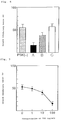
- Figure 4 is a graph showing the restoring effect of PSK to the growth inhibition by TGF- ⁇ 1, in the experiments wherein PSK and TGF- ⁇ 1 were added to the in vitro growing system of the fetal mink lung cell line Mv1Lu, as carried out in Example 3.
- Figure 5 is a graph showing a dose-dependency of the restoring effect of PSK to the growth inhibition by TGF- ⁇ 1, in the experiments wherein PSK and TGF- ⁇ 1 were added to the in vitro growing system of the fetal mink lung cell line Mv1Lu, as carried out in Example 3.
- Figure 6 is a graph showing the restoring effect of PSK to the growth inhibition by TGF- ⁇ 1, in the experiments wherein PSK and TGF- ⁇ 1 were added to the in vitro growing system of the mouce T cell line CTLL-2, as carried out in Example 3.
- Figure 7 is a graph showing a dose-dependency of the restoring effect of PSK to the growth inhibition by TGF- ⁇ 1, in the experiments wherein PSK and TGF- ⁇ 1 were added to the in vitro growing system of the mouse T cell line CTLL-2, as carried out in Example 3.
- Figure 8 is a graph showing a dose-dependency of the TGF- ⁇ 1 binding to the fetal mink lung cell line Mv1Lu, in the experiments wherein the 125I labeled TGF- ⁇ 1 was added to the in vitro binding assay system of the cell line Mv1Lu, as carried out in Example 4.
- Figure 9 is a graph showing a dose-dependency of the TGF- ⁇ 1 binding to the mouse T cell line CTLL-2, in the experiments wherein the 125I labeled TGF- ⁇ 1 was added to the in vitro binding assay system of the cell line CTLL-2, as carried out in Example 4.
- Figure 10 is a graph showing a dose-dependency of the cell binding inhibitory by PSK, in the experiments wherein the 125I labeled TGF- ⁇ 1 and PSK were added to the in vitro binding assay system of the fetal mink lung cell line Mv1Lu, as carried out in Example 4.
- Figure 11 is a graph showing a dose-dependency of the cell binding inhibitory by PSK, in the experiments wherein the 125I labeled TGF- ⁇ 1 and PSK were added to the in vitro binding system of the mouse T cell line CTLL-2, as carried out in Example 4.
- Figure 12 is a graph showing the effect by the differences of the tumor sizes, when TGF- ⁇ 1 and/or PSK were administered to the leukemic cells-implanted mice, as carried out in Example 5.
- the protein-polysaccharide used as an active ingredient in the binding agent of the present invention is disclosed in, for example, Japanese Examined Patent Publications (Kokai) No. 46-17149, No. 51-36322, No. 56-14274, No. 56-14275, and No. 56-14276.
- the protein-polysaccharide is an extract from mycelia, broth, or fruit bodies that is obtained by culturing the fungus belonging to Coriolus which belongs to Basidiomycetes.
- the protein-polysaccharide contains about 18 to 38 % by weight of proteins, and has a molecular weight of not less than 5,000, preferably 5000 to 3000,000.
- PSK protein-polysaccharide
- PSK may be prepared by extracting the mycelia of Coriolus versicolor (Fr.) Quél [FERM-P2412 (ATCC20547)] with hot water, purifying and then drying the extract.
- the average molecular weight (ultracentrifugal method) is about 100,000.
- the sugar portion in the major fractions is ⁇ -D-glucan.
- the glucan has a branched structure containing 1 ⁇ 3, 1 ⁇ 4 and 1 ⁇ 6 bonds, and mainly comprises glucose (74.6 % by weight) and mannose (15.5 % by weight).
- PSK is soluble in water, but hardly soluble in methanol, pyridine, chloroform, benzene or hexane. PSK begins to be gradually decomposed at about 120 °C.
- the protein-polysaccharide is extremely safe, because of very low toxicity and few side-effects.
- the acute toxicity of PSK is shown in the following Table 1.
- Table 1 Animal sp. Route LD50 (mg/kg) Male Female Mice per os >20000 >20000 Rats per os >20000 >20000
- the acute toxicity shown in Table 1 was determined by the following method.
- the 4- or 5-week-old ICR-JCL mice (21 to 24 g) and the 4- or 5-week-old Donryu rats (100 to 150 g) were used.
- the agent was orally administered as shown in Table 1.
- the protein-polysaccharide was dissolved in physiological saline and the solution was administered. Death and body weight were observed for 7 days. Thereafter, the animals were sacrificed for autopsy. No death was observed in mice and rats even by the maximum administrable doses, and thus, the determination of LD50 was substantially impossible.
- the protein-polysaccharide used as an active ingredient in the binding agent of the present invention selectively binds to TGF- ⁇ and PDGF, but does not bind to various cytokines including growth factors other than TGF- ⁇ and PDGF.
- the protein-polysaccharide does not bind to epidermal growth factor (EGF); interleukin (IL)-1 ⁇ , IL-1 ⁇ , IL-2, IL-3, IL-4, IL-6, IL-7, IL-8, or IL-10; tumor necrosis factor (TNF)- ⁇ or TNF- ⁇ ; interferon (IFN)- ⁇ , IFN- ⁇ , or IFN- ⁇ ; granulocyte colony-stimulating factor (G-CSF); or granulocyte-macrophage colony-stimulating factor (GM-CSF)
- the TGF- ⁇ which binds to the protein-polysaccharide is not limited, but includes, for example, TGF- ⁇ 1, TGF- ⁇ 2, TGF- ⁇ 3, TGF- ⁇ 4, and TGF- ⁇ 5.
- the protein-polysaccharide used as an active ingredient in the binding agent of the present invention inhibits the physiological activity of TGF- ⁇ and PDGF by selectively binding thereto. This will be concretely demonstrated in Examples 3 and 4 (in vitro) and Example 5 (in vivo), respectively. More particularly, when TGF- ⁇ is added to an in vitro growth reaction culture of cells highly sensitive to TGF- ⁇ (i.e., the fetal mink lung cell line Mv1Lu and the mouse T cell line CTLL-2), the growth of the cells is inhibited. If the protein-polysaccharide is added in advance to the in vitro growth reaction culture, the inhibitory action of TGF- ⁇ is reduced. The binding of TGF- ⁇ to the cells is also inhibited. Further, in the in vivo experiment of mice to which leukemic cells are implanted, the tumor growth promoted by administering TGF- ⁇ is inhibited by administering.PSK.
- the protein-polysaccharide selectively binds only to the particular growth factors, i.e., TGF- ⁇ and PDGF, and thus, the function of the protein-polysaccharide is limited to the inhibition of the physiological activities of bound TGF- ⁇ and PDGF only. Therefore, it is believed that no side-effect caused by any inhibition of functions of other growth factors is produced. Further, the protein-polysaccharide has extremely low toxicity, and has been clinically proved to hardly produce side-effect. Thus, it may be safely administered for a long period of time.
- the binding agent of the present invention When the binding agent of the present invention is administered to an animal including human as an inhibitor of TGF- ⁇ and/or PDGF, the binding agent may be formulated into a composition for various routes, such as a composition for oral administration, injections for subcutaneous, intravenous, or intramuscular administration, or a suppository for rectal administration.
- the composition for oral administration is, for example, tablet, granule, powder, or capsule.
- the composition may contain a binder, excipient, lubricant, disintegrating agent, or wetting agent.
- the oral liquid composition may be in the form of mixture for internal use, shaking mixture, suspension, emulsion, or syrup, or in the form of a dry product which should be re-dissolved when used.
- the above oral liquid composition may contain an additive or preservating agent.
- a parenteral composition such as injection, suppository, or ointment, may contain an additive, such as a stabilizing agent, buffer, preservating agent, or isotonicity.
- the composition may be in the form of an aqueous solution, suspension, solution, or emulsion in oily or aqueous vehicle.
- the active ingredient may be in the form of powder which should be re-dissolved in a suitable vehicle, such as sterilized water without a pyrogenic substance, when used.
- the dose of the binding agent may vary with administration routes, ages, individual differences, or symptoms, but in general, 0.5 to 1000 mg/kg weight/day. In an oral administration, a dose of 20 to 1000 mg may be administered once or divided into two or three.
- TGF- ⁇ 1 To a vial containing 1 ⁇ g of lyophilized human TGF- ⁇ 1 (Takara Shuzo), 5 mM HCl (100 ⁇ l) containing bovine serum albumin (2 mg/ml) was added to dissolve human TGF- ⁇ 1. Then, 9.9 ml of phosphate buffered physiological saline (pH 7.4) containing bovine serum albumin (2 mg/ml) was added thereto to prepare a TGF- ⁇ 1 solution (100 ng/ml).
- PSK Traffic-on-Wikthyl-N-(Krestin)
- phosphate buffered physiological saline pH 7.4
- bovine serum albumin 2 mg/ml
- PSK solutions containing 0.1 ⁇ g/ml, 0.5 ⁇ g/ml, 1.0 ⁇ g/ml, 5.0 ⁇ g/ml, 10 ⁇ g/ml, 50 ⁇ g/ml, 100 ⁇ g/ml, 500 ⁇ g/ml or 1000 ⁇ g/ml of PSK.
- TGF- ⁇ 1 (100 ng/ml) solution (100 ⁇ l) and the PSK (0.1 to 1000 ⁇ g/ml) solution (100 ⁇ l) were mixed in a test tube, and reaction was performed at 22 °C for 3 hours.
- TGF- ⁇ 1 content in the mixed solution was measured by a commercial available Enzyme Immunoassay kit (TGF- ⁇ 1 ELISA System; Amersham Japan). The results are shown by closed circle ( ⁇ ) in Fig. 1. Further, the results by radioimmunoassay using 125I labeled anti-TGF- ⁇ 1 antibodies are shown by open circle ( ⁇ ) in Fig. 1. The binding ratio (%) in the axis of Fig.
- Binding ratio (%) (Cc - Cp) / Cc ⁇ 100 wherein Cc is a measured content of TGF- ⁇ 1 in control groups, and Cp is a measured content of TGF- ⁇ 1 in PSK-addition groups.
- the TGF- ⁇ 1 content in PSK-addition groups is dose-dependently lowered in comparison with that in control groups.
- PSK binds to the epitope of TGF- ⁇ 1.
- the binding activities of PSK and various cytokines and growth factors other than TGF- ⁇ were measured, using commercially available assay kit.
- the results in Table 2 clearly show that PDGF binds to PSK, as is the case with TGF- ⁇ , but PSK does not bind to other cytokines or growth factors.
- the binding ratio (%) in Table 2 were calculated from the equation (I).
- PSK (Sankyo) was dissolved in phosphate buffered physiological saline (pH 7.4) containing bovine serum albumin (2 mg/ml) to prepare a solution of PSK (200 ⁇ g/ml).
- phosphate buffered physiological saline (pH 7.4) containing 0.1 % bovine serum albumin was used as an eluting solution.
- Each of the eluates was collected in 1 ml portions by a fraction collector, and the radioactivities were measured by a gamma counter.
- the fetal mink lung cell line Mv1Lu (Dainippon Pharmaceutical) or the mouse T cell line CTLL-2 (Rikagaku Kenkyusho) was suspended in the culture medium as mentioned below so that the concentration became 5 x 10⁵ cells/ml, and 100 ⁇ l of the suspension was poured in each well of 96-well culture plate (Falcon 3072; Becton-Dickinson Labware, New Jersey, USA). Then, a TGF- ⁇ 1 solution prepared from the lyophilized human TGF- ⁇ 1 (Takara Shuzo) as in Example 1 was added to each well so that the concentration thereof became 50 ng/ml. The cells were cultured in a 5 % CO2 incubator at 37 °C for 48 hours.
- the culture medium for the cell line Mv1Lu Eagle's minimum essential medium containing 10 % fetal bovine serum, 2 mM glutamine and 0.1 mM non-essential amino acids was used.
- the culture medium for the cell line CTLL-2 the RPMI 1640 medium containing 10 % fetal bovine serum, 20 units/ml mouse interleukin-2, and 2 mM glutamine was used.
- MTT reagent i.e., a solution prepared by dissolving 3-(4,5-dimethylthiazol-2-yl)-2,5-diphenyl-tetrazolium bromide in phosphate buffered physiological saline so that the concentration became 5 mg/ml
- MTT reagent i.e., a solution prepared by dissolving 3-(4,5-dimethylthiazol-2-yl)-2,5-diphenyl-tetrazolium bromide in phosphate buffered physiological saline so that the concentration became 5 mg/ml
- test (A) for the fetal mink lung cell line Mv1Lu the PSK solution was added to each well to which the Mv1Lu suspension had been poured as in the control culture test, so that the concentration of PSK became 100 ⁇ g/ml, then TGF- ⁇ 1 was added so that the concentration became 50 ng/ml, and thereafter the procedure of the control culture test was repeated.
- test (B) for the fetal mink lung cell line Mv1Lu after the PSK solution was added as in the test (A), the cells were thoroughly washed with the culture medium to remove unbound PSK, then TGF- ⁇ 1 was added so that the concentration became 50 ng/ml, and thereafter the procedure of the control culture test was repeated.
- Fig. 4 The results are shown in Fig. 4.
- PSK(-) is the results of the control culture test wherein PSK was not added
- A is the results of the test (A) wherein after PSK was added, TGF- ⁇ 1 was added without washing
- B is the results of the test (B) wherein after PSK was added and the unbound PSK was removed by washing, TGF- ⁇ 1 was added.
- test (A) for the mouse T cell line CTLL-2 the PSK solution was added to each well to which the CTLL-2 suspension had been poured as in the control culture test, so that the concentration of PSK became 100 ⁇ g/ml, then TGF- ⁇ 1 was added so that the concentration became 50 ng/ml, and thereafter the procedure of the control culture test was repeated.
- TGF- ⁇ 1 was added to each well to which the CTLL-2 suspension had been poured as in the control culture test, so that the concentration became 50 ng/ml, then the PSK solution was added so that the concentration of PSK became 100 ⁇ g/ml, and thereafter the procedure of the control culture test was repeated.
- PSK(-) is the results of the control culture test wherein PSK was not added
- A is the results of the test (A) wherein after PSK was added, TGF- ⁇ 1 was added without washing
- B is the results of the test (B) wherein after TGF- ⁇ 1 was added, PSK was added without washing
- C is the results of the test (C) wherein after PSK was added and the unbound PSK was removed by washing, TGF- ⁇ 1 was added.
- growth inhibitory ratio (%) (Ac - Ap) / Ac ⁇ 100 wherein Ac is an absorbance at 570 nm of formazan formed in the control culture test, Ap is an absorbance at 570 nm of formazan formed in the test wherein TGF- ⁇ 1 was added, or TGF- ⁇ 1 and PSK were added.
- the growth of the cell lines was inhibited by TGF- ⁇ 1.
- TGF- ⁇ 1 When PSK was added before adding TGF- ⁇ 1, the inhibitory action by TGF- ⁇ 1 was lowered in each cell line. Further, the function of PSK is dose-dependent. Therefore, it is manifest that the direct binding of PSK and TGF- ⁇ 1 brings about the reduction of TGF- ⁇ 1 activity.
- the fetal mink lung cell line Mv1Lu (Dainippon Pharmaceutical) or the mouse T cell line CTLL-2 (Rikagaku Kenkyusho) was suspended in the culture medium for the binding tests [i.e., Dulbecco's minimum essential medium containing 0.1 % bovine serum albumin and 25 mM Hepes] so that the concentration became 1 x 10⁶ cells/ml.
- the cells were precultured in a 5 % CO2 incubator at 37 °C for 2 hours. After the cultivation was completed, the cells were washed with the culture medium for the binding tests three times to adjust the cell concentration to 1 x 10⁶ cells/ml.
- a solution of 125I labeled human recombinant TGF- ⁇ 1 (74 - 167 TBq/mmol; Daiichi Kagaku Yakuhin) prepared as in Example 2 so that the concentration thereof became 1 ng/ml, 5 ng/ml, 10 ng/ml, or 50 ng/ml.
- the cells were cultured at 22 °C for 3 hours. After the cells were washed by centrifuging, radioactivities bound to cells were measured by a gamma counter. Non-specific bindings of cells were examined in the presence of non-labeled TGF- ⁇ 1. The results are shown in Fig. 8 (the fetal mink lung cell line Mv1Lu) and Fig. 9 (the mouse T cell line CTLL-2). As clear from Figs. 8 and 9, the radioactivity bound to cells were dependent on the concentration of TGF- ⁇ 1 added.
- Binding inhibitory ratio (%) (Rc - Rp) / Rc ⁇ 100 wherein Rc is the radioactivity (dpm) when PSK is not added, and Rp is the radioactivity (dpm) when PSK is added.
- EL4 leukemia cells were subcutaneously implanted to 8-week-old female C57BL/6 mice (Charles River Japan) (a group consists of 5 mice) in an amount of 1 x 10⁶ cells.
- the size of the tumor was measured by a slide caliper with time.
- the TGF- ⁇ 1 solution prepared as in Example 1 was intraperitoneally administered at a dose of 1 ⁇ g per a mouse for 4 days in succession after the implantation of the tumor.
- the PSK solution prepared as in Example 1 was intraperitoneally administered at a dose of 100 mg/kg for 4 days in succession after the implantation of the tumor.
- the tumor sizes at the 9th day after the implantation are shown in Fig.
- the protein-polysaccharide used in the present invention can selectively inhibit only the biological activities of TGF- ⁇ 1 and/or PDGF, without an allergic reaction when an antibody preparation (anti-TGF- ⁇ 1 or PDGF antibody) is administered in a living body, or without lowering the activity of the antibody preparation when a neutralizing antibody to the preparation is formed. Further, the protein-polysaccharide used in the present invention has been clinically used as a carcinostatic agent and proved to hardly produce side-effects.
Landscapes
- Health & Medical Sciences (AREA)
- Life Sciences & Earth Sciences (AREA)
- Chemical & Material Sciences (AREA)
- Natural Medicines & Medicinal Plants (AREA)
- Mycology (AREA)
- Medicinal Chemistry (AREA)
- Organic Chemistry (AREA)
- General Health & Medical Sciences (AREA)
- Pharmacology & Pharmacy (AREA)
- Veterinary Medicine (AREA)
- Botany (AREA)
- Microbiology (AREA)
- Biotechnology (AREA)
- Epidemiology (AREA)
- Animal Behavior & Ethology (AREA)
- Alternative & Traditional Medicine (AREA)
- Public Health (AREA)
- Medical Informatics (AREA)
- Gastroenterology & Hepatology (AREA)
- Biochemistry (AREA)
- Biophysics (AREA)
- Genetics & Genomics (AREA)
- Molecular Biology (AREA)
- Proteomics, Peptides & Aminoacids (AREA)
- Engineering & Computer Science (AREA)
- Medicines That Contain Protein Lipid Enzymes And Other Medicines (AREA)
- Peptides Or Proteins (AREA)
Applications Claiming Priority (2)
| Application Number | Priority Date | Filing Date | Title |
|---|---|---|---|
| JP22428194 | 1994-08-25 | ||
| JP224281/94 | 1994-08-25 |
Publications (2)
| Publication Number | Publication Date |
|---|---|
| EP0702028A2 true EP0702028A2 (fr) | 1996-03-20 |
| EP0702028A3 EP0702028A3 (fr) | 1998-07-08 |
Family
ID=16811317
Family Applications (1)
| Application Number | Title | Priority Date | Filing Date |
|---|---|---|---|
| EP95113342A Withdrawn EP0702028A3 (fr) | 1994-08-25 | 1995-08-25 | Agent liant le facteur de croissance |
Country Status (4)
| Country | Link |
|---|---|
| US (1) | US5693610A (fr) |
| EP (1) | EP0702028A3 (fr) |
| AU (1) | AU680778B2 (fr) |
| CA (1) | CA2156767A1 (fr) |
Cited By (1)
| Publication number | Priority date | Publication date | Assignee | Title |
|---|---|---|---|---|
| EP0725077A1 (fr) * | 1995-02-06 | 1996-08-07 | Kureha Chemical Industry Co., Ltd. | Nouvelles glycoprotéines, procédé pour leur préparation et composition pharmaceutique |
Families Citing this family (21)
| Publication number | Priority date | Publication date | Assignee | Title |
|---|---|---|---|---|
| WO2000024940A1 (fr) * | 1998-10-28 | 2000-05-04 | Vysis, Inc. | Reseaux cellulaires et methodes de detection et d'utilisation de marqueurs de troubles genetiques |
| EP1478354A4 (fr) * | 2002-01-22 | 2008-09-24 | Genzyme Corp | Utilisation des antagonistes de tgf-beta dans le traitement ou la prevention du rejet chronique du transplant |
| US7048932B2 (en) * | 2002-05-22 | 2006-05-23 | The Chinese University Of Hong Kong | Preparation and standardization of immunomodulatory peptide-linked glucans with verifiable oral absorbability from coriolus versicolor |
| NZ592039A (en) | 2003-08-27 | 2013-03-28 | Ophthotech Corp | Combination therapy for the treatment of ocular neovascular disorders |
| JP5481028B2 (ja) * | 2004-10-13 | 2014-04-23 | ザ オハイオ ステート ユニバーシティー リサーチ ファウンデーション | ウイルス関連リンパ増殖性障害を処置または予防するための方法 |
| WO2007050793A2 (fr) | 2005-10-25 | 2007-05-03 | The Johns Hopkins University | Methodes et compositions de traitement du syndrome de marfan et de troubles associes |
| EP2230252A1 (fr) | 2006-03-13 | 2010-09-22 | The Johns Hopkins University | Augmentation de la thromborésistance endothéliale |
| EP2918288B1 (fr) | 2006-10-03 | 2017-08-16 | Genzyme Corporation | Utilisation d'antagonistes de TGF-BETA pour traiter des nourrissons risquant de développer une dysplasie broncho-pulmonaire |
| WO2010099139A2 (fr) | 2009-02-25 | 2010-09-02 | Osi Pharmaceuticals, Inc. | Thérapie anti-cancer combinée |
| US8465912B2 (en) | 2009-02-27 | 2013-06-18 | OSI Pharmaceuticals, LLC | Methods for the identification of agents that inhibit mesenchymal-like tumor cells or their formation |
| US8642834B2 (en) | 2009-02-27 | 2014-02-04 | OSI Pharmaceuticals, LLC | Methods for the identification of agents that inhibit mesenchymal-like tumor cells or their formation |
| WO2010099138A2 (fr) | 2009-02-27 | 2010-09-02 | Osi Pharmaceuticals, Inc. | Procédés pour l'identification d'agents qui inhibent les cellules tumorales de type mésenchymateuses ou leur formation |
| TR201816180T4 (tr) | 2010-03-12 | 2018-11-21 | Genzyme Corp | Meme kanserini tedavi etmek için kombinasyonlu tedavi. |
| CA2823154A1 (fr) | 2010-12-27 | 2012-07-05 | Lsip, Llc | Cellules spi et leur procede de production |
| JP2014519813A (ja) | 2011-04-25 | 2014-08-21 | オーエスアイ・ファーマシューティカルズ,エルエルシー | 癌薬剤発見、診断、および治療におけるemt遺伝子シグネチャーの使用 |
| US20140308275A1 (en) | 2011-07-27 | 2014-10-16 | Inserm (Institut National De La Sante Et De La Recherche Medicale | Methods for diagnosing and treating myhre syndrome |
| BR112014009789A2 (pt) | 2011-10-26 | 2017-04-25 | Seattle Children's Res Inst | cisteamina no tratamento da doença fibrótica |
| EP2799537B1 (fr) | 2011-12-28 | 2021-09-22 | Kyoto Prefectural Public University Corporation | Normalisation d'une culture de cellules endothéliales de la cornée |
| WO2013152252A1 (fr) | 2012-04-06 | 2013-10-10 | OSI Pharmaceuticals, LLC | Polythérapie antinéoplasique |
| WO2015064768A1 (fr) | 2013-10-31 | 2015-05-07 | 京都府公立大学法人 | Médicament thérapeutique pour des maladies associées à la mort cellulaire du réticulum endoplasmique dans l'endothélium de la cornée |
| US10882903B2 (en) | 2015-05-18 | 2021-01-05 | Arizona Board Of Regents On Behalf Of The University Of Arizona | Methods and compositions for treating an alphavirus infection |
Family Cites Families (20)
| Publication number | Priority date | Publication date | Assignee | Title |
|---|---|---|---|---|
| JPS536412A (en) * | 1976-07-07 | 1978-01-20 | Kureha Chem Ind Co Ltd | Preparation of n-containing polysaccharides |
| JPS6045528A (ja) * | 1983-08-11 | 1985-03-12 | Kureha Chem Ind Co Ltd | 虚血性脳疾患改善剤 |
| JPS6045525A (ja) * | 1983-08-11 | 1985-03-12 | Kureha Chem Ind Co Ltd | 抗リウマチ剤 |
| JPS6045532A (ja) * | 1983-08-11 | 1985-03-12 | Kureha Chem Ind Co Ltd | 血糖降下剤 |
| JPS6045527A (ja) * | 1983-08-11 | 1985-03-12 | Kureha Chem Ind Co Ltd | 血圧降下剤 |
| JPS6045533A (ja) * | 1983-08-11 | 1985-03-12 | Kureha Chem Ind Co Ltd | プロスタグランジン調節剤 |
| JPS6045524A (ja) * | 1983-08-11 | 1985-03-12 | Kureha Chem Ind Co Ltd | 抗炎症剤 |
| JPS6045526A (ja) * | 1983-08-11 | 1985-03-12 | Kureha Chem Ind Co Ltd | 虚血性心疾患改善剤 |
| JPS6045530A (ja) * | 1983-08-11 | 1985-03-12 | Kureha Chem Ind Co Ltd | ネフロ−ゼ症候群改善剤 |
| JPS6045529A (ja) * | 1983-08-11 | 1985-03-12 | Kureha Chem Ind Co Ltd | 抗血栓症剤 |
| JPS6045523A (ja) * | 1983-08-11 | 1985-03-12 | Kureha Chem Ind Co Ltd | 解熱鎮痛剤 |
| JPS6045531A (ja) * | 1983-08-11 | 1985-03-12 | Kureha Chem Ind Co Ltd | 抗高脂血症剤 |
| JPS60139622A (ja) * | 1983-12-26 | 1985-07-24 | Kaneshiro Nagai | 制癌剤 |
| JPH0211521U (fr) * | 1988-06-25 | 1990-01-24 | ||
| JPH0643336B2 (ja) * | 1988-06-30 | 1994-06-08 | 呉羽化学工業株式会社 | 血管増殖抑制剤 |
| JPH03109331A (ja) * | 1989-09-22 | 1991-05-09 | Asahi Chem Ind Co Ltd | 腫瘍壊死因子効果増強剤 |
| JPH0645525A (ja) * | 1992-07-27 | 1994-02-18 | Nec Corp | 薄膜抵抗素子の製造方法 |
| AU5541094A (en) * | 1992-10-30 | 1994-05-24 | Consejo Superior De Investigaciones Cientificas | Compositions and methods for modifying the regulatory activity of tgf-beta |
| JP3199081B2 (ja) * | 1992-11-13 | 2001-08-13 | 味の素株式会社 | 抗腫瘍剤 |
| JPH08208704A (ja) * | 1995-02-06 | 1996-08-13 | Kureha Chem Ind Co Ltd | 新規な糖タンパク質複合体、その製造方法、並びに抗腫瘍剤、免疫調節剤及び増殖因子阻害剤 |
-
1995
- 1995-08-23 CA CA002156767A patent/CA2156767A1/fr not_active Abandoned
- 1995-08-24 US US08/519,023 patent/US5693610A/en not_active Expired - Fee Related
- 1995-08-25 AU AU30289/95A patent/AU680778B2/en not_active Ceased
- 1995-08-25 EP EP95113342A patent/EP0702028A3/fr not_active Withdrawn
Non-Patent Citations (1)
| Title |
|---|
| None |
Cited By (1)
| Publication number | Priority date | Publication date | Assignee | Title |
|---|---|---|---|---|
| EP0725077A1 (fr) * | 1995-02-06 | 1996-08-07 | Kureha Chemical Industry Co., Ltd. | Nouvelles glycoprotéines, procédé pour leur préparation et composition pharmaceutique |
Also Published As
| Publication number | Publication date |
|---|---|
| AU3028995A (en) | 1996-03-07 |
| EP0702028A3 (fr) | 1998-07-08 |
| CA2156767A1 (fr) | 1996-02-26 |
| AU680778B2 (en) | 1997-08-07 |
| US5693610A (en) | 1997-12-02 |
Similar Documents
| Publication | Publication Date | Title |
|---|---|---|
| US5693610A (en) | Binding agent for growth factor | |
| Mahmood et al. | Pharmacokinetic and pharmacodynamic considerations in the development of therapeutic proteins | |
| Scicchitano et al. | In vivo immunomodulation by the neuropeptide substance P | |
| DE3686794T2 (de) | Reinigung des natuerlichen kolonie-stimulierenden faktors-1. | |
| EP0181455A2 (fr) | Application de préparations contenant de l'interféron-gamma (IFN-gamma) pour le traitement systématique de différentes maladies humaines à dose réduite | |
| US5792450A (en) | Purified human CSF-1 | |
| EP0643972A2 (fr) | Utilisation d'un facteur-1 stimulant de colonie (CSF-1) recombinante pour la préparation d'un médicament traitant l'infection cytomégalovirus et leukopeni | |
| EP0488718B1 (fr) | Agent immunostimulant contenant l'interleukine-2 et de la 5'-déoxy-5-fluorouridine | |
| US7115568B2 (en) | Methods using TCF II | |
| EP4574845A1 (fr) | Hétérodimère fc/il-15r-alpha de sous unité fc portant la mutation il-15 et son utilisation | |
| US5534251A (en) | Stabilized il-1α medicinal composition | |
| EP0377823A2 (fr) | Utilisation de TNF pour l'obtention d'un médicament destiné au traitement du psoriasis | |
| JPWO1993011769A1 (ja) | 制癌剤 | |
| JPH08113540A (ja) | 増殖因子結合剤 | |
| DE69102265T2 (de) | Immunkomplexe. | |
| EP0447353B1 (fr) | Préparation pharmaceutique pour la maturation de prothymocytes | |
| JPH0725785A (ja) | インターロイキン−6の医薬組成物 | |
| JP2799483B2 (ja) | インターロイキン−1β組成物の安定化方法 | |
| Abe et al. | The endogenous induction of tumor necrosis factor serum (TNS) for the adjuvant postoperative immunotherapy of cancer—Changes in immunological markers of the blood— | |
| DE3608608A1 (de) | Verwendung von interferon-gamma (ifn-gamma) enthaltenden praeparationen zur systemischen behandlung von autoimmunerkrankungen, viruserkrankungen und malignen erkrankungen des menschen in niedriger dosierung | |
| EP0891778A2 (fr) | Agents pour la prévention et/ou le traitement de désordres causés par les radiatons | |
| JP2518634B2 (ja) | ヒト ツモア・ネクロシス・フアクタ−の製造方法 | |
| JP2518635B2 (ja) | ヒト ツモア・ネクロシス・フアクタ− | |
| EP0548376A1 (fr) | Medicament antitumoral | |
| HK40128319A (en) | Il-15 mutant-fc/il-15r-alpha subunit-fc heterodimer and use thereof |
Legal Events
| Date | Code | Title | Description |
|---|---|---|---|
| PUAI | Public reference made under article 153(3) epc to a published international application that has entered the european phase |
Free format text: ORIGINAL CODE: 0009012 |
|
| 17P | Request for examination filed |
Effective date: 19950825 |
|
| AK | Designated contracting states |
Kind code of ref document: A2 Designated state(s): DE FR GB |
|
| PUAL | Search report despatched |
Free format text: ORIGINAL CODE: 0009013 |
|
| AK | Designated contracting states |
Kind code of ref document: A3 Designated state(s): DE FR GB |
|
| 17Q | First examination report despatched |
Effective date: 19991102 |
|
| STAA | Information on the status of an ep patent application or granted ep patent |
Free format text: STATUS: THE APPLICATION IS DEEMED TO BE WITHDRAWN |
|
| 18D | Application deemed to be withdrawn |
Effective date: 20000314 |